
by Katrin Trüstedt
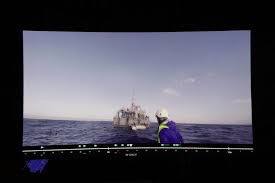
In a Palazzo in Palermo, a video installation of a moving digital map of the sea traces the disappearance of a migrant ship. With this installation, the project Forensic Oceanography makes visible what is – even from this Palazzo, facing the Mediterranean Sea – usually removed from sight.
The figure of the migrant is, according to Thomas Nail, the political figure of our time, and this century will be the century of the migrant. In his book Nail traces the long history of migration, to question the notion of the nation state – in fact historically a fairly recent idea. Understood as a stable and organic, self-reproducing and self-sustaining whole, this notion tends to cast migrants as abnormalities and exceptions.[1] Instead, the figure of the migrant, the stateless, and the refugee should be seen as the defining figures for our time, as writers from Hannah Arendt[2] to Thomas Nail have suggested. With much more climate change migration to be expected, this figure can only become more crucial. While appearing quite prominently in political discourse as a problem, the migrant has remained in many other ways still unseen. It is this peculiar status of the figure of the migrant that “Forensic Oceanography” highlights in Palermo, as both excluded and included in European politics and discourse. Read more »

 In this world of divisive and indeed, not infrequently, ugly politics, particularly in the United States under the present administration, and the British pursuit of an exit from the European Union, any opportunity for finding relief from the ‘angst’ of day to day politics is to be welcomed. The reading of Peter Wohlleben’s The Mysteries of Nature Trilogy: The Hidden Life of Trees, The Secret Network of Nature and The Inner Life of Animals provided me with such an opportunity.
 In the next couple of months two of the largest democracies in the world—India and Indonesia—will have their national elections. At a time when democracy is under considerable pressure everywhere, the electoral and general democratic outcome in these two countries containing in total more than one and a half billion people (more than one and a half times the population in democratic West plus Japan and Australia) will be closely observed.
 There is a sense in certain quarters that both experimental and theoretical fundamental physics are at an impasse. Other branches of physics like condensed matter physics and fluid dynamics are thriving, but since the composition and existence of the fundamental basis of matter, the origins of the universe and the unity of quantum mechanics with general relativity have long since been held to be foundational matters in physics, this lack of progress rightly bothers its practitioners.

 I was struck by a sentence in Susan Orlean’s The Library Book: “If nothing lasts, nothing matters.” This line was part of a discussion of memory, the fear of being forgotten, and the value of passing things on to future generations. I share a passion for the idea of continuity between generations (and I highly recommend Orlean’s book), but ultimately I don’t think that something has to last to matter. Alan Watts, in his book This Is It, says that “This—the immediate, everyday, and present experience—is IT, the entire and ultimate point for the existence of a universe.” It’s not about connecting with anything but what’s here in front of me now. (Easier said than done, of course.)
 I teach two kinds of group exercise classes, and part of the certification processes for both disciplines devoted no small amount of attention to how to speak to your minions, uh, students.
 “…And now to introduce our second panelist: Martha. Martha does believe that academic philosophy is worth pursuing, and she has – of course – written a book about it. Martha, can you briefly summarize your argument?”

 My answering machine whirrs. From an echoing room, the chainsaw-voice shouts into a speaker phone:
 One of the philosophical tools that seems utterly obvious to me is the so-called “use/mention distinction”. Because it strikes me as so obvious, it is always baffling to me that people seem to have such trouble with it.