by Tim Sommers

Sometime in the near future I hope you will find yourself in New York or London, Pittsburgh or Sydney, Detroit or Portland in a music venue, a theater space, or a bookstore attending a “storyslam”. They happen in at least 25 cities in at least 4 countries and attendance varies from under a hundred people to several hundred people. Many, probably the bulk, are associated with The Moth organization – which sponsors many other events including an NPR Radio Hour featuring stories (often from slams). First-Person Arts in Philadelphia has its own large and lively scene – and there are many smaller organizations and slams elsewhere, including, for example, Chicago’s Story Club. And there are many more out there in bars and pubs and bookstores. In the era of New Media, storytelling – maybe, the oldest media of all – is making a comeback.

Most storyslams follow some version of the Moth’s basic template. A theme is announced and advertised well ahead of time. Themes I have heard include Walls, Envy, Love Hurts, Detour, Heat, Magic, and Public Transportation. The night of the slam wanna-be storytellers put their names in a bag or a box or a hat. There’s a host (usually a stand-up comedian or a storyteller), often a musical guest, and the host pulls names out of the hat over the course of the night and these random strangers make their way through the darkened space to a bright stage with a mic and they tell you a story for around five minutes.
If you are the storyteller, you are supposed to tell a story that is true, about you, and relatively short. No one facts check, of course. Usually, you are judged, however. But not, you know, in a very judgey way. Unlike comedy open mic nights which tend to be brutal, storyslam crowds are warm and supportive – in an NPRish kind of way. And there’s no prize. Art, Nietzsche would tell you, just needs to be judged. Plus, many of the slams have grandslams at the end of the year featuring all of the winning storytellers from earlier slams telling stories on a new theme. Read more »
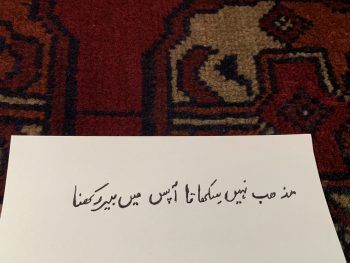 Less than a month ago, the Indian Air Force conducted airstrikes inside Pakistan. The last attack of this kind took place in 1971, before I was born, and though tensions between the two countries have never ceased, even the family’s fragmented recollections of blackouts, travel restrictions and patriotic songs on the radio had become a distant memory for me until the moment I found myself stranded in Karachi due to airspace closure and witnessed not just military crossfire but that of the media of the two countries. The outbursts on news channels, as well as social media were interspersed with slogans and songs. One Indian patriotic song in particular, a ghazal by Allama Iqbal who is known as Pakistan’s national poet, sung not only in the voices of India’s celebrity singers and sweet-faced schoolchildren, but also adapted to their military march tune, caught my attention.


 In this world of divisive and indeed, not infrequently, ugly politics, particularly in the United States under the present administration, and the British pursuit of an exit from the European Union, any opportunity for finding relief from the ‘angst’ of day to day politics is to be welcomed. The reading of Peter Wohlleben’s The Mysteries of Nature Trilogy: The Hidden Life of Trees, The Secret Network of Nature and The Inner Life of Animals provided me with such an opportunity.
 In the next couple of months two of the largest democracies in the world—India and Indonesia—will have their national elections. At a time when democracy is under considerable pressure everywhere, the electoral and general democratic outcome in these two countries containing in total more than one and a half billion people (more than one and a half times the population in democratic West plus Japan and Australia) will be closely observed.
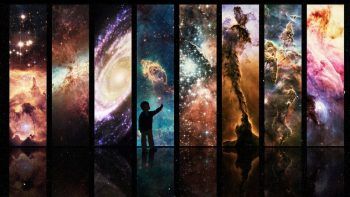 There is a sense in certain quarters that both experimental and theoretical fundamental physics are at an impasse. Other branches of physics like condensed matter physics and fluid dynamics are thriving, but since the composition and existence of the fundamental basis of matter, the origins of the universe and the unity of quantum mechanics with general relativity have long since been held to be foundational matters in physics, this lack of progress rightly bothers its practitioners.
 I was struck by a sentence in Susan Orlean’s The Library Book: “If nothing lasts, nothing matters.” This line was part of a discussion of memory, the fear of being forgotten, and the value of passing things on to future generations. I share a passion for the idea of continuity between generations (and I highly recommend Orlean’s book), but ultimately I don’t think that something has to last to matter. Alan Watts, in his book This Is It, says that “This—the immediate, everyday, and present experience—is IT, the entire and ultimate point for the existence of a universe.” It’s not about connecting with anything but what’s here in front of me now. (Easier said than done, of course.)
 I teach two kinds of group exercise classes, and part of the certification processes for both disciplines devoted no small amount of attention to how to speak to your minions, uh, students.
 “…And now to introduce our second panelist: Martha. Martha does believe that academic philosophy is worth pursuing, and she has – of course – written a book about it. Martha, can you briefly summarize your argument?”