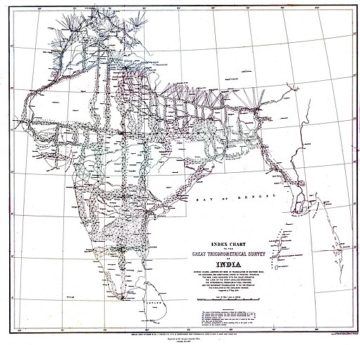
Pattern Language
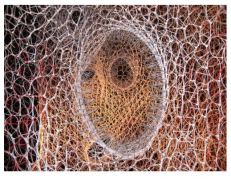
strolling through town with Plato
we take the sidewalk one step at a time;
shards of its exposed aggregate form archipelagos,
and overhead, Jesus in a cloud, or is it Lao Tzu
explaining Is without a word
clefts in the bark of trees we pass
define Appalachian humps. we saw Scranton
strewn along a grey gully on the lichen side
of the fat trunk of a sugar maple when we glanced
a net of angst chokes a birch in the side yard
of a small house, but it’s just Bittersweet
being a garrote —its hot orange berries
are incendiary cherries, its network of vines
untamed thought
a wall of desiccated siding, so in need of paint
its south face (some of it is dust, some parched
raised grain) is the surface of Mars:
what’s left of its spent red pigment
is the feel of utter space and rust
hairline cracks in river ice in the dam pond
are rifts of splintered glass silvered on one side
full of mere reflections falling to the sea
a crow measures distance between
gutter pebbles with her beak
aligning as if she were a smart array of atoms
laying out the footings of a house or universe;
patterns in her brain must be the forms she seeks
.Jim Culleny, 1/2/17

 At the 100th anniversary of John Rawls’ birth back in February, some of the most generous op-eds, whilst celebrating the brilliance of his thought, lamented the torpor of his impact. ‘Rawls studies’ are by no means the totality of political philosophy, but they are one of its most significant strands, and his approach has been dominant for the past 50 years. I’m an admirer of political philosophy, having happily spent much time and energy studying it, specifically looking at theories of deliberative democracy, an area with important connections to Rawls’ thought. That political philosophy does not have much to say that is of direct practical concern does not bother me, the sense that it is not just uninfluential, but is disconnected from the reality of the present moment does though.
 Anderson Ambroise. Rubble Sculpture.

 I don’t think I saw an actual daffodil until I was 19, although I had admired the many varieties I saw pictured in bulb catalogs and even—I hesitate to admit this—written haiku about daffodils (at 14, in an English class). When my first husband and I drove through Independence, Missouri, early in our marriage, I saw my first daffodils, a large clump tossing their heads in a sunshiny breeze. Wordsworth flashed upon my inner ear, and as I remember it, I recited “And then my heart with pleasure fills, and dances with the daffodils!” (If I did in fact say that, I’m sure I added the gratuitous exclamation point.) My husband, who was driving, gently asked me to return my attention to the map (I was navigating).

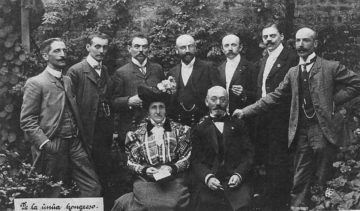 In 1887 Ludwik Zamenhof, a Polish ophthalmologist and amateur linguist, published in Warsaw a small volume entitled Unua Libro. Its aim was to introduce his newly invented language, in which ‘Unua Libro’ means ‘First Book.’ Zamenhof used the pseudonym ‘Doktor Esperanto’ and the language took its name from this word, which means ‘one who hopes.’ The picture shows Zamenhof (front row) at the First International Esperanto Congress in Boulogne in 1905.
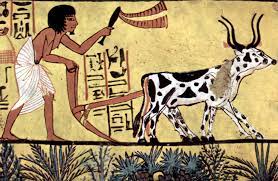 If, for a long time now, you’ve been getting up early in the morning, setting off to school or your workplace, getting there at the required time, spending the day performing your assigned tasks (with a few scheduled breaks), going home at the pre-ordained time, spending a few hours doing other things before bedtime, then getting up the next morning to go through the same routine, and doing this most days of the week, most weeks of the year, most years of your life, then the working life in its modern form is likely to seem quite natural. But a little knowledge of history or anthropology suffices to prove that it ain’t necessarily so.
 It’s official: Lilly Singh, the YouTube phenomenon,
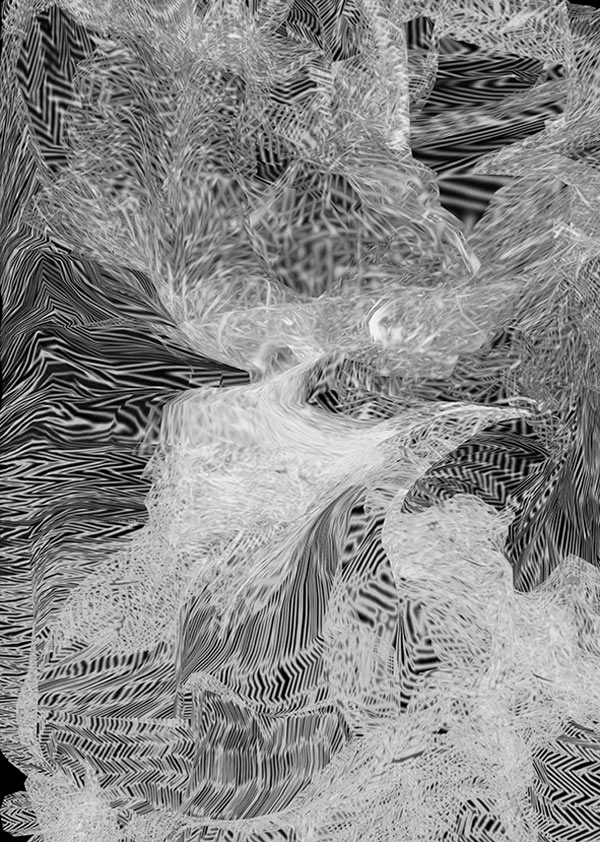 Marlène Huissoud. A3 Drawings 8, 2020.