
by David Kordahl
When I was a physics graduate student at Arizona State, one of my fellow grad students had a roommate who, after obtaining an undergraduate business degree, got a job as an office assistant for an economics professor. The roommate (remember, not a grad student) was earning like a young professional, not a wizard’s apprentice. “You know what he’s doing this week?” the grad student told us during a typical lunchtime rant. “He’s downloading files one by one from a dot-gov website and copying them into spreadsheets. A week of work, for what I could write as a five-minute script! And he’s getting $60,000 a year for this!”
Whether or not $60,000 sounds like a lot of money depends on one’s position. My whole life, I have seen claims the median physics B.S. graduate makes that much, but I personally didn’t make $60,000 until my third year as an assistant professor—and, even then, only after getting another job and negotiating a raise.
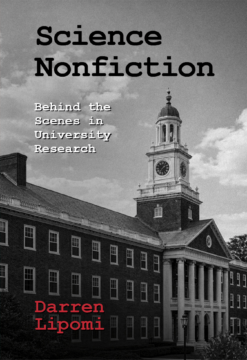
Science Nonfiction: Behind the Scenes in University Research, the new memoir from Dr. Darren Lipomi, chair of the Department of Chemical and Sustainability Engineering at the University of Rochester, addresses such issues bluntly—until it doesn’t. “There is a fair case to be made that the financial burden of research is borne not by the taxpayer,” Lipomi writes, “but by the ‘forever trainee’—the twenty-two-year-old PhD student who becomes a postdoctoral scholar at twenty-nine, and an untenured research scientist at thirty-four.” But now in his mid-forties, having more or less figured the system out, Lipomi is doing better than fine, and his memoir charts an uneasy path between celebration and critique.
It would be easy to rip Science Nonfiction apart as a vanity project. Despite being short (around 150 pages), the book includes more personal asides than any rigorous editor would allow. Chapter 1 tells us not only about his childhood enthusiasm for Legos, but also about his father’s dementia and brother-in-law’s suicide. Chapter 6, after informing us about the ironic “Virgins Forever” club he formed with his high school band buddy, is entirely about getting a girlfriend, and Chapter 11 is entirely about having a child with that girlfriend, now his wife.
But Lipomi’s tendency to overshare also gives his book its value. Success of the kind he has achieved requires some obnoxiousness. Caveat emptor.
From the beginning of the book, Lipomi displays a rare combination of traits that make him an effective research scientist—a combination, that is, of wild arrogance, unflappable work ethic, and the ability to pivot quickly whenever projects fail. As a high school senior, his aim is to become a professional trombonist, but when he isn’t admitted to either Eastman School of Music or Northwestern University, he pivots to chemical engineering. While at Boston University, he pivots again—after 9/11, he briefly changes his major to anthropology, before returning to chemistry (not engineering)—but eventually he finds himself working five hours a day as an undergraduate researcher.
He is wracked with intense anxiety through all this, but never fails to do the next day’s work. This leads to a first-author paper in Organic Letters as an undergrad, followed by admittance into the country’s top chemistry programs: Harvard, Caltech, Stanford, Berkeley, Scripps, Columbia, and UCLA—everywhere he applied, save MIT. At Harvard, he joins the research group of George M. Whitesides, whose renowned productivity is partly enabled by meeting with his advisees only once a year. On his first day in the Whitesides lab, a sixth-year grad student tells him, “Joining this lab was the worst decision I ever made in my life.”
But Lipomi doesn’t change labs. Instead, he switches to a subject that better interests Whitesides, and cranks out five first-author papers in five years.
Consider that puzzling phrase: the first-author paper. The “first author” is the person—in large labs, typically a grad student or a postdoc—who actually writes the paper, as opposed to the last author, who typically provides the funding and approves the publication. Lipomi is at his best in Science Nonfiction when he details such conventional hierarchies within science, discussing the relative merits of dollars vs. awards vs. citations, and how he was able to obtain them all.
During his ascent, Lipomi makes sure to tick every professional box. As a graduate student, he networks his way into a postdoctoral position and knows just how important it is to name-drop his famous advisor, George Whitesides (“the H-bomb of scientific advisors”). As a postdoc, he needs his own grant funding, so he becomes an “Intelligence Community Postdoctoral Fellow,” paid for by the CIA and NSA. As an assistant professor, he understands exactly what his $640,000 startup package means. “While my department chair was never so explicit, I knew that I had to bring in one thousand dollars per square foot of my laboratory each year just to make the math work—to justify my presence on the faculty.”
Part of the purpose of this book is to show the difficult working conditions of early career scientists. Lipomi shows himself working seven days a week during his entire graduate career, and this pace barely slows once he takes a postdoc at Stanford. He risks danger (during one explosion, only his safety goggles save him from blindness), and he endures poverty (while still at Harvard, he sells his trombone just to make ends meet). But what is all this sacrifice for?
Maybe this is all just the means to an end—a route toward scientific discovery. So: is it worth it? I’ll admit I read the back half of Science Nonfiction with a mixture of admiration and unease, an attitude not dissimilar to Lipomi’s toward his own advisor, and perhaps to the system as a whole.
I’ve never been especially willing to reshape myself around the requirements of my profession, and as a result, according to the standard metrics (dollars, awards, citations), I’m about an order of magnitude less successful than Lipomi. Lipomi, for his part, retains his own para-scientific interests (trombones, podcasting, writing a book like this one), and is about an order of magnitude less successful than someone like his advisor, Whitesides, who went all in on science. Science Nonfiction portrays scientific professionalization as a process that is at once dehumanizing and transformative, sacrificial and empowering, but in the end Lipomi’s stance is clear. Reforms are warranted, but the sacrifices are worth it.
By the end of the book, I was almost convinced. Lipomi now supervises graduate students and no longer carries out his own bench experiments. His students have founded their own companies, won their own grants, achieved glory.
I, on the other hand, am still teaching undergraduate labs.
Of course, there’s some irony here. Lipomi acts as a sort of accidental Cassandra for potential scientists. Anyone with doubts about joining the profession would likely read this book and conclude, sensibly, “I would prefer not to.” Lipomi is pragmatic and opportunistic, something like the opposite of the figure we valorize in conventional scientific biographies, but his success in today’s research universities is far nearer to the type one might reasonably hope to achieve. Sometimes the best person to expose a troubled system is not an outsider critic, but the insider whose recruitment pitch is indistinguishable from a warning.
Enjoying the content on 3QD? Help keep us going by donating now.