
by Rafaël Newman
 About ten years ago, I received an invitation to coffee from a fellow I hadn’t seen in a while. At the time, Rolf Kuhn was teaching English at a middle school in the nearby town of Baden; our acquaintance was the result of our frequenting the same English-language bookstore—Pile of Books, still run in those days by our common friend Dani Nufer—in Zurich, where we both lived. The gap in our regular contact had been due to a caesura in my personal life, which had occasioned a lengthy stay abroad, and did not reflect any deterioration of our friendship.
We met, at Rolf’s suggestion, at a place called Chez Marion, across from Zurich’s central library and just up the slope from Rudolf Brun Bridge over the Limmat. Chez Marion, which has since ceded its location to a schnitzel restaurant, was a French bistro in the evenings and an old-fashioned Zurich café by day, with curtains in the windows and frilly paper round the stems of tea glasses. Just the place for a chat with a Swiss teacher approaching retirement, I thought.
And indeed, the coming change in Rolf’s employment status soon came up, and I asked him what he was planning on doing with his free time.
“I’m going to break into the testing center at a Big Pharma company,” he responded without hesitation, “and free all the lab animals.”
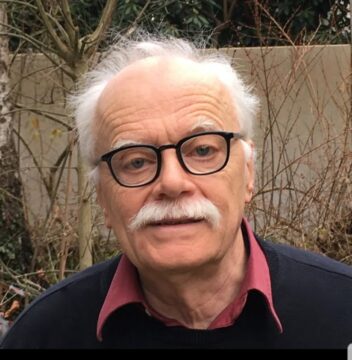
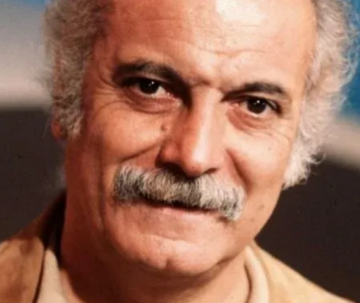
This wasn’t the answer I had been expecting to hear, from a white-haired Swiss burgher in such well-mannered surroundings. But I really shouldn’t have been surprised. After all, in the late 1990s and into the early years of the new millennium, while working at the middle school and in accordance with Switzerland’s Milizprinzip, which envisions politics as a part-time job to be performed not by professional legislators but by specialists in a variety of trades, Rolf had served in Zurich’s city parliament, or Gemeinderat, where he represented the Socialist Party and spoke up frequently on issues of social justice and environmental protection. Furthermore, one of the occasions on which he and I had first met, years earlier, at Dani’s bookshop was the time I performed an acoustic set there with The NewMen, a country-punk outfit for which I once provided lyrics and vocals—and Rolf’s enthusiasm for our rough-and-ready show that evening had been wholehearted. Finally, if only symbolically, with his walrus moustache and rugged good looks Rolf could have passed as the long-lost brother of Georges Brassens, France’s celebrated anarchiste punk troubadour, whose most notorious ballad, “Le gorille,” features an animal escaping from confinement to wreak havoc among the hypocritical patrons of a zoo…
I don’t know if my friend Rolf, who died this past March just shy of his 73rd birthday, was a fan of Brassens, although he was certainly as well-read in the French classics, which had been among the Gallic songwriter’s inspirations, as he was in the English modernists. In fact, it was one of these last that provided us with an additional connection, over the past few years, when Rolf and I would meet regularly at the Zurich James Joyce Foundation, where we were both members. We would attend annual events, including the JJingles Joycean Christmas Party, featuring music and dramatic readings, or Bloomsday, on June 16, when Rolf would organize an annual gathering by Joyce’s grave at Fluntern Cemetery in the hills above Zurich.
Our re-inaugurated friendship took a further turn on April 7, 2023, when Rolf turned 70, and his wife, Susan Wyrsch Kuhn, threw a party for him, with entertainment provided by a few surprise guests. I was honored to be among these, along with my friend, the poet Hugo Ramnek, and to read aloud selections from some of Rolf’s favorite works: by Faulkner (“A Rose for Emily”), from Shakespeare’s Sonnets (Rolf had a marvelous framed parchment containing the complete text of Macbeth, written in miniature script, hung on the wall of his foyer)—and of course by James Joyce. That day I read a passage out of “The Dead,” from Joyce’s Dubliners (1914), a story whose celebrated last lines were then also cited, three years later this past April, in Rolf’s death notice in the Neue Zürcher Zeitung:
His soul swooned slowly as he heard the snow falling faintly through the universe and faintly falling, like the descent of their last end, upon all the living and the dead.
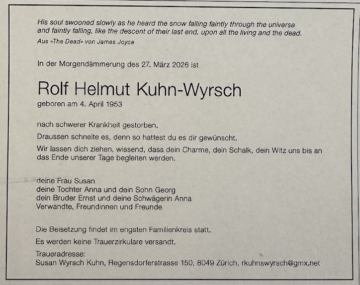
Susan told me, when we met to discuss the obituary, that snow had been falling outside the window when Rolf died.
In April of 2023, however, my friend was still very much alive, regaling the guests at his day-long birthday luncheon with stories of old Wiedikon, the working-class Zurich neighborhood of his youth; of his travels, in France and in the USA; and of the joys and sorrows of teaching literature to young people. He was also, as usual, outspoken—while we enjoyed the lavish, strictly vegetarian meal Susan and their daughter and son had prepared—on the subject of animal rights. And it was in admiration of this conviction, and in memory of our conversation years before at Chez Marion, that I wrote the following sonnet:
Rare are the birds that break their cage and fly
Outside the hungry bounds that we have made;
Light never near a trap our hand has laid;
Fold not their wings for us, nor for us die.
How rarer yet, who of our number try
Egregiously to thwart this rude crusade:
Loose from its perch behind the barricade
Merely one bird, and grant it to the sky.Upstarting from his own to airier flocks
There is one here, relieved of somber gown,
Keen to campaign again, as in his youth!
Undaunted by these warders and those locks
He’s pledged to burn their creature-prison down,
Nor cease to bear the standard of his truth.
…and recited it that same day, in honor of the rare, fierce bird we were celebrating.
*
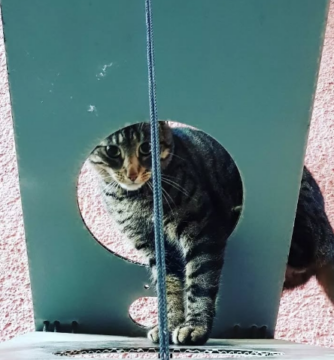
I’ll get another chance to recite something for Rolf this week. When we gather with other Friends of the Zurich James Joyce Foundation at the Irish writer’s grave this June 16, on Bloomsday, to commemorate the date in 1904 on which Joyce first “walked out” with Nora Barnacle, and on which the events of Ulysses are set, we will also be remembering our fellow member and friend Rolf. Thus in addition to our usual readings from Joyce’s English texts, we will hear Rolf’s own rendering of a passage from Ulysses into Züridütsch, the Swiss-German dialect of his native Wiedikon. I will provide a reading of the original English, from the fourth chapter of Ulysses, also known as the Calypso episode, in which Leopold Bloom communes with the family cat while preparing breakfast for his wife Molly:
— Milk for the pussens, he said.
— Mrkgnao! the cat cried.
They call them stupid. They understand what we say better than we understand them. She understands all she wants to. Vindictive too. Cruel. Her nature. Curious mice never squeal. Seem to like it. Wonder what I look like to her. Height of a tower? No, she can jump me.
— Afraid of the chickens she is, he said mockingly. Afraid of the chookchooks. I never saw such a stupid pussens as the pussens.
— Mrkrgnao! the cat said loudly.
She blinked up out of her avid shameclosing eyes, mewing plaintively and long, showing him her milkwhite teeth. He watched the dark eyeslits narrowing with greed till her eyes were green stones. Then he went to the dresser, took the jug Hanlon’s milkman had just filled for him, poured warmbubbled milk on a saucer and set it slowly on the floor.
— Gurrhr! she cried, running to lap.
When we hear Rolf’s version—entitled “De Mr. Bloom und sini Chatz”— we will notice that, while rendering Joyce’s human English into Züridütsch, Rolf has left pussens’s language exactly as it appears in Ulysses: “Mrkrgnao”.
Is this because the sound Joyce transcribes is simply untranslatable onomatopoeia?
Or could it be that my dear, departed friend Rolf, like Bloom—or rather, like Joyce himself—enjoyed some privileged access to the consciousness of an animal that spoke neither Irish-English nor Swiss-German, and longed only for compassion?