
by Scott Samuelson
Once I’ve hung a picture on the wall, I pretty much never look at it again. It goes right from the forefront of my mind to the background of my room. It’s only when a guest comments on it that I bother to see it again.
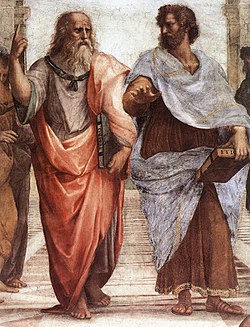
A similar thing can be said for iconic works of art. We see them so often that we don’t bother to look at them anymore. A good example is Raphael’s School of Athens, especially its central scene of Plato and Aristotle in conversation. It’s used to illustrate pretty much every article concerning philosophy in the popular media. When we see it, we think “philosophy” or maybe “classics” and move on.
Art historians aren’t much better. They love the game of guessing who each figure in the School of Athens is modeled on or is supposed to represent. Instead of seeing “philosophy,” their great advance is to see “Michelangelo” and “Heraclitus.” As fun and minorly informative as the guessing game can be, it still sees the painting as a cheap allegory.
I started taking a fresh look at the School of Athens when I had to teach it as part of a study abroad course to Rome. The more I looked at it, the more I started to see it as a compelling and comprehensive philosophy of education. To my surprise, I’ve found that it illustrates the complexity of what I aspire to as a teacher.
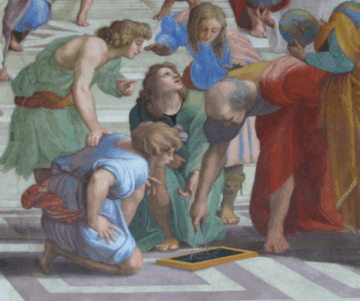
Let’s start with one of Raphael’s most ingenious inventions: his depiction of Euclid teaching a group of pupils. It’s a profound image of what we might call “student-centered” education. The geometer is bent over into a shape resembling his protractor. He’s literally and figuratively turned himself into an instrument of education. If we follow the students’ faces upward, the first (in the bottom position) is staring at the slate struggling to understand the proof. Above him, a student is pointing down at the slate with a look of dawning understanding (“wait, I think I’m getting this!”). He looks up at a student who’s buoyed up by understanding (“ah, yes, that makes perfect sense!”). The student to his right (our left) is the ideal graduate-student-type student: not only does he get it, he’s anticipating the next move in the proof. The entire group forms a compositional circle with the face of dawning understanding at the center. Maybe better than calling such education “student-centered,” we should call it “understanding-centered.”
I see this kind of teaching as the most straightforward form of education: to make sure students clearly understand an idea and its rationale, to break down a complex whole into its grammatical parts and to walk students clearly through those parts to see how they work together. But that’s hardly the whole story of education.
In the School of Athens, almost everything in the composition is mirrored and balanced—in a right-brain-left-brain sort of way. The complement of Euclid’s student-centered teaching is Pythagoras’s teacher-centered teaching. The mysterious philosopher is absorbed in his book, utterly indifferent to the students who strain to look around him at a chalkboard that has written on it his difficult theory of the music of the spheres. Here too a compositional circle is formed—only this time with the master at the center. I especially love how one old thinker, hunched and peering, is jotting things down in his notebook much like a college student getting the notes from a fellow student concerning a missed class.
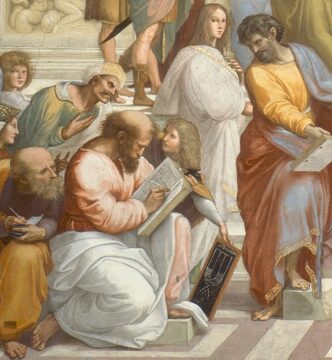
Isn’t it often the case that our best teachers are those who aren’t even trying to teach us? I’m talking about masters who are so absorbed in what they’re doing that they inspire us to want to channel their energies. Even for students who aren’t going to become masters themselves, when they encounter teachers deeply invested in what they’re doing, it can inspire them to want to figure out what all the fuss is about. My point is that it’s extremely important for us to encounter mystery and mastery accompanied by intellectual passion.
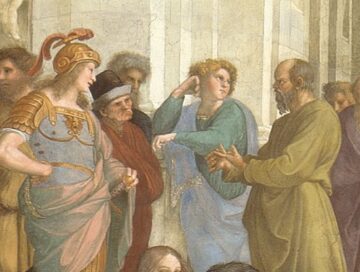
Above the Pythagorean crew we find Socrates giving a lecture, counting off points on his fingers, while his students react to them in different ways. One stares off as if in a distracted daydream (as a teacher, I’ve learned not to underestimate this student), another frowns skeptically, another in fancy militaristic garb (Alcibiades?) looks on with affectionate curiosity. What we’re seeing here is something far more diffusive and unpredictable than the Euclidean model. Ideas have been put into open-ended play. Socrates’s interlocutors are engaged in varying degrees of self-examination: What do his points have to do with me? Teaching, in this Socratic manner, is about launching and empowering the journey of thinking. The motley students remind me of my favorite years as a teacher, teaching philosophy to non-traditional students at a community college.
Everywhere you look around the painting you see people learning. Or maybe it’s more accurate to say that you see people growing through acts of enlivened thinking—meditating, studying, writing. One of my favorite vignettes is of a young man who’s propped himself against a wall and formed a makeshift desk with his crossed legs to jot down some notes about his sudden revelation. Above him an older guy looks on with an expression eloquent of “Whatcha writin’?”
It’s funny, but I looked at this famous fresco for a long time before it dawned on me that the famous central image is also an image of education. Quite arguably, the most famous teacher-student combo in Western philosophy is Plato and Aristotle. In the art-historical scholarship, there’s a lot of debate about if the two figures are debating (the ideal versus the real)—or if they’re hammering out a synthesis of theory and practice (Plato holds the Timaeus, Aristotle the Ethics). Regardless of the substance of their conversation, the standout thing is that they’re on the same plane. They have different ideas and approaches, but each philosopher has become as respectable and valuable as the other. What’s in their compositional center isn’t exactly teaching or learning: it’s conversation, which mixes and elevates both teaching and learning.
Isn’t this the highest goal of education? In a sense, the purpose is for the teacher and student to be no longer teacher and student—for student Aristotle to become philosopher Aristotle. It’s been one of the joys of my teaching career to have my students say things that make me see things anew or even think differently—and ultimately to meet them, long after our classes are over, as full intellectual equals able to agree and disagree at a level far beyond agreement and disagreement.
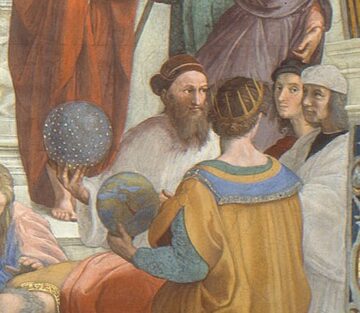
Just ask Raphael, who learned from almost everyone and encoded many of his teachers in the School of Athens. He learned his geometry and sense of architecture from Bramante—who’s his model for Euclid. He learned his linear perspective from Leonardo—who’s his model for Plato. He learned his sense of composition from his slightly older contemporary Michelangelo—who’s his model for moody Heraclitus. What about the teacher he learned the art of painting from? Raphael movingly paints his self-portrait in the School of Athens right next to his teacher Perugino. They converse among the astronomers presumably to show that painting can be a liberal art on par with the highest science.
At the center, Plato famously points up to the heavens and Aristotle makes a downward motion with his hand as if to respond, “Bring it back down to earth, Plato!” To add a new dimension to the up-down dynamic, Raphael inserts an out-in dynamic: his self-portrait stares out at us. As the artist and the subject, he’s both in and out of the painting: he’s made it, and he’s reflected in it. That dynamic is the essence of education. We’re reflected in what we read and study and make, and we stand outside of it to lead our lives. Just as Plato and Aristotle complement and enliven each other, so too does education complement and enliven our humanity.
Raphael’s educational philosophy isn’t any one model—isn’t Euclidean, Pythagorean, Socratic, Platonic, Aristotelian, or autodidacticism. It’s the synthesis of all of them. It’s like his portrait is saying to us, “Here’s what I’ve learned, and here’s what I now have to teach—what do you make of all that?”
***
PS: For what it’s worth, I have a chapter about The School of Athens called “Be the Conversation” in my book Rome as a Guide to the Good Life: A Philosophical Grand Tour.
***
Scott Samuelson holds a joint appointment at Iowa State University in Philosophy & Religious Studies and Extension & Outreach. His book To Taste: On Cooking and the Good Life will come out this fall.
Enjoying the content on 3QD? Help keep us going by donating now.