A Greeting on the Trail
Turning fifty, at last I come to understand,
belatedly, unexpectedly, and quite suddenly,
that poetry is not going to save anybody’s life,
least of all my own. Nonetheless I choose to believe
the journey is not a descent but a climb,
as when, in a forest of golden-green morning sunlight,
one sees another hiker on the trail, who calls out,
where are you bound, friend, to the valley or the mountaintop?
Many things—seaweed, pollen, attention—drift.
News of the universe’s origin infiltrates atom by atom
the oxygenated envelope of the atmosphere.
My sense of purpose vectors away on rash currents
like the buoys I find tossed on the beach after a storm,
cork bobbers torn from old crab traps.
And what befalls the woebegotten crabs,
caged and forgotten at the bottom of the sea?
Are the labors to which we are summoned by dreams
so different from the tasks to which the sunlight of reality
enslaves us? One tires of niceties. We sleep now
surrounded by books, books piled in heaps
by the bedside, stacked along the walls of the room.
Let dust accrue on their spines and colophons,
let their ragged towers rise and wobble.
Of course the Chinese poets were familiar with all this,
T’ao Ch’ien, Hsieh Ling-yün, Po Chü-i,
masterful sophisticates adopting common accents
for their nostalgic drinking songs and laments
to age and temple ruins, imperial avarice,
autumn leaves caught in a tumbling stream.
As the river flows at the urging of gravity, as a flower
blooms after April rain, we are implements
of the unseen, always working for someone else.
The boss is a tall woman in a sky-blue shirt
or a man with one thumb lost to a cross-cut saw
or science or art or the emperor, what matter?
We scrabble within the skin of time
like mice in the belly of a boa constrictor,
Jonah within leviathan, pacing the keel, rib to rib,
surrounded by the pulse of that enormous, compassionate heart.
Later we dance in orchards of guava and lychee nuts
to the shifting registers of distant music,
a clattering of plates as great fish are lifted from the grill,
seared black with bitter orange and lemongrass.
Orchid trees bloom here, Tulip trees and Flame trees,
but no Idea trees, no trees of Mercy,
for these are human capacities, human occasions.
Because it has about it something of the old village magic,
the crop made to rise by seed of words,
by spell or incantation—
because it frightens and humbles us to recall
our submission to such protocols—
for this do we fear poetry, for the unresolved darkness
of the past. Where are you bound, friend,
on this bright and fruitful morning—to the valley
or the mountaintop? To the mountaintop.
.
by Campbell McGrath
from the Kenyon Review

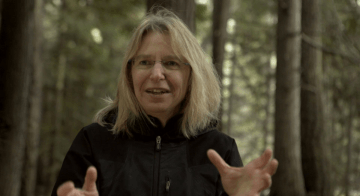 Consider a forest: One notices the trunks, of course, and the canopy. If a few roots project artfully above the soil and fallen leaves, one notices those too, but with little thought for a matrix that may spread as deep and wide as the branches above. Fungi don’t register at all except for a sprinkling of mushrooms; those are regarded in isolation, rather than as the fruiting tips of a vast underground lattice intertwined with those roots. The world beneath the earth is as rich as the one above. For the past two decades, Suzanne Simard, a professor in the Department of Forest & Conservation at the University of British Columbia, has studied that unappreciated underworld. Her specialty is mycorrhizae: the symbiotic unions of fungi and root long known to help plants absorb nutrients from soil. Beginning with landmark experiments describing how carbon flowed between paper birch and Douglas fir trees, Simard found that mycorrhizae didn’t just connect trees to the earth, but to each other as well.
 Justin E. H. Smith is a professor of history and philosophy of science at the University of Paris. In addition to his recent book,
  If you could look closely enough at the objects that surround you, zooming in at magnifications far beyond those you could ever see with most microscopes, you would eventually get to a point where the familiar rules of your everyday experiences break down. At scales where blood cells and viruses seem enormous and molecules come into view, things are no longer subject to the simple laws of physics that we learn in high school.
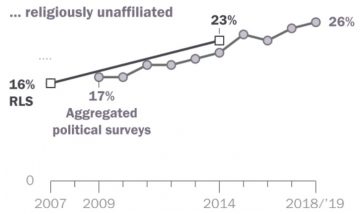 The religious landscape of the United States continues to change at a rapid clip. In Pew Research Center telephone surveys conducted in 2018 and 2019, 65% of American adults describe themselves as Christians when asked about their religion, down 12 percentage points over the past decade. Meanwhile, the religiously unaffiliated share of the population, consisting of people who describe their religious identity as atheist, agnostic or “nothing in particular,” now stands at 26%, up from 17% in 2009.
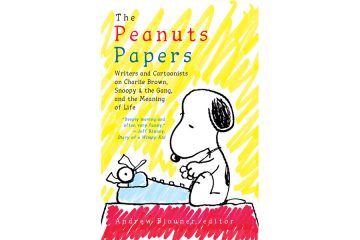 The best thing about this excellent and pleasing anthology of 33 tributes to “Peanuts” is that it will probably evoke your own memories of newspaper comic-strip reading and reawaken your appreciation of Charles M. Schulz’s round-headed, adult-sounding children and the imaginative dog Snoopy. “An isolated four-panel comic strip of Charlie Brown and Linus debating a philosophical point can be appreciated just as it is, humorous, insightful, compact, and perfect; one strip a day documenting one man’s thoughts for half a century has the weight of a full life,” writes the cartoonist Ivan Brunetti. As a collective eulogy to a cultural phenomenon, “The Peanuts Papers: Writers and Cartoonists on Charlie Brown, Snoopy & the Gang, and the Meaning of Life” testifies to the inspiration and importance of Schulz’s work at critical times in the authors’ (usually) younger lives. Satirist and critic Joe Queenan reflects: “Unlike so many other venerated objects in U.S. pop culture, it was sweet without being stupid, reassuring without being infantile.”
 I’m writing these words in clothes that reek of tear gas. Trying to process the pulse of the street while still part of it, while our feet are still there on the ground, fleeing water cannons, not knowing where to go, hiding in the crowd, among people just like us, groups of us marching, dodging smoke and soldiers. This is a celebration, a protest, a demand for change that began with students jumping turnstiles in the metro after fares were hiked. Without any organizer, without petitions, leaders, or negotiations, the whole thing escalated and then exploded into chaos in the streets. And there is yelling, and singing, and banging on pots, and fire, and beatings. In front of the palace of La Moneda, near the theater where I work, a man tells a soldier that he doesn’t understand why the soldier is protecting privileges that will never be his. A woman screams that we’re killing ourselves, we’re committing suicide, with all this inequality.
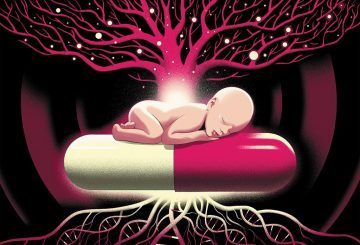 In the autumn of 1869, Charles Darwin was hard at work revising the fifth edition of On The Origin of Species and drafting his next book, The Descent of Man, to be published in 1871. As he finished chapters, Darwin sent them to his daughter, Henrietta, to edit — hoping she could help to head off the hostile responses to his debut, including objections to the implication that morality and ethics could have no basis in nature, because nature had no purpose.
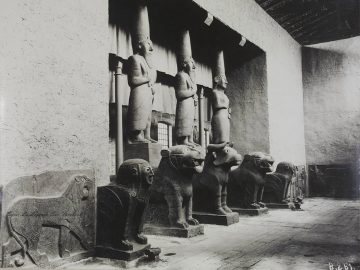 When Samuel Beckett visited the Tell Halaf Museum in Berlin’s Charlottenburg district on 21 December 1936, he had the place to himself. Though King Faisal of Iraq had visited the makeshift museum when it opened six years earlier and the Illustrated London News had run a cover story on the quirky institution, the museum was hardly a popular tourist destination. You had to be in the know. After Beckett rang for the key, he was left alone among colossal lions, scorpion-bird-men, griffons, and sphinxes. “Superbly daemonic, sinister + implacable,” the yet unknown Irish writer wrote in his diary.
 Late on election night, November 8, 2016, Paul Krugman wrote in the New York Times: “. . . people like me, and probably like most readers of The New York Times, truly didn’t understand the country we live in. We thought that our fellow citizens would not, in the end, vote for a candidate . . . so scary yet ludicrous.” About two and half years before that night, many liberals in India felt something similar at Narendra Modi’s massive victory—though one should say, Modi is scary but not ludicrous.
 The gene-editing method CRISPR has transformed biology, giving scientists the ability to modify genes to treat or prevent genetic diseases by correcting dangerous mutations and to create a host of new genetically modified plants and animals. But the technique, which involves using an enzyme called a nuclease that acts as molecular scissors to “cut” DNA, can cause unintended effects. Making such double-stranded breaks in DNA can result in unwanted genetic material being inserted or deleted, which can have consequences including activating genes that cause cancer. Most mutations cannot be corrected easily without creating these undesirable genetic by-products.
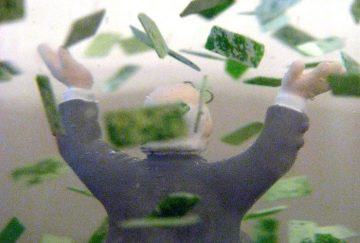
 Perhaps the grandest tale of capitalist modernity is entitled ‘The Disenchantment of the World’. Crystallised in the work of Max Weber but eloquently anticipated by Karl Marx, the story goes something like this: before the advent of capitalism, people believed that the world was enchanted, pervaded by mysterious, incalculable forces that ruled and animated the cosmos. Gods, spirits and other supernatural beings infused the material world, anchoring the most sublime and ultimate values in the ontological architecture of the Universe. In premodern Europe, Catholic Christianity epitomised enchantment in its sacramental cosmology and rituals, in which matter could serve as a conduit or mediator of God’s immeasurable grace. But as Calvinism, science and especially capitalism eroded this sacramental worldview, matter became nothing more than dumb, inert and manipulable stuff, disenchanted raw material open to the discovery of scientists, the mastery of technicians, and the exploitation of merchants and industrialists. Discredited in the course of enlightenment, the enchanted cosmos either withered into historical oblivion or went into the exile of private belief in liberal democracies. As Marx put it, all that was solid melted into air, and the most heavenly ecstasies drowned in the icy water of egotistical calculation.
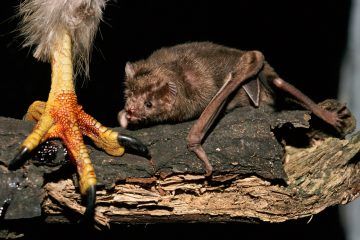 It has been a big year for leeches. A new species
 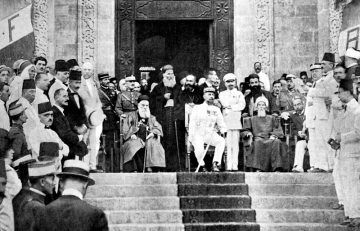 Throughout modern history, the weight of Western colonialism in the name of freedom and religious liberty has distorted the nature of the Middle East. It has transformed the political geography of the region by creating a series of small and dependent Middle Eastern states and emirates where once stood a large interconnected Ottoman sultanate. It introduced a new – and still unresolved – conflict between ‘Arab’ and ‘Jew’ in Palestine just when a new Arab identity that included Muslim, Christian and Jewish Arabs appeared most promising. This late – last – Western colonialism has obscured the fact that the shift from Ottoman imperial rule to post-Ottoman Arab national rule was neither natural nor inevitable. European colonialism abruptly interrupted and reshaped a vital anti-sectarian Arab cultural and political path that had begun to take shape during the last century of Ottoman rule. Despite European colonialism, the ecumenical ideal, and the dream of creating sovereign societies greater than the sum of their communal or sectarian parts, survived well into the 20th-century Arab world.
 The major cause of cancer-related deaths is the spread of cancer cells from their primary site to other parts of the body