
Lesly-Marie Buer in the Boston Review:
 In 2017, for the second time in recent years, U.S. life expectancy decreased. Headlines blamed the decline on suicides and opioids, and cast impoverished rural whites as the primary victims. A great deal of attention has been focused on Appalachia, whose population is (erroneously) portrayed as uniformly white, poor, and ravaged by drug addiction. White sickness has thus come to stand for what is supposedly wrong with health, health care, and culture in the United States.
The truth is not so simple. Black mortality rates continue to dwarf those of whites—another tragic indication of how our society has normalized racial inequality. In West Virginia, the state with the highest overdose death rate, the rate of overdose among blacks is slightly higher than among whites. In Tennessee, whites fare worse than blacks, but maybe not for long: from 2008 to 2016, the overdose mortality rate more than quadrupled among blacks compared to about a doubling among whites. Moreover, mortality rates increased for seven of the ten leading causes of death, with the highest percentage increase seen in influenza and pneumonia. Drug addiction, then, is not the easy explanation we have made it out to be. Income inequality, loss of social safety net services, and state violence against communities of color are also massive problems, a conclusion borne out by a large body of research. But by only focusing on class—those poor white Appalachians—most media reports ignore the racism, xenophobia, and LGBTQ discrimination found in every aspect of the U.S. health care system, from medical research to bedside care.
More here.
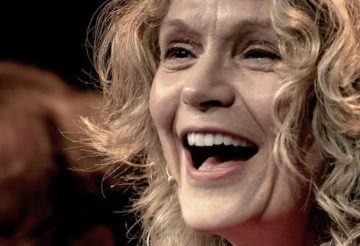 Ignorance involves having a false belief, or no belief at all, on a topic. This can be the result of a simple lack of information. In that case, as soon as we read up on the topic we have knowledge. What distinguishes knowledge resistance, by contrast, is that it cannot be fixed by supplying information. It is, as it were, a type of ignorance that is not easily cured.
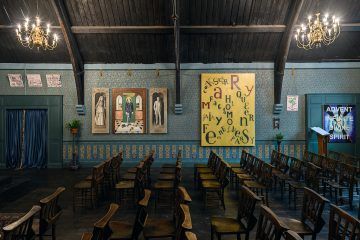 The light is dim, the air richly scented. Little purple tea lights flicker in the votive candle rack and the walls are decorated with twining sunflowers, exuberant passionflowers and several canvases of blousy green carnations monogrammed with Oscar Wilde’s prisoner ID number C.3.3. The Temple is a deconsecrated church with an attractive dark wood ceiling and matching antique chairs. A half-size marble statue of Wilde presides. The artists, McDermott and McGough, have painted various icons spelling out pejoratives such as ‘pansy’, ‘faggot’ and ‘cocksucker’, adorned with gold leaf and richly-coloured paint. Towards the back are intricate woodcut-style depictions of massacres with titles like ‘Nun Cutting Rope of Dead Homeric’, black canvases with cut-out fatality statistics, and monochrome portraits of individuals more recently killed by homophobia and transphobia, such as Justin Fashanu, Brandon Teena and Marsha P. Johnson. A placard in the hallway spells out all of the bigotries the temple stands against, ending with the instruction ‘only love here’. Opposite is a purpose-built offertory box ‘For the Sons and Daughters of Oscar Wilde’.
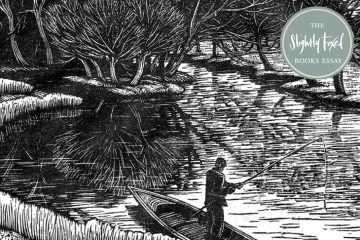 In the spring of 1883 my mother, Maud Du Puy, came from America to spend the summer in Cambridge with her aunt, Mrs Jebb. She was nearly 22, and had never been abroad before; pretty, affectionate, self-willed, and sociable; but not at all a flirt. Indeed her sisters considered her rather stiff with young men. She was very fresh and innocent, something of a Puritan, and with her strong character, was clearly destined for matriarchy.
 It is obvious that the discomfort I once felt over taking antidepressants echoed a lingering, deeply ideological societal mistrust. Articles in the consumer press continue to feed that mistrust. The benefit is ‘mostly modest’, a flawed analysis in The New York Times told us in 2018. A widely shared YouTube
 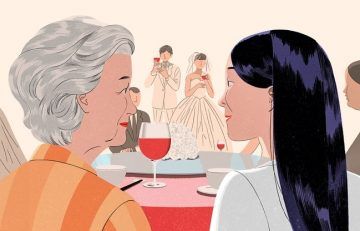 When a movie starts with a diagnosis of terminal cancer, what next? The first thing we saw in Akira Kurosawa’s “Ikiru” (1952) was an X-ray of a man’s stomach, with a tumor clearly visible, and Lulu Wang’s new film, “The Farewell,” sets off with similar starkness. An aged woman undergoes a CT scan, and we learn that she has Stage IV lung cancer and three months to live. But here’s the difference. Kurosawa’s hero, a meek civil servant, took stock of his mortality and decided to waste not a drop of the time that remained. Wang’s elderly lady, by contrast, is a merry old soul, already skilled at being alive, and requiring no further encouragement. So nobody tells her that she’s going to die.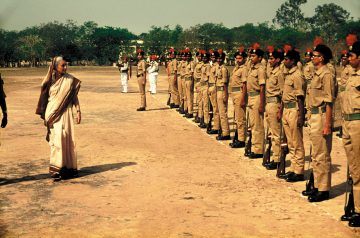
 Consider the writer as houseguest. Is it a good idea to invite someone into your home whose occupation it is to observe everything? The writer as host might be no better. Even the most thoughtful guest will undoubtedly interfere with the writer’s productivity during the visit. It’s really no surprise that people who write for a living have given us some of our wisest sayings about a visit’s proper length.
 Adam Tooze in the LRB:
 In Medium, first Seyla Benhabib responds to Raymond Guess piece in Point Magazine
 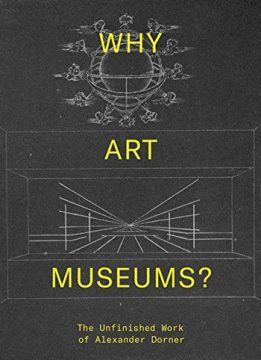 “Art museums are in a state of crisis.” The diagnosis is drastic, the remedy equally so: a radical update of both form and function. Hopelessly out of touch with the pulse of contemporary culture and the rhythms of everyday life, the grandiose architecture of the museum must be rethought in terms of adaptability and flexibility, with inert galleries transformed into sites of ongoing experimentation. Likewise the visitor’s experience, still rooted in antiquated models of passive contemplation, must be reimagined as a process of active participation and immersive engagement. Museums must reinvent themselves wholesale, in other words, to “guarantee their survival in a changing world.”
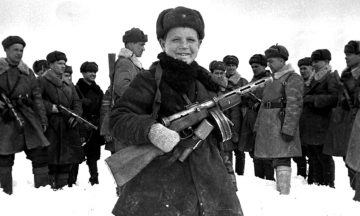 It is no coincidence that most of her witnesses have been women. Alexievich, who began her writing life as a reporter on a local paper in Belarus, realised early on that what she was looking for, the memory of what things felt like, is better conveyed by women, who feel little shame in expressing an unvarnished sense of remembered horror. The death of beloved sons is a constant refr, as is that of suicide, about which she has also written a number of short storiesain that runs through her books. Embittered by wars in which they have been tricked into fighting, maimed by wounds that never heal, revolted by killings in which they were forced to take part, Alexievich’s male characters come home from war to take their own lives, leaving their desolate mothers to grieve anew. “They sent me back,” one woman says bleakly in Boys in Zinc, “a different man.”
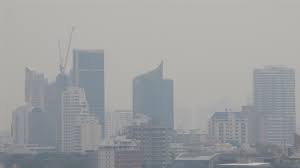 And what a scandal! The scale of this modern plague, we have begun to see, is staggering. We have long known that nearly three million people in poor countries die prematurely each year from inhaling wood smoke from open fires used for cooking, but we didn’t know until quite recently that many people in modern cities are having their lives cut short as a result of breathing in vehicle exhaust gases and industrial fumes. The official narrative has been that since the end of coal-burning in homes in the 1950s and the demise of heavy industry, urban air has been relatively clean, leaving us with nothing to worry about. The reality is shockingly different. We understand now that air pollution doesn’t just harm our lungs, as coal dust did, but also gets into the bloodstream. The World Health Organisation reckons that nine in ten people around the world breathe air containing ‘high levels’ of pollution; it is responsible for 26 per cent of premature deaths from heart disease, 24 per cent of those from strokes and nearly one-third of all deaths from lung cancer. It is linked to obesity in children, autism and dementia.
 In 1978, in