The Aesthetic Beauty of Math

Karen Olsson at The Paris Review:

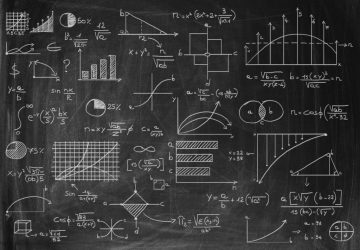
Many ideas on a blackboard

Trying to explain my work to a non-mathematician, he wrote, would be like trying to explain a symphony to someone who can’t hear. Later he would rely on another metaphor, calling math “art in a hard material.”

Mathematics is an artistic endeavor, his words suggest. Yet Simone was skeptical. What kind of art? What is the material? Even poets have language, but your work seems to rely on sheer abstraction, she wrote her brother.

That math is an art, that one of its signature qualities is its beauty—these are ideas that continue to be articulated by mathematicians, even as non-mathematicians may wonder, as Simone did, what that could possibly mean. I myself become wary when a mathematician or scientist speaks about the beauty of her discipline, since it can seem vague and high-handed, if not wrong.

more here.

On the Vernacular Modernism of I.M. Pei (1917–2019)

Thomas de Monchaux at n+1:

Pei’s stature among architects is hard to convey. However visually entertaining their work, the likely legacies of other American so-called starchitects shrink—some to triviality—beside the decades of modern design that Ieoh Ming Pei produced, from his earliest built work in 1948 to his last project sixty years later. By the time he co-designed the Museum of Islamic Art in Doha in 2008, he was among the last practicing students of a teacher from the Bauhaus. Walter Gropius taught, and later taught beside, Pei at the Harvard Graduate School of Design. Gropius had arrived there in 1937. Pei, the scion of a Suzhou banking family who left Shanghai in 1935 for undergraduate study at Penn and MIT, arrived at Harvard in 1942. His classmates included Paul Rudolph and Philip Johnson.

Modernism in design was not conceived as a style but a refutation of the historicist stylistic revivals that had defined the previous four centuries of architecture in the developing West, forts and factories notwithstanding. Early modern buildings valued user experience over signifying appearance, which enabled them to apply new efficiencies in industrial engineering and standardized manufacturing.

more here.

We Went to the Moon. Why Can’t We Solve Climate Change?

John Schwartz in The New York Times:

Climate change is certainly an urgent challenge. Rising levels of greenhouse gases are raising temperatures worldwide, leading to shifting weather patterns that are only expected to get worse, with increased flooding and heat waves, and drought and wildfiresafflicting millions. The task of reversing that accumulation of greenhouse gases is vast, and progress is painfully slow. The idea of a moon shot for climate has been gaining supporters. Beto O’Rourke and Kirsten Gillibrand use the idea in their presidential campaigns, as did Michael Bloomberg in unveiling his recently announced $500 million Beyond Carbon campaignIn a commencement speech this year at the Massachusetts Institute of Technology he said, “It is time for all of us to accept that climate change is the challenge of our time.” He concluded, “It may be a moon shot — but it’s the only shot we’ve got.”

Does the enduring metaphor fit the task of countering the grinding destructiveness of a warming planet?

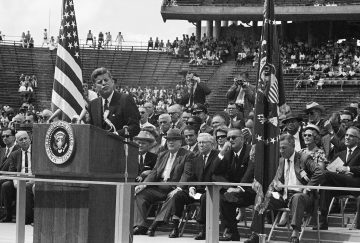
Climate presents more complicated issues than getting to the moon did, said John M. Logsdon, historian of the space program and founder of the Space Policy Institute at George Washington University. In 1970, Dr. Logsdon wrote a book, “The Decision to Go to the Moon,” that laid out four conditions that made Apollo possible. In the case of the space program, the stimulus was the first human spaceflight of the Russian cosmonaut Yuri A. Gagarin, which filled Americans with dread of losing the space race. In an interview, Dr. Logsdon said it has to be “a singular act that would force action, that you couldn’t ignore.” Other moon shot prerequisites, he said, include leaders in a position to direct the resources necessary to meet the goal on “a warlike basis,” with very deep national pockets — people like President Kennedy, who began the program, and Lyndon Johnson and Richard Nixon, who brought it to fruition. Finally, Dr. Logsdon said, “the objective has to be technically feasible.” Scientists and engineers had told Mr. Kennedy that “there were no technical show stoppers in sending humans to the moon — it would just take a hell of a lot of engineering.”

More here.

How Trump’s arch-hawk lured Britain into a dangerous trap to punish Iran

Simon Tisdall in The Guardian:

John Bolton, White House national security adviser and notorious Iraq-era hawk, is a man on a mission. Given broad latitude over policy by Donald Trump, he is widely held to be driving the US confrontation with Iran. And in his passionate bid to tame Tehran, Bolton cares little who gets hurt – even if collateral damage includes a close ally such as Britain. So when Bolton heard British Royal Marines had seized an Iranian oil tanker off Gibraltar on America’s Independence Day, his joy was unconfined. “Excellent news: UK has detained the supertanker Grace I laden with Iranian oil bound for Syria in violation of EU sanctions,” he exulted on Twitter. Bolton’s delighted reaction suggested the seizure was a surprise. But accumulating evidence suggests the opposite is true, and that Bolton’s national security team was directly involved in manufacturing the Gibraltar incident. The suspicion is that Conservative politicians, distracted by picking a new prime minister, jockeying for power, and preoccupied with Brexit, stumbled into an American trap.

In short, it seems, Britain was set up.

As a result, Britain has been plunged into the middle of an international crisis it is ill-prepared to deal with. The timing could hardly be worse. An untested prime minister, presumably Boris Johnson, will enter Downing Street this week. Britain is on the brink of a disorderly exit from the EU, alienating its closest European partners. And its relationship with Trump’s America is uniquely strained. Much of this angst could have been avoided. Britain opposed Trump’s decision to quit the 2015 nuclear deal with Iran, the trigger for today’s crisis. It has watched with alarm as the Trump-Bolton policy of “maximum pressure”, involving punitive sanctions and an oil embargo, has radicalised the most moderate Iranians.

More here.

Sunday, July 21, 2019

He Hears America Singing Guns N’ Roses

Troy Jollimore in the New York Times:

“America’s epic,” the poet Campbell McGrath writes, “is the odyssey of appetite.” It’s a good line, both clever and seductive, though in the wrong hands it’s the sort of thing that could be merely reductive. But McGrath knows the ins and outs of appetite as deeply, and as thoroughly, as he knows the highways and byways of America. He has spent decades exploring both. “Nouns & Verbs: New and Selected Poems” is a rich and invigorating sampling of the poetic results of these explorations.

America is McGrath’s primary subject, as it was Walt Whitman’s. (There are few poets today who seem to have inherited such a healthy measure of the Whitmanic spirit.) Like Whitman, like America, McGrath ranges in his work from the beautiful to the brash, from the expansive to the intimate. It encompasses sprawling vistas, urban conflagrations and tiny, tender dioramas. Because he loves driving cross-country, it is, too, a poetry of motels, small towns, remote outposts and roadside attractions.

More here.

The Miracle of General Equilibrium

Philip Pilkington in Inference Review:

GENERAL EQUILIBRIUM THEORY, or GET, is the metatheory on which all of mainstream economics rests; it remains very abstract, and it has been carefully studied by only a small number of economists. Invented by the French economist Leon Walras in 1899, GET was neglected for half a century as economists dealt with the intensifying business cycle, the emergence of central banks, and the Great Depression. The economists who began to take notice of it in the 1950s tended to be applied mathematicians, or, at least, economists with strongly analytical gifts.1 In the 1960s, a debate arose between John Maynard Keynes’s students at Cambridge University and mathematical economists at MIT. Known as the Cambridge capital controversies, the debate called into question the presumption that aggregation functions defined over microeconomic models could coherently yield a macroeconomic model of the economy.2

Controversy and critique led economists to micro-founded models in which micro and macroeconomic theories were, at least, presumptively consistent. The standard micro-founded economic model, used by many central banks and presented to graduate students, is the dynamic stochastic general equilibrium model.

More here.

Homo Saecularis: Modernity is puzzling and unnamable precisely because of the death of God

Jay Tolson in The Hedgehog Review:

Who is secular man, and why is he so unhappy?

Those are the questions animating The Unnamable Present, a short but wide-ranging book on the puzzles of late modernity and the ninth volume of Roberto Calasso’s extended commentaries on, among many other related topics, the mythical-religious wellsprings of human civilizations. Chairman of Italy’s distinguished literary house Adelphi Edizione, Calasso is too good a historian to say that Homo saecularis emerged only in recent centuries. The lineaments of the type have existed since Paleolithic times, present as what Calasso calls a “perpetual shadow.” The shadow has been cast by the figure dominating most of the human record, Homo religiosus, defined by the sociologist Mircea Eliade as one who “always believes there is an absolute reality, the sacred, which transcends this world but manifests itself in the world, thereby sanctifying it and making it real.”

What has changed dramatically in recent centuries, Calasso writes, is that “the shadow has been transformed into normal man, who finds himself a solitary, hapless protagonist at the center of the stage.” Unlike the many varieties of Homo religiosus—Calasso mentions Vedic man, born owing four debts, above all those to the Hindu gods—Homo saecularis “owes nothing to anyone,” stands alone, free to do what he wishes “so long as it is lawful.”

More here.

Tech Prophecy And The Underappreciated Causal Power Of Ideas

Steven Pinker at his own website:

Artificial intelligence is an existence proof of one of the great ideas in human history: that the abstract realm of knowledge, reason, and purpose does not consist of an élan vital or immaterial soul or miraculous powers of neural tissue. Rather, it can be linked to the physical realm of animals and machines via the concepts of information, computation, and control. Knowledge can be explained as patterns in matter or energy that stand in systematic relations with states of the world, with mathematical and logical truths, and with one another. Reasoning can be explained as transformations of that knowledge by physical operations that are designed to preserve those relations. Purpose can be explained as the control of operations to effect changes in the world, guided by discrepancies between its current state and a goal state. Naturally evolved brains are just the most familiar systems that achieve intelligence through information, computation, and control. Humanly designed systems that achieve intelligence vindicate the notion that information processing is sufficient to explain it—the notion that the late Jerry Fodor dubbed the computational theory of mind.

More here.

Why this ancient philosophical tradition is astonishingly suitable for modern life — down to its physics

Temma Ehrenfeld in AlterNet:

‘The pursuit of Happiness’ is a famous phrase in a famous document, the United States Declaration of Independence (1776). But few know that its author was inspired by an ancient Greek philosopher, Epicurus. Thomas Jefferson considered himself an Epicurean. He probably found the phrase in John Locke, who, like Thomas Hobbes, David Hume and Adam Smith, had also been influenced by Epicurus. Nowadays, educated English-speaking urbanites might call you an epicure if you complain to a waiter about over-salted soup, and stoical if you don’t. In the popular mind, an epicure fine-tunes pleasure, consuming beautifully, while a stoic lives a life of virtue, pleasure sublimated for good. But this doesn’t do justice to Epicurus, who came closest of all the ancient philosophers to understanding the challenges of modern secular life.

…Epicureans did focus on seeking pleasure – but they did so much more. They talked as much about reducing pain – and even more about being rational. They were interested in intelligent living, an idea that has evolved in our day to mean knowledgeable consumption. But equating knowing what will make you happiest with knowing the best wine means Epicurus is misunderstood. The rationality he wedded to democracy relied on science.

…Its principles read as astonishingly modern, down to the physics. In six books, Lucretius states that everything is made of invisible particles, space and time are infinite, nature is an endless experiment, human society began as a battle to survive, there is no afterlife, religions are cruel delusions, and the universe has no clear purpose. The world is material – with a smidgen of free will. How should we live? Rationally, by dropping illusion. False ideas largely make us unhappy. If we minimise the pain they cause, we maximise our pleasure.

More here.

This New Liquid Is Magnetic, and Mesmerizing

Knvul Sheikh in The New York Times:

Lodestone, a naturally-occurring iron oxide, was the first persistently magnetic material known to humans. The Han Chinese used it for divining boards 2,200 years ago; ancient Greeks puzzled over why iron was attracted to it; and, Arab merchants placed it in bowls of water to watch the magnet point the way toMecca. In modern times, scientists have used magnets to read and record data on hard drives and form detailed images of bones, cells and even atoms. Throughout this history, one thing has remained constant: Our magnets have been made from solid materials. But what if scientists could make magnetic devices out of liquids? In a study published Thursday in Science, researchers managed to do exactly that. “We’ve made a new material that has all the characteristics of an ordinary magnet, but we can change its shape, and conform it to different applications because it is a liquid,” said Thomas Russell, a polymer scientist at the University of Massachusetts, Amherst, and the study’s lead author. “It’s very unique.”

Using a special 3D printer, Dr. Russell and his colleagues at the Lawrence Berkeley National Laboratory injected iron oxide nanoparticles into millimeter-scale droplets of toluene, a colorless liquid that does not dissolve in water. The team also added a soap-like material to the droplets, and then suspended them in water. The soap-like material caused the iron oxide nanoparticles to crowd together on the surface of the droplets and form a semisolidshell. “The particles get stuck in place, like a traffic jam at 5 o’clock,” Dr. Russell said. Next, the scientists placed the droplets on a stirring plate with a spinning bar magnet, and observed something extraordinary: The solid magnet caused the positive and negative poles of the liquid magnets to follow the external magnetic field, making the droplets dance on the plate. When the solid magnet was removed, the droplets remained magnetized.

The motion of liquid droplets can also be guided with external magnets. Thus employed, liquid magnets could be useful for delivering drugs to specific locations in a person’s body, and for creating “soft” robots that can move, change shape or grab things.

More here.

Saturday, July 20, 2019

Spadework

Alyssa Battistoni in n+1:

IN 2007, WHEN I WAS 21 YEARS OLD, I wrote an indignant letter to the New York Times in response to a column by Thomas Friedman. Friedman had called out my generation as a quiescent one: “too quiet, too online, for its own good.” “Our generation is lacking not courage or will,” I insisted, “but the training and experience to do the hard work of organizingwhether online or in personthat will lead to political power.”

I myself had never really organized. I had recently interned for a community-organizing nonprofit in Washington DC, a few months before Barack Obama became the world’s most famous (former) community organizer, but what I learned was the language of organizinghow to write letters to the editor about its necessitynot how to actually do it. I graduated from college, and some months later, the global economy collapsed. I spent the next years occasionally showing up to protests. I went to Zuccotti Park and to an attempted general strike in Oakland; I participated in demonstrations against rising student fees in London and against police killings in New York. I wrote more exhortatory articles. But it wasn’t until I went to graduate school at Yale, where a campaign for union recognition had been going on for nearly three decades, that I learned to do the thing I’d by then been advocating for years.

More here.

Iran: The Case Against War

Steven Simon and Jonathan Stevenson in New York Review of Books:
There is no plausible reason for the United States to go to war with Iran, although the Trump administration appears to be preparing to do so. In mid-May, the Pentagon presented the White House with plans for deploying up to 120,000 troops to the Middle East to respond to Iranian attacks on US forces or the acceleration of Iran’s nuclear weapons program.

To be sure, the Iranian government is guilty of genuine transgressions against American interests and values. It backs Syria’s brutal dictator, Bashar al-Assad. It undermines the security of Israel by organizing and sustaining Shia militias in Syria, supporting the Palestinian extremist group Hamas, and arming the Lebanese Shia militia Hezbollah. By serving as Iran’s proxy on Israel’s border, Hezbollah exposes Lebanon—long a fragile state—to the risk of Israeli retaliation. Iran has also supported Shia militias in Iraq that in theory answer to the Iraqi prime minister through a special commission, but in practice are outside the national military command structure, which compromises the cohesion and authority of the Iraqi state.

More here.

An Economy in Waiting

John Case in The New Republic:

The 2020 Democratic field now teems with proposals to mitigate rampaging wealth and income inequality, from Kamala Harris’s plan to increase tax credits for low- and moderate-income families to Elizabeth Warren’s wealth tax. Such plans overlook, however, the principal set of relations that skew American capitalism upward: the ownership and operational control of business enterprises.

This failing is puzzling, because ownership and control so obviously matter. People who own companies, or who run them on the owners’ behalf, decide where and how much to invest. They decide how many people to hire, what sort of working conditions to provide, and—within broad limits—how much to pay those employees. All such decisions go a long way toward determining how well an economy serves its participants.

And decisions aside, ownership mightily affects the distribution of wealth and income all by itself. To take just one example, consider a successful midsize company—a regional restaurant chain, say, or a construction firm with $200 million in annual revenue and $10 million to $20 million in net profit. If it’s owned by one person or a small group, as is often the case, these owners may receive a million or more in income every year, and they have an asset likely worth tens of millions. Most of their employees will be lucky to earn $50,000 a year and save up a few thousand in a 401(k) plan. Surely broadening the ownership of business is a good idea.

More here.

‘Plastic Emotions’ by Shiromi Pinto – An Architectural Romance

Shahidha Bari at The Guardian:

There’s an air of romance to nearly all the places Shiromi Pinto describes in Plastic Emotions, her novel about a love affair between two great 20th-century architects. Some of those places are tropical and alluring. In Sri Lanka, we head to Kandy with its verdant hills, and then Colombo with its chattering bourgeoisie. In India, Pinto takes us to Chandigarh and its elegantly experimental modernist buildings. Even in Paris and London, we are surrounded by the glamour of bohemians and their postwar parties. But it’s in the mildly prosaic confines of a conference in Bridgwater, Somerset, that the Swiss-French architect Le Corbusier seems first to have collided with a Sri Lankan architect called Minnette de Silva.

more here.

“The Liberal Idea Has Become Obsolete”

Martin Jay at The Point:

I was first alerted to Raymond Geuss’s sour anti-commemoration of Jürgen Habermas’s ninetieth birthday, “A Republic of Discussion,” coincidentally on the same day that Vladimir Putin declared the obsolescence of liberalism in a meeting with Donald Trump. Trump, with the exquisite cluelessness that has made him so easy to mock, took the remark to refer to American political liberals, such as those in the Democratic Party. But Putin’s target was something much larger: the tradition of liberal democratic norms and institutions he and his fellow authoritarian populists are determined to undermine. It is the tradition that Geuss finds so lamely defended by Habermas’s theory of communicative action, which believes in discursive deliberation as a fundamental principle of a liberal democratic polity.
Since guilt by association may not be a fair tactic—although in this case, it is hard to resist—let’s look at Geuss’s argument on its own terms. The first point to make is that it is, in fact, an argument, made publicly, drawing on reasons and evidence, employing Geuss’s characteristic rhetorical flair and keen intellect, and not a mindless rant.

more here.

Which Way to the City on a Hill?

Marilynne Robinson at the NYRB:

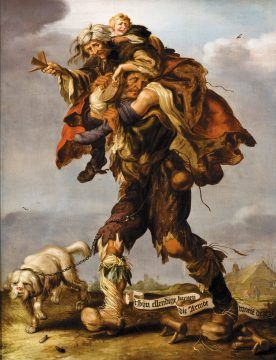
Adriaen van de Venne: Allegory of Poverty, 1630s

Recently, at a lunch with a group of graduate students, conversation turned to American colonial history, then to John Winthrop’s 1630 speech “A Modell of Christian Charity,” associated now with an image borrowed from Jesus, “a city on a hill.” This phrase has been grossly misinterpreted, both Winthrop’s use of it and Jesus’. In any case, the students pronounced the speech capitalist, with a certainty and unanimity that, quite frankly, is inappropriate to any historical subject, and would be, even if the students, or the teachers who gave them the word, could define “capitalist.” Because I encounter variants of this conversation in such settings all over the country, I should not be heard as criticizing any particular university when I say that such certainty is not the product of good education. Indeed, it is distinctively the product of bad education.

This characterization of Winthrop’s speech had the finality of a moral judgment, which is odd but, again, typical. For these purposes, capitalism is simply what America is and does and has always done and will do into any imaginable future. A dark stream of greed flows beneath its glittering surface, intermingling with its best works, its highest motives, and it is naive to think otherwise. Like the country itself, it is a rude, robust intrusion of unbridled self-interest upon a world whose traditional order was humane—in the best sense, civilized. Capitalism is, by these lights, original with and exclusive to us, except where Americanization has extended its long reach. This is believed so utterly that the fact that Marx was making his critique of the mature industrial/colonial economy of Britain is overlooked or forgotten.

more here.

Hacking Humans: Yuval Noah Harari Roundtable at the École polytechnique fédérale de Lausanne

Yuval Noah Harari speaks about human hackability and sits down for a conversation moderated by Leila Delarive: With Ken Roth (Executive Director of Human Rights Watch), Effy Vayena (professor of bioethics at ETH Zurich), and Jacques Dubochet (winner of the Nobel Prize for Chemistry) — accompanied by presentations from Grégoire Courtine (EPFL) and Jocelyne Bloch (CHUV), and Jamie Paik (EPFL).