
Helen Sullivan in The New York Times:
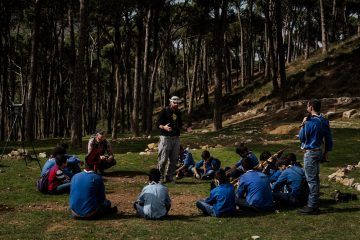 Mr. Serhal grew up in Lebanon but studied wildlife management at Oklahoma State University, graduating in 1982, at the height of the Lebanese civil war. His plan was to return and establish a hunting farm in Lebanon. But he abandoned it when, while using binoculars for the first time, he watched as a bobwhite quail hen — a game bird — ushered her chicks from bush to bush. “That gave me the shock of my life,” he said. His binoculars revealed a different way of viewing nature: “When you go to the field as a hunter with a gun, you don’t see the bird. The minute you flush it, you shoot.”
Watching the bobwhite mother protect her chicks, he thought: “I am a criminal.”
In 1990, Mr. Serhal completed a stint at the Brooklyn Zoo and, with Lebanon’s 15-year civil war ended, returned home. In 1996, he helped establish the Shouf Biosphere Reserve, Lebanon’s first national park. But after a few years, he felt the Shouf wasn’t working as well as it should. The American model, of land designated and protected by the government, had angered people in the surrounding villages, who had been free to use the area for as long as anyone could remember, to graze livestock and pick wild herbs. Mr. Serhal thought that, instead, hima might be accepted as a traditional concept; it also would include communities and municipalities in the design of the conservation areas. Hima wouldn’t be just about protecting nature, Mr. Serhal said; it would be “nature plus people.” When S.P.N.L. helped a community design a local hima, the group suggested additional conservation methods, like banning hunting. The first hima was established in southern Lebanon in 2004. Today there are 25; they have been given legal status by the government and cover more land than Lebanon’s national parks. Five of the designated hima are also what BirdLife calls “Important Bird Areas,” of which there are 15 in the country. Last year, Mr. Serhal was awarded Japan’s Midori Prize for Biodiversity, among the world’s most prestigious awards for conservation work.
More here.
 There are two very different essays I’ve been meaning to write, both of which equally merit the title of the present one.
 At a recent group meeting, my postdoc raised a question: “Should we make our theoretical model more complex so that our explanation of the data will not appear too trivial?” I was surprised by this suggestion and felt obligated to explain why. “Simplicity is a virtue,” I said, “not a deficiency. Excessive mathematical gymnastics is used to show off in branches of theoretical physics that have scarce experimental data. But as physicists, we should seek the simplest explanation for our data. This is the lifeblood of physics and the appropriate measure of success.”
 Early Friday morning, Qasem Soleimani, the head of the Iranian Revolutionary Guards Corps Quds Force, was
 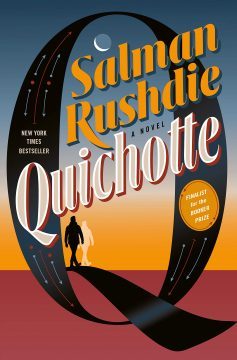 The story of Don Quixote never gets old. First published (Book One, that is) in 1605, Cervantes’s novel continually makes the list of the greatest books of all time, being the second most translated after the Bible. In 2002, the Norwegian Academy of Science and Letters asked a hundred authors across the world to name their choice for “best novel” of all time: Cervantes won in a landslide. Considered by many people to be “the first modern novel”, it is a story of a man’s search for truth. It is also hilariously funny. I was not surprised to learn that it is one of the most requested books by the inmates at Guantánamo.
 My mother had green eyes. Black hair. Her name was Marie Augustine Adeline Legrand. She was born a peasant, daughter of farmers, near Dunkirk. She had one sister and seven brothers. She went to teachers college, on a scholarship, and she taught in Dunkirk. The day after an inspection, the inspector who had visited her class asked for her hand in marriage. Love at first sight. They got married and left for Indochina. Between 1900 and 1903. A sort of commitment, adventure, a sort of desire, too, not for fortune but for success. They left like heroes, pioneers, they visited the schools in oxcarts, they brought everything, quills, paper, ink. They had succumbed to the posters of the era urging, as if they were soldiers: “Enlist.”
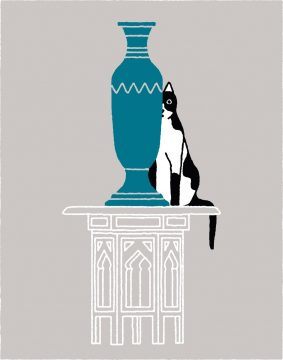 Nadira was living in Bahawalpur, in Pakistan. One day, she saw a cat on the window ledge of her room. It was looking into the room in a disquieting way, and she told the servant to get rid of the cat. He misunderstood and killed the poor creature. Not long after this, in a laundry basket near the window, Nadira found a tiny kitten who was so young that its eyes were still closed. She understood then that the poor creature that had been so casually killed was the mother of the little kitten, who was probably the last of the litter. She thought she should adopt him. The kitten slept in her bed, with Nadira and her two children. He received every attention that Nadira could think of. She knew very little about animals, and almost nothing about cats. She must have made mistakes, but the kitten, later the cat, repaid the devotion with extraordinary love. The cat appeared to know when Nadira was going to come back to the house. It just turned up, and it was an infallible sign that in a day or two Nadira herself would return. This happy relationship lasted for seven or eight years. Nadira decided then to leave the city and go and live in the desert. She took the cat with her, not knowing that a cat cannot easily change where it lives: all the extraordinary knowledge in its head, of friends and enemies and hiding places, built up over time, has to do with a particular place. A cat in a new setting is half helpless. So it turned out here.
 Jeremy Bernstein in Inference:
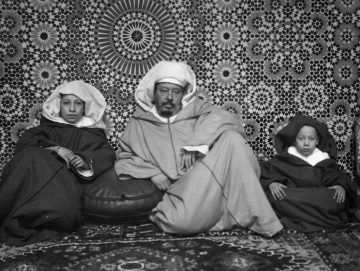 Adam Shatz over at the NYRB:
 C
C At a global financial services firm we worked with, a longtime customer accidentally submitted the same application file to two offices. Though the employees who reviewed the file were supposed to follow the same guidelines—and thus arrive at similar outcomes—the separate offices returned very different quotes. Taken aback, the customer gave the business to a competitor. From the point of view of the firm, employees in the same role should have been interchangeable, but in this case they were not. Unfortunately, this is a common problem.
 Antonia Malchik in Aeon:
 A “VISIONARY,” A “PROPHET,” A “MODERN-DAY LEONARDO”: Writers often resort to panegyrics when confronted with the eccentric, daunting intellect of Agnes Denes. Given the ambition of the octogenarian artist’s career, which spans fifty years and emerges from deep research into philosophy, mathematics, symbolic logic, and environmental science, it’s hard to fault them.
 I
I It’s astonishing that humans are expected to make our way in the world with language alone. “To speak is an incomparable act / of faith,” the poet Craig Morgan Teicher has written. “What proof do we have / that when I say mouse, you do not think / of a stop sign?”