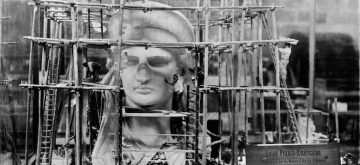
Not my prayer
Not my prayer but
the daffodils’ for sun and bees intoning
in such numbers their fevered mantra
of the morning
not mine but the thousand
prayers of tuna sleek
and silver bursting through the ocean
breach in fear of no net
nor mine the prayers
of dozing lions on the safe road
warming their heaving bodies
sans the unmistakable
scent of hunting humans
all the unkilled bear
deer and song-dog orisons
breathed on roads suddenly still
no speed-of-headlight
death hurtling at them now
all the birdsong more varied
more prayerful than ever
with the chattering of finches common
to our hearing woven
through the calls of species thought
too shy too rare to venture near but here
they are
all the open hemisphere of sky once azure
now azure once again a blue
too blue to fathom except as earth’s
petition for just another day
without us
all prayers theirs
for a break from history from this
cult of progress from the unstoppable
momentum of human toil from all this doing and making
from the churning madness of us
praying for a world precipitously devoid
of us long enough for us to grasp
how to their uncomprehending senses
we are the virus itself.
by Octavio Solis
from 3ViewsTheater
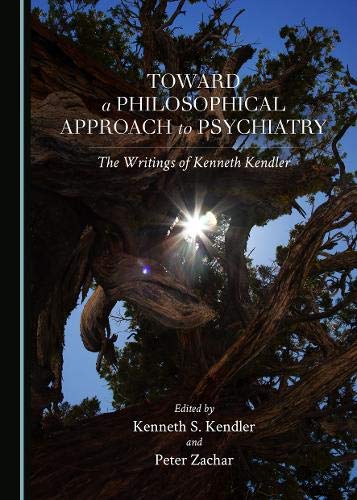 There continues to be an impressive appetite for conceptual and philosophical explorations of psychiatry. The publishing field is now populated by a diverse array of backgrounds and perspectives. The general public seems mostly interested in decrying the medicalization of normal and the transformation of our woes into neatly packaged mental disorders. The academic literature is dominated by philosophers and philosophically-trained professionals; while the intellectual discourse is of high caliber, it unfortunately remains largely inaccessible to mental health professionals and much of the general public, and resultantly it has had little influence outside the academic community. There is also a cohort of individuals with a critical interest in the subject but whose philosophical focus remains stuck on classical critical figures such as Thomas Szasz, Michel Foucault and R.D. Laing, with little engagement with contemporary philosophy of science. The philosophical work of Kenneth Kendler and his various collaborators (John Campbell, Carl Craver, Kenneth Schaffner, Erik Engstrom, Rodrigo Munoz, George Murphy, and Peter Zachar) assembled in a specially curated volume occupies a unique and special position in this contemporary landscape and there is much to be said in its favor.
 What would become known as the CARES Act
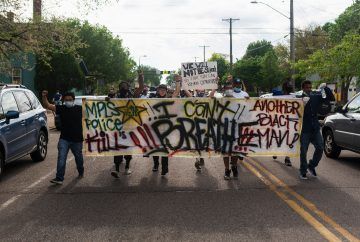 Two incidents separated by twelve hours and twelve hundred miles have taken on the appearance of the control and the variable in a grotesque experiment about race in America. On Monday morning, in New York City’s Central Park, a white woman named Amy Cooper called 911 and told the dispatcher that an African-American man was threatening her. The man she was talking about, Christian Cooper, who is no relation, filmed the call on his phone. They were in the Ramble, a part of the park favored by bird-watchers, including Christian Cooper, and he had simply requested that she leash her dog—something that is required in the area. In the video, before making the call, Ms. Cooper warns Mr. Cooper that she is “going to tell them there’s an African-American man threatening my life.” Her needless inclusion of the race of the man she fears serves only to summon the ancient impulse to protect white womanhood from the threats posed by black men. For anyone with a long enough memory or a recent enough viewing of the series “
 As many countries emerge from lockdowns, researchers are poised to use genome sequencing to avoid an expected second wave of COVID-19 infections. Since the first whole-genome sequence of the new coronavirus, SARS-CoV-2, was
 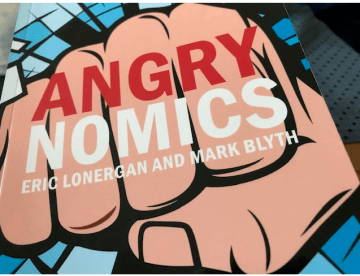 The combined total of inflation and unemployment used to be known as the “misery index”: Jimmy Carter cited it when he was campaigning in 1976 against Gerald Ford for the presidency. But the index was even higher in 1980, dooming Carter’s re-election bid. Barack Obama reduced the misery index during his two terms of office; indeed of all the Presidents since 1945, only Harry Truman left office with a lower misery index. But that didn’t seem to make voters happy; although Hillary Clinton (Obama’s party successor) won the popular vote, Donald Trump took enough key states to be elected. Similarly in 2016, British inflation was low and unemployment had been falling for years, yet voter anger resulted in Britain voting to leave the EU.
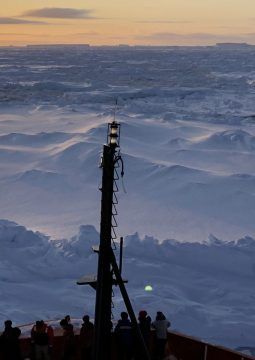 Julia Wellner and other crew members for this year’s Thwaites Glacier Offshore Research Project stepped onto the deck of the research vessel/icebreaker (RV/IB) Nathaniel B. Palmer in January, leaving from a crowded pier in Punta Arenas, Chile, and sailing to west coast of Antarctica.
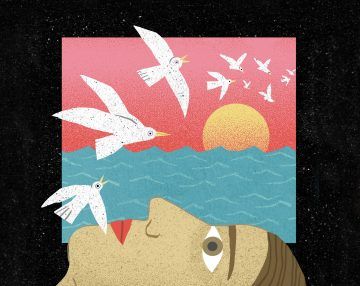 When in mid-March “
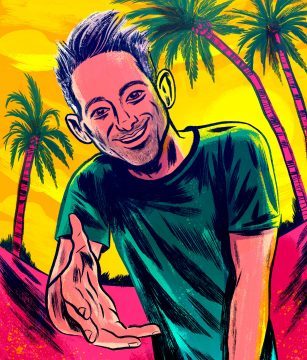 Adam Horovitz was born in Manhattan, in 1966, and raised there by his mother, the artist Doris Keefe. His father, the playwright Israel Horovitz, left the family in 1969. New York in the seventies was wild and lawless, which suited a young person searching for a tribe. As a teen-ager, Horovitz played in a New York punk band called the Young and the Useless. There was no imaginable future in music for him. It was just a way to pass the time, an excuse to hang out and meet people who were into the same things as he was. The Young and the Useless would often play shows with another punk band called the Beastie Boys, which consisted at the time of Horovitz’s friends Adam Yauch, Michael Diamond, John Berry, and Kate Schellenbach. In 1982, as the Beastie Boys were moving from punk to hip-hop, Berry left the band, and Horovitz, who was sixteen, replaced him. A couple of years later, they asked Schellenbach to leave, as they pursued, in Horovitz’s words, a new “tough-rapper-guy identity.”
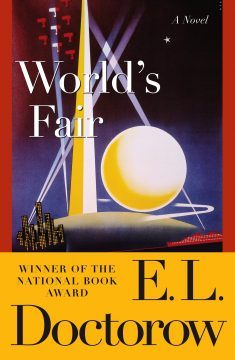 Doctorow was named after Edgar Allan Poe, who in 1846 rented a farmhand’s shingled cottage in the Bronx for $100 a year. He moved in with his young wife, Virginia, and her mother, Maria Clemm, who was Poe’s aunt. Virginia had late-stage tuberculosis and the trio had picked the Bronx for its clean air; it was also judiciously removed from the literary squabbles that swirled around Poe, as well as from the sites of his heroic drinking binges. The homestead, in what is now Fordham, was thirteen miles from the centre of New York on the New York and Harlem Railroad. Trains departed three times a day from Williams Bridge to City Hall.