
A talk Sam Bowles and Wendy Carlin over at the Santa Fe Institute:
Category: Recommended Reading
John Lewis (1940 – 2020)
Eddie Gale (1941 – 2020)
Judy Dyble (1949 – 2020)
Saturday, July 18, 2020
The Keynesian Revolution
 Jonathan Kirschner in Boston Review:
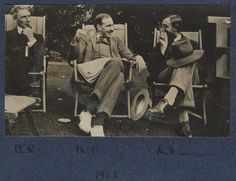
On September 9, 1938, John Maynard Keynes, fifty-five years old and the most famous economist in the world, read his essay “My Early Beliefs” to the Memoir Club, a circle of Bloomsbury Group friends who gathered occasionally to discuss the private reflections of its members. Keynes took the opportunity to revisit the philosophical principles of his confidants in the youthful exuberance of their twenties, “our mental history in the dozen years before” World War I. The rich, dazzling memoir, published posthumously at Keynes’s request (and subsequently included in his Essays in Biography), is well described by biographer Robert Skidelsky as “a key document for understanding his life’s work.”
The Keynes of “My Early Beliefs” was no longer a young man; recovering from a major heart attack, he read to the group reclining on a sofa to conserve his energy. Moreover, 1938 was not 1910; the intervening decades, shattering a long period of peace and prosperity, were characterized by war, disorder, and depression. Armed with this melancholy hindsight, Keynes would chastise his youthful cohort: “as the years wore on towards 1914, the thinness and superficiality, as well as the falsity of our view of man’s heart became, it now seems to me, more obvious.” And as the Memoir Club assembled that evening, German troops were massed on the Czechoslovakian border, and Neville Chamberlain would soon climb aboard an airplane for the first time in his life, that he might reason with Adolph Hitler. This context surely informed Keynes’s retrospective lament, “we were not aware that civilisation was a thin and precarious crust” layered atop a cauldron of horrors simmering just below the surface.
More here.
The Dollar and Empire
 Herman Mark Schwartz in Phenomenal World:
What does the US dollar’s continued dominance in the global monetary and financial systems mean for geo-economic and geo-political power? In a recent article, Yakov Feygin and Dominik Leusder question whether the United States actually enjoys an “exorbitant privilege” from the global use of the USD as the default currency for foreign exchange reserves, trade invoicing, and cross-border lending. Like Michael Pettis, they argue that the dollar’s primacy actually imposes an exorbitant burden through its differential costs on the US population.
Global use of the dollar largely benefits the top 1 percent of wealth holders in the United States, while imposing job losses and weak wage growth on much of the rest of the country. This situation flows from the structural requirements involved in having a given currency work as international money. As Randall Germain and I have argued in various venues, a country issuing a globally dominant currency necessarily runs a current account deficit.1 Prolonged current account deficits erode the domestic manufacturing base. And as current account deficits are funded by issuing various kinds of liabilities to the outside world, they necessarily involve a build-up of debt and other claims on US firms and households.
A large share of those foreign claims are on US firms in the form of corporate equity. US holdings of foreign firms’ equity are roughly equal in size, but these are largely held by the top 1 percent. The bulk of US debt to the rest of the world is public and private debt, including securitized mortgages. As the top 1 percent largely avoid taxation, the broad US public is on the hook for those debts. The rich reap the rewards of dollar dominance in the form of financial rents and easier tax avoidance. Meanwhile, the rest of us compete against artificially cheap low wage imports while struggling to find affordable housing.
More here.
Was This Ancient Taoist the First Philosopher of Disability?
 John Altmann and Bryan W. Van Norden in the NYT:
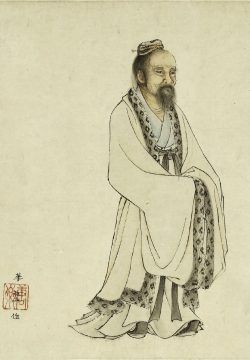
In one of his philosophical parables, the Taoist philosopher Zhuangzi (fourth century B.C.) describes a man he calls Splay-limb Shu. This man’s “chin is sunk in his belly,” Zhuangzi writes. “His shoulders are above his head, and pinched together so they point to the sky. His five organs are on top, his thighs tight against his ribs.” In Zhuangzi’s era as in our own, most people would consider Splay-limb Shu to be unfortunate.
But Zhuangzi, whose work frequently challenged society’s norms, sees things differently. He notes, for instance, that Shu is in no danger of being conscripted into the military or pressed into forced labor. Instead, he lives contentedly in his community, supporting himself by “plying a needle and taking in laundry.” Shu, Zhuangzi concludes, is “able to keep himself alive and to live out the years Heaven gave him” precisely because he is different from others.
Even today, this insight is striking. Zhuangzi poses the idea that Shu’s difference — one we would classify today as a disability — is not a misfortune, and in doing so challenges an assumption that has existed in cultures of all kinds for millenniums.
More here.
The Virtue in Violence
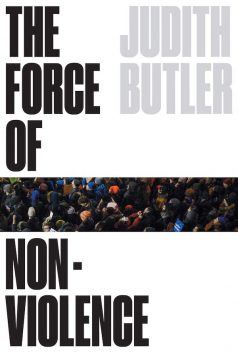 Faisal Devji reviews Judith Butler’s The Force of Nonviolence, in the LA Review of Books:
NONVIOLENCE, CLAIMS JUDITH BUTLER, echoing the views of virtually all its theorists and practitioners, is neither a virtue born out of weakness nor an unrealistic ideal, but something that exists even in the exertion of force. As M. K. Gandhi put it in his commentary on the Mahabharata, evil depends on goodness, since even an army deployed for the most sinister purpose must rely upon the courage, friendship, loyalty, and sacrifice of its troops for one another more than on the war’s ostensible cause. Violence, then, arises from evil’s failure to master its own instruments, and therefore from virtue itself, which must withdraw from evil to enable its collapse in a process the Mahatma called “noncooperation.” Butler’s book addresses the problem posed by the intertwined character of violence and nonviolence.
For Butler, however, violence is linked to nonviolence by the fact that they must both deploy force, which therefore needs to be appropriated in such a way as to ensure its dedication to nonviolence defined by a focus on the equality or “grievability” of all lives. The importance of force as a morally ambiguous category is clear both from the way it appears as a paradox in her book’s title, The Force of Nonviolence, as well as in Butler’s references to Jacques Derrida’s essay on Walter Benjamin, “Force of Law,” and, indeed, the latter’s own essay on the “Critique of Violence,” to which this in turn refers. But the genealogy produced by this predictable play of cross-references, nicely described by the English phrase “going up one’s own arse,” should give us pause for thought.
More here.
John Lewis’s Legacy and America’s Redemption
David Remnick in The New Yorker:
 John Robert Lewis was born in 1940 near the Black Belt town of Troy, Alabama. His parents were sharecroppers, and he grew up spending Sundays with a great-grandfather who was born into slavery, and hearing about the lynchings of Black men and women that were still a commonplace in the region. When Lewis was a few months old, the manager of a chicken farm named Jesse Thornton was lynched about twenty miles down the road, in the town of Luverne. His offense was referring to a police officer by his first name, not as “Mister.” A mob pursued Thornton, stoned and shot him, then dumped his body in a swamp; it was found, a week later, surrounded by vultures.
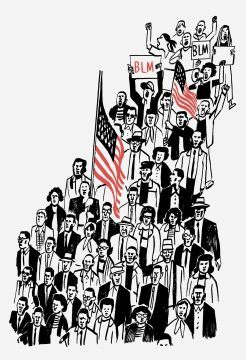
These stories, and the realities of Jim Crow-era segregation, prompted Lewis to become an American dissident. Steeped in the teachings of his church and the radio sermons of Martin Luther King, Jr., he left home for Nashville, to study theology and the tactics of nonviolent resistance. King teased him as “the boy from Troy,” the youngest face at the forefront of the movement. In a long career as an activist, Lewis was arrested forty-five times and beaten repeatedly by the police and by white supremacists, most famously in Selma, on March 7, 1965—Bloody Sunday—when he helped lead six hundred people marching for voting rights. After they had peacefully crossed a bridge, Alabama troopers attacked, using tear gas, clubs, and bullwhips. Within moments of their charge, Lewis lay unconscious, his skull fractured. He later said, “I thought I was going to die.
Too often in this country, seeming progress is derailed, reversed, or overwhelmed. Bloody Sunday led directly to the passage of the Voting Rights Act––and yet suppressing the Black vote is a pillar of today’s Republican Party strategy. The election of the first African-American President was followed by a bigot running for election, and now reëlection, on a platform of racism and resentment.
More here.
Saturday Poem
—after Neil deGrasse Tyson, black astrophysicist & director of the Hayden Planetarium, born in 1958, New York City. In his youth, deGrasse Tyson was confronted by police on more than one occasion when he was on his way to study stars.
The Black Maria
The Skyview apartments
…………. circa 1973, a boy is
kneeling on the rooftop, a boy who
…………. (it is important
to mention here his skin
…………. is brown) prepares his telescope,
the weights & rods,
…………. to better see the moon. His neighbor
(it is important to mention here
…………. that she is white) calls the police
because she suspects the brown boy
…………. of something, she does not know
what at first, then turns,
…………. with her white looking,
his telescope into a gun,
…………. his duffel into a bag of objects
thieved from the neighbors’ houses
…………. (maybe even hers) & the police
(it is important to mention
…………. that statistically they
are also white) arrive to find
…………. the boy who has been turned, by now,
into “the suspect,” on the roof
…………. with a long, black lens, which is,
in the neighbor’s mind, a weapon &
…………. depending on who you are, reading this,
you know that the boy is in grave danger,
…………. & you might have known
somewhere quiet in your gut,
…………. you might have worried for him
in the white space between lines 5 & 6,
…………. or maybe even earlier, & you might be holding
your breath for him right now
…………. because you know this story,
it’s a true story, though,
…………. miraculously, in this version
of the story anyway,
…………. the boy on the roof of the Skyview lives
Read more »
Shakespeare Lost His Son to Plague. A Novel Asks How It Shaped His Art
Geraldine Brooks in The New York Times:
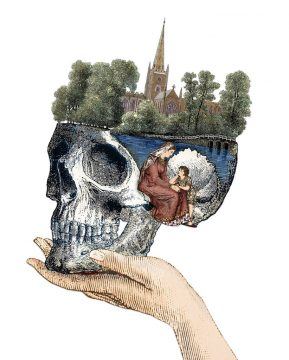 “Hamnet” is an exploration of marriage and grief written into the silent opacities of a life that is at once extremely famous and profoundly obscure. Countless scholars have combed through Elizabethan England’s parish and court records looking for traces of William Shakespeare. But what we know for sure, if set down unvarnished by learned and often fascinating speculation, would barely make a slender monograph. As William Styron once wrote, the historical novelist works best when fed on short rations. The rations at Maggie O’Farrell’s disposal are scant but tasty, just the kind of morsels to nourish an empathetic imagination. We know, for instance, that at the age of 18, Shakespeare married a woman named Anne or Agnes Hathaway, who was 26 and three months pregnant. (That condition wasn’t unusual for the time: Studies of marriage and baptism records reveal that as many as one-third of brides went to the altar pregnant.) Hathaway was the orphaned daughter of a farmer near Stratford-upon-Avon who had bequeathed her a dowry. This status gave her more latitude than many women of her time, who relied on paternal permission in choosing a mate.
Shakespeare was a grammar school graduate, the eldest son of a glove maker in declining fortune. His father had once been the equivalent of Stratford’s mayor, but by the time his son was 18, he had fallen into debt, disrepute and legal opprobrium.
More here.
Friday, July 17, 2020
Drinking Alone: Real Solidarity Is Harder Than It Looks
Jonathan Malesic in Commonweal:
 One night in August 2005, just after I’d moved to Wilkes-Barre, Pennsylvania, for a job as a theology professor, I needed beer. To get to the distributor, I drove over a concrete bridge, its four pylons etched with words like “Perseverance” and “Industry” and topped by monumental eagles. Once there, I wandered through the pallets of warm cases trying to find a thirty-pack of PBR until the thin, gruff man behind the counter asked what I was looking for. I told him, he pointed to the right pallet, and I met him at the register.
He asked for ID, and I showed him my Virginia license. He looked me in the eye. “I figured you had to be out of state,” he said as he handed it back. “The young people around here don’t drink Pabst.” I told him they did in Virginia. I didn’t tell him it was because hipsters fetishized white working-class culture. I mentioned instead that I’d just moved here. “Oh yeah? For good?” “Yeah.” “That’s too bad. You should go back. Welcome to one of the worst drug havens in the country.”
I told him I’d heard of the local drug problem. He then expanded upon his point, and began riffing on racist and misogynist themes. He told me there was no nightlife in town because the cops were always out waiting to nab you after you left the bar and tried to drive home. I stood impassively at the counter, hoping his rant would burn out if I didn’t feed it with dialogue.
More here.
America Should Prepare for a Double Pandemic
Ed Yong in The Atlantic:
 Seven years ago, the White House was bracing itself for not one pandemic, but two. In the spring of 2013, several people in China fell sick with a new and lethal strain of H7N9 bird flu, while an outbreak of MERS—a disease caused by a coronavirus—had spread from Saudi Arabia to several other countries. “We were dealing with the potential for both of those things to become a pandemic,” says Beth Cameron, who was on the National Security Council at the time.
Neither did, thankfully, but we shouldn’t mistake historical luck for future security. Viruses aren’t sporting. They will not refrain from kicking you just because another virus has already knocked you to the floor. And pandemics are capricious. Despite a lot of research, “we haven’t found a way to predict when a new one will arrive,” says Nídia Trovão, a virologist at the National Institutes of Health. As new diseases emerge at a quickening pace, the only certainty is that pandemics are inevitable. So it is only a matter of time before two emerge at once.
“We have to prepare for a pandemic to happen at any time, and ‘any time’ can be when we’re already dealing with one pandemic,” Cameron told me.
More here.
Ravi Shavi’s new song: “Casino”
RAVI SHAVI “CASINO” OFFICIAL from Robert Houllahan on Vimeo.
Full album available here.
Joseph Stiglitz: Are We Overreacting on Climate Change?
Joseph E. Stiglitz in the New York Times:
 The thesis of Bjorn Lomborg’s “False Alarm” is simple and simplistic: Activists have been sounding a false alarm about the dangers of climate change. If we listen to them, Lomborg says, we will waste trillions of dollars, achieve little and the poor will suffer the most. Science has provided a way to carefully balance costs and benefits, if we would only listen to its clarion call. And, of course, the villain in this “false alarm,” the boogeyman for all of society’s ills, is the hyperventilating media. Lomborg doesn’t use the term “fake news,” but it’s there if you read between the lines.
As with others in Lomborg’s camp, there’s the pretense in this book of balance and reference to careful studies. Yes, climate change is real. Yes, we should do something about it. But, goes his message, let’s be real, there are other problems, too. Resources are scarce. The more money we spend on climate change, the less we have to grow the economy; and as we all know (or do we?) everybody benefits from growth, especially the poor. And besides, there’s not much we can do about climate change.
More here.
Alan Turing’s Lost Radio Broadcast Rerecorded
Turing and the Uncomputable
Algis Valiunas at The New Atlantis:
 The integrity of his understanding mattered immensely to the emerging mathematician. Even as an undergraduate Turing was known for remaining oblivious of the published literature and figuring out his own method of conceiving proofs. After faltering academically in the early going, he demonstrated his supreme competence in his final exams in 1934, being designated a B-star Wrangler — Cantabrigian parlance for a hotshot. In 1935 he presented a dissertation, “On the Gaussian Error Function.” In it he included his proof of the central limit theorem, which explained the way measurements fall into place to produce the statistical bell curve. Although someone else had already proved the theorem more than a decade before, Turing’s version was sufficiently novel and elegant to impress the authorities, and King’s named him a Fellow at the startling age of twenty-two. Admirers celebrated his achievement with an ambiguous morsel of verse: “Turing / Must have been alluring / To get made a don / So early on.”
more here.
The Two Last Suppers
Jerry Saltz at New York Magazine:
 This isn’t a style of the Church, Italy, a patron, or a doctrine. It’s a personal style, the work of a self-taught 40-something gay man who devised ways to dye one’s hair blond as well as build bridges. Art history has been going through regular stylistic shifts ever since. This is what a social revolution looks like.
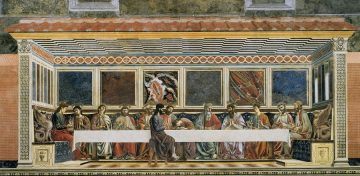
This brings us to Castagno’s marvelous Last Supper, a Middle Renaissance masterpiece. This huge beauty covers one wall in the Florence refectory of the Benedictine nuns of Saint Apollonia. The space isn’t rhythmic, cinematic, naturalistic, breathing, or real. It’s a wildly exciting mix of Byzantine with forced geometric perspective, exaggerated horizontality, metaphysical symbolism, finicky late medievalism, spiritualism, and episodic herky-jerkiness. It shows us what Last Suppers used to look like: Each disciple might be given particular attributes to universalize them and make them recognizable; they might hold certain objects, follow established iconographic or pictorial programs, pose in specific ways.
more here.
Friday Poem
Charaxos and Larichos
Say what you like about Charaxos,
that’s a fellow with a fat-bellied ship
always in some port or other.
What does Zeus care, or the rest of his gang?
Now you’d like me on my knees,
crying out to Hera, “Blah, blah, blah,
bring him home safe and free of warts,”
or blubbering, “Wah, wah, wah, thank you,
thank you, for curing my liver condition.”
Good grief, gods do what they like.
They call down hurricanes with a whisper
or send off a tsunami the way you would a love letter.
If they have a whim, they make some henchmen
fix it up, like those idiots in the Iliad.
A puff of smoke, a little fog, away goes the hero,
it’s happily ever after. As for Larichos,
that lay-a-bed lives for the pillow. If for once
he’d get off his ass, he might make something of himself.
Then from that reeking sewer of my life
I might haul up a bucket of spring water.
by Sappho
from Poetry, July/August 2016
Translated from the Greek by William Logan
How the first Americans made their way from Siberia to Patagonia
Gillen D’Arcy Wood in Nautilus:
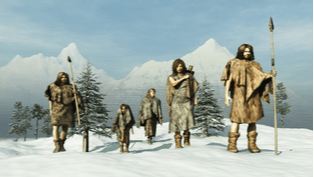 In the summer of 1977, on a field trip in northern Patagonia, the American archaeologist Tom Dillehay made a stunning discovery. Digging by a creek in a nondescript scrubland called Monte Verde, in southern Chile, he came upon the remains of an ancient camp. A full excavation uncovered the trace wooden foundations of no fewer than 12 huts, plus one larger structure designed for tool manufacture and perhaps as an infirmary. In the large hut, Dillehay found gnawed bones, spear points, grinding tools and, hauntingly, a human footprint in the sand. The ancestral Patagonians—inhabitants of Tierra del Fuego and the Magellan Straits—had erected their domestic quarters using branches from the beech trees of a long-gone temperate forest, then covered them with the hides of vanished ice age species, including mastodons, saber-toothed cats, and giant sloths.
Fire pits indicated where the Monte Verdeans cooked their food. Grinding stones helped fashion their spear points for hunting while, scattered on the excavated floor of the large hut, Dillehay uncovered the fossilized remains of more than 20 medicinal plants, including a species of giant kelp, Durvillaea antarctica. The species was discovered in the 1830s by explorer Jules-Sébastien Dumont D’Urville, who identified the indigenous giant seaweed during the first of his three Southern Ocean voyages on the beaches of the Falkland Islands, east of Tierra del Fuego. Because seaweed is short-lived, the Durvillaea fossil provided the most precise available date for human occupation of the site. Radiocarbon analysis of charcoal, worked wooden artifacts, and the leftover bones of a mastodon meal confirmed the presence of ice age hunter-gatherers at Monte Verde 14,500 years ago, at least 1,000 years prior to any existing archaeological evidence for human colonization of the Americas, North or South.
During his Beagle voyage into the south Atlantic Ocean in the 1830s, Charles Darwin wondered how the Patagonians had come to venture so far south, into sub-polar cold.
More here.