https://www.youtube.com/watch?v=JBqrlgZXZXk&feature=emb_logo

https://www.youtube.com/watch?v=JBqrlgZXZXk&feature=emb_logo
Cam Scott at Music and Literature:
 A certain mythology has gathered around the thirty-five year hiatus that followed Coursil’s incredibly fruitful period of musical cosmopolitanism. There is a romantic obscurity to the way in which jazz fans discuss the career interruptions of their favorite players, mistaking hard times and financial exigencies for semi-monastic trials of spirit. A prime example would be Sonny Rollins, who retreated into a prolonged rehearsal session at the height of his fame, practicing all hours on the Williamsburg bridge and bearing solitary witness to the city; or Dexter Gordon, whose incarceration in the fifties secured his reputation as the perennial ambassador of bebop, and an intercontinental comeback kid. Other disappearances are far more lacunar and prolonged, such as that of sought-after bassist Henry Grimes, who devoted himself to poetry and literature during a decades-long stint in the workaday world, only to emerge with startling vigor in the early twenty-first century.
Coursil’s willful abstention from recording was in service to a scholarly path.
more here.
Jack Beatty at Lapham’s Quarterly:
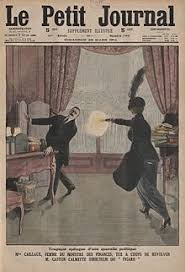 Of the millions of bullets fired in 1914, only two changed history: the bullet fired on June 28 in Sarajevo by Gavrilo Princip’s Browning automatic that killed Archduke Franz Ferdinand, and the bullet fired on March 16 in Paris by Henriette Caillaux that killed Gaston Calmette. As premier in 1911, her husband had by back-channel negotiations defused a war-charged crisis with Germany, grounds for believing he could have worked his magic again three years later, when he would have all but certainly been elected premier again—but for the bark of Henriette’s Browning. Months before the war, anticipating that Caillaux, then the finance minister, would soon be premier, Belgium’s ambassador to Paris assured Brussels: “Caillaux’s presence in power will lessen the acuteness of international jealousies and will constitute a better base for relations between France and Germany.” That was heresy in “official Paris,” where “everybody that you meet tells you that an early war with Germany is certain and inevitable.” Months into the war, the Kölnische Zeitung stated, “If Monsieur Caillaux had remained in office, if Madame Caillaux’s gesture had not been made, the plot against the peace of Europe would not have succeeded.”
more here.
Amit Chaudhuri in the TLS:
 To include the Upanishads and the Bhagavad Gita in a series called “Footnotes to Plato” may seem odd for many reasons – some obvious, some less so. But to address the oddity is invigorating, and offers a way of considering the necessity of placing these works in the wider discussion, as well as the historical and conceptual impediments to doing so.
Among the impediments is a logistical one which reveals how, in the West, value and significance are attributed according to certain classificatory norms and not others. I don’t mean the “canon”; I’m referring to a more basic category: authorship. “Footnotes to Plato” (like Western philosophy), is, generally, as much about the philosophers as it is about the philosophy. In fact, the field of knowledge called “the history of Western philosophy” could just as easily be called “the history of Western philosophers”, inasmuch as Western philosophers are the sum total of their lives and works, and we often defer to both biography and thought when we interact with the philosophy. Each body of work has a personality, but so does its author; in almost every case, we can, literally, put a “face” to the work, whether that’s a photograph of Bertrand Russell or a fourth-century BC bust of Plato.
What do we do with a philosophy when there’s no philosopher in sight?
More here.
Debraj Ray and S. Subramanian in the Boston Review:
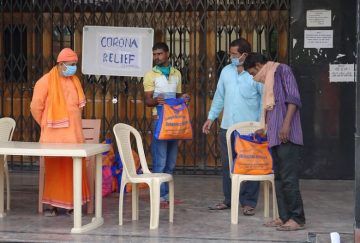 It has been just over five months since the first case of COVID-19 was detected in India. With nearly a million confirmed cases, the country now has the third greatest number of infections, behind only the United States and Brazil. At least 25,000 people have died.
The outbreak began, as it did elsewhere, with an isolated case—a student at Wuhan University who had returned to Kerala in late January. Before long the infection had moved into community transmission, with over 1,000 confirmed reports by the end of March. But in the central government’s scheme of priorities, COVID-19 was initially swamped by other preoccupations: Assembly elections in Delhi, murderous communal atrocities in the aftermath of a profoundly provocative Citizenship Amendment Act passed last year, Donald Trump’s visit to India in late February, and the politics of regime change in the state of Madhya Pradesh.
More here.
James L. Gibson and Joseph L. Sutherland at SSRN:
Over the course of the period from the heyday of McCarthyism to the present, the percentage of the American people not feeling free to express their views has tripled. In 2019, fully four in ten Americans engaged in self-censorship. Our analyses of both over-time and cross-sectional variability provide several insights into why people keep their mouths shut. We find that:
(1) Levels of self-censorship are related to affective polarization among the mass public, but not via an “echo chamber” effect because greater polarization is associated with more self-censorship.
(2) Levels of mass political intolerance bear no relationship to self-censorship, either at the macro- or micro-levels.
(3) Those who perceive a more repressive government are only slightly more likely to engage in self-censorship. And
(4) those possessing more resources (e.g., higher levels of education) report engaging in more self-censorship.
Together, these findings suggest the conclusion that one’s larger macro-environment has little to do with self-censorship. Instead, micro-environment sentiments — such as worrying that expressing unpopular views will isolate and alienate people from their friends, family, and neighbors — seem to drive self-censorship. We conclude with a brief discussion of the significance of our findings for larger democracy theory and practice.
More here.
Emily Tamkin in New Statesman:
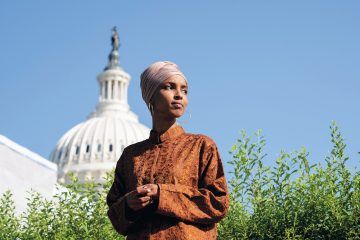 This is not the usual bland political memoir offering yet another story of finding the American dream. In part, this is because Ilhan Omar is not another dull politician. That much is obvious from the waves she has made in Washington, DC since becoming a member of Congress in 2019. Omar, from Minnesota, and Rashida Tlaib, from Michigan, are the first two Muslim women elected to Congress. Along with two other women of colour, who are also in their first term, Alexandria Ocasio-Cortez and Ayanna Pressley, they are known as “the squad”. The 181-year-old ban on wearing religious head-wear in the House chamber was changed in 2019, allowing Omar to wear her hijab on the floor of Congress. While running for Congress, Omar admits, she was worried that this rule would keep her from being able to serve.
Omar quickly gained attention for her progressive stances, aggressive questioning of foreign policy hawks, and contentious statements on Israel (she apologised for one of these comments, a 2019 tweet that suggested Republican support for Israel was “all about the Benjamins, baby” – ie, financially motivated). And she has been relentlessly attacked from all sides, from the far right to the centre left. Donald Trump ranted about Omar in a rally in 2019, prompting the crowd to start chanting, “Send her back.” Omar was born in Mogadishu, Somalia, in 1982. She was the baby of the family; “a particularly tiny child” and a tomboy. She lost her mother at a very young age, but even so her family lived what sounds like a happy, chaotic but colourful life – until war came and they left for the US. Omar’s book gives an insight into one of the likely future leaders of Democratic politics. Some of the details are unexpected: I didn’t think the person, living or dead, she would choose to meet would be Margaret Thatcher: “Time and time again,” Omar writes, “she showed up in rooms filled with men and didn’t have to do much to lead them to decide that she should be in charge.”
More here.
Kevin Berger in Nautilus:
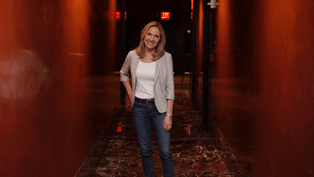 Helen Fisher first appeared in Nautilus in 2015 with her article, “Casual Sex May Be Improving America’s Marriages.” Since then we’ve interviewed the biological anthropologist a host of times, anxious to hear her insights into the ties that bind and fray. Fisher made her name in popular science in 1992 with her book, Anatomy of Love, tracing the evolution of love from prehistoric to neuroscientific times. She’s the author of other books including Why Him? Why Her? Today she’s a senior research fellow at the Kinsey Institute and chief scientific advisor to Match.com.
Fisher’s research has found its way into many articles and books about the science of love and sex, including Love Drugs, a provocative new book by Brian D. Earl and Julian Savulescu, also featured this week in Nautilus. We could hardly create a Nautilus issue about love and sex without her voice. Her comments below represent her key points about the biology of love and sex, and are often counterintuitive and surprising. They are drawn from my interviews with her and presented on their own under short headings.
I Love You, Doctor
We put over 100 people who were madly in love into a brain scanner using fMRI. We noticed those who had fallen in love in the first eight months had a lot of activity in brain regions linked with intense feelings of romantic love. Those who had been madly in love for a longer period of time—from eight to 17 months—showed additional activity in a brain region linked with feelings of deep attachment. That vividly showed us the brain can easily fall happily and madly in love rapidly, but feelings of deep attachment take time. Romantic love is like a sleeping cat: It can be awakened at any time. But attachment, those feelings of cosmic, deep, profound love for another person, takes time.
More here.
 Andrew Gelman over at his website:
Tyler Cowen writes:
Avoid criticizing other public intellectuals. In fact, avoid the negative as much as possible. However pressing a social or economic issue may be, there is almost always a positive and constructive way to reframe your potential contribution. This also will force you to keep on thinking harder, because it is easier to take apparently justified negative slaps at the wrongdoers.
This is not my approach, so it might be worth exploring our differences here.
1. Most importantly, there’s division of labor, or the ecosystem. I think it’s good to have some writers who are positive and others who are negative. Each of us has our own style. If Cowen is comfortable being positive most of the time and that works for him, that’s cool.
2. Regarding my own negativity: one thing I’ve found is that often I will start from a positive, constructive perspective but then move to the negative after a series of frustrations.
For example, I thought the newspaper columnist David Brooks had some interesting insights regarding Bobos, Red and Blue America, etc., but I gradually got frustrated at his sloppiness and his refusal to correct his mistakes. Where do you draw the line between making a mistake and flat-out lying? I’m not sure.
This comes up a lot: the beauty-and-sex-ratio research, the Why We Sleep book, Pizzagate, ESP at Cornell, ovulation-and-clothing, etc etc etc. People make mistakes, we discuss these mistakes in a constructive way, and we reach escalating levels of frustration as the promulgators of these errors refuse to consider the possibility they may be wrong.
But that’s all background. Here’s my main point:
3. Negativity (when applied with rigor) requires more care than positivity.
More here.
 Daniel Steinmetz-Jenkins interviews Roberto Unger in The Nation:
ROBERTO MANGABEIRA UNGER: To grasp the meaning of this moment for the future of the country, it is useful to begin by distinguishing the immediate background—the failure of the established approach to racial injustice in the United States—from the larger context of which this failure forms a part: the disorientation of American progressives and the long-standing absence in American politics of any program responsive to the needs, interests, and aspirations of the working-class majority of the country, white or black.
The prevailing response to racial injustice in the United States has been the integrationist orthodoxy. It treats racial injustice as a threshold issue, to be addressed before all problems of economic equality and opportunity. Its signature expression is affirmative action. It has done little for those who most require protection, the vast number of black people who languish in prisons and dead-end jobs. This approach has offended the white working-class majority, who believe themselves to be victims of a conspiracy between sanctimonious white elites and the representatives of black workers. And it has provided a model for the identity politics that has addressed legitimate demands for respect and recognition only by diverting the country from engagement with its structural problems.
There is an alternative. The alternative is to distinguish individualized racial discrimination from the advancement of the unequipped, the excluded, and the impoverished.
More here.
 Sam Moyn over at the Quincy Institute:
Since September 11, 2001, American policy in matters of war has abandoned the restraints in the U.S. Constitution and international law, with grievous results not merely for wrongful victims of war (such as the abused captives in Guantánamo Bay or civilians killed in drone strikes) but also for those whom the laws governing how war is conducted were never devised to protect. In focusing exclusively on harms to abused captives and civilians killed as “collateral damage,” American debate has ignored a wider set of wrongs. These include the death and injury of fighters themselves on both sides, including long-term post-traumatic stress; the fate of populations under increasing surveillance and constant threat of force; and the enormous costs of an “endless war” footing that whole societies must bear. In the American case, these costs come to trillions of dollars.
With rare exceptions, debate has focused in the honorable but wrong place: on making the conduct of war less brutal and more plausibly legal.[1] In the later years of George W. Bush’s administration, the United States sought to make his war on terror more humane while lending it greater legitimacy; the harshest treatments of detainees, notably those fairly considered torture, were eliminated. The ironic result was that the war on terror endured. Endless war was elaborated during the presidency of Barack Obama, with its pivot away from heavy-footprint interventions to light– and no-footprint operations involving armed drones, standoff missiles, and special forces. Surprisingly, the same pattern has continued under President Donald Trump. His rhetoric of brutality and his contradictory promises to bring troops home notwithstanding, Trump has adopted no dramatically new methods while intensifying many of the conflicts he inherited.
More here.
 Sarah Stoller in Aeon:
Modern-day flexible work policies didn’t arise in a sudden moment of crisis, but from the slow burn of second-wave feminist activism. In the 1970s, even though growing numbers of women had entered the paid workforce, they continued to do a disproportionate share of the childcare and housework. In the consciousness-raising and campaign groups that cropped up in the US and Europe, women increasingly recognised that what felt ‘merely’ personal was, in fact, political. A new generation of activists pushed for changes in the structure and conditions of paid work. The idea was to render it more suited to the needs of workers with caring responsibilities and allow women of all backgrounds to participate in the economy on equal terms with men. Meanwhile, men would be urged to share more fully in maintaining home and family. Feminist activism for what we now call ‘flexibility’ was part of a vision for remaking communities and supporting the needs of workers as whole human beings. This is most apparent in the first-hand testimony of the women who dedicated their energies to reimagining paid work at a time when the 9-to-5, 40-hour working week was the near-universal model for professional success.
In the decades since feminists first challenged the structures governing paid work, the vision at the heart of their campaigning has been lost. While employers have adopted some feminist ideas for reforming the workplace, for the most part they’ve strategically bracketed the question of who ends up looking after the children. Ironically, piggybacking on feminists’ ideas about transforming paid work has done more to contribute to a 24/7 work culture than it has to opening up new options for women. Only by looking back at the earlier ideals that structured flexible employment policies can we recover a richer sense of what it might mean to imagine a future that works for us all.
More here.
 Hassina Mechaï over at the Verso blog:
It’s a truism that France is not the USA. But, it is also true that France is no exception to the racist inflammation whose fever presently boils over. We will have to examine this fever which irrupts and erupts over the body of a French society which is defined, a priori, as being without race.
In France, it is possible to be supremely racist, all the while affirming, hand on heart, that race does not exist. Race does not exist and yet, racism possesses weight, it injures and it kills. How so? What mystery and sleight-of-hand allows for both these statements which, in theory, seem impossible to combine? How can one suffer racism if the category of race, a mental and social categorisation which creates a division in the hierarchy of humanity, has not been attached to you, despite yourself? For these reasons, racism gets a bad press in France. It is erased from fundamental texts, condemned to the museum of history’s horrors.
Let’s break what is ‘unthought’ down into pieces and words that make sense. To words that capture the ‘unthinkable’ too. What is a ‘people’? If we stick to etymology, we arrive at the Latin idea of the populus. It’s simple – too simple. In Greek, the terminology is more complex, better able to discharge the notion of ‘belonging’ contained in the Latin. Firstly, we have the demos, the political unit of people; then the genos, those of common origin by birth. Finally, we have the ethnos: a people who have culture and customs in common. Otherwise known as the three ways of belonging to a social body: citizenship, nationality, identity. In France, everything is unified under the universal principle of citizenship. But here, in the French case, there is a hypothesis that needs unpicking: a slip has been made in order to encode in the ethnos all of the unequal theories and fantasies which were attached to the genos, a group claiming shared descent.
More here.
Sian Cain in The Guardian:
 When I think that it won’t hurt too much, I imagine the children I will not have. Would they be more like me or my partner? Would they have inherited my thatch of hair, our terrible eyesight? Mostly, a child is so abstract to me, living with high rent, student debt, no property and no room, that the absence barely registers. But sometimes I suddenly want a daughter with the same staggering intensity my father felt when he first cradled my tiny body in his big hands. I want to feel that reassuring weight, a reminder of the persistence of life.
Then I remember the numbers. If my baby were to be born today, they would be 10 years old when a quarter of the world’s insects could be gone, when 100 million children are expected to be suffering extreme food scarcity. My child would be 23 when 99% of coral reefs are set to experience severe bleaching. They would be 30 – my age now – when 200 million climate refugees will be roaming the world, when half of all species on Earth are predicted to be extinct in the wild. They would be 80 in 2100, when parts of Australia, Africa and the United States could be uninhabitable.
We are in the middle of a mass extinction, the first caused by a single species. There are 7.8 billion of us, on a planet that scientists estimate can support 1.5 billion humans living as the average US citizen does today. And we know that the biggest contribution any individual living in affluent nations can make is to not have children. According to one study, having one fewer child prevents 58.6 tonnes of carbon emissions every year; compare that with living car-free (2.4 tonnes), avoiding a transatlantic return flight (1.6), or eating a plant-based diet (0.82). Another study said it was almost 20 times more important than any other choice an environmentally minded individual could make. Such claims have been questioned. After all, does a parent really bear the burden of their child’s emissions? Won’t our individual emissions fall as technologies and lifestyles change? Isn’t measuring our individual carbon footprint – a concept popularised by oil and gas multinational BP – giving a free pass to the handful of corporate powers responsible for almost all carbon emissions? The only thing that isn’t up for debate is that we all know that we are living in ways that can’t continue.
More here.
Margot Harrison in The New York Times:
 In early April, at the height of the pandemic lockdown, Gianpiero Petriglieri, an Italian business professor, suggested on Twitter that being forced to conduct much of our lives online was making us sick. The constant video calls and Zoom meetings were draining us because they go against our brain’s need for boundaries: here versus not here. “It’s easier being in each other’s presence, or in each other’s absence,” he wrote, “than in the constant presence of each other’s absence.”
Petriglieri’s widely retweeted post reads like the germ of a horror tale. The liminal space between presence and absence, reality and unreality, is often where the literature of fear unfolds — a place called the “uncanny.” That old aesthetic term for creeping dread, famously dissected by Freud, is typically now applied to disturbing specimens of digital animation said to reside in the “uncanny valley.”
Screens and artificial intelligence have shown up regularly in the horror genre since the dawn of the personal computer. “Ghost in the machine” stories are so common that, when I submitted a proposal for a horror novel about technology, my editor warned me against deploying a malevolent A.I. as my antagonist. But it’s hard to find scary stories that depict how we become the ghosts in the machine. The anxiety we feel when our virtual connections outweigh our real ones is more often a subject for nonfiction, such as a 2018 New York Times article headlined “A Dark Consensus About Screens and Kids Begins to Emerge in Silicon Valley.” A quote in the piece from a Silicon Valley office worker — “I am convinced the devil lives in our phones” — has stuck with me like the tagline on a dog-eared vintage horror paperback.
Beauty is sexual, and sexuality
Is the fertility of the earth and the fertility
Of the earth is economics. Though he is no recommendation
For poets on the subject of finance,
I thought of him in the thick heat
Of the Bangkok night. Not more than fourteen, she saunters up to you
Outside the Shangri-la Hotel
And says, in plausible English,
“How about a party, big guy?”
Here is more or less how it works:
The World Bank arranges the credit and the dam
Floods three hundred villages, and the villagers find their way
To the city where their daughters melt into the teeming streets,
And the dam’s great turbines, beautifully tooled
In Lund or Dresden or Detroit, financed
By Lazeres Freres in Paris or the Morgan Bank in New York,
Enabled by judicious gifts from Bechtel of San Francisco
Or Halliburton of Houston to the local political elite,
Spun by the force of rushing water,
Have become hives of shimmering silver
And, down river, they throw that bluish throb of light
Across her cheekbones and her lovely skin.
by Robert Haas
from Time and Materials
Ecco Press, 2007