
From Phys.Org:
 Yale physicists have developed an error-correcting cat—a new device that combines the Schrödinger’s cat concept of superposition (a physical system existing in two states at once) with the ability to fix some of the trickiest errors in a quantum computation. It is Yale’s latest breakthrough in the effort to master and manipulate the physics necessary for a useful quantum computer: Correcting the stream of errors that crop up among fragile bits of quantum information, called qubits, while performing a task.
…In a traditional computer, information is encoded as either 0 or 1. The only errors that crop up during calculations are “bit-flips,” when a bit of information accidentally flips from 0 to 1 or vice versa. The way to correct it is by building in redundancy: using three “physical” bits of information to ensure one “effective”—or accurate—bit. In contrast, quantum information bits—qubits—are subject to both bit-flips and “phase-flips,” in which a qubit randomly flips between quantum superpositions (when two opposite states exist simultaneously).
Until now, quantum researchers have tried to fix errors by adding greater redundancy, requiring an abundance of physical qubits for each effective qubit. Enter the cat qubit—named for Schrödinger’s cat, the famous paradox used to illustrate the concept of superposition. The idea is that a cat is placed in a sealed box with a radioactive source and a poison that will be triggered if an atom of the radioactive substance decays. The superposition theory of quantum physics suggests that until someone opens the box, the cat is both alive and dead, a superposition of states. Opening the box to observe the cat causes it to abruptly change its quantum state randomly, forcing it to be either alive or dead. “Our work flows from a new idea. Why not use a clever way to encode information in a single physical system so that one type of error is directly suppressed?” Devoret asked. Unlike the multiple physical qubits needed to maintain one effective qubit, a single cat qubit can prevent phase flips all by itself. The cat qubit encodes an effective qubit into superpositions of two states within a single electronic circuit—in this case a superconducting microwave resonator whose oscillations correspond to the two states of the cat qubit.
More here.
 The far left of the Democratic Party spent much of the primary attacking Kamala Harris, decrying her as an
  His work was substantial, his opinions horrendous, his reputation a battleground. It was February 1949 and the Fellows in American Letters of the Library of Congress had decided to award the inaugural Bollingen Prize for Poetry to Ezra Pound for The Pisan Cantos. Pound, a giant of modernism, had begun the poems in a US Army detention camp and finished them in a psychiatric hospital under indictment for treason, having spent much of the war broadcasting anti-Semitic, fascist propaganda for Mussolini. The judging panel, which included W. H. Auden, Robert Lowell and Pound’s friend T. S. Eliot, justified its decision on purely aesthetic grounds, because to take into account Pound’s politics
  It all began with a simple question.
 Six to eight weeks. That’s how long some of the nation’s leading public health experts say it would take to finally get the United States’ coronavirus epidemic under control. If the country were to take the right steps, many thousands of people could be spared from the ravages of Covid-19. The economy could finally begin to repair itself, and Americans could start to enjoy something more like normal life.
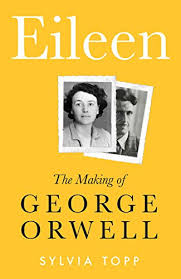 Eileen Blair, George Orwell’s first wife, is the subject of this welcome and assiduously researched biography by Sylvia Topp. Eileen married Orwell in 1936 when he was a virtual unknown and, until her death in 1945 at the age of just thirty-nine, shared with him a life that was lived primarily on the unreliable income from his writing. She did not live to see even the beginnings of the worldwide fame that would come her husband’s way with Animal Farm, which was published in the year of her death.
 Immediately afterwards, the paintings take a turn towards our grosser world, and the realism begins to hurt. The portrait of John Minton has a piercing sadness. The portrait of Francis Bacon with lowered eyes has a Germanic intensity; it’s as if Grunewald had started a noli me tangere. The wide-eyed girl appears once more, in a green dressing gown, with a dog resting its head in her lap, but she has come back to our edgy, nerve-ridden world. Another girl appears. She has yellow hair and a charming face, and the images of her are still controlled by line.
 We are used to thinking of idleness as a vice, something to be ashamed of. But when the British philosopher Bertrand Russell wrote “
 What is
  When it comes to many philosophical issues, people feel conflicted or confused. There is something drawing them toward one intuition but also something drawing them toward the exact opposite intuition. This tension seems to be an important aspect of what makes us regard these issues as important philosophical problems in the first place.
 It’s easy to foresee that technological progress will change how we live; it’s much harder to anticipate exactly how. Self-driving cars represent an enormous technological challenge, but one that is plausibly on the way to being solved. What will be the unanticipated consequences when autonomous vehicles become commonplace? Jason Torchinsky is a fan of technology, but also a fan of driving, and his recent book Robot, Take the Wheel examines how our relationship with cars is likely to change in the near future.
 On July 17, President Donald Trump sat for a
 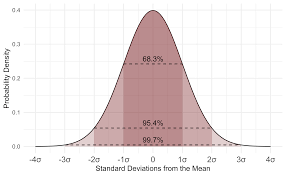 Statistics in the Progressive Era were more than mere signs of a managerial government’s early efforts to sort and categorize its citizens. The emergence of statistical selves was not simply a rationalization of everyday life, a search for order (as Robert Wiebe taught a half century of historians to say). The reliance on statistical governance coincided with and complemented a pervasive revaluation of primal spontaneity and vitality, an effort to unleash hidden strength from an elusive inner self. The collectivization epitomized in the quantitative turn was historically compatible with radically individualist agendas for personal regeneration—what later generations would learn to call positive thinking.
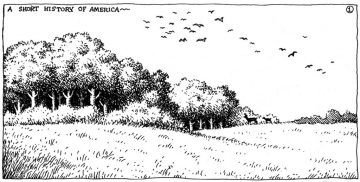 The comic is bookended by two pieces of nondiegetic text. We start with the title hovering above a pastoral scene, nature as yet unspoiled: trees, deer, birds, and a gently sloping hill. We can safely assume this is America, but when? It could be yesterday, or thousands of years ago. We deduce that the second panel shows this same setting not long after, because of a key continuity: the trees, placed in the same position inside the two panels, haven’t grown much. Our eyes adjust quickly to repetition and become acutely sensitive to any deviation, however small. Instantly, we take in the hill and felled trees, along with the introduction of the railroad track, upon which chugs a small train, billowing steam as it disappears into the distance. The wild animals are gone, a visual shorthand for the encroachment of humans. Because of the train’s presence, we infer that these first two panels take place in the early-to-mid-nineteenth century. In the third panel, a few birds glide in the sky, recalling the first panel. The hill remains in the scene (though altered), as well as the train track, but years must have passed, because we also see a house, shed, and cart (signifying “farm”), as well as a dirt road (signifying “town”), telegraph wires, and a man with horse and buggy. Will this fellow be our main character?