
 Edward Fishman in the Boston Review:
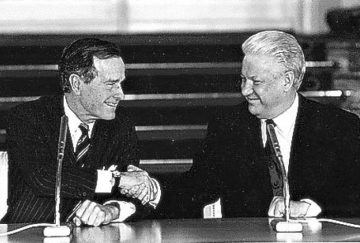
While the implementation of U.S. foreign policy has fluctuated widely across administrations, the overarching aims have remained remarkably stable since the end of the Cold War. From George H. W. Bush’s “new world order” to Bill Clinton’s “democratic enlargement,” George W. Bush’s “freedom agenda” to Barack Obama’s “rules-based international order,” the goal has been to extend the reach of democracy and free markets around the globe. During the Cold War, the United States and its allies built one international order, and the Soviet Union built another. For the past thirty years, the United States has sought to universalize the order that survived the fall of the Berlin Wall—a project we can call liberal universalism. Its objective—expanding an order that already existed—explains why there has been little innovation in international organizations since the end of the Cold War, whereas Washington has labored to increase membership in institutions that predate 1989.
The fourth year of Trump’s presidency has ended this history. To be sure, the viability of liberal universalism has been waning for some time—the 2003 invasion of Iraq, the 2008 financial crisis, and the 2016 presidential election sowed serious doubts about the United States’ global role, economic stewardship, and democratic processes. But Washington’s flailing response to COVID-19 has been the nail in the coffin, calling into question the basic competence of the American state and the cohesion of American society. We now face widespread disillusionment not only with U.S. leadership, but with the American political and economic model itself: a crisis of confidence caused by a crisis of competence. Even if Trump loses in a landslide in November, restoring liberal universalism is no longer feasible or desirable.
More here.

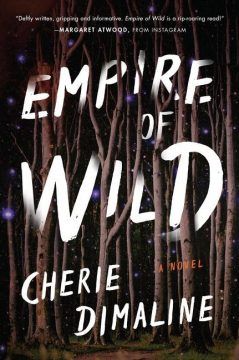 Roanhorse said she started out writing “Tolkien knockoffs about white farm boys going on journeys” because she figured that’s what epic fantasy was supposed to be. After deciding to feature a Native woman as the hero, in 2018 she released “
 Uncoupling healthcare assets from healthcare services: Using technology and next-generation logistics, many healthcare services will be uncoupled from their facility-based operations. The explosion of telemedicine over the past 60 days, substituting for the legacy in-person physician visit, points to a future in which the home is the optimal site of medical care.
 Routinely hailed as one of the most
 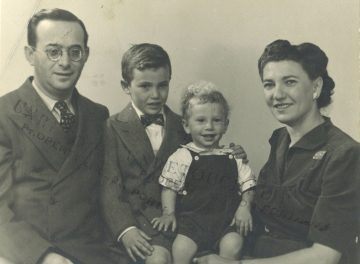 My parents were married at six o’clock on Sunday evening, October 25, 1936, at the Quincy Manor in the Bedford-Stuyvesant section of Brooklyn, and a week or so later, they began clipping coupons from the front page of The New York Post, one coupon a day, and mailing them to the Post, twenty-four coupons at a time, which coupons, along with ninety-three cents, brought them four volumes of a twenty-volume set of The Complete Works of Charles Dickens, a set that, with full-page illustrations, was printed from plates Harper & Brothers had used for older, more expensive sets. The Post’s promotion began in January 1936 and expired on May 16, 1938, two weeks before I was born. And when, eighty-two years later, in the week of June 9, 2020—a week that marked the 150th anniversary of Dickens’s death—I was isolated in my New York City apartment due to the Covid-19 lockdown, it occurred to me that this might be a good time to do what I’d often thought of doing: reread all of Dickens.
 In our latest study, published in
 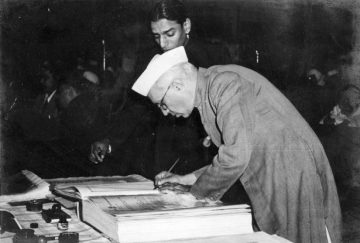 This August India celebrates seventy-three years as an independent nation. During these decades of independence, the country has been run democratically (aside from the twenty-one months of the infamous Emergency from 1975 to 1977). With the exception of Costa Rica, no other developing country has enjoyed as long a democratic run since World War II. And in the case of Costa Rica, it is worth bearing in mind that the country is small, with a GDP per capita
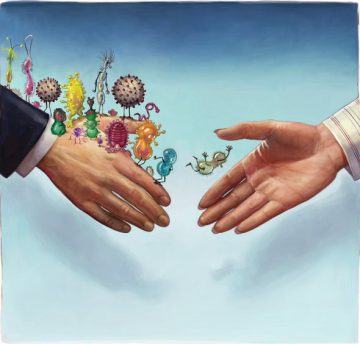 Here’s something I thought I’d never say: Donald Trump was correct. Back in 1997, anyway. About shaking hands. “The Japanese have it right,” the allegedly germaphobic Trump wrote (with co-author Kate Bohner) in the book Trump: The Art of the Comeback. “They stand slightly apart and do a quick, formal and very beautiful bow in order to acknowledge each other’s presence … I wish we would develop a similar greeting custom in America. In fact, I’ve often thought of taking out a series of newspaper ads encouraging the abolishment of the handshake.” Of course, because of COVID-19, the handshake is out. Unfortunately, it could make its own comeback without vigorous lobbying against it. I will now do some of that lobbying. “Recent medical reports,” Trump also wrote, “have come out saying that colds and various other ailments are spread through the act of shaking hands. I have no doubt about this.” Indeed, a search using the terms “handshake” and “infection” in journal articles between 1990 and 1997 turns up a 1991 write-up in the Journal of Clinical Microbiology with the title “Potential Role of Hands in the Spread of Respiratory Viral Infections: Studies with Human Parainfluenza Virus 3 and Rhinovirus 14.”
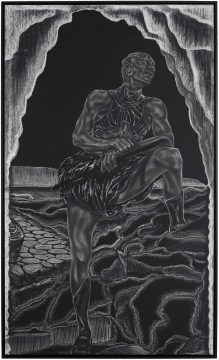 A woman stands in an otherworldly landscape, looking out. The landscape is sublime, though not the European sublime of cliffs, peaks, and mist. Here the sublime is
 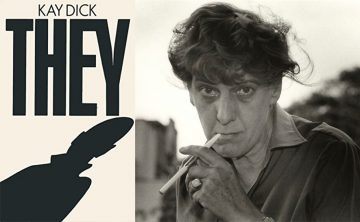 It’s apt then that much of the novel’s power lies in its mystery. The narrator—if, indeed, we’re listening to the same single voice throughout—seems to be a writer, who lives in a book-filled ex-coastguard’s cottage, alone apart from their dog. They are never named. Nor is his or her gender revealed, something that’s in line with what Kris Kirk, in an interview with Dick in the Guardian in 1984 described as Dick’s “androgynous mental attitude.” Dick had just finished explaining why the “overall tone” of the personal relationships depicted in her books is always bisexual, which is how she herself identified. She also notes that although she’s sexually attracted to both men and women, there’s “something extra” in her relationships with the latter; “this love, this emotion,” she clarifies. “I have certain prejudices and one of them is that I cannot bear apartheid of any kind—class, colour or sex,” she tells Kirk. “Gender is of no bloody account and if anything drives me round the bend it’s these separatist feminist lessies.” Given that Dick made a habit of loosely fictionalizing her own experiences, I’ve come to think of her protagonist in They as female. Even more inscrutable though are the “they” of the book’s title; “omnipresent and elusive,” as Howard describes them, extremely dangerous and violent, but also strangely vacant and automaton-like. “They” are rarely distinguished as individuals, which situates them in stark contrast to the narrator and her acquaintances.
 If we’d lost the war, we’d all have been prosecuted as war criminals.” So said
 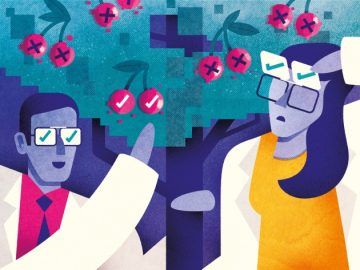 The past decade has seen a raft of efforts to encourage robust, credible research. Some focus on changing incentives, for example by modifying promotion and publication criteria to favour open science over sensational breakthroughs. But attention also needs to be paid to individuals. All-too-human cognitive biases can lead us to see results that aren’t there. Faulty reasoning results in shoddy science, even when the intentions are good.