Sean Carroll On Life and Its Meaning

Sean Carroll in Preposterous Universe:

A podcast only hits the century mark once! And for Mindscape, this is it. There have been holiday messages and bonus episodes and the like. But this is the 100th officially-numbered episode. To celebrate, I decided to treat myself to a solo episode in which I reflect, somewhat non-systematically, on the age-old question of the meaning of life. I end up spending a lot (most?) of the time talking about the meaning of “life,” i.e. what it means to be a living organism in a naturalistic universe. But then I go on to muse about the construction of human meaning in a world where values are not imposed on us or objectively grounded in physical facts.

I think life does have meaning, and it’s important to understand what forms it might take. I settle largely on the idea that humans can conceive of different possible futures, assign value to them, and work against the natural order of things to create something that otherwise would not have been. This is far from the final word, even in my own mind; it’s an invitation to think and converse in a reasonable way about some of the biggest questions there are. Just like the podcast in general.

More here.

The left changed the coronavirus narrative overnight

Thomas Chatterton Williams in The Guardian:

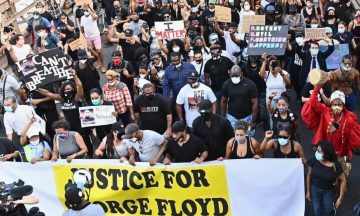
Less than two weeks after Floyd’s killing, the American death toll from the novel coronavirus has surpassed 100,000. Rates of infection, domestically and worldwide, are rising. But one of the few things it seems possible to say without qualification is that the country has indeed reopened. For 13 days straight, in cities across the nation, tens of thousands of men and women have massed in tight-knit proximity, with and without personal protective equipment, often clashing with armed forces, chanting, singing and inevitably increasing the chances of the spread of contagion.

Scenes of outright pandemonium unfold daily. Anyone claiming to have a precise understanding of what is happening, and what the likely risks and consequences may be, should be regarded with the utmost skepticism. We are all living in a techno-dystopian fantasy, the internet-connected portals we rely on rendering the world in all its granular detail and absurdity like Borges’s Aleph. Yet we know very little about what it is we are watching.

More here.

A New Jewish Canon

Claire E. Sufrin and Yehuda Kurtzer at Marginalia Review:

We moved forward with the idea of assembling a canon, aware of the chutzpah, based on a few understandings. One is our belief that even when canon formation is not taking place explicitly in a closed gathering, certain ideas and texts become implicitlycanonical through other means such as compelling presentation, citation, and education. Communities and consensuses can create canon by bringing powerful ideas to life and to market, and by privileging some ideas and texts over others. For example, Yosef H. Yerushalmi’s Zakhor is required reading in dozens of college and graduate school courses in Jewish Studies; it is among the most commonly cited texts in Jewish Studies lectures in both academic and lay settings. No one person decided that the book is important, but the book has emerged over time as a canonical piece of Jewish Studies scholarship with relevance for the larger Jewish community. In engaging actively and directly in canon formation, in naming what we were doing an act of “canonization,” and in inviting commentary from our colleagues we hoped to call attention to the implicit canonization that was already happening and to open a conversation about it.

more here.

Little Christo

Neda Neynska at the LRB:

100,000 square metres of fabric was used to wrap the Reichstag in 1995. Christo and Jeanne-Claude said at the time that the project was born out of his ‘acute interest’ as a political refugee in the relationship between East and West: ‘Here they meet in the most dramatic way.’ The event received wide press coverage, like all their projects, but was also the subject of a personal documentary about Christo and Anani. Standing beside the wrapped Reichstag, leaning against the remains of the Berlin Wall, Anani, by then a famous actor, is anguished: ‘I never had Hristo’s energy. He left with a pencil in his pocket and made it. I never dared.’
The film also includes plenty of cigarette smoking, moody lighting, and dinner table conversations about life and chance. ‘Hristo, I think there is a deep psychological moment here,’ Jeanne-Claude says at one point.

more here.

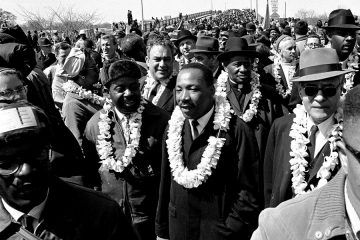
The Forgotten King: Commentary on protest, race, and MLK

Ken Makin in The Christian Science Monitor:

There is an unholy invocation that rises from some Americans in times of racial distress. It is an exclamation from the voices of the status quo, the clarion call of conservative thinking: What would Martin Luther King do? It is as unauthentic and uninspiring as it is ambiguous – and that is the point. Reducing Dr. King’s understanding of racial and social issues to a warped perspective of the “I Have A Dream” speech is propagandist and ahistorical, but it has worked.

It is easy to celebrate the “I Have A Dream” refrain and the final paragraph of Dr. King’s speech from the perspective of all lives matterAnd when this happens, when we allow freedom to ring, when we let it ring from every village and every hamlet, from every state and every city, we will be able to speed up that day when all of God’s children, black men and white men, Jews and Gentiles, Protestants and Catholics, will be able to join hands and sing in the words of the old Negro spiritual, “Free at last! Free at last! Thank God almighty, we’re free at last!”

But what about black lives? How would Dr. King feel about the modern-day anti-police-brutality protests? How would he respond to the deaths of George Floyd, Trayvon Martin, and so many more? Long before he declared that a riot was “the language of the unheard,” he spoke about black unrest. Where? In the “I Have A Dream” speech:

It would be fatal for the nation to overlook the urgency of the moment. This sweltering summer of the Negro’s legitimate discontent will not pass until there is an invigorating autumn of freedom and equality. Nineteen sixty-three is not an end, but a beginning. And those who hope that the Negro needed to blow off steam and will now be content will have a rude awakening if the nation returns to business as usual. And there will be neither rest nor tranquility in America until the Negro is granted his citizenship rights. The whirlwinds of revolt will continue to shake the foundations of our nation until the bright day of justice emerges.

More here.

A Citizen Scientist Makes Her Mark in Microbiome Research

Amy Schleunes in The Scientist:

The first thing Martha Carlin noticed was a faraway look in her husband’s eyes. It was a subtle change, she says, something only a wife would see. She happened to be reading Lucky Man by Michael J. Fox at the time, and began to wonder about some of the symptoms she’d observed in her husband: his loss of facial expressions, his quivering pinky finger, his trembling tongue. An appointment with an internist led to an appointment with a neurologist, who confirmed Carlin’s worst fears. In the fall of 2002, her husband John was diagnosed with Parkinson’s disease. He was 44 years old.

Carlin spent the next seven years reading everything she could find on Parkinson’s. A consultant skilled at identifying breakpoints in businesses, Carlin concluded that the disease is “a systems problem,” she says, a collapse of the body’s ecosystem. Much of what she had learned implicated the gut, including the finding that constipation is one of the earliest symptoms of Parkinson’s, often emerging 10 years or more before a diagnosis. In late 2014, Carlin read a study that identified a specific imbalance in the composition of Parkinson’s patients’ gut microbiomes, suggesting that changes in the gut microbiota could be an important biomarker for the disease. “That is it,” she remembers thinking. “The gut is the general ledger of the body.”

She quit her consulting job and enlisted the help of Jack Gilbert, a microbiome expert then at the University of Chicago. Carlin paid Gilbert, who serves on The Scientist’s editorial advisory board, to analyze her and her husband’s stool samples, and also donated $30,000 to cover part of the salary of one of his postdocs. Together, she and Gilbert pored over the microbiome literature. They kept coming across mentions of certain microbial genes that were overexpressed in conditions such as Parkinson’s and autism, suggesting “functional similarities at a systems level,” Carlin says. It seemed logical to her that investigating such complex conditions would require looking at the whole community of bacteria in the living system.

More here.

Tuesday Poem

“Give your daughters difficult names
Names that command the full use of the tongue
My names makes you want to tell me the truth.
My names does not allow me to trust anyone
who cannot pronounce it right.”
…………………………. —Warson Shire

Give your daughters Difficult Names

Many of my contemporaries,
role models,
But especially,
Ancestors

Have a name that brings the tongue to worship.
Names that feel like ritual in your mouth.

I don’t want a name said without pause,
muttered without intention.

I am through with names that leave me unmoved.
Names that leave the speaker’s mouth unscathed.

I want a name like fire,
like rebellion,
like my hand griping massa’s whip—

I want a name from before the ships
A name Donald Trump might choke on.

I want a name that catches you in the throat
if you say it wrong
and if you’re afraid to say it wrong,
then I guess you should be.

I want a name only the brave can say
a name that only fits right in the mouth of those who love me right,
because only the brave
can love me right

Assétou Xango is the name you take when you are tired
of burying your jewels under thick layers of
soot
and self-doubt.

Assétou the light
Xango the pickaxe
so that people must mine your soul
just to get your attention.

Read more »

Sunday, June 7, 2020

What does ‘defund the police’ mean?

Sam Levin in The Guardian:

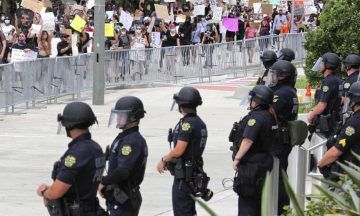
The call to “defund the police” has become a rallying cry at protests across America this week, and some lawmakers appear to be listening.

Activists who have long fought to cut law enforcement budgets say they are seeing an unprecedented wave of support for their ideas, with some elected officials for the first time proposing budget reductions and divestments from police. Here’s what we know about the movement, and how cities and states are responding.

What does it mean to ‘defund the police’?

For years, community groups have advocated for defunding law enforcement – taking money away from police and prisons – and reinvesting those funds in services. The basic principle is that government budgets and “public safety” spending should prioritize housing, employment, community health, education and other vital programs, instead of police officers. Advocates argue that defunding is the best way forward since attempts to reform police practices over the last five years have failed, as evidenced by the brutal killing of George Floyd. Groups have a range of demands, with some seeking modest reductions and others viewing full defunding as a step toward abolishing contemporary police services.

More here.

COVID-19 Can Last for Several Months

Ed Yong in The Atlantic:

For vonny leclerc, day one was March 16.

Hours after British Prime Minister Boris Johnson instated stringent social-distancing measures to halt the SARS-CoV-2 coronavirus, LeClerc, a Glasgow-based journalist, arrived home feeling shivery and flushed. Over the next few days, she developed a cough, chest pain, aching joints, and a prickling sensation on her skin. After a week of bed rest, she started improving. But on day 12, every old symptom returned, amplified and with reinforcements: She spiked an intermittent fever, lost her sense of taste and smell, and struggled to breathe.

When I spoke with LeClerc on day 66, she was still experiencing waves of symptoms. “Before this, I was a fit, healthy 32-year-old,” she said. “Now I’ve been reduced to not being able to stand up in the shower without feeling fatigued. I’ve tried going to the supermarket and I’m in bed for days afterwards. It’s like nothing I’ve ever experienced before.” Despite her best efforts, LeClerc has not been able to get a test, but “every doctor I’ve spoken to says there’s no shadow of a doubt that this has been COVID,” she said. Today is day 80.

More here.

Scientists tap the world’s most powerful computers in the race to understand and stop the coronavirus

Jeremy Smith in The Conversation:

The largest number of COVID-19 supercomputing projects involves designing drugs. It’s likely to take several effective drugs to treat the disease. Supercomputers allow researchers to take a rational approach and aim to selectively muzzle proteins that SARS-CoV-2, the virus that causes COVID-19, needs for its life cycle.
The viral genome encodes proteins needed by the virus to infect humans and to replicate. Among these are the infamous spike protein that sniffs out and penetrates its human cellular target, but there are also enzymes and molecular machines that the virus forces its human subjects to produce for it. Finding drugs that can bind to these proteins and stop them from working is a logical way to go.

More here.

A Date to Pinpoint on the Moral Arc of the Universe

Simonetta Nardin in Chasing Waterfalls:

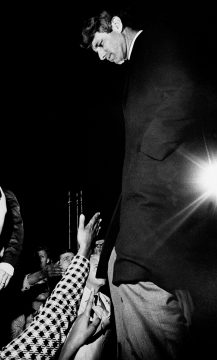
Today marks the anniversary of the death of Robert F. Kennedy, assassinated in 1968 after winning the primary in California, on the way to obtaining the nomination of the Democratic party and, perhaps, the presidency.
Just two months earlier, Kennedy had found himself in front of a mostly African-Americans in Indianapolis. Martin Luther King had been murdered that afternoon, and it was Kennedy who broke the news. He had been advised against keeping that election event and addressing the crowd, but Kennedy showed courage and moral standing, telling local police officers that if they crowd would bother them, “you’re the one with the problem.” RFK had the credibility to speak honestly about King, and how personal that loss was, evoking (for the first time in public) his brother who was murdered five years earlier.

In the somewhat grainy video of the time, you can clearly hear the gasps of disbelief and pain with which the news was received. RFK spoke only for about five minutes. Quoting Aeschylus and the Greeks, he said, among other things: “What we need in the United States is not division; what we need in the United States is not hatred; what we need in the United States is not violence or lawlessness; but love and wisdom, and compassion toward one another, and a feeling of justice toward those who still suffer within our country, whether they be white or they be black.”

The mostly improvised words he delivered that April 4, 1968, are dramatically current as America relives scenes from the same movie 52 years later – the riots in the cities, the police brutality towards African Americans, the economic crisis that aggravates the already dramatic social inequalities.

More here.

Sunday Poem

You’re So Paranoid

……….. —for José

A wall of cops moves like a wall of water on a barge no beauty.
A wall of iron swallows the woman who falls to the ground and keeps
falling. There’s a video. The picture stays intact (again).
………. It’s not pretty, meaning it’s hard to watch.
When a poet says we have to keep our eyes open I know who he’s talking to
I don’t listen. I listen long enough to hate him.
If I say the woman dragged by her hair.
If I compare it.

I witnessed meaning stood by the window meaning shuddered let
hand fall gently over lips pulled coat tight tighter.
A wall of cops bucks like a frightened boar. (If I describe it.)
Will it speak. If I say it came furtive and dressed in red.
………. The cops think cop thoughts.
………. The cops move.
They walk like
a walk. Like an economy which after all is a fairy
bucking with hunger. Not pretty. Not picture.
I follow the border patrol agent through the airport thinking
fast thoughts bloodfast blood hound steps he buys
a burrito. If I say he stood alive in line
and my friends are afraid to leave their bathrooms my friends
who I love and love and. My friends who eat
from plates who plug cords into machines for singing.
(If I say a wall of men standing on my friends’ necks.) (If I describe it.)
My friends. Who slice plums illegally on soccer fields. Whose knees
move like knees into the grass. If I name the grass.
If I call sweet liquor and smoke
(if I say cloy).
Read more »

Why have Republican leaders abandoned their principles in support of an immoral and dangerous president?

Anne Applebaum in The Atlantic:

In english, the word collaborator has a double meaning. A colleague can be described as a collaborator in a neutral or positive sense. But the other definition of collaborator, relevant here, is different: someone who works with the enemy, with the occupying power, with the dictatorial regime. In this negative sense, collaborator is closely related to another set of words: collusioncomplicityconnivance. This negative meaning gained currency during the Second World War, when it was widely used to describe Europeans who cooperated with Nazi occupiers. At base, the ugly meaning of collaborator carries an implication of treason: betrayal of one’s nation, of one’s ideology, of one’s morality, of one’s values.

How does it feel to be black in newly ‘woke’ America?

Chase Quinn in The Guardian:

How does it feel to be black in America right now? First, I wonder, do I capitalize the “B”? Is that grammatically correct? More to the point, as an element of style, a choice, does it prove something to you or to me if I don’t? I confess I don’t know any more. These are the petty games that play on my mind as a black American. I cannot speak for all black people, of course. We are not a monolith; you seem to understand this by now. I can only speak for myself – as a black writer. That experience, at least, I know. Instead of worrying about the white man who might murder me in my own home, or on my morning run, what preys on me in the night is how I constructed the sentence as I replay the day, if it was adequately punctuated in its disavowal of racist oppression.
You see, I was raised in the house of “you can be whatever you want – with hard work,” the appendix like the slamming shut of a piano. I’m 33 years old. I was taught to be proud of being black, and I am. There are few things of which I am prouder. No dangling prepositions here, just the facts. I have earned the straight As. I have stayed past the bell. I have pushed myself to raise my hand, to venture an answer, even when I wasn’t sure I understood the question. I was taught that fear, like racial oppression or homophobia, was to be overcome. Walk with your head held high, my mother taught me. Let them admire and be transformed by your strength, by your unassailable conduct. Play it again, Sam – the one that says things will be different in the next life. They’ll look at me and think how far we’ve come. But will they, actually?

I heard from my cousin the other day. She texted me a video of her son on the news. He was protesting in front of the White House. To the newscaster, he said: “They’re not hearing us.” His friend added: “When you talk, it’s just words to them.” Just words indeed. I thought to myself: I should be proud. Proud that my little cousin, who also survived a school shooting just a few years ago, is out on the street, marching, standing up for what is right. Proud of his mother too, for raising a young black man and sending him to college, as a single mother. But instead I felt sorry, like I’d failed him. Like we all had.

More here.

Saturday, June 6, 2020

The Present Crisis Demands a New International Monetary System for the Public Good

Mona Ali in The Political Quarterly:

In this ongoing catalogue of coronavirus-related disorder – extraordinary death tallies, a global lockdown and chaotic financial markets – history reminds us that it is in precisely these conditions that old doctrines are overturned and new paradigms are ushered in.

Crises catapult changes. Amidst this pandemic there are now mass protests across America following the death of George Floyd, an African American, at the hands of a white police officer. The tear gas and ‘show of force’ tactics deployed by the US police on protesters mark a new inflection point in this crisis, highlighting its perils and possibilities.

This moment, if any, clarifies and crystallises the necessity of a new social contract. Whilst economic thinking might appear distant and removed from more immediate concerns, unequal access to finance and other forms of social provisioning has amplified the suffering of marginalised communities across the world.

Now is the time to conceive and construct a new international monetary system, different to the present which furthers the political and economic dominance of a few to one founded on principles of social justice and sustainability. Lessons learned from the past might guide us as we reimagine global money for the twenty-first century.

More here.

Letter from a Region in My Mind

James Baldwin in The New Yorker:

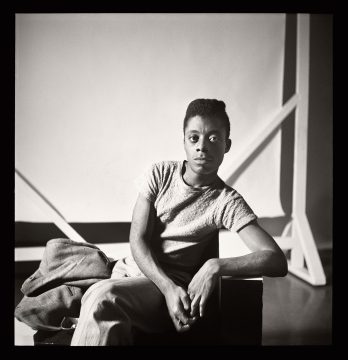
I underwent, during the summer that I became fourteen, a prolonged religious crisis. I use “religious” in the common, and arbitrary, sense, meaning that I then discovered God, His saints and angels, and His blazing Hell. And since I had been born in a Christian nation, I accepted this Deity as the only one. I supposed Him to exist only within the walls of a church—in fact, of our church—and I also supposed that God and safety were synonymous. The word “safety” brings us to the real meaning of the word “religious” as we use it. Therefore, to state it in another, more accurate way, I became, during my fourteenth year, for the first time in my life, afraid—afraid of the evil within me and afraid of the evil without. What I saw around me that summer in Harlem was what I had always seen; nothing had changed. But now, without any warning, the whores and pimps and racketeers on the Avenue had become a personal menace. It had not before occurred to me that I could become one of them, but now I realized that we had been produced by the same circumstances. Many of my comrades were clearly headed for the Avenue, and my father said that I was headed that way, too. My friends began to drink and smoke, and embarked—at first avid, then groaning—on their sexual careers. Girls, only slightly older than I was, who sang in the choir or taught Sunday school, the children of holy parents, underwent, before my eyes, their incredible metamorphosis, of which the most bewildering aspect was not their budding breasts or their rounding behinds but something deeper and more subtle, in their eyes, their heat, their odor, and the inflection of their voices. Like the strangers on the Avenue, they became, in the twinkling of an eye, unutterably different and fantastically present. Owing to the way I had been raised, the abrupt discomfort that all this aroused in me and the fact that I had no idea what my voice or my mind or my body was likely to do next caused me to consider myself one of the most depraved people on earth. Matters were not helped by the fact that these holy girls seemed rather to enjoy my terrified lapses, our grim, guilty, tormented experiments, which were at once as chill and joyless as the Russian steppes and hotter, by far, than all the fires of Hell.

More here.