The not-so-notorious RBG

Radhika Coomaraswamy in Daily FT (Sri Lanka):

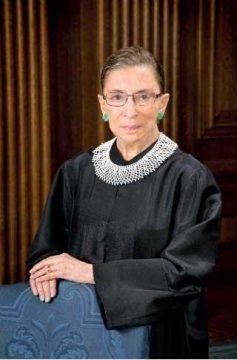
A diminutive, shy person with head bowed down walked into the room. She walked slowly but with a purposive step. When she began the class her voice was just above a whisper and her words were accompanied by long pauses as we strained to listen. This was 1976 and I was enrolled in the class of Professor Ruth Bader Ginsburg as she began her pioneering course on sex-based discrimination and the law.

As a South Asian I was used to vibrant and colourful women leaders. Ginsburg was anything but. With a cold, piercing, powerful, intellect, she showed us how to dissect arguments, plan a cohesive strategy and win the battle. She was all about the analysis, the details and the hard work. Her main area of interest in the law was Civil Procedure, the rules and processes of the legal system. I usually fell asleep during those classes but it was Ginsburg who convinced me that if you are going to be a human rights lawyer, first master the procedure. Your passion will guide the substance.

More here.

The world’s top 50 thinkers 2020: the winner

From Prospect Magazine:

It’s a disease of the body, but it has redefined the requirements for a great mind. In the last issue, we renewed a Prospect tradition and identified 50 top world thinkers. It was an all-new list for the Covid-19 age, since the mood called for thinking of a different sort—less chin-stroking, more hands on. Then 20,000-odd votes were cast and counted in a public ballot. The results are in, and represent a landslide win for the practical minds party. The top spot was overwhelmingly secured by a figure who—on first blush—is as far from a caricature intellectual of the Jean-Paul Sartre variety as you can get. That’s not quite right since, like Sartre, KK Shailaja is a communist, albeit from a party created to keep its distance from Soviet Moscow. It helps run the state of Kerala in south India, where Shailaja or “Teacher,” as she is fondly nicknamed due to a previous occupation, is the indefatigable health minister.

So deft was her handling of a 2018 outbreak of the deadly Nipah disease that it was commemorated in a film, Virus. In 2020, she was the right woman in the right place. When Covid-19 was still “a China story” in January, she not only accurately foresaw its inevitable arrival, but also fully grasped the implications. She rapidly got the WHO’s full “test, trace and isolate” drill implemented in the state, and bought crucial time by getting a grip of the airports, and containing the first cases to arrive on Chinese flights. Of course the virus returned, but there was rigorous surveillance and quarantine—sometimes in makeshift structures. The public messages have been consistent, and Shailaja follows them to the letter, with social distancing in all official meetings (which can go on until 10pm) and restricting herself to a Zoom-only relationship with her grandchildren.

More here.

How Can We Bear This Much Loss?

Amitha Kalaichandran in The New York Times:

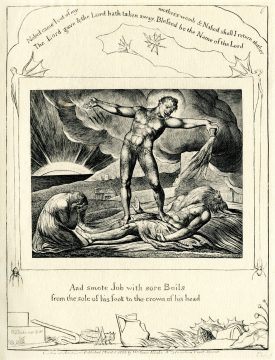
I thought of the biblical story of Job last month when I was asked to speak to the National Partnership for Hospice Innovation. How would I counsel others to cope with losses so terrifying and unfair? How could those grieving find a sense of hope or meaning on the other side of that loss? In my research I found myself drawn to the powerful rendition of the Book of Job by the 18th-century British poet, artist and mystic William Blake, in particular his collection of 22 engravings, completed in 1823, that include beautiful calligraphy of biblical verses. Job, of course, is the Bible’s best-known sufferer. His bounty — home, children, livestock — is taken cruelly from him as a test of faith devised by Satan and carried out by God. He suffers both mental and physical illness; Satan covers him in painful boils.
Job is conflicted — at times he still has his faith and trusts in God’s wisdom, and other times he questions whether God is corrupt. Finally, he demands an explanation. God then allows Job to accompany him on a tour of the vast universe where it becomes clear that the universe in which he exists is more complex than the human mind could ever comprehend. Though Job still doesn’t have an explanation for his suffering, he has gained some peace; he’s humbled. Then God returns all that Job has lost. So, the story is, in large part, about the power of one man’s faith. But that’s not all.

…It’s also about our attachments — to our identities, our faith, the possessions and people we have in our lives. Grief is a symptom of letting go when we don’t want to. Understanding that attachment is the root of suffering — an idea also central to Buddhism — can give us a glimpse of what many of us might be feeling during this time.

More here.

Saturday Poem

Charlie Parker (1950)

Bird is building a metropolis with his horn.
Here are the gates of Babylon, the walls of Jericho cast down.
Might die in Chicago, Kansas City’s where I was born.

Snowflake in a blizzard, purple rose before the thorn.
Stone by stone, note by note, atom by atom, noun by noun,
Bird is building a metropolis with his horn.

Uptown, downtown, following the river to its source,
Savoy, Three Deuces, Cotton Club, Lenox Lounge.
Might just die in Harlem, Kansas City’s where I was born.

Bird is an abacus of possibility, Bird is riding the horse
of habit and augmented sevenths. King without a crown,
Bird is building a metropolis with his horn.

Bred to the labor of it, built to claw an eye from the storm,
made for the lowdown, the countdown, the breakdown.
Might die in Los Angeles, Kansas City’s where I was born.

Bridge by bridge, solo by solo, set by set, chord by chord,
woodshed to penthouse, blue to black to brown,
Charlie Parker is building a metropolis with his horn.
Might just die in Birdland, Kansas City’s where I was born.

by Campbell McGrath
from the Academy of American Poets

Friday, September 25, 2020

Edward Said: American Intellectual, Palestinian Patriot, Breaker of Dogmas

Khaled Beydoun in Newsweek:

Edward W. Said

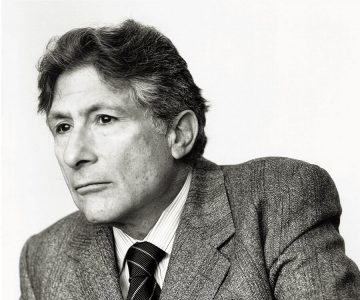
Edward Said, who died 17 years ago today, has been called many things. A literary critic and an exile, an unyielding voice for Palestinian self-determination, an educator, a trailblazer, a “normalizer”—and even “a prophet of the political violence” unfolding in the United States today, seventeen years after he took his final breath.

During a lifetime that spanned nearly sixty-eight years and witnessed definitive geopolitical currents and shifts, Said stood apart as one of the world’s most incisive public intellectuals. A Palestinian by birth and an American by choice, Said took on this role in the early 1980’s following the publication of Orientalism, a text that dismantled European misrepresentations of Islam in its annals of literature.

This moment converged with the aftermath of the Iranian hostage crisis and ascendance of the Islamic Republic of Iran, which reoriented the whole of Islam as the “enemy of the West.” And in turn, propelled Said and his work onto the center of the public stage.

More here.

Read about and watch 31 Buster Keaton Films Online free

Josh Jones in Open Culture:

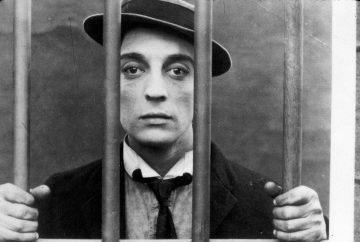
In 1987, Video magazine published a story titled “Where’s Buster?” lamenting the lack of Buster Keaton films available on videotape, “despite renewed interest” in a legend who was “about to regain his rightful place next to Chaplin in silent comedy’s pantheon.” How things have changed for Keaton fans and admirers. Not only are most of the stone-faced comic genius’ films available online, but he has maybe eclipsed Chaplin as the most popularly revered silent film star of the 1920s.

Keaton has always been held in the highest esteem by his fellow artists. He was dubbed “the greatest of all the clowns in the history of the cinema” by Orson Welles, and served as a significant inspiration for Samuel Beckett. (He was the playwright’s first choice to play Waiting for Godot’s Lucky, though he was too perplexed by the script to take the role). In Peter Bogdanovich’s new documentary, The Great Buster: A Celebration, Mel Brooks and Carl Reiner discuss his foundational influence on their comedy, and Werner Herzog calls him “the essence of movies.”

More here.

Why Covid is at least 10 times more deadly than the flu

Rod Jackson in the New Zealand Herald:

Estimates of the proportion of people who die from Covid-19 have been controversial, with some even dismissing it as similar to a bad flu. There are three main problems accounting for this controversy.
In this article, I describe each of these problems and some of the ways that epidemiologists such as me me try to deal with them.

Problem 1: To calculate the proportion of people who have been infected with Covid-19 and who die as a result (the Infection Fatality Proportion), you need two numbers – the number of deaths (the numerator) and the number of people who have been infected (the denominator) and then you divide the numerator by the denominator.

It sounds simple, but unfortunately accurate information on both these numbers for Covid-19 is hard to find, unless you know what to look for. Just for the record, I have used the correct epidemiological term – the “Infection Fatality Proportion” not the “Infection Fatality Rate” – because it’s not actually a rate. In epidemiology, a rate requires a time component, for example, 10 deaths per 1000 people per year.

More here.

Neruda in Ceylon: On making peace (of sorts) with Pablo Neruda

Robina P Marks in the Sri Lanka Guardian:

My love for your poetry is complicated further, because the memory of a Tamil woman called Thangamma keeps casting a dark shadow of fear and menace over your work. She darts and dives between the lines of your poems with an angry, restless spirit that will not cease.
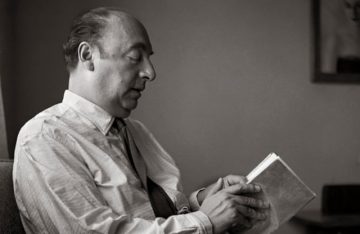
Thangamma, the woman who would come every morning to your house next to the sea to collect buckets of your human waste, and those of others in your street. Thangamma, that you dreamt of possessing, and to whom you offered endless gifts of fruit and silk that she ignored. Until one day, as you recall in your writing, when you gripped her hard by her wrists. You described this vividly:

“Unsmiling, she let herself be led away and soon was naked in my bed. Her waist, so very slim, her full hips, the brimming cups of her breasts made her like one of the thousand-year-old sculptures from the south of India… She kept her eyes wide open all the while, completely unresponsive. She was right to despise me. The experience was never repeated.”

And then you continued with an account of the rest of your life, in your memoir, as if this was of no consequence, and just a momentarily regrettable incident. Did you think that saying “she was right to despise me” somehow absolved you from this act of rape?

More here.

For Camus, It Was Always Personal

Robert Zaretsky at the LARB:

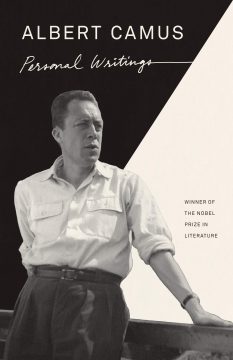
In her sharp and sympathetic foreword, Alice Kaplan observes that, for readers who know Camus only as the author of The Stranger, the “lush emotional intensity of these early essays and stories will come as a surprise.” Yet I confess that, even for someone who knew this side of Camus, I was again, as I reread the pieces, surprised by their Dionysian intensity.
The lyricism is especially bracing today, when even Dionysus would think twice before throwing a bacchanalia. For Camus, the lyrical sentiments were deeply rooted in the physical and human landscape of his native Algeria. They flowed from the childhood he spent in a poor neighborhood of Algiers, where he was raised by an illiterate and imperious grandmother and a deaf and mostly mute mother in a sagging two-story building, whose cockroach-infested stairwell led to a common latrine on the landing.

more here.

The Many Faces of Ethan Hawke

John Lahr at The New Yorker:

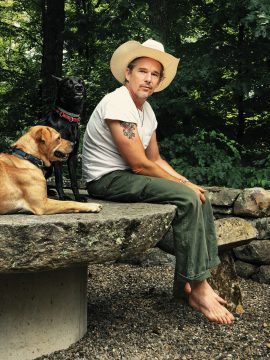
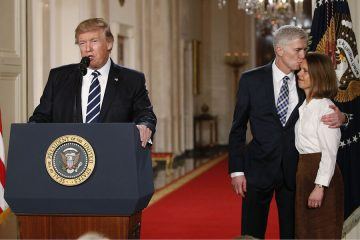
Throughout his career, Hawke has consistently challenged himself to grow. He has appeared in more than eighty movies, predominantly independent films interspersed with Hollywood money-makers. He has directed four films, written three novels, and co-founded a theatre company. In the process, Hawke has been nominated for four Academy Awards (including two for Best Adapted Screenplay) and a Tony, for his performance, in Tom Stoppard’s trilogy “The Coast of Utopia,” as Mikhail Bakunin, the revolutionary Russian anarchist, whose bowwow personality resurfaces in the fulminations of Hawke’s John Brown. The range of Hawke’s roles—a romantic charmer (in the “Before” trilogy), a drug-addled Chet Baker (in “Born to Be Blue”), a guilt-ridden suicidal priest (in “First Reformed”), to name just a few—is also a reflection of his expansive empathy. “Acting, at its best, is like music,” he said. “You have to get inside your character’s song.”
more here.

Friday Poem

The Light Above the Grass

I wake up in the morning
And think

People are alive
Making things, children

And apps, they
Are running to one

Another and then my arm
Falls asleep.

Most of the men
Who did not exactly know

They were my father
Are dead

And so

My father keeps
dissolving.

Tonight

Both my sons are sleeping
At their mom’s apartment.

I can’t always feel
My legs

But I don’t want to tell

Anyone. I’m so afraid
Of everything.

Read more »

Supreme Court: Would Trump pick inevitably mean a sharp right turn?

Henry Gass in The Christian Science Monitor:

With a presidential election less than five weeks away, and a new term at the U.S. Supreme Court just over a week away, President Donald Trump says he will, in a matter of days, announce his third nominee to the high court. The funeral for Justice Ruth Bader Ginsburg, whose seat he would be filling after she died last week, is not scheduled until next week, but President Trump and other Republican Party leaders have made clear their intent to return the court to its full complement of nine justices as soon as possible. The announcement is certain to provoke a fierce and partisan confirmation battle in the U.S. Senate. But if the nomination is successful, it could transform the high court in a way perhaps not seen in close to a century, securing a two-thirds majority of conservative jurists that could advance conservative causes like regulating abortion, expanding gun rights, and reining in federal regulations at a speed and scope of its choosing.
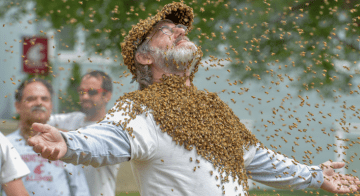
To date, President Trump’s two other appointments – Justices Neil Gorsuch and Brett Kavanaugh – have replaced other members of the court’s right wing. But replacing Justice Ginsburg, for decades a liberal stalwart of the court, would represent a much starker rightward turn. It would likely see influence shift between the justices – namely away from Chief Justice John Roberts, who would cease to be the court’s ideological center. The conservative justices do not see eye to eye on every issue, a dynamic that could moderate decisions they reach in some areas of the law. But for the most part, it could be this reinforced conservative majority that would be shaping U.S. law for the next 15 or 20 years. The only questions would be how radically, and how quickly, the court moves.

More here.

The Fungal Evangelist Who Would Save the Bees

Merlin Sheldrake in Nautilus:

If anyone knows about going fungal, it’s Paul Stamets. I have often wondered whether he has been infected with a fungus that fills him with mycological zeal—and an irrepressible urge to persuade humans that fungi are keen to partner with us in new and peculiar ways. I went to visit him at his home on the west coast of Canada. The house is balanced on a granite bluff, looking out to sea. The roof is suspended on beams that look like mushroom gills. A Star Trek fan since the age of 12, Stamets christened his new house Starship Agarikon—agarikon is another name for Laricifomes officinalis, a medicinal wood-rotting fungus that grows in the forests of the Pacific Northwest.
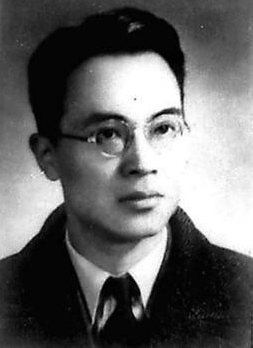
…In Stamets’ world, fungal solutions run amok. Give him an insoluble problem and he’ll toss you a new way it can be decomposed, poisoned, or healed by a fungus. Fungi are veteran survivors of ecological disruption. Their ability to cling on—and often flourish—through periods of catastrophic change is one of their defining characteristics. They are inventive, flexible, and collaborative. With much of life on Earth threatened by human activity, are there ways we can partner with fungi to help us adapt? Stamets and a growing number of mycologists think exactly this. Many symbioses have formed in times of crisis. The algal partner in a lichen can’t make a living on bare rock without striking up a relationship with a fungus. Might it be that we can’t adjust to life on a damaged planet without cultivating new fungal relationships?

More here.

Thursday, September 24, 2020

Qian Zhongzhu Should Win the Nobel

Brendan O’Kane in the Los Angeles Review of Books:

Qian Zhongshu (1910-1998)

Qian Zhongshu is a tough pitch to win the Nobel prize in literature this year. He’s dead, for starters – traditionally an obstacle to many things, including winning Nobel prizes – and his total creative output consists solely of a few essays, several short stories, and a single novel. On the other hand, that novel, Fortress Besieged, seems to me to be the high-water mark of something significant, if hard to explain, so I’m going to make my best case for it being enough to secure Qian’s place in history. The book takes its title from a French proverb, sets its action in the China of the 1930s, and tracks the misfortunes of Fang Hongjian, a feckless, cowardly student returning from Europe with a mail-order doctorate in Chinese from an American university that exists only in the imagination of a crooked Irishman. It may be one of the most cosmopolitan books ever written; certainly it is, as literary critic C. T. Hsia said, one of the greatest Chinese novels of the 20th century.

More here.

How To Know When You Can Trust A COVID-19 Vaccine

Maggie Koerth in Five Thirty-Eight:

If a COVID-19 vaccine went on the market before Election Day, Kamala Harris said she’s not sure she’d take it. And she’s not alone. In a recent poll, a majority of Americans — 62 percent — said they were worried that the Trump administration would pressure the Food and Drug Administration to release a vaccine before it’s ready, and 54 percent said they simply wouldn’t take that hypothetical vaccine at all, even if it were free.
Scientists around the world are currently undertaking one of the fastest vaccine-development programs in history, trying to get the novel coronavirus under control as quickly as humanly possible. But the vaccines being tested sit at a nexus of misinformation and mistrust. Between Trump’s apparent meddling in federal health agencies’ decision-makingskepticism about the seriousness of the disease, and long-standing culture wars around the safety of vaccines in general, it’s easy to find yourself floundering, unsure who you can trust.

So I spoke with a handful of people who really know how vaccines, clinical trials and COVID-19 work to find out how to know when it’s a good idea to get the vaccine. They offered these four pieces of advice.

More here.

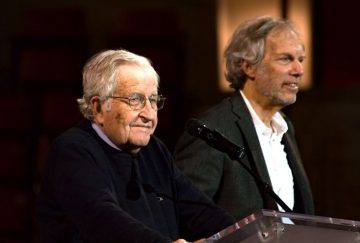
An interview with Noam Chomsky and Robert Pollin on the climate crisis, COVID-19, and the future of environmental politics

Noam Chomsky, Robert Pollin, and C. J. Polychroniou in the Boston Review:

C. J. Polychroniou: How does the coronavirus pandemic, and the response to it, shed light on how we should think about climate change and the prospects for a global Green New Deal?
Noam Chomsky: At the time of writing, concern for the COVID-19 crisis is virtually all-consuming. That’s understandable. It is severe and is severely disrupting lives. But it will pass, though at horrendous cost, and there will be recovery. There will not be recovery from the melting of the arctic ice sheets and the other consequences of global warming.

Not everyone is ignoring the advancing existential crisis. The sociopaths dedicated to accelerating the disaster continue to pursue their efforts, relentlessly. As before, Trump and his courtiers take pride in leading the race to destruction. As the United States was becoming the epicenter of the pandemic, thanks in no small measure to their folly, the White House cabal released its budget proposals. As expected, the proposals call for even deeper cuts in healthcare support and environmental protection, instead favoring the bloated military and the building of Trump’s Great Wall. And to add an extra touch of sadism, “the budget promotes a fossil fuel ‘energy boom’ in the United States, including an increase in the production of natural gas and crude oil.”

More here.

When Murakami Came to the States

David Karashima in The Paris Review:

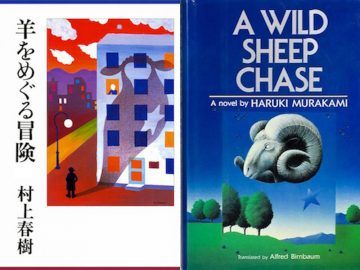
On May 10, 1989, Haruki Murakami’s editor at Kodansha International, Elmer Luke, sent Murakami a fax reporting on the sale of U.S. paperback rights to A Wild Sheep Chase (to Plume for fifty-five thousand dollars) and asking him to take part in the promotional activities that were scheduled in New York that fall. Murakami declined. Several months later, Luke and Murakami met in person for the first time in Tokyo (together with another editor from KI), and on August 14, just three days before a copy of A Wild Sheep Chase arrived at the Murakamis’ home, Luke again asked Murakami to join him in New York. Murakami once again declined. On September 24, Luke asked again, saying that Murakami’s translator Alfred Birnbaum had become unable to attend, and that they had also managed to arrange an interview with the New York Times. Murakami finally relented.

Murakami and his wife, Yoko, landed in New York on October 21, and Luke and Tetsu Shirai, the head of Kodansha’s New York offices, picked them up at the airport. Shirai remembers handing Murakami a copy of that day’s New York Times folded open to a story in the arts section about him and A Wild Sheep Chase. The headline, “Young and Slangy Mix of the U.S. and Japan,” was followed by a tagline: “A best-selling novelist makes his American debut with a quest story.” “Of course, it was something that had been in the works,” Shirai tells me, “but I was surprised by how well the timing worked out.”

Shirai and Luke had chosen a hotel on the Upper East Side, thinking Murakami, an avid runner, would like to be near Central Park. Ten years later, Murakami would write in an essay for the women’s magazine an an that, while he preferred the Village and SoHo with its many bookshops and secondhand record stores, he ends up staying uptown in New York because “the appeal of running in Central Park in the morning is too great.”

More here.