
Lisa Allardice in The Guardian:
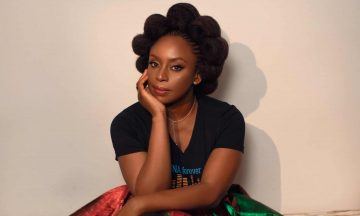 A few hours before Chimamanda Ngozi Adichie and I are due to speak, the result of the US election is finally called. The Nigerian novelist, who is based in Maryland but is currently in Lagos, where she spends part of the year, had been on her way back from taking her daughter to a birthday party when she heard the news. “The moment that we’ve been waiting for,” she says. “Everyone was calling: my best friend, my mum, my sister called, we were all sort of screaming down the phone.” Her husband, a hospital doctor, had returned to the US the previous week. “He and I were going crazy,” she says. “I was almost close to tears because I thought this is really about people who just want decency back. I feel it is really not ideological, it is more about wanting something human and humane. I find it so moving.”
As it is for so many, her relief is tempered by disappointment at Donald Trump’s unexpectedly strong performance. “I’ve always felt that Trump is as much America as Obama,” she says. “People on the left like to say ‘This is not America’, but actually it is. If you look at the history of America, it is not that surprising that Trump is so popular.” People feel “very threatened” both by the idea of a more inclusive, multiracial politics and women having more overt power, she says. So the victory for Kamala Harris as the first black female vice-president-elect is all the more thrilling. “It is impossible to talk about her, about what’s happened today, without thinking about what might happen in four or eight years – that she might in fact become president,” Adichie says. “Even if just for the symbolism of it, because the symbolic nature of leadership is important.”
More here.
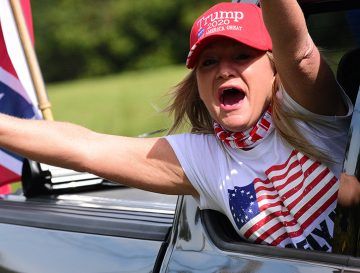 LAST TUESDAY NIGHT,
 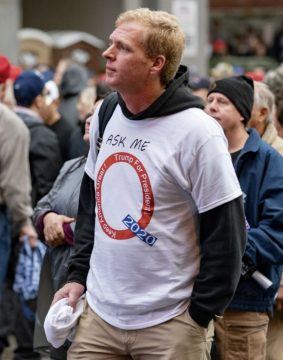 When I saw QAnon, I knew exactly what it was and what it was doing. I had seen it before. I had almost built it before. It was gaming’s evil twin. A game that plays people. (cue ominous music)
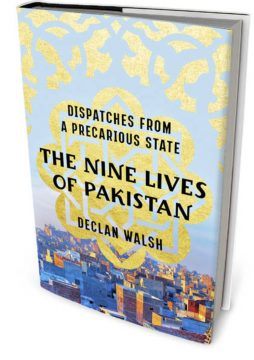 Pakistan was created in 1947 as a homeland for the Muslims of Hindu-majority India—“carved from the flanks of British India,” as Mr. Walsh puts it. Its “Great Leader” (“Quaid-e-Azam” in Urdu) was Muhammad Ali Jinnah, an unlikely agitator for a confessional Muslim state. A worldly lawyer who drank alcohol and married outside his faith, he was, Mr. Walsh tells us, “purposefully vague about his beliefs” for much of his life. In a poignant passage, Mr. Walsh parses a photograph of Jinnah taken in September 1947, a month after Pakistan was born: In it, he wears “the gaze of a man who gambled at the table of history, won big—and now wonders whether he won more than he bargained for.”
 There she stands, the fortysomething Susan Sontag, at a rock ‘n’ roll show in a packed New York club, encircled by sweaty kids. “Being the oldest person in a room did not make her self-conscious,” writes Sigrid Nunez in her memoir Sempre Susan. “The idea that she could ever be out of place anywhere because of her age was beyond her—like the idea that she could ever be de trop.” Sontag gave herself a regal, Oscar-Wilde-like permission to be at the center of things. That could be charming, much of the time. Other traits were less appealing. Sontag used to forbid her son David to look out of the window during train trips because, after all, there was nothing interesting about nature. Read a book instead, or, better, talk to me! was her message.
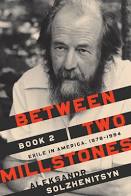 But, more importantly: the artist does not in fact require too detailed a study of his predecessors. It was only by fencing myself off, and not knowing most of what was written before me, that I’ve been able to fulfill my great task: otherwise you wear out and dissolve in it and accomplish nothing. If I’d read The Magic Mountain (and I still haven’t), it might somehow have impeded my writing of Cancer Ward. I was saved by the fact that my self-propelled development didn’t get distorted. I have always been hungry for reading, for knowledge—but in my school years in the provinces, when I was freer, I didn’t have that sort of guidance or access to that sort of library. And starting from my student years, my life was swallowed up by mathematics. I’d just set up a fragile connection with the Moscow Institute of Philosophy, Literature and History when the war came, then prison, the camps, internal exile, and teaching—still mathematics, but physics too (preparing experiments for demonstration in class, which I found very difficult). And years and years of conspiring under pressure and racing, underground, to complete my books, for the sake of all those who’d died without a chance to speak. In my life I’ve had to gain a thorough grounding in artillery, oncology, the First World War, and then prerevolutionary Russia too, which by then was so impossible to imagine.
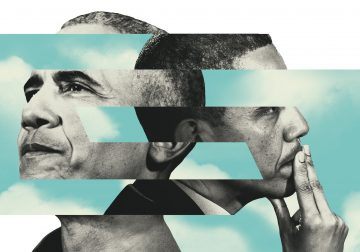 Barack Obama is as fine a writer as they come. It is not merely that this book avoids being ponderous, as might be expected, even forgiven, of a hefty memoir, but that it is nearly always pleasurable to read, sentence by sentence, the prose gorgeous in places, the detail granular and vivid. From Southeast Asia to a forgotten school in South Carolina, he evokes the sense of place with a light but sure hand. This is the first of two volumes, and it starts early in his life, charting his initial political campaigns, and ends with a meeting in Kentucky where he is introduced to the SEAL team involved in the Abbottabad raid that killed Osama bin Laden.
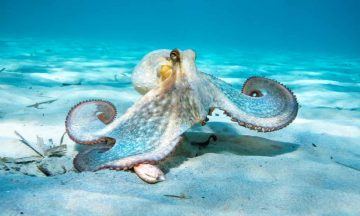 We live in a golden age of science writing, where weighty subjects such as quantum mechanics, genetics and cell theory are routinely rendered intelligible to mass audiences. Nonetheless, it remains rare for even the most talented science writers to fuse their work with a deep knowledge of the arts. One such rarity is the Italian theoretical physicist Carlo Rovelli who, like some intellectual throwback to antiquity, treats the sciences and the humanities as complementary areas of knowledge and is a subtle interpreter of both. His best-known work is
 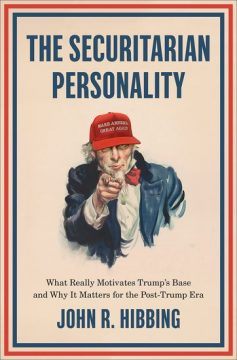 ON JULY 21, 2016, the Republican National Convention was in full swing and delegates in ruddy Americana and cowboy attire packed the Cleveland’s Quicken Loans Arena. Although it’s hard for most of us to recall, this was a time where even staunch Republicans were doubting Trump’s ascendency to the United States’s highest office. I was there, and remember it fondly, and was intrigued as to why those who did want Trump were willing to vote for a man who had called Mexicans rapists and had made fun of a handicapped New York Times journalist. A 52-year-old delegate from Vermont stressed the usual three prongs: the border, anti-terrorism, the military. Trump’s insensitivity mattered not. “To me,” the delegate said, “if you’re not safe, then you’ve got nothing.”
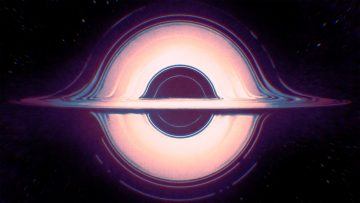 In a series of breakthrough papers, theoretical physicists have come tantalizingly close to resolving the
 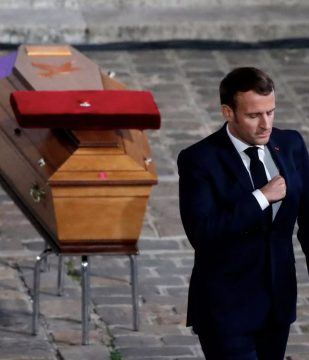 Five years ago, American journalists called me following the terrorist attack that took the lives of my former colleagues and friends at Charlie Hebdo. They all thought that we were going to elect Marine Le Pen. I tried to explain to them that it’s precisely because there is a leftist movement associated with Charlie—both anti-racist and secular, a left that remains lucid about the dangers of extremism—that we had a chance to avoid that fate. But my explanations were in vain.
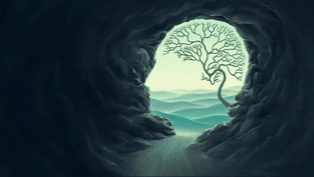 The evolutionary explanation for human connection to nature is a colossal safari through the African savanna, where our ancestors fought, fed, and frolicked for millions of years. The biologist E.O. Wilson speculated on this story in Biophilia, a slim volume on human attraction to nature. Wilson defined biophilia as an “innate tendency to focus on life and lifelike processes.” He argued that if other animals are adapted to their environments and are best-suited to the environments in which they evolved—for example, a thick white coat serves the polar bear well in its native cold and snowy Arctic—then is it possible that humans too, despite our ability to live anywhere on this planet, are best adapted to the particular environment in which we evolved?