
Enjoying the content on 3QD? Help keep us going by donating now.
Category: Recommended Reading
Terence Tao: Hardest Problems in Mathematics, Physics & the Future of AI
Enjoying the content on 3QD? Help keep us going by donating now.
Looking Back at the White Man
James G. Harper and Philip W. Scher at Cabinet Magazine:
In January 1934, the eminent anthropologist Julius Lips sat in a small hotel room at the Hôtel des Nations in the Latin Quarter of Paris, staring down at a trunk full of cardboard-mounted photographs. It was about all he had with him, having fled Germany with no family, no means of support, and no clear conception of his future except the idea that he might make his way to the United States. The photographs in the trunk, collected over a decade and through an extensive scholarly and institutional network, were of artworks from around the world that depicted the figure of the European through non-Western eyes. Some wryly humorous, some outright insulting, these objects tell a different story than that which Europeans had told themselves during the age of colonialism. Lips intended his research to culminate in a groundbreaking book, the working title of which was “How the Black Man Looks at the White Man.”
Back in Germany, Julius Lips had been a star on the rise: appointed director of the Rautenstrauch-Joest Museum in 1928 at the age of thirty-three, he was tenured as a senior faculty member at the University of Cologne just two years later. But with the rise of the Nazi party and Lips’s refusal to “coordinate” with the new regime, he was dismissed from his posts and his career came to a halt. His unwillingness to hand over the trunk full of photographs only further infuriated the authorities.
more here.
Enjoying the content on 3QD? Help keep us going by donating now.
Israel’s War of Grand Ambition
Shlomo Ben-Ami at Project Syndicate:
 The rapidly escalating military conflict between Israel and Iran represents a clash of ambitions. Iran seeks to become a nuclear power, and Israeli Prime Minister Binyamin Netanyahu longs to be remembered as the Israeli leader who categorically thwarted Iran’s nuclear program, which he views as an existential threat to Israel’s survival. Both dreams are as misguided as they are dangerous.
Iran’s nuclear ambitions have always been driven primarily by the goal of securing the regime’s survival, not annihilating Israel, which is far more likely to be destroyed at the end of a long war of attrition than under a mushroom cloud. But Israel cannot afford to treat Iran’s threats of nuclear Armageddon as mere bloviating, particularly after Hamas’s October 7 terrorist attack, which triggered Israel’s long, brutal, and ongoing offensive against the Iranian proxy in Gaza. It is not wrong to fear a nuclear Iran.
But Netanyahu is a key reason why Iran’s nuclear program is as far along as it is.
More here.
Enjoying the content on 3QD? Help keep us going by donating now.
The World That ABBA Made
Mitch Therieau at The New Yorker:
 There is probably not a second that goes by without an ABBA song being played somewhere in the world. A remix of “Gimme! Gimme! Gimme! (A Man After Midnight)” is pulsing through a club on a Mediterranean island, a Vietnamese grocery store is piping in “Happy New Year,” a Mexican radio station is playing the Spanish-language version of “Knowing Me, Knowing You.” Live performances, too, continue unabated, and not just in karaoke bars, or in stage productions of “Mamma Mia!” Maybe it is morning in Kawasaki, Japan, and a tribute band is performing for thirty people in a public square, or evening in Johannesburg, where a different tribute act plays to a sold-out theatre. (The group Björn Again, the best known of these reënactors, claims to have been summoned to perform for an enthusiastic Vladimir Putin; the Kremlin denies this.) In London, you can see and hear the real thing—or, at least, life-size holograms of its members, affectionately called ABBAtars, fronting a live band in a purpose-built arena.
Such is the afterlife in pop Valhalla. ABBA, made up of the songwriter-producers Björn Ulvaeus and Benny Andersson and the singers Agnetha Fältskog and Anni-Frid Lyngstad, is bigger today than it ever was during the group’s active years, between 1972 and 1982—a dense stretch that saw the two couples that made up the band splitting up but continuing to make music together.
more here.
Enjoying the content on 3QD? Help keep us going by donating now.
Wednesday Poem
Obligation #25 (Transaction)
I cross my legs -I- brush
my clavicle / I pitch my
laugh – I laugh – I look
away / I smile – I lock my
weight in my right
hip – I pop tongue – I smear lip
gloss – I slip / on heels – I eat when I
can – I am not / always fixed – I am
Trying always new
movements – I move to a
city that swells / in a river
valley – I still see crows / I loved
a man who was made of more
want than reliability
– I love him – I undress myself
for weather / wilding its
way through the trees – I pull
cards now too – I can see there
from here – do I mention economy
at this point? I cost I want & it costs
to want this.
By Jzl Jmz
from Split This Rock
Enjoying the content on 3QD? Help keep us going by donating now.
Uncovering the Exposome: An Emerging Field Casts a Wide Net
Emma Merchant in Undark Magazine:
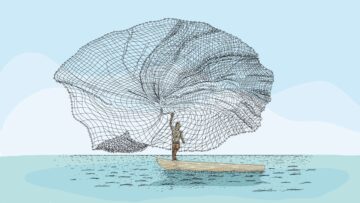 The lab buildings of Long Island’s renowned Cold Spring Harbor Laboratory have hosted researchers responsible for some of the most consequential scientific leaps in human genetics and disease. In the last 60 years, eight of the lab’s scientists have earned Nobel Prizes, including for work on how viruses replicate, on chromosome structure, and how edited genes can cause disease.
That setting felt auspicious when nearly two-dozen people, most of them researchers, gathered at a conference center about 5 miles from the main campus in December 2023 to lay out the definition for a budding scientific discipline nearly two decades in the making. The work aims to understand human health outcomes by cataloguing the tens of thousands of chemicals and conditions a person is exposed to over the course of their life and determine how those interactions affect their unique biology, a concept referred to as the exposome.
More here.
Enjoying the content on 3QD? Help keep us going by donating now.
The Standoff: Harvard’s Future in the Balance
From Harvard Magazine:
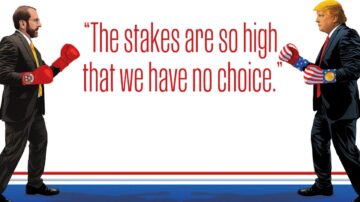 Harvard never wanted or expected this. University leaders had spent the spring in conversation with the Trump administration, which threatened to withdraw federal funding if charges of antisemitism on campus were not addressed. But when a letter arrived on April 11 with a list of sweeping demands—effectively giving the government control of Harvard’s hiring, admissions, and even the makeup of academic departments—negotiations came to a halt. In an interview with NBC later that month, President Alan M. Garber explained the decision: “The stakes are so high that we have no choice” but to fight.
So launched the extraordinary battle that is playing out in federal court, in op-ed pages, on social media, and sometimes in the streets. The government has targeted Harvard’s research funding, endowment, and ability to enroll international students. Harvard has filed two federal lawsuits, seeking to stop the government’s actions on the grounds of free speech violations and administrative overreach. And the University’s stand against the Trump administration has made Harvard a symbol in the public eye—a stand-in for higher education, globalization, and the government’s traditional role in advancing science and innovation.
More here.
Enjoying the content on 3QD? Help keep us going by donating now.
A common parenting practice may be hindering teen development
Sujata Gupta in ScienceNews:
 For years, researchers and policymakers have been sounding the alarm about the limited opportunities children and teenagers have to play and explore without adults around. For instance, children across much of the Western world are less likely to hold part-time jobs or walk or bike to school alone compared with previous generations, psychologist Peter Gray and colleagues noted in a September 2023 review in the Journal of Pediatrics. Other research shows that parents report increasing discomfort with letting their kids engage in risky, unsupervised play.
That loss of freedom coincides with a decades-long uptick in teen mental health problems. But showing that one causes the other has proven difficult because of all the other recent changes to childhood, such as technology use, researchers say. But it’s clear that squelching childhood independence undermines normal development, including a teenager’s innate need for close peers and intimate partners, says Gray, of Boston College. “It’s absolutely no surprise to me that we are seeing these dramatic rises in anxiety, depression, even suicide among teenagers.”
More here.
Enjoying the content on 3QD? Help keep us going by donating now.
Tuesday, June 17, 2025
How Pakistan fell in love with sushi
Sanam Maher in The Guardian:
 When the 17-storey Avari Towers opened in Karachi in April 1985, it was the tallest hotel in the city. “It felt otherworldly,” said one chef who worked there as a teenager. “It was there that I saw a swimming pool for the first time,” he remembered, “and swimsuits.” By December 1986, this $32m building had another novelty to offer – Fujiyama, a Japanese restaurant at its summit. There had been no advertisements for Fujiyama, and for its first six weeks, the only way to get in was with an invitation; these began to land in the homes and offices of the city’s bankers, businessmen, doctors and other members of Karachi’s elite. By the new year, the restaurant was so busy it had waiting lists. There were now two kinds of people in the city of 6 million: those who had tried sushi and those who had not.
In the late 80s, a Japanese restaurant like Fujiyama was an expensive proposition: foreign chefs had to be hired, staff trained, and ingredients, from wasabi to rice, constantly imported. Sushi – raw fish – in a country where daal roti is a staple and vegetables are often cooked down until they lose their crunch: who would take such a risk? And yet, somehow, it paid off. Fujiyama was the first place to serve Japanese cuisine in Pakistan, and it was where many Pakistanis encountered sushi for the first time.
Today, you can finish your day of fasting during Ramadan at a sushi buffet or host a wedding reception for a small (by Pakistani standards) gathering of 100 or more at a Japanese restaurant. When restaurants closed during the pandemic, waiters zipped across the city on motorbikes to deliver sushi.
More here.
Enjoying the content on 3QD? Help keep us going by donating now.
An immersive ‘flow state’ isn’t only accessible to great artists and athletes. You can find your flow too. Here’s how
Julia F Christensen at Aeon:
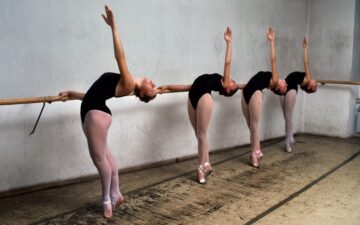 To tap into the flow state, your skill level and the challenge of the task you’re working on should be in perfect balance. This is one of the eight principles of flow, first described by the Hungarian scientist Mihaly Csikszentmihalyi. He coined the term ‘flow’ in 1990 after decades of scientific work about what surgeons, painters, dancers, writers, scientists, martial artists, musicians and other creatives have in common – a curious, all-absorbing state of mind where we feel amazing and are incredibly productive and creative at the same time.
Modern neuroscience distinguishes between two mental states: one of striving, where a surge of dopamine keeps us laser-focused on external goals like winning, perfection or achievement – and another of serene presence, where we hover in the moment, simply being. In this latter state, our neural chemistry shifts; endogenous opioids and endocannabinoids fill the brain, bringing feelings of deep satisfaction, fulfilment and joy in the now.
Motivation psychologists distinguish these two states as extrinsic and intrinsic motivation for what we’re doing. The former takes hard work and discipline to keep us going. The latter propels us forward, as by magic: flow. Research even shows that those more prone to enter the flow state might have lower risk of mental health problems and cardiovascular disease.
More here.
Enjoying the content on 3QD? Help keep us going by donating now.
Geoffrey Hinton on the Dangers of AI
Enjoying the content on 3QD? Help keep us going by donating now.
These Dis-United States
Richard Kreitner in The Nation:
 Let’s be frank: It’s a somewhat presumptuous name for a magazine. Adopting it may have been akin to what philosophers refer to as a “speech act,” meant to call into being the very thing referred to. Largely absent from pre–Civil War political rhetoric, which more often spoke of “the union” or “the republic,” the word nation appeared five times in Abraham Lincoln’s 1863 Gettysburg Address. Two years later, when the first issue rolled off the presses in July 1865, the Confederacy had been defeated and Lincoln murdered, and a fierce fight over whether the “nation, conceived in Liberty, and dedicated to the proposition that all men are created equal,” would indeed see “a new birth of freedom” was just beginning. The Nation was founded to see that struggle through—and we will.
By the 1920s, there was still something a little incongruous in a magazine so named devoting hundreds of pages over three years to an extensive meditation on each of the separate states. Penned by some of the most illustrious writers of the period—W.E.B. Du Bois on Georgia, Edmund Wilson on New Jersey, Sherwood Anderson on Ohio, Willa Cather on Nebraska, H.L. Mencken on Maryland, Sinclair Lewis on Minnesota, Theodore Dreiser on Indiana—the essays in that series, “These United States,” explored the rich history, geography, and character of those minor subdivisions supposedly effaced by the Civil War. The country was often depicted as “one vast and almost uniform republic,” the editors observed in an introductory note in 1922. But that left out what made American life interesting: “What riches of variety remain among its federated commonwealths? What distinctive colors of life among its many sections and climates and altitudes?”
In perusing the following dispatches from “These Dis-United States,” as we’re calling the series this time around, you may well be struck by how similar the experiences of this moment are in many states across this bruised and battered land.
More here.
Enjoying the content on 3QD? Help keep us going by donating now.
Pico Iyer on Finding the World in a Benedictine Monastery
Maria Popova at The Marginalian:
 The best measure of serenity may be our distance from the self — getting far enough to dim the glare of ego and quiet the din of the mind, with all its ruminations and antagonisms, in order to see the world more clearly, in order to hear more clearly our own inner voice, the voice that only ever speak of love.
It is difficult to achieve this in society, where the wanting monster is always roaring and the tyranny of should reigns supreme.
We need silence.
We need solitude.
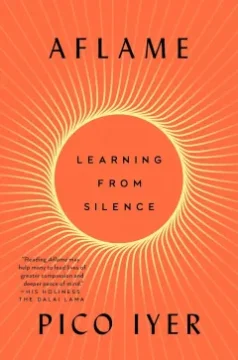
The great paradox of our time is that the more they seem like a luxury in a world of war and want, the more of a necessity they become to the survival of our souls. Pico Iyer, that untiring steward of the human soul, liberates the possibility imprisoned in the paradox with his slender and splendid book Aflame: Learning from Silence (public library) — a reckoning with the meaning of life drawn from his time spent in a Benedictine monastery on a journey toward inner stillness and silence, along which his path crosses those of those of fellow travelers in search of unselfing: a 100-year-old Japanese monk and a young Peruvian woman with a love of Wittgenstein (who worked as a gardener in a monastery himself), the Dalai Lama and Leonard Cohen, a middle-aged corporate refugee “red-cheeked and glowing with life” and a white-haired French-Canadian widow with a spirit that “keeps shining, like a candle in the fog.”
more here.
Enjoying the content on 3QD? Help keep us going by donating now.
Hiroshi Shimizu • Japanese Girls at the Harbor (1933)
Enjoying the content on 3QD? Help keep us going by donating now.
How to Be Healthy at 100: Centenarian Stem Cells Could Hold the Key
Shelly Fan in Singularity Hub:
 When Jeanne Calment died at the age of 122, her longevity had researchers scratching their heads. Although physically active for most of her life, she was also a regular smoker and enjoyed wine—lifestyle choices that are generally thought to decrease healthy lifespan.
Teasing apart the intricacies of human longevity is complicated. Diet, exercise, and other habits can change the trajectory of a person’s health as they grow older. Genetics also plays a role—especially during the twilight years. But experiments to test these ideas are difficult, in part because of our relatively long lifespan. Following a large population of people as they age is prohibitively expensive, and results could take decades. So, most studies have turned to animal aging models—including flies, rodents, and dogs—with far shorter lives.
But what if we could model human “aging in a dish” using cells derived from people with exceptionally long lives?
More here.
Enjoying the content on 3QD? Help keep us going by donating now.
Reading through bad feeling
Garth Greenwell in The Yale Review:
 I came to all of Jane Austen’s novels late, and to Persuasion particularly so, finally discovering it in a graduate seminar on the long eighteenth century. By that time, I had fallen in love with Austen, with her comedy and her depth as a moral thinker, above all with her humaneness, the tenderness that doesn’t cancel out but nevertheless subsumes the prickly, arch, almost always delightful critique she aims at her characters, even the characters she obviously intends us to admire. So I remember my shock when, in a novel that had already won me over and that I continue to love, I came upon one of the cruelest passages in any of the books I know. It comes in chapter eight; Anne Elliot and Captain Wentworth are visiting the Musgroves. Anne and Wentworth were once in love, until Anne (under persuasion) called things off; now, for the first time in years, they’re running in the same circles again. Wentworth is bitter, and pointedly cold; in this moment they’re further separated, perched on the same sofa but with their hostess—“no insignificant barrier”—between them.
More here.
Enjoying the content on 3QD? Help keep us going by donating now.
Tuesday Poem
Ode to Skateboard-Guy Who Took Munitions from ICE
in LA, Walked Away and Flipped Them Off
You look like half my friends from 1994.
Baggy pants, bulked sweatshirt,
beanie, or backward cap (can’t tell
through the haze) and double shoulder-strapped
Jensen backpack. Board in hand,
walking down the street like the street
is an old friend who kissed your girl
and you want to rough him up but not enough
to lose a friend cause she’ll likely leave one day.
You strut straight up to the lCE-line, Guard-line, LAPD—
who can tell at this point, uniforms beget
uniforms, masked faces moving in the name
of hauling day laborers out of Home Depot
men, fathers, hoping for a few work hours,
a day’s wage, trying to build something.
The cops don’t hesitate firing gas, pepper, rubber
bullets, at you, one baggy man lugging
his board, and you stand as if dared, holding
ground, then parade away through powder and smoke.
In the name of humans living out the abstractions
tossed like tickertape—hope, opportunity, freedom—
actually living, a body buying buckets of nails
and 2x4s in that orange warehouse, filling
a flat cart, swiping a debit card, wearing
Carhart jeans, a sweatshirt, a backwards cap,
wrist grabbed while sticking a wallet back
in his back pocket, the whip of image fliting
across his thoughts of his daughter walking
through the door, home from school,
his wife unpacking from a day of processing
numbers or food then he’s gone, swallowed
by cement: that body is body and ideal.
That body is any body. Making a life is to foster
enchantment in nails, cut lumber, the belief
that working hard will actually pay off. How many
who love freedom have the courage to stand firm
on another country’s ground? To find hope in hammers,
in a single finger and a slightly slouched shoulder?
by Jeremy Voigt
Enjoying the content on 3QD? Help keep us going by donating now.
On Hiroshi Shimizu
Alex Kong at n+1:
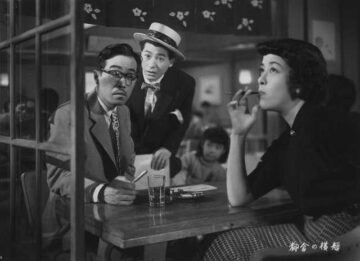 In matters of style, diligence is usually understood to be antithetical to spontaneity. This is the conventional wisdom when it comes to cinematic style too, and among viewers in the West, Japanese cinema in particular tends to be thought of as the effusive outpouring of maverick auteurs—iconoclasts raging against the machine and rejecting commercial constraints to protect their cherished individuality. So it can be surprising that many of that tradition’s great achievements in fact emerged from an industrial studio system built around mass production. Ozu and Mizoguchi, for instance, were above all journeymen directors for large studios, working under a mandate to churn out product at scale, and Naruse, too, was known as a faithful employee who always finished his films under budget and never said no to an assignment; needless to say, these conditions didn’t stop them from creating masterpieces. One of their colleagues was the woefully overlooked Hiroshi Shimizu, who made at least 163 films over the course of a career that spanned the silent era and the talkies. The assembly-line conditions don’t seem to have been especially onerous for him: “I’m going to make only three films the way the company wants me to,” Shimizu said in 1935, “and in exchange I can make two films that I want.”
more here.
Enjoying the content on 3QD? Help keep us going by donating now.
Monday, June 16, 2025
$50,000 Berggruen Prize Essay Competition
From the website of the Berggruen Institute:
 The annual Berggruen Prize Essay Competition seeks to stimulate new thinking and innovative concepts while embracing cross-cultural perspectives across fields, disciplines, and geographies. By posing fundamental philosophical questions of significance for both contemporary life and for the future, the competition will serve as a complement to the Berggruen Prize for Philosophy & Culture, which recognizes major lifetime achievements in advancing ideas that have shaped the world.
The competition awards a prize of $50,000 USD for essays submitted in English and $50,000 USD for essays submitted in Chinese. An award ceremony will be hosted, and the winning essays will be published to give readers insight into perspectives of both East and West.
The inspiration for the competition originates from the role essays have played in the past, including the essay contest held by the Académie de Dijon. In 1750, Jean-Jacques Rousseau’s essay Discourse on the Arts and Sciences, also known as The First Discourse, won and notably marked the onset of his prominence as a profoundly influential thinker. Similarly, our competition aspires to create a platform for groundbreaking ideas and intellectual innovation.
More information here.
Enjoying the content on 3QD? Help keep us going by donating now.