
Category: Recommended Reading
Cynthia Haven: My never-before-published Q&A with Adam Zagajewski
Cynthia Haven in her blog:
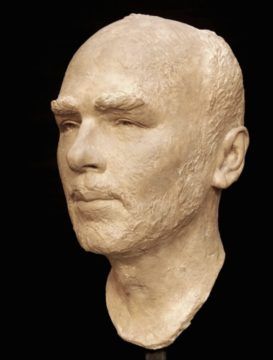 I wrote about poet Adam Zagajewski, who died last weekend at 75, for the Poetry Foundation about a decade ago. The published article, “Risk, Try, Revise, Erase,” wasn’t a Q&A, but I sent him some questions anyway, for the fun of it. Some of his replies were included in my article, but my questions were more guided by my interests and curiosity than focused journalistic intent.
That’s why this interview was never published before. It didn’t seem polished enough or grand enough. But I can’t get my friend out of my mind today. So the Book Haven provides me an opportunity to share these outtakes with a very gifted poet who left us too soon. He was one of the reasons I wanted to go back to Kraków, and now it’s hard to imagine the city without him. It is said that he lived in the shadow of poetry giants, but he also became one, and on his own his quiet terms. (A week or ago I wrote about sculptor Jonathan Hirschfeld’s sculpture of Miłosz. I also share his portrait of Adam above, circa 1990, in the same spirit of the moment.)
Q. First, a simple question from my own personal interest. I love your poem “Three Angels.” It takes place on St. George Street – I take it that’s in Kraków? Did you have any particular bakery in mind when you wrote this poem?
A. No, there’s no bakery in the St. George Street. Actually there’s no St. George Street in Krakow–there’s a St. John Street, though. I like sometimes small shifts like that: I’m close to reality but not too close. And there are many bakers in Krakow (bread is good here).
More here.
The Sexual Translator
Wayne Koestenbaum at n+1:

The pivotal event in our friendship concerned Mallarmé. The translator, Abel Mars, had discovered the secret key to Divagations, and embarked on a translation that would reveal to the world the unsuspected sexual architecture underlying Mallarmé’s sense-confounding essays, which destroyed readers while seeming to titillate them. Abel (or Abelline, as I sometimes called him, in moments of intimacy) had a fear of blue objects (vases, shirts, flowers, paintings, rugs); anything blue horrified him, perhaps because his mother had once exposed him, during a childhood attack of meningitis, to a not-yet-patented blue light, which a quack acquaintance had pushed on the family as a cure-all device for their ailing, precocious son. The blue light, which his mother had trained on his naked body as he lay on the living room carpet, had caused him to bleed from the ears; the bleeding cured his meningitis—expelling it from his body—but instilled in him a fear of anything blue. More logical it would have been if Abel had grown to fear illness itself; paradoxically, he feared not the pathogens but the anti-pathogens.
more here.
Do We Know What Knowing Is?
https://www.youtube.com/watch?v=15-PCBFutos
Magic, Mystery, and Imagination in American Realism
Albert Mobilio at Artforum:
 Charles Patterson’s Peppers, 1953, presents a pair of gigantic green peppers against an unnaturally manicured landscape. Textured with a kind of tense muscularity, the fruits convey the sense they might burst forth from the board and, as such, are more than a little bit threatening. This slightly off-kilter depiction of quotidian objects, rendered with painterly exactitude, seems precisely to fit Barr’s characterization. But in another piece of Patterson’s—The Room, 1958—the stagey improbability and expressionless faces of its five assembled characters combine to much less disconcerting effect. A wide-eyed female figure reclines on a divan while a man and woman struggle with a large dog that may wish to chase the cat dashing beneath the studio couch. An open curtain behind the group reveals an elderly woman robing a skeletal figure in a bath. If the realm of unconscious reverie is being evoked, it is done with a deliberateness that recalls the clichés of an overly earnest Surrealism—locomotives emerging from fireplaces, elephants on bony stilts, and the like.
more here.
Frantumaglia: Elena Ferrante’s Blurred Lines
Pamela Erans in VQR:
The enormous attention to Elena Ferrante’s Neapolitan quartet—first the books published in the US between 2012 and 2015 and then the HBO series that has so far covered the first two titles, My Brilliant Friend and The Story of a New Name—has obscured the fact that in Ferrante’s novelistic output as a whole, female friendship has not been a primary theme. The three intense and at times phantasmagorical novels she published before the Neapolitan quartet dealt with friendship almost not at all. Troubling Love (1992) is about the relationship between a middle-aged woman and her recently deceased mother; in The Days of Abandonment (2002) a mother of two young children is abruptly left by her husband; and while The Lost Daughter (2006) concerns two women who meet on a beach vacation, it has more to do with the narrator’s odd, impulsive theft of a doll beloved by the other woman’s daughter. Messy familial bonds have been the focus of Ferrante’s work: bonds between grown daughters and their mothers, mothers and their young children, and women and their husbands. She is interested in intimacy and betrayal, merging and separation, the peril of togetherness on the one hand and solitude on the other. Either losing oneself in another or remaining too distant can threaten the stability of her first-person, female narrators. Above all, in Ferrante’s novels, close relationships, whether hostile or loving, never truly end.
All three of Ferrante’s pre-quartet novels involve a small number of significant characters and take place in highly compressed periods of time.
More here.
Decades Before the Civil War, Black Activists Organized for Racial Equality
Kate Masur in Smithsonian:
In summer 1836, white residents of Cincinnati rioted, not for the first time, against their black neighbors. On this occasion, the Ohioans rallied first against the city’s newly established abolitionist newspaper, The Philanthropist, destroying editor James Birney’s printing press and throwing the pieces into the Ohio River. From there they rampaged through black neighborhoods, attacking businesses and looting private homes. Ohio was a free state, but African Americans living there were subject not only to periodic white lawlessness but also to explicitly racist laws. The so-called “black laws,” which the state legislature began passing in 1804, required black residents to register with county officials (which included showing proof that they were legally free, getting landowners to post bonds on their behalf, and paying a fee), forbade African Americans from testifying in court cases involving whites, and reserved public education for white children only. Separately, the state constitution declared that only white men were entitled to vote.
Despite such strictures, Ohio and other destinations north of the Ohio River looked promising to free and enslaved black people hoping to leave the states where slavery was legal. According to U.S. Census figures, the black population of Ohio grew steadily in the first half of the 19th century, climbing from 9,568 to 17,342 between 1830 and 1840, for example. While this population only amounted to one percent of the state’s total population, the activism of black Ohioans, both in its success and failures, offer a window into this country’s first civil rights movement.
More here.
Thursday, March 25, 2021
Why the Social Market Economy Succeeds
Lars P. Feld, Peter Jungen, and Ludger Schuknecht in Project Syndicate:

The COVID-19 pandemic has intensified ongoing debates about the future of capitalism and the economic framework best suited to meet the post-pandemic world’s long-term needs. Developed economies will, of course, need strong growth to offset the economic damage wrought by the virus, and to rise to the challenges posed by climate change and societal aging. And yet, across the developed world, the pace of economic growth has been slowing for decades, casting doubt on how these challenges will be met.
How should the gap between actual and necessary growth be closed? Should developed economies continue to focus on Keynesian demand management, thus risking the accumulation of ever more debt? Or should we shift to a longer-term, rules-based approach that anchors expectations and builds confidence, albeit at the expense of some policy discretion?
More here.
Sean Carroll’s Mindscape Podcast: Elizabeth Anderson on Equality, Work, and Ideology
Sean Carroll in Preposterous Universe:
 Imagine two people with exactly the same innate abilities, but one is born into a wealthy family and the other is born into poverty. Or two people born into similar circumstances, but one is paralyzed in a freak accident in childhood while the other grows up in perfect health. Is this fair? We live in a society that values some kind of “equality” — “All men are created equal” — without ever quite specifying what we mean. Elizabeth Anderson is a leading philosopher of equality, and we talk about what really matters about this notion. This leads to down-to-earth issues about employment and the work ethic, and how it all ties into modern capitalism. We end up agreeing that a leisure society would be great, but at the moment there’s plenty of work to be done.
More here.
Not only production and distribution difficulties but also ideologies of western supremacy are hindering global vaccination efforts
Santiago Zabala in Al Jazeera:
 Even though China and Russia started inoculating their citizens last year before publishing the efficacy results from their phase 3 clinical trials, which inevitably raised legitimate concerns, these vaccines have since been proven safe and efficient. The medical journal The Lancet published in February results from late-stage trials showing that Sputnik V, the Russian vaccine, has an efficacy rate of 91.6 percent. At least twenty-five countries around the world, meanwhile, have approved and are administering Sinopharm, one of the Chinese vaccines, with seemingly successful results.
This conviction in Western scientific and technological superiority is so established that it does not seem ideological any longer. The Western nations have become so consumed by their perceived superiority that they cannot even imagine non-Western success in vaccine development.
More here.
Sabine Hossenfelder: Whatever Happened to Life on Venus?
Marilynne Robinson’s Testimony
Elisa Gonzalez at The Point:
 But Robinson’s Christianity manifests as more than a formal approach to experience—the particulars of her belief do matter, and they serve as a foundation for the representation of American racism in the Gilead novels. With John Calvin, she shares the conviction that there is “a visionary quality to all experience” and that God animates, at every moment, all of creation. This endows that creation with immanence and revelatory potential. She believes in the existence of souls, mysterious and unaccountable and equal, which profoundly influences how she engages the material reality of racist institutions and social practices. She believes, like Calvin and the contemporary Black theologian Reggie L. Williams, that each encounter with another person is an encounter with an image of God, in effect God himself, thus placing an immense weight on the treatment of others, surpassing even the Golden Rule. Even if a man is trying to kill you, “you owe him everything.” As Calvin does, she believes that each encounter with another person is a question that God is asking of you. In a recent lecture, she described one of God’s goals for creation—which, by implication, should be a human goal—as “human flourishing.” “Flourishing” is a startling word. Its pursuit demands far more than tolerance, or even civic equality: it demands a passionate devotion to others, regardless of your connections through family, country, race or religion. For her, good and evil are relational, social—not solely internal matters. Christianity, she has said, is an ethic, not an identity.
more here.
Wayne Koestenbaum’s Winningly Capricious Stories
Negar Azimi at Bookforum:
 IN THE ANTIC TALE that opens The Cheerful Scapegoat, Wayne Koestenbaum’s book of self-described “fables,” a woman named Crocus, like the flower, arrives at a house party wearing a checkered frock designed by the Abstract Expressionist Adolph Gottlieb. She cowers in the entrance, vacillating over whether to enter or not. She phones her doctor, a man whom she refers to as the “miscreant-confessor,” who entreats her to be social. Inside, Crocus accompanies a “fashionable mortician” to a bedroom where she happens upon a fully clothed woman lying atop a fully clothed man. Observing something “unformed and infantile” about the man’s features, Crocus is overcome by a feeling of revulsion, “as if she were looking at a Chardin painting for the first time and were not comprehending her ecstasy—a conundrum which forced Crocus to shove her rapture into a different medicine-cabinet, a hiding-place christened ‘Disgust.’” From this point on, any attempt to pithily encapsulate what happens is doomed.
more here.
Leo Strauss – The Origins of Political Science (Part 1)
Thursday Poem
Walt Whitman at Bear Mountain
Neither on horseback nor seated,
But like himself, squarely on two feet,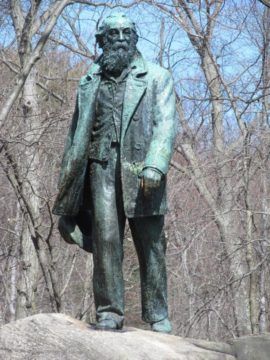
The poet of death and lilacs
Loafs by the footpath. Even the bronze looks alive
Where it is folded like cloth. And he seems friendly.
“Where is the Mississippi panorama
And the girl who played the piano?
Where are you, Walt?
The Open Road goes to the used-car lot.
“Where is the nation you promised?
These houses built of wood sustain
Colossal snows,
And the light above the street is sick to death.
“As for the people—see how they neglect you!
Only a poet pauses to read the inscription.”
“I am here,” he answered.
“It seems you have found me out.
Yet did I not warn you that it was Myself
I advertised? Were my words not sufficiently plain?
I gave no prescriptions,
And those who have taken my moods for prophecies
Mistake the matter.”
Then, vastly amused—”Why do you reproach me?
I freely confess I am wholly disreputable.
Yet I am happy, because you found me out.”
A crocodile in wrinkled metal loafing . . .
Then all the realtors,
Pickpockets, salesmen and the actors performing
Official scenarios,
Turned a deaf ear, for they had contracted
American dreams.
But the man who keeps a store on a lonely road,
And the housewife who knows she’s dumb,
And the earth, are relieved.
All that grave weight of America
Cancelled! Like Greece and Rome.
The future in ruins!
The castles, the prisons, the cathedrals
Unbuilding, and roses
Blossoming from the stones that are not there . . .
The clouds are lifting from the high Sierras,
The Bay mists clearing,
And the angel in the gate, the flowering plum,
Dances like Italy, imagining red.
The Amazon Union Drive and the Changing Politics of Labor
Benjamin Wallace-Wells in The New Yorker:
 Most contemporary union drives are ultimately about the past—about the contrast that they draw between the more even prosperity of previous decades and the jarring inequalities of the present. But one that will culminate on Monday, the deadline for nearly six thousand employees of an Amazon fulfillment center in Bessemer, Alabama, to cast ballots on whether to affiliate with the Retail, Wholesale, and Department Store Union, is the rare union campaign that is obviously about the future. In this case, hyperbole is possible. The Democratic congressman Andy Levin, of Michigan, a union stalwart, has described it as “the most important election for the working class in this country in the twenty-first century.” On Monday, the Reverend Dr. William Barber, as prominent a figure as exists in the modern civil-rights movement, travelled to Alabama and said, “Bessemer is now our Selma.”
That this election is about the future has something to do with the workers themselves, who embody the political transformation of the South to which progressives pin their dreams. According to union officials, a majority of the people employed at the facility, which is outside of Birmingham, are Black, and a majority are women. On the drive up to the facility, supporters of the R.W.D.S.U. planted a sign featuring the Democratic politician and voting-rights advocate Stacey Abrams striking a Rosie the Riveter pose. A high-ranking labor official in Washington pointed me to a detail from an interview, published in The American Prospect, with the campaign’s on-the-ground leader, a thirty-three-year-old organizer named Josh Brewer. Brewer said that many of the workers who supported the union had been involved in demonstrations to bring down Confederate statues in Birmingham, and they often organized themselves.
But the significance of the drive has more to do with the company itself.
More here.
Politicians must dial down the rhetoric over COVID vaccines
Editorial in Nature:
 In January, French President Emmanuel Macron called the AstraZeneca–Oxford coronavirus vaccine “quasi-ineffective for people over 65”, on the day that the European Medicines Agency (EMA) recommended approving it. Kate Bingham, one of the architects of the UK vaccine-procurement programme, has since called the remarks “irresponsible”, because the vaccine has been recommended by regulators for use in people of all ages.
Although some 20 million doses of the vaccine developed by AstraZeneca, based in Cambridge, UK, and the University of Oxford, UK, have been administered across Europe, a political war of words has erupted over its safety and efficacy. Such interventions risk increasing vaccine hesitancy. Communication on vaccine safety and efficacy must always be handled with extreme care. Last week, more than 20 European countries paused the vaccine’s roll-out for a few days after a very few cases of blood clots were detected in people who had been vaccinated. These were 7 cases of clots in multiple blood vessels (disseminated intravascular coagulation) and 18 cases of clotting known as cerebral venous sinus thrombosis. Among the people affected, nine deaths had been recorded.
More here.
Wednesday, March 24, 2021
Wilfrid Sellars, sensory experience and the ‘Myth of the Given’
Nate Sheff in Psyche:
 Most of us think that knowledge starts with experience. You take yourself to know that you’re reading this article right now, and how do you know that? For starters, you might cite your visual experiences of looking at a screen, colourful experiences. And how do you get those? Well, sensory experiences come from our sensory organs and nervous system. From there, the mind might have to do some interpretative work to make sense of the sensory experiences, turning the lines and loops before you into letters, words and sentences. But you start from a kind of cognitive freebie: what’s ‘given’ to you in experience.
It’s a tantalising idea, and maybe it’s close to the truth. But if we’re not careful, we might run afoul of what the American philosopher Wilfrid Sellars (1912-89) called ‘the Myth of the Given’. While many philosophers consider Sellars’s attack on the Myth to be his legacy, it’s one of his least-understood ideas. That’s too bad, because once we set aside ‘epistemological shoptalk’ (one of my favourite Sellarsisms), the basic idea is simple – and far-reaching.
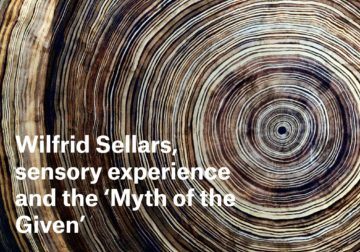
Let’s start with something easy. You probably know how to read tree rings, the circles-within-circles that appear in the cross-sections of trees. Tree rings form as a tree grows, making new layers of bark. Counting the rings helps you determine the tree’s age, since each ring correlates with one year of growth. Now imagine we’re looking at a recently felled oak, and we count 75 rings. It would be innocent for me to say to you: ‘Those 75 rings mean the tree was 75 years old.’ More metaphorically, the rings ‘tell us about’ the tree’s age.
In a stricter sense, though, the tree rings don’t really ‘say’ anything. The patterns in the tree can give useful information to anyone who can read them, but the rings themselves aren’t actually ‘about’ anything. Remember, a ring forms as a side-effect of trees doing what trees do. They don’t express information in the way that trails, maps or sentences do.
But why not?
More here.
Something beyond the Standard Model of particle physics?
Jon Butterworth in The Cosmic Shambles:
 The experiment measures the decays of B-hadrons, particles containing bottom quarks. Quarks make up the protons and neutrons inside every atomic nucleus, but those are “up” and “down” quarks. The bottom quark is one of their cousins, and is much heavier.
This means B-hadrons need something like the collisions at the LHC to produce them (that’s the “b” in LHCb). It also means they are unstable, because the b-quark inside them will decay to less massive particles.
One type of particles that can be produced in these decays is a lepton. In this case, either an electron, or their heavier cousin, the muon. The Standard Model makes a very firm prediction that both these decays should be equally likely. The measurement shows that the decay to pairs of muons only happens about 85% as often as the decay to pairs of electrons.
Of course, the devil is in the uncertainties.
One man’s quest to find his son lays bare the reality of Palestinian life under Israeli rule
Nathan Thrall in the New York Review of Books:
 On the day before the accident, Milad Salama could hardly contain his excitement for the kindergarten class trip. “Baba,” he said, addressing his father, Abed, “I want to buy food for the picnic tomorrow.” Abed took his five-and-a-half-year-old son to a nearby convenience store, buying him a bottle of the Israeli orange drink Tapuzina, a tube of Pringles, and a chocolate Kinder Egg, his favorite dessert.
Early the next morning, Milad’s mother, Haifa, helped her fair-skinned, sandy-haired boy into his school uniform: gray pants, a white-collared shirt, and a gray sweater bearing the emblem of his private elementary school, Nour al-Houda, or “light of guidance.” Milad’s nine-year-old brother, Adam, old enough to walk to school on his own, had already left. Milad hurried to finish his breakfast, gathered his lunch and picnic treats, and rushed out to board the school bus. Abed was still in bed.
On most days, Abed worked for the Israeli phone and Internet service provider Bezeq. But that morning, he and his cousin had plans to go to Jericho.
More here.