
Enjoying the content on 3QD? Help keep us going by donating now.
Category: Recommended Reading
Climate Caused the US Civil War
Tomas Pueyo at Uncharted Territories:
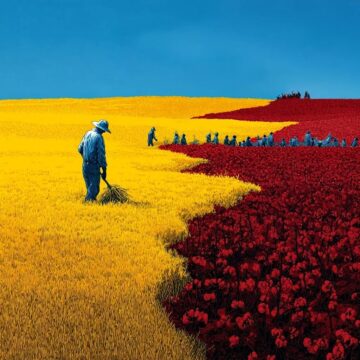 Because of climate, the North farmed crops like wheat and barley that required very little work, and that work was easy to automate. This tended to make farmers independent, incentivize industrialization for the machinery, and push settlers west very fast, as they weren’t as limited by labor needs.
Conversely, the crops grown in the south—mainly cotton, tobacco, sugarcane, and rice—all require substantially more work, so getting lots of workers at the lowest possible cost made or broke fortunes. This is why slavery emerged here, why it was fundamental to the South’s economy, and why Southerners went to war to continue it.
Why does all this matter? It’s not just a crucial fact of US history. This has dramatic consequences today, from the roots of racial inequality, to where the Democratic party wins elections, and the relative poverty of the US South.
So let’s dive in: How exactly did climate cause the Civil War, and what are the consequences of that today?
More here.
Enjoying the content on 3QD? Help keep us going by donating now.
Wednesday Poem
First Light
after the Webb discovery
The newest moon they found around Uranus
is so small it fits inside
a sentence.
Ten kilometers across,
they think. A shimmer
between Ophelia and Bianca—
it doesn’t even pull at things.
Still, it’s there—
threaded on the same old dark.
I read this the same week
Mickey died. She was only ours
eleven months—not long enough
to unlearn flinching. She’d still sleep
under the table, even after
we moved the table.
They say the moon was always there,
just invisible. Too soft
for Voyager. Too faint for Hubble.
How many things love us
quietly? How many
never get seen
until a better eye looks?
The article showed no images—
only a plot of starlight interrupted
like breath paused
in grief. And a line drawn
where the absence
spoke.
I don’t think I believe
in heaven, but still I like
that the cold knows how
to hold a secret for a long time
without
breaking it.
by Sushanta Basumatary
Enjoying the content on 3QD? Help keep us going by donating now.
On Malaparte: A Biography
Andrew Stuttaford at The New Criterion:
 Kaputt is episodic, its style dreamlike, surreal, hallucinatory, grotesque, a vision of a world so askew that even the skies have gone mad: “the sky was an eyeless face—a dead white face.” The carcasses of horses remain trapped in a frozen lake, “a vast sheet of white marble . . . . Only the heads stuck out of the crust of ice.” Frank playing Chopin in his castle, “Malaparte” wandering through the Romanian city of Jassy (Iași), just ahead of a pogrom: “It began to rain, a slow warm rain that seemed to drop out of a cut vein.” Occasionally he escapes to high society—Princess This, Count That—adding some Proust to a work that owes much more to Goya.
In Kaputt, Malaparte the novelist uses the credibility, such as it was, of Malaparte the journalist, leaving it up to the reader to decide how much is fact, heavily embellished fact, or entirely made up, an ambiguity not unhelpful for an author rewriting his own past. And by the time of Kaputt’s publication, this is what Malaparte was trying to do. His association with Italy’s Fascist regime had been complicated, but it was close enough to merit a (brief) jailing after Mussolini had been overthrown, and the promise of dangerous questions to come.
more here.
Enjoying the content on 3QD? Help keep us going by donating now.
The Worlds of Albert Einstein
Dmitri Levitin at Literary Review:
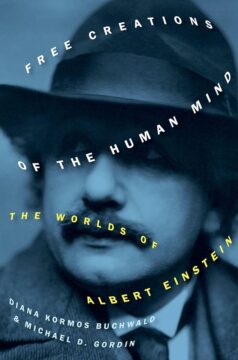 Historians of science have a guilty secret: we don’t particularly enjoy writing about those deemed singular geniuses. The public – or at least publishers – want stories of revolutionaries who stood entirely apart from their peers and predecessors, or, failing that, to see them ‘exposed’ as plagiarists (ideally stealing the work of the oppressed). But science rarely works in such simplistic ways. A century of historical scholarship has shown that the figure of the lone genius is largely mythical.
Still, it remains tempting to think that Albert Einstein is the exception to the rule. Everything about him savours of the preternatural: his discovery, aged just twenty-six, of special relativity while working as a clerk at the Swiss Patent Office; his appearance in later life as a wild-haired guru uttering sage pronouncements about the universe; the sheer weirdness of the general theory of relativity and quantum physics. Diana Buchwald and Michael Gordin’s marvellous and concise new biography shows that for all his unquestionable brilliance, Einstein almost always worked as part of a broader community rather than delivering vatic pronouncements from on high.
more here.
Enjoying the content on 3QD? Help keep us going by donating now.
How Common Knowledge Shapes the World
Enjoying the content on 3QD? Help keep us going by donating now.
How did life get multicellular? Five simple organisms could have the answer
Alla Katsnelson in Nature:
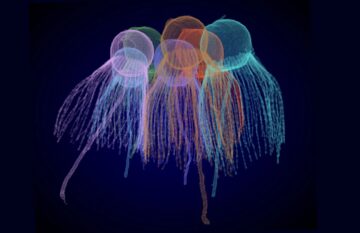 For some three billion years, unicellular organisms ruled Earth. Then, around one billion years ago, a new chapter of life began. Early attempts at team living began to stick, paving the way for the evolution of complex organisms, including animals, plants and fungi. Across all known life, the move to multicellularity happened at least 40 times, suggests one study1. But, in animals, it seems to have occurred only once.
Enjoying the content on 3QD? Help keep us going by donating now.
Tuesday, August 26, 2025
The Pleasure of Patterns in Art
Samuel Jay Keyser at The MIT Press Reader:
 Made at the high point of Kline, de Kooning, and Pollock, Andy Warhol’s “Campbell’s Soup Cans” was a poke in the eye of abstract expressionism. Not only was it blatantly mimetic, but it was being blatantly mimetic with a mundane commercial product found in every supermarket and corner grocery store in America. When people think of repetition in painting, they probably think first of these iconic soup cans.
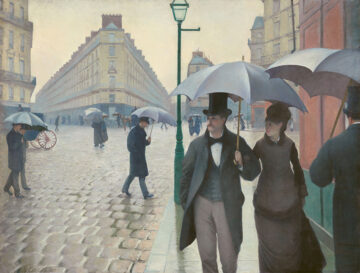
But not all repetition is as in-your-face or as disruptive as “Campbell’s Soup Cans.” One painting from the Impressionist period is particularly pertinent. I am thinking of “Paris Street; Rainy Day” by Gustave Caillebotte. Currently housed in the Art Institute of Chicago, it was originally exhibited at the Third Impressionist Exhibition in Paris in 1877. It is probably Caillebotte’s best-known work. I consider it a masterpiece and regret that I have never seen the real thing. Even so, it never ceases to bowl me over. Discussions of it typically focus on the incredible verisimilitude of the painting, the sense that it is photographic in its vivid capture of an ordinary moment.
More here.
Enjoying the content on 3QD? Help keep us going by donating now.
The Reality of Recursive Improvement: How AI Automates Its Own Progress
Eric Drexler at AI Prospects: Toward Global Goal Alignment:
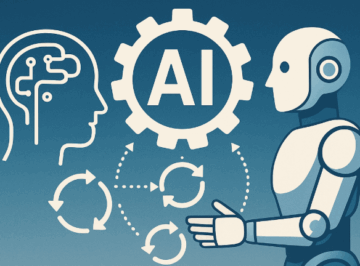 Automating routine tasks expands possibilities. Before automatic differentiation, deep learning practitioners derived and implemented gradients by hand for each model family, a laborious and error-prone process. When Theano and its successors automated this mathematical labor, they transformed neural networks from a specialized practice into a broadly accessible discipline. This unlock, combined with massive datasets and GPU computing, catalyzed the deep learning revolution.
Today, we’re seeing a confluence of similar advances happening simultaneously across the ML stack. This isn’t the “recursive self-improvement” of AGI mythology, where a monolithic entity modifies itself toward superintelligence. It’s a systemic process in which specialized tools automate routine tasks while making new tasks tractable. Researchers increasingly orchestrate these tools to build automated workflows.
Today’s trajectory is toward orchestrating systems that integrate piecemeal-superhuman capabilities of increasing scope. Looking forward, the comprehensive automation of research tasks has become a question of timelines, not outcomes. What we’re witnessing now are the early stages, and in this domain, automation accelerates automation.
More here.
Enjoying the content on 3QD? Help keep us going by donating now.
Sentience Beyond Biology — Patrick House chairs Debate with Dmitry Volkov, Joscha Bach, Matthew MacDougall, & Murray Shanahan
Enjoying the content on 3QD? Help keep us going by donating now.
Hermann Nitsch
Enjoying the content on 3QD? Help keep us going by donating now.
Yanis Varoufakis: Will Trump’s Working-Class Base Turn on Him?
Yanis Varoufakis at Project Syndicate:
 Following the 2008 financial collapse, US capitalism changed forever. While the banks were bailed out, more and more workers with secure, high-quality employment found themselves among the “untouchables” scrounging for a living in short-term, low-paid, dead-end jobs. Whereas Reagan and the Bushes won elections because secure proletarians voted for them and untouchables were too disheartened to vote at all, Trump won by rallying the untouchables, who now included a growing number of hitherto secure proletarians.
Against the backdrop of Bill (and Hillary) Clinton’s open romancing of Wall Street, Barack Obama’s banker bailouts, and Joe Biden’s suicidal strategy of telling struggling people that the Democrats had delivered an “excellent” economy, Trump tapped into working-class rage. All it took to attract voters the Democrats had long since abandoned were some incoherent musings about a “broken” country and the “carnage” that feckless, self-interested elites had inflicted on people like them.
Democrats hope and pray that when the pain from Trump’s One Big Beautiful Bill begins to bite, workers will desert him.
More here.
Enjoying the content on 3QD? Help keep us going by donating now.
On Hermann Nitsch’s Orgies Mysteries Theater
Göksu Kunak at Artforum:
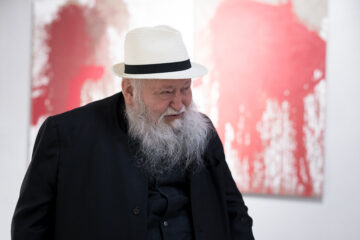 What transpired next was a kind of Dionysian rural festival where performers hung carcasses and living bodies, animal and human, losing themselves in pouring, smearing, splashing—actions Nitsch had developed for years. Mythical figures became crucial scaffolds alongside Christian elements like garments, foot-washing, a grail, and the cross. Odysseus and Parsifal recurred as structural motifs that framed the choreography, scent, sound, and sacrificial acts: Odysseus as an emblem of the wandering heroic subject who must cross the threshold into chaos, the way the performers descend into a forest of flesh. Performers took their time carrying wooden structures for which human and animal bodies were used as embellishment. Huge white cloths were stretched, spattered with bright-red animal blood next to lilies, slaughtered flesh, and the symbolically crucified, tied-up human body.
In Nitsch’s work, disembodiment becomes a way to get back into the body. But there’s also something digital in his immersive choreography whereby everything, even nature, seems programmed. The sun set. Flowers smelled. Birds chirped. There was an ongoing pitch, a sound that lingered in the space, even when the actions stopped. It felt very weird to drink the Nitsch-branded Wine and talk.
more here.
Enjoying the content on 3QD? Help keep us going by donating now.
Using Hyperbaric Oxygen Therapy To Help the Body Heal
Enjoying the content on 3QD? Help keep us going by donating now.
A Prominent Buddhist Scholar’s Quest To Unify East And West
Costică Brădăţan at The American Scholar:
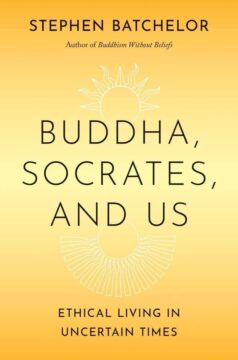 “Raised in Britain as a post-Christian secular humanist and trained in Asia as a Tibetan and Zen Buddhist monk,” Stephen Batchelor writes at the end of his book, Buddha, Socrates, and Us, “I find that I can no longer identify exclusively with either a Western or an Eastern tradition.” Decades of dwelling in these traditions—each with its own intellectual, spiritual, and philosophical riches—have left him strangely homeless. Far from making him unhappy, though, this state of existential homelessness has given Batchelor access to what he sees as a higher life. For, while “unsettling and disorienting” at times, such “spaces of uncertainty seem far richer in creative possibilities, more open to leading a life of wonder, imagination, and action.”
At its core, Batchelor’s Buddha, Socrates, and Us may be read as a response to a simple, yet important observation: everything in life tends to fall into patterns, to settle into habits and routines. Not even matters of the spirit—religion and philosophy, beliefs and ideas, thinking and writing—seem to escape this fate. Such mindless repetition makes our lives easier and more comfortable, at least on the outside, but to do things mechanically and unthinkingly is to invite emptiness and meaninglessness into our existence.
more here.
Enjoying the content on 3QD? Help keep us going by donating now.
Why a Kiwi May Be the Perfect Snack
Caroline Legaspi in The New York Times:
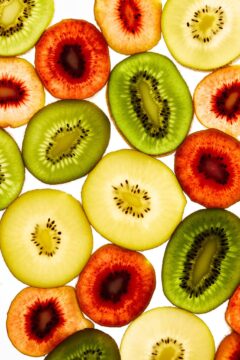 Apples and bananas may be some of America’s favorite fruits. But nutrition experts say that kiwis deserve a spot in your shopping cart. These brown, fuzzy fruits with green, yellow or even red flesh are packed with beneficial nutrients like fiber and vitamin C. And on TikTok, wellness influencers rave about their digestive and sleep-inducing benefits. “Kiwis are having a moment right now, and for good reason,” said Judy Simon, a clinical dietitian at the University of Washington Medical Center in Seattle.
Here’s why their spotlight is so well-deserved, and how incorporating kiwis into your diet may influence your health. Kiwis contain an impressive array of nutrients. A medium-sized fruit offers a little over two grams of fiber at just 48 calories. The skin is especially fiber-rich.
More here.
Enjoying the content on 3QD? Help keep us going by donating now.
Monday, August 25, 2025
Trump’s Global War on Decarbonization
Mark Blyth and Daniel Driscoll at Project Syndicate:
 The US sits atop vast reserves of fossil fuels, which have underpinned its national prosperity for decades. They have lit cities, powered factories, stimulated postwar job growth, and forged broad regional political coalitions among labor, agriculture, and corporations. They are also highly profitable commodities, with exports creating global dependence on US supplies (which is especially true for liquefied natural gas following Russia’s full-scale invasion of Ukraine). Fossil fuels are a core component of the country’s political economy – and a key factor in US domestic and foreign policymaking.
The Trump administration recognizes this. It includes ideological realists who understand that energy transitions make hegemons – that energy is power. Just as coal drove the industrial revolution in England, oil and gas fueled America’s postwar dominance. Whoever controls energy controls the future.
Unfortunately for the US, if the next energy transition is a green one, the future surely belongs to China, whose green-tech dominance is so firmly established that it does not really matter which metric you look at.
More here.
Enjoying the content on 3QD? Help keep us going by donating now.
The Sarin shortcut: How AI lowers the bar for chemical weapons
Ashutosh Jogalekar at the Bulletin of the Atomic Scientists:
 For those contemplating mass casualties, biotoxins like ricin are easy to produce. But delivering them effectively is difficult, requiring specialized techniques like aerosolization. Conversely for chemical warfare agents like sarin, synthesis (because of restricted precursors) has traditionally been the hard part, even if delivering them does not require specialized methods.
However, that balance is tipping because of advances in artificial intelligence. Generative AI and off-the-shelf computational tools are collapsing the precursor barrier, making DIY sarin analogs (compounds that resemble the molecular structure of sarin) as attractive as castor-bean mash for rogue individuals. These applications can make the synthesis and use of nerve agents for nefarious purposes marginally but consequentially more probable.
More here.
Enjoying the content on 3QD? Help keep us going by donating now.
David Brooks talks to Tyler Cowen about Audacity, AI, and the American Psyche
Enjoying the content on 3QD? Help keep us going by donating now.
Fiction and the Fantastic: Stories by Jorge Luis Borges
Enjoying the content on 3QD? Help keep us going by donating now.