
Andrew Stuttaford at The New Criterion:
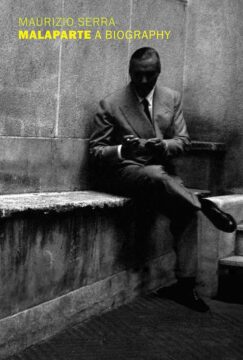 Kaputt is episodic, its style dreamlike, surreal, hallucinatory, grotesque, a vision of a world so askew that even the skies have gone mad: “the sky was an eyeless face—a dead white face.” The carcasses of horses remain trapped in a frozen lake, “a vast sheet of white marble . . . . Only the heads stuck out of the crust of ice.” Frank playing Chopin in his castle, “Malaparte” wandering through the Romanian city of Jassy (Iași), just ahead of a pogrom: “It began to rain, a slow warm rain that seemed to drop out of a cut vein.” Occasionally he escapes to high society—Princess This, Count That—adding some Proust to a work that owes much more to Goya.
In Kaputt, Malaparte the novelist uses the credibility, such as it was, of Malaparte the journalist, leaving it up to the reader to decide how much is fact, heavily embellished fact, or entirely made up, an ambiguity not unhelpful for an author rewriting his own past. And by the time of Kaputt’s publication, this is what Malaparte was trying to do. His association with Italy’s Fascist regime had been complicated, but it was close enough to merit a (brief) jailing after Mussolini had been overthrown, and the promise of dangerous questions to come.
more here.
Enjoying the content on 3QD? Help keep us going by donating now.