
Costică Brădăţan at The American Scholar:
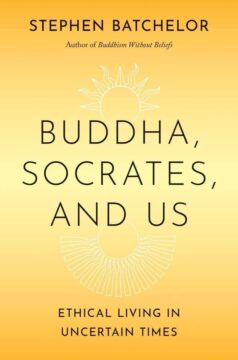 “Raised in Britain as a post-Christian secular humanist and trained in Asia as a Tibetan and Zen Buddhist monk,” Stephen Batchelor writes at the end of his book, Buddha, Socrates, and Us, “I find that I can no longer identify exclusively with either a Western or an Eastern tradition.” Decades of dwelling in these traditions—each with its own intellectual, spiritual, and philosophical riches—have left him strangely homeless. Far from making him unhappy, though, this state of existential homelessness has given Batchelor access to what he sees as a higher life. For, while “unsettling and disorienting” at times, such “spaces of uncertainty seem far richer in creative possibilities, more open to leading a life of wonder, imagination, and action.”
At its core, Batchelor’s Buddha, Socrates, and Us may be read as a response to a simple, yet important observation: everything in life tends to fall into patterns, to settle into habits and routines. Not even matters of the spirit—religion and philosophy, beliefs and ideas, thinking and writing—seem to escape this fate. Such mindless repetition makes our lives easier and more comfortable, at least on the outside, but to do things mechanically and unthinkingly is to invite emptiness and meaninglessness into our existence.
more here.
Enjoying the content on 3QD? Help keep us going by donating now.