Activist, Professor, Politician, Aesthete — the many contradictions of Edward Said

Jackson Arn in Forward:

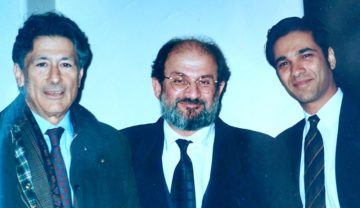
Edward W. Said, Salman Rushdie, and S. Abbas Raza at Columbia University in 1994. (Photo by Azra Raza.)

You could read any of Edward Said’s books, but you couldn’t take them home with you. Looking back, this was obviously a metaphor for something or other. At the time it seemed like a simple-enough fact—but then, I was only a freshman.

The Edward Said Reading Room opened in the spring of 2011, eight years after Said died of leukemia and a few months before I started college at Columbia. I liked it because it was small enough to pace through without losing sight of my laptop, and because the late professor had had fantastic taste in books. There were about 2,000 of them on the shelves, all from his personal collection and spanning most of his favorite subjects: Arabic modernism, classical music, the Frankfurt School, the two-state solution, the 19th-century realist novel. If book collections are always self-portraits, this was the grandest self-portrait I’d ever seen. So, no: students weren’t allowed to check these books out of Butler Library — that would have chipped the paint.

Said taught literature at Columbia for 40 years. During my four as an undergrad, he came up so often it felt like he still did.

More here.

DNA of Giant ‘Corpse Flower’ Parasite Surprises Biologists

Christie Wilcox in Quanta:

They are invisible at first. In their Southeast Asian forest homes, they grow as thin strands of cells, foreign fibers sometimes more than 10 meters long that weave through the vital tissues of their vine hosts, siphoning nourishment from them. Even under a microscope, the single-file lines of cells are nearly indistinguishable from the vine’s own. They seem more like a fungus than a plant.

But when the drive to breed awakens them, the members of the Rafflesiaceae family erupt as immense, stemless, rubbery red “corpse flowers” covered in polka dots, with a putrid smell like rotting meat designed to draw pollinating carrion flies. The blooms of one species, Rafflesia arnoldii, are the largest flowers in the world — each one can be more than a meter across and weigh a whopping 10 kilograms, roughly the heft of a toddler.

More than a decade ago, Rafflesiaceae parasites caught the eye of Jeanmaire Molina, an evolutionary plant biologist at Long Island University in Brooklyn, who wondered if their genomes were as bizarre as their outward forms.

More here.

Redesigning AI

Daron Acemoglu in the Boston Review:

Artificial Intelligence (AI) is not likely to make humans redundant. Nor will it create superintelligence anytime soon. But like it or not, AI technologies and intelligent systems will make huge advances in the next two decades—revolutionizing medicine, entertainment, and transport; transforming jobs and markets; enabling many new products and tools; and vastly increasing the amount of information that governments and companies have about individuals. Should we cherish and look forward to these developments, or fear them?

There are reasons to be concerned. Current AI research is too narrowly focused on making advances in a limited set of domains and pays insufficient attention to its disruptive effects on the very fabric of society. If AI technology continues to develop along its current path, it is likely to create social upheaval for at least two reasons. For one, AI will affect the future of jobs. Our current trajectory automates work to an excessive degree while refusing to invest in human productivity; further advances will displace workers and fail to create new opportunities (and, in the process, miss out on AI’s full potential to enhance productivity). For another, AI may undermine democracy and individual freedoms.

More here.

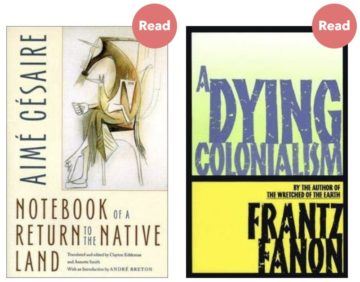
The Best Postcolonial Literature, recommended by Anjuli Fatima Raza Kolb

Cal Flyn in Five Books:

Postcolonial literature brings together writings from formerly colonised territories, allowing commonalities across disparate cultures to be identified and examined. Here, the University of Toronto academic Anjuli Fatima Raza Kolb recommends five key works that explore philosophical and political questions through allegory, personal reflection and powerful polemic.

What is postcolonial literature and why should we read it?

There are two separate but connected fields that I’m drawing these postcolonial books from.

First, there’s the intuitive definition of postcolonial literature, which is basically just literary work produced in formerly colonised nations by the people who live there. Already you can tell that this is a complicated category – is Albert Camus a postcolonial writer because he was an Algerian Pied-Noir? His siting in Algeria is as important as his identification with the French canon. So ‘postcolonial writing’ crumbles at the slightest touch when we use geography and history in order to define it.

What’s more useful to me is thinking about postcolonialism not as a historical definition or geographic category, but as a method—an approach that is explicitly about the liberatory politics of oppressed peoples. So I’m going to talk today about books that I would put in both camps at once.

More here.

Sunday Poem

—Untitled

The moonlight shining through the high branches
All the poets say is more
Than the moonlight shining through the high branches.

But to me, not knowing what I think,
What the moonlight shining through the high branches
Is, apart from being
The moonlight shining through the high branches,
Is just that,
The moonlight shining through the high branches.

by Fernando Pessoa
from The Complete Works of Alberto Caeiro
New Directions Paperbooks, 2020
translation from the Portuguese by Margaret Jull Costa & Patricio Ferrari

Harpies, sirens, and other ‘nasty’ women: Going beneath misogyny

Barbara Spindel in The Christian Science Monitor:

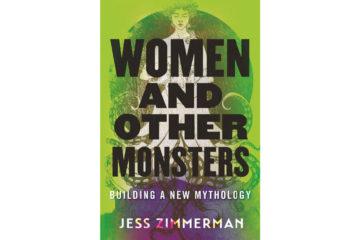
In high school, one of author Jess Zimmerman’s Internet usernames was Medusa. A self-described mythology nerd, her childhood copy of “D’Aulaires’ Book of Greek Myths” was well-worn. But as she recalls in her scorching collection of essays, “Women and Other Monsters: Building a New Mythology,” she particularly identified with the snake-haired creature whose power originated in ugliness: The mere sight of Medusa could turn a man to stone. As a teenager who was profoundly insecure about her looks, Zimmerman writes that calling herself Medusa was “an attempt to recuse myself from the game of human attraction before anyone pointed out that I’d already lost.”

Mythology is rife with hideous female creatures. Many of them, like Medusa, have the face of a woman but other grotesque, unnatural body parts. The Sirens are half bird, half woman; Scylla’s lower half is a mass of snarling dogs; the Sphinx has the body of a lion and the wings of a bird. All of them pose grave dangers to male heroes.

That’s not the only thing they have in common. “All the stories about monstrous women, about creatures who are too gross, too angry, too devious, too grasping, too smart for their own good, are stories told by men,” Zimmerman notes, citing Ovid, Homer, Virgil, and Sophocles. They were intended to be cautionary tales, warning women not to overreach, but the author wonders what would happen if women were to stop reading them as warnings and instead embrace them as aspirations.

More here.

India’s massive COVID surge puzzles scientists

Smriti Mallapaty in Nature:

The pandemic is sweeping through India at a pace that has staggered scientists. Daily case numbers have exploded since early March: the government reported 273,810 new infections nationally on 18 April. High numbers in India have also helped drive global cases to a daily high of 854,855 in the past week, almost breaking a record set in January. Just months earlier, antibody data had suggested that many people in cities such as Delhi and Chennai had already been infected, leading some researchers to conclude that the worst of the pandemic was over in the country.

Researchers in India are now trying to pinpoint what is behind the unprecedented surge, which could be due to an unfortunate confluence of factors, including the emergence of particularly infectious variants, a rise in unrestricted social interactions, and low vaccine coverage. Untangling the causes could be helpful to governments trying to suppress or prevent similar surges around the world. European countries such as France and Germany are also currently experiencing large outbreaks relative to their size, and nations including Brazil and the United States are reporting high infection rates at around 70,000 a day. But India’s daily totals are now some of the highest ever recorded for any country, and are not far off a peak of 300,000 cases seen in the United States on 2 January.

More here.

Saturday, April 24, 2021

Marshall Sahlins (1930–2021)

(Photo by Ulf Andersen/Getty Images)

Keir Martin and Theo Rakopoulos in Jacobin:

Marshall Sahlins, who passed away at ninety on April 5, was not only the most notable anthropological writer of his generation; he was also a profoundly radical — and influential — thinker with a genuine commitment to political action.

There are many in the academy who fear that political engagement dilutes or undermines the purity of theoretical reflection. Sahlins’s life and work stands as a clear corrective to that position. Throughout his career, he was motivated by his opposition to oppression wherever he saw it, be it toward marginalized populations targeted by economic and military expansionism or toward academic communities threatened with the curtailment of their intellectual expression.

It is this commitment that underpinned so much of his pioneering theoretical work, such as his critique of the universal application of neoclassical economics in Stone Age Economics. That collection of essays marks one of the most powerful challenges on record to the assumed natural universality of the allegedly rational economic actor that haunts economic textbooks.

Sahlins was prolific. Apart from many articles, he authored some nineteen books, some of which have profoundly influenced the way we think anthropologically, and also more generally in the social sciences. His analysis inspired a wide range of radical thinkers, including left and post-left anarchists. The ecological neo-primitivist John Zerzan owed much to Sahlins (“my single most important influence”), while Hakim Bey has repeatedly cited “The Original Affluent Society” as the major inspiration for his thinking.

More here.

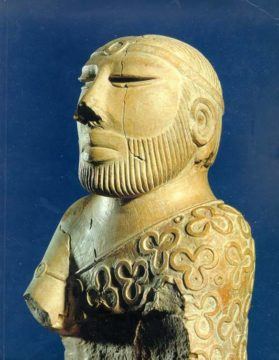
Killing the Priest-King: Addressing Egalitarianism in the Indus Civilization

Adam S. Green in the Journal of Archaeological Research (h/t Jain Family Institute):

The archaeologists who first investigated the Indus civilization thought it diverged sharply from contemporary societies in Egypt and Mesopotamia (Marshall 1931, p. xi). For nearly a century, archaeologists have made a concerted effort to close this gap and make the Indus seem more “normal” in comparison with other complex societies. This is especially true with respect to inequality—specifically, stratification in the distribution of wealth and hierarchies of political power. In my view, these efforts have been largely unsuccessful. Marshall’s observation was basically correct; attempts to refute it have been based on the theoretical assumption that all social complexity entails stratified social relations, rather than a critical interpretation of the empirical evidence. I argue that the widespread distribution of production activities and wealth in Indus cities indicates that the stratification of wealth and power, particularly in the hands of a ruling class who monopolized resources and dictated the production activities of everyone else, was absent from the Indus civilization.

Indus cities (c. 2600–1900 BC) were expansive and planned, with large-scale architecture and sophisticated early technologies—writing, metallurgy, weights and measures, and seals—that matched those from contemporaneous societies in Egypt and Mesopotamia. And yet, it has long been noted that Indus cities lack the tombs, palaces, and aggrandizing art that characterize other early complex societies (e.g., Fairservis 1967). These lines of evidence are essential to the comparative study of complex societies and particularly to the analysis of past inequalities in wealth and power (e.g., Feinman 1995; Feinman and Marcus 1998; Smith 2012). Their absence in the Indus suggests that the forms of inequality that we would expect to find if a class of ruling nobles managed society were limited or absent in Indus cities. Given that complex societies have often been defined by the presence of such stratification (e.g., Trigger 2003, p. 46), the perception that the absence of a ruling class in the Indus civilization risked its omission from comparative debates about the emergence of social complexity gained ground. In response, there arose an implicit argument that the Indus was indeed exceptional, not because it lacked a ruling class, but because to fully appreciate its political economy required an exceptional set of criteria (e.g., Kenoyer 1998).

More here.

Slave Rebellions and Mutinies Shaped the Age of Revolution

Steve Hahn in Boston Review:

The Age of Revolution (1770–1850), bookended by the American and French Revolutions on the one side and the Revolutions of 1848 on the other, is widely viewed as the progenitor of the modern Euro-Atlantic world. Its intellectual energy fused the liberal and republican ideas of John Locke with the ideals of the eighteenth-century Enlightenment; its political energy fed off the struggles between the bourgeois and their aristocratic enemies. Although visionary hopes could meet crushing defeats—as they did during the popular risings of 1848—by the end, there were new parliamentary regimes, emerging nation-states, declarations of rights, and the eruption of an industrial age.

And yet, this classic narrative leaves out the most radical of the revolutions that exploded neither in continental Europe nor in North or South America, but in the Caribbean, on the island the French called Saint-Domingue and the victorious rebels would call Haiti (Ayiti), after its indigenous name.

Until recently, the Haitian Revolution and other Caribbean slave rebellions have been treated as sidebars to the Age of Revolution. In part this is because of a Eurocentrism that has long diminished the role of Black people in shaping history. But equally important, enslaved people didn’t fit an accepted image of political actors, and thus it was difficult for historians to see them standing alongside the signers of the Declaration of Independence in America, the Jacobins in France, the Bolivareans in Gran Colombia, the Mazzinians in Italy, or the Chartists in England: envisioning, allying, struggling, surmounting.

More here.

Biden’s Anti-China Ambitions

Dilip Hiro in The Nation:

Like his immediate predecessor, Joe Biden is committed to a distinctly anti-China global strategy and has sworn that China will not “become the leading country in the world, the wealthiest country in the world, and the most powerful country in the world…on my watch.” In the topsy-turvy universe created by the Covid-19 pandemic, it was, however, Jamie Dimon, the CEO and chairman of JP Morgan Chase, a banking giant with assets of $3.4 trillion, who spoke truth to Biden on the subject.

While predicting an immediate boom in the US economy “that could easily run into 2023,” Dimon had grimmer news on the future as well. “China’s leaders believe that America is in decline,” he wrote in his annual letter to the company’s shareholders. While the United States had faced tough times in the past, he added, today “the Chinese see an America that is losing ground in technology, infrastructure, and education—a nation torn and crippled by politics, as well as racial and income inequality—and a country unable to coordinate government policies (fiscal, monetary, industrial, regulatory) in any coherent way to accomplish national goals.” He was forthright enough to say, “Unfortunately, recently, there is a lot of truth to this.”

As for China, Dimon could also have added, its government possesses at least two powerful levers in areas where the United States is likely to prove vulnerable: dominant control of container ports worldwide and the supplies of rare earth metals critical not just to the information-technology sector but also to the production of electric and hybrid cars, jet fighters, and missile guidance systems.

More here.

Blake Bailey, Philip Roth, and the Biography That Blew Up

Alexandra Schwartz in The New Yorker:

Philip Roth has not had much luck with biographers. Late in his life, furiously aggrieved after the failure of his marriage to the actress Claire Bloom and the publication of Bloom’s incendiary memoir of their years together, he asked a close friend, Ross Miller, an English professor at the University of Connecticut, to take on the task. Roth sent Miller lists of family members and friends he wanted to be interviewed, along with the questions that he felt should be asked. (“Would you have expected him to achieve success on the scale he has?”) It didn’t work out, for various reasons. Roth had wanted Miller to refute a familiar charge, “this whole mad fucking misogynistic bullshit!” that he felt flattened his long erotic history into one false accusation. But Miller came to his own conclusion. “There is a predatory side to both Sandy and Philip,” he told a cousin of Roth’s. (Sandy was Roth’s older brother.) “They look at women—I’m not gonna write about this—but they are misogynist. They talk about women in that way.”

This anecdote is recounted by Miller’s successor, Blake Bailey, in “Philip Roth: The Biography,” his eight-hundred-page account of Roth’s eighty-five-year life, which was published earlier this month. Talking about women “in that way” didn’t seem to be a problem for Bailey. Roth had read and admired Bailey’s biography of John Cheever, but Bailey was offered the job, by his own account, after enthusing with Roth over the qualities of Ali MacGraw, who starred in the film adaptation of “Goodbye, Columbus.” Readers of Bailey’s book will encounter a lot of that sort of thing, to an often voyeuristic degree. (“Locker-room chummy sex talk,” a male writer friend texted me, of a passage in which the young Roth’s girlfriend Maxine Groffsky, the model for the “Goodbye, Columbus” character Brenda Patimkin, is described as “slipping into his cabana, say, and blowing him” while Roth changes into a bathing suit. “Who is he writing that sentence for? It sounds like he’s bantering with Roth.”) But the book’s readers are now limited in number. On Wednesday, after allegations surfaced that Bailey had groomed and harassed female students in the nineteen-nineties, when he was an eighth-grade English teacher at Lusher School, in New Orleans—and that he had raped two women, including a former student—his publisher, W. W. Norton, halted distribution of the biography. Bailey was dropped by his literary agency earlier in the week.

More here.

Seth Rogen and the Secret to Happiness

Jonah Weiner in The New York Times:

Seth Rogen’s home sits on several wooded acres in the hills above Los Angeles, under a canopy of live oak and eucalyptus trees strung with outdoor pendants that light up around dusk, when the frogs on the grounds start croaking. I pulled up at the front gate on a recent afternoon, and Rogen’s voice rumbled through the intercom. “Hellooo!” He met me at the bottom of his driveway, which is long and steep enough that he keeps a golf cart up top “for schlepping big things up the driveway that are too heavy to walk,” he said, adding, as if bashful about coming off like the kind of guy who owns a dedicated driveway golf cart, “It doesn’t get a ton of use.” Rogen wore a beard, chinos, a cardigan from the Japanese brand Needles and Birkenstocks with marled socks — laid-back Canyon chic. He led me to a switchback trail cut into a hillside, which we climbed to a vista point. Below us was Rogen’s office; the house he shares with his wife, Lauren, and their 11-year-old Cavalier King Charles Spaniel, Zelda; and the converted garage where they make pottery. I was one of the first people, it turns out, to see the place. “I haven’t had many people over,” Rogen said, “because we moved in during the pandemic.”

Coyote paw prints pocked the trail. Water burbled somewhere beneath us. It was an idyllic scene disturbed only by Rogen’s phone, which was vibrating madly with messages. That morning, Houseplant, the cannabis company he co-founded in 2019 in Canada, his native country, officially started selling its own weed strains in California. Within moments of the launch there was an hourlong wait to enter the web store, and before long the whole site crashed under the weight of Rogen-loving hordes clamoring to buy what he described as his personally “hand-smoked” nugs. (The company also sells stoner home goods, like a blocky, Bauhausian table lighter designed to be impossible to lose.) “Crazy day,” he said, tapping at his screen. “I’m literally responding to people on Twitter, telling them we’re working on it — doing my own customer-service strategy, basically!”

Rogen’s overwhelmingly casual demeanor — chucklingly agreeable, continually stoned — has long belied his productivity: He has been working almost constantly since he was 13, when he started doing stand-up comedy around Vancouver.

More here.

How The Just So Stories Were Made

Kathryn Hughes at The Guardian:

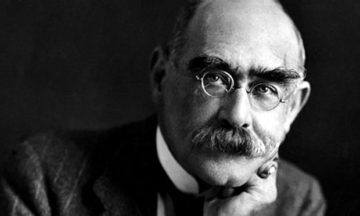
It is always tricky writing about Kipling. By the time of his death in 1936 his jingoism, with its babble about the “white man’s burden” in Africa, made many moderate souls feel queasy. Batchelor is too scrupulous a scholar to ignore what came after the Just So Stories – indeed he points out that within two years of the book’s publication the satirist Max Beerbohm was drawing Kipling as an imperial stooge, the diminutive bugle-blowing cockney lover of a blousy-looking Britannia.
Nonetheless, Batchelor urges us to see the stories as evidence that as a young man Kipling was an imaginative artist of the first rank. Full of bustling linguistic ingenuity, conjured by a man whose first language was actually Hindi rather than English, the stories themselves are hopeful, expansive, joyfully attentive to a world where difference and separation can be mended by imaginative acts.

more here.

Louis Menand Examines the Churn of American Culture After World War II

David Oshinsky at the New York Times:

The evenhanded approach of Louis Menand, who won a Pulitzer Prize for “The Metaphysical Club,” is like a breath of fresh air. “The Free World” sparkles. Fully original, beautifully written, it covers the interchange of arts and ideas between the United States and Europe in the decades following World War II. Menand is no cheerleader; his assessment of America’s failures can be withering. But his larger point, backed by a mountain of research and reams of thoughtful commentary, is that American culture ascended in this era for the right reasons. “Ideas mattered. Painting mattered. Movies mattered. Poetry mattered,” he tells us.

Much of this was the result of the forced migration of intellectual talent after Mussolini and Hitler came to power. We tend to remember the scientists who fled — like Albert Einstein — much more than the composers, performers, writers, poets, philosophers and political theorists.

more here.

Friday, April 23, 2021

Stable Locus of Personal Identity

Justin E. H. Smith in Damage:

I thought I was so clever. For a few days, anyway.

In early 2021, as you almost certainly know, “Non-Fungible Tokens”, or NFTs, burst onto the scene and changed the way we talk and think. An NFT is a sort of digital title or deed, comparable to the papers in your glove compartment establishing ownership of the car. Unlike the paper title, however, the NFT is based on blockchain, a distributed-ledger technology that lives on the open internet, and of which we are all, collectively, the bookkeepers and guardians. After the auction for $69 million of an NFT for a work by the American digital artist Mike Winkelmann (aka Beeple) on March 11, I immediately began minting “joke” NFTs. I imagined these to be “very serious jokes”, experimentally pushing the concepts of value and of tokenization right up to their limits for the sake of some urgent “point”.

Thus for example I minted a “Token of the Type/Token Distinction Itself”, which swiftly sold for $200 (to a computational linguist who wanted to give his students a good laugh). Buoyed by this success, I went on to mint “the Non-Fungible Token of All Non-Fungible Tokens”, followed by a variation on that famous set-theoretic impossibility, “The Non-Fungible Token of All Non-Fungible Tokens That Are Not Non-Fungible Tokens of Themselves”. I was “in my zone”, as they say. Though none of these subsequent experiments managed to get sold, I was having the time of my life cranking out joke-tokens at record pace.

More here.