
Tabish Khair in Berfrois:
 At the core of Anton Chekov’s short story, ‘The Requiem’, there is a tussle over a word. Mass is just over in the small village church of Verhny Zaprudy. Andrey Andreyitch, a shopkeeper and an old inhabitant of the village, is angrily summoned by Father Gregory, still standing in his vestments by a door. He thrusts a small note at Andrey, demanding, “Was it you asked for prayers for the rest of Mariya’s soul?” In that small note is written, in big, “staggering” letters, “For the rest of the soul of the servant of God, the harlot Mariya.” Andrey readily acknowledges that he had sent the note.
Father Gregory is livid. It turns out that, unlike what the reader might have suspected, Father Gregory is not angry at being asked to pray for a ‘harlot.’ He is angry because Mariya is Andrey Andreyitch’s daughter. How dare you write such a note, he asks? Andrey fails to understand. For him, his daughter, who had become a well-known actress in Moscow, is a harlot in Biblical terms.
More here.
 Released from the silo of conventional philosophy, I found the neuroscientists at the medical school to be uniformly hospitable and curious about what I was up to. A human brain was indeed delivered to me in the anatomy lab, and holding it my hands, I felt an almost reverential humility toward this tissue that had embodied someone’s love and knowledge and skills. It looked so small, relative to what a human brain can do.
 In cities big and small, hospitals are too full to accept new patients and diagnostic centers take up to three days or more to do chest scans of those who might have Covid-19. Doctors and hospital staff are completely exhausted.
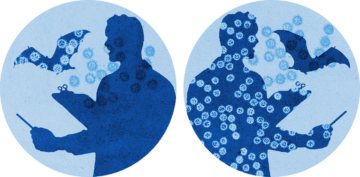 “In North America we pose a far greater risk to our bats than they do to us,” said O’Keefe, a bat ecologist and professor of environmental science at the University of Illinois at Urbana-Champaign. COVID-19 is a zoonotic disease, an illness that jumped from animal hosts to humans. But disease transfer isn’t just a one-way street. It takes only a bit of evolutionary bad luck to turn a bat’s head cold into a human’s killer. But it takes only a little more for the same virus to jump from humans to other animals. Zoonosis begets reverse zoonosis, which can, in turn, come back around to zoonosis again. A virus we give to a bat could, someday, come back around to reinfect us. Animals’ health is ours, ours is theirs, theirs is ours.
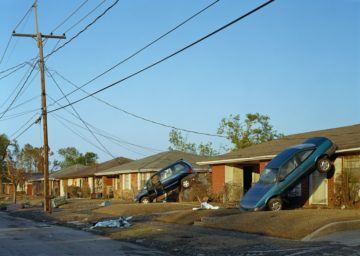 Polidori: Well, America is a Protestant country. Protestants don’t take so well to pathos, so they think that I’m a reactionary, because I am making misery look beautiful. And so because of this, I am minimizing the plight of the victims. I only get this in Anglo-Saxon countries, the rest of the world doesn’t think that way.
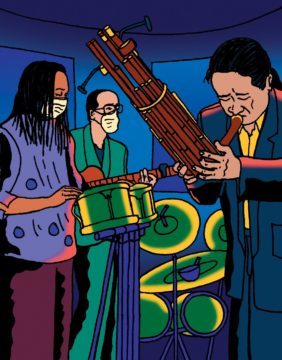 On the stage of an empty concert hall, the Austrian-born composer
 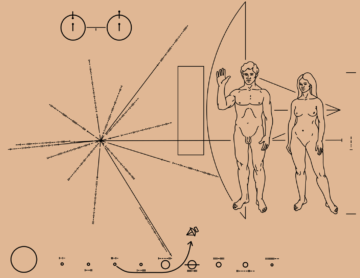 I often think about George Berkeley’s observation (without recalling quite where he offered it) that when we think we are imagining to ourselves the heat of the sun, what we are really imagining is the heat of a stove or a similar familiar source of mundane household warmth. A stove is already hot enough to reduce my hand to ash fairly quickly. And without a hand left, without any nerve endings to give me any report at all on the external world, I’m hardly in a position to note the difference between 300 degrees Fahrenheit and 5,700 degrees Kelvin. Both, Berkeley thinks, are just too darn hot.
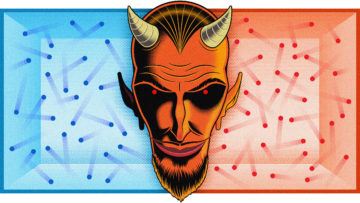 The universe bets on disorder. Imagine, for example, dropping a thimbleful of red dye into a swimming pool. All of those dye molecules are going to slowly spread throughout the water. Physicists quantify this tendency to spread by counting the number of possible ways the dye molecules can be arranged. There’s one possible state where the molecules are crowded into the thimble. There’s another where, say, the molecules settle in a tidy clump at the pool’s bottom. But there are uncountable billions of permutations where the molecules spread out in different ways throughout the water. If the universe chooses from all the possible states at random, you can bet that it’s going to end up with one of the vast set of disordered possibilities.
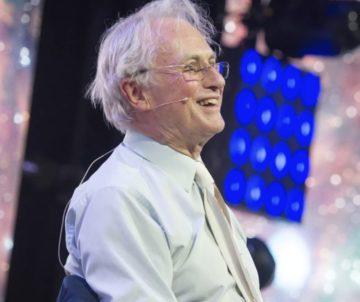 Last week, the American Humanist Association (AHA) stripped British author Richard Dawkins of his 1996 Humanist of the Year award after he made a comment on Twitter that offended some in the transgender community.
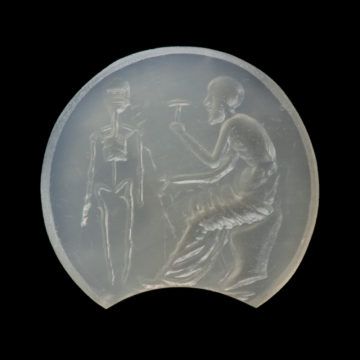 How long have we been imagining artificial life? A remarkable set of ancient Greek myths and art shows that more than 2,500 years ago, people envisioned how one might fabricate automatons and self-moving devices, long before the technology existed. Essentially some of the earliest-ever science fictions, these myths imagined making life through what could be called biotechne, from the Greek words for life (bio) and craft (techne). Stories about the bronze automaton Talos, the artificial woman Pandora, and other animated beings allowed people of antiquity to ponder what awesome results might be achieved if only one possessed divine craftsmanship. One of the most compelling examples of an ancient biotechne myth is Prometheus’ construction of the first humans.
 Born in 1872, Teffi was a contemporary of Alexander Blok and other leading Russian Symbolists. Her own poetry is derivative, but in her prose she shows a remarkable gift for grounding Symbolist themes and imagery in the everyday world. “The Heart” is entirely realistic and at times even gossipy—yet the story is permeated throughout with Christian symbolism relating to fish. In “A Quiet Backwater,” she achieves a still more successful synthesis of the heavenly and the earthly. Toward the end of this seven-page story a laundress gives a long disquisition on the name days of various birds, insects, and animals. The mare, the bee, the glowworm—she tells a young visitor—all have their name days. And so does the earth herself: “And the Feast of the Holy Ghost is the name day of the earth herself. On this day, no one dairnst disturb the earth. No diggin, or sowin—not even flower pickin, or owt. No buryin t’ dead. Great sin it is, to upset the earth on ’er name day. Aye, even beasts understand. On that day, they dairnst lay a claw, nor a hoof, nor a paw on the earth. Great sin, yer see.” In a key poem—almost a manifesto—of French Symbolism, Charles Baudelaire interprets the whole world as a web of mystical “correspondences.” In a less grandiose way, Teffi conveys a similar vision. She was, I imagine, delighted by the paradox of the earth’s name day being the Feast of the Holy Spirit—not, as one might expect, the feast of a saint associated with some activity like plowing.
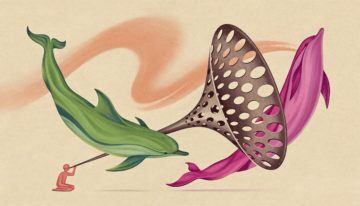 Disney’s 2019 remake of its 1994 classic “The Lion King” was a box-office success, grossing more than one and a half billion dollars. But it was also, in some ways, a failed experiment. The film’s photo-realistic, computer-generated animals spoke with the rich, complex voices of actors such as Donald Glover and Chiwetel Ejiofor—and many viewers found it hard to reconcile the complex intonations of those voices with the feline gazes on the screen. In giving such persuasively nonhuman animals human personalities and thoughts, the film created a kind of cognitive dissonance. It had been easier to imagine the interiority of the stylized beasts in the original film. Disney’s filmmakers had stumbled onto an issue that has long fascinated philosophers and zoologists: the gap between animal minds and our own. The dream of bridging that divide, perhaps by speaking with and understanding animals, goes back to antiquity. Solomon was said to have possessed a ring that gave him the power to converse with beasts—a legend that furnished the title of the ethologist Konrad Lorenz’s pioneering book on animal psychology, “
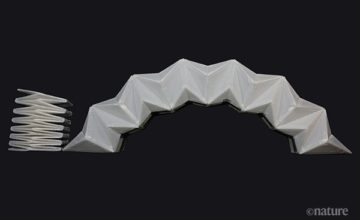 It might seem surprising that origami, the ancient Japanese art of paper folding, is an integral part of engineering. However, origami structures can be folded up compactly and deployed at the nano- and macroscales seemingly without effort. They are therefore well suited for a wide range of applications, including robotics