
Category: Recommended Reading
A Possible Way Forward In An Age Of Institutional Fragmentation
Alan Jacobs at The Hedgehog Review:
 The Distributists of a century ago, like their great predecessors John Ruskin and William Morris, were aware of the danger that a subsidiarist devolution into smallholdings could have an atomizing effect on society. They thought that one means by which to counteract this tendency was to encourage the renewal of the ancient guild system. The best-known exponent of this idea was Arthur Penty, who in 1906 published a book called The Restoration of the Guild System. (Excerpt here, full text here.) Penty thought that the then-rising trade union movement could lay the foundation for a new set of guilds—one of many examples of the ways in which it can be difficult to label these alternative economic orders as either Left or Right in political orientation. The best-known example of an anarcho-syndicalist system, the Mondragon Corporation in the Basque region of Spain, was founded by a Catholic priest, José María Arizmendiarrieta, whose intellectual sources were much the same as those of the famously right-wing Chesterton and Belloc.
more here.
Wednesday Poem
Song of Winnie Mandela
Yet I know
that I am Poet!
I pass you my Poem.
A poem doesn’t do everything for you.
You are supposed to go on with your thinking.
You are supposed to enrich
the other person’s poem with your extensions,
your uniquely personal understandings,
thus making the poem serve you.
I pass you my Poem! — to tell you
we are all vulnerable —
the midget, the Mighty,
the richest, the poor.
Men, women, children, and trees.
I am vulnerable.
Hector Pieterson was vulnerable.
My Poem is life, and not finished.
It shall never be finished.
My Poem is life, and can grow.
Wherever life can grow, it will.
It will sprout out,
and do the best it can.
I give you what I have.
You don’t get all your questions answered in this world.
How many answers shall be found
in the developing world of my Poem?
I don’t know. Nevertheless I put my Poem,
which is my life, into your hands, where it will do the best it can.
I am not a tight-faced Poet.
I am tired of little tight-faced poets sitting down to
shape perfect unimportant pieces.
Poems that cough lightly — catch back a sneeze.
This is the time for Big Poems,
roaring up out of sleaze,
poems from ice, from vomit, and from tainted blood.
This is the time for stiff or viscous poems.
Big, and Big.
by Gwendolyn Brook
from Kinna Reads
—for reading by the poet click link above
The Significance of the Derek Chauvin Verdict
David Remnick in The New Yorker:
 At the Hennepin County Government Center on Tuesday afternoon, Judge Peter Cahill opened a yellow envelope and read out the verdict against Derek Chauvin, the former Minneapolis police officer who, last May, kneeled on the neck of George Floyd for nine minutes and twenty-nine seconds, killing Floyd and igniting a nationwide uprising against police abuse and systemic racism. Chauvin wore a pale-blue face mask. His eyes darted from side to side. The verdict was guilty on charges of second-degree unintentional murder, third-degree murder, and second-degree manslaughter. And, within just a few minutes, it was over. Chauvin, now a convicted murderer, was handcuffed and led out of the courtroom. Cahill thanked the jury for its “heavy-duty service.” Bail was revoked. The sentence will be handed down in eight weeks.
Outside, on a broad lawn, several hundred people had congregated to wait for the news. There were Black Lives Matter activists, reporters, and many people who rushed to the area after getting alerts on their phones that the judge would soon read out the will of the jury. And, when they heard the first of the three guilty verdicts, the reaction was loud and unambiguous.
“It was an explosive cheer,” Jelani Cobb told me, by telephone, from the courthouse. Cobb, a staff writer at The New Yorker, a historian, and the Ira A. Lipman professor of journalism at Columbia University, has been in Minneapolis covering the trial for the magazine. And he has been covering issues of race and criminal justice for many years, from Newark to Atlanta and beyond. We spoke at length on Tuesday; our conversation has been edited for length and clarity.
More here.
An exceptional view of phase transitions in non-equilibrium systems
Cynthia and Charles Reichhardt in Nature:
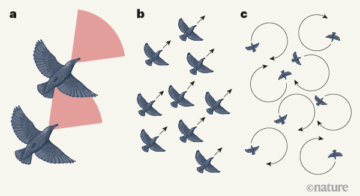 Strongly non-reciprocal interactions and non-conservative forces can arise in social interactions, such as those that occur when pedestrians avoid each other, or when birds fly together as a flock3. These systems are examples of ‘active matter’, in which each element (a person or bird, in our examples) contains an internal energy source that injects energy into the system by enabling each element to move under its own propulsion4. By contrast, ordinary non-active matter is purely passive, such as a leaf drifting on a river in response to the underlying currents.
Let’s consider the example of non-reciprocal interactions between flocking birds (Fig. 1a). To maintain a flocking arrangement, each bird adjusts its flight on the basis of the movement of the other birds in its immediate vicinity. Bird eyes, however, did not evolve to provide vision in all directions simultaneously. Instead, each bird responds only to other birds within its forward cone of vision5. If bird A is in the vision cone of bird B, then B responds to the motion of A; but if B is outside the vision cone of A, then A does not respond to the motion of B. In other words, the equivalence of action and reaction is lost.
More here.
Tuesday, April 20, 2021
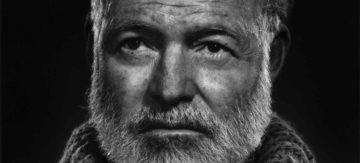
Finding Hemingway: Seeing the Self Behind the Self-Mythologizer
Alex Thomas in Literary Hub:
 When I visited Ernest Hemingway’s home in Key West, I took only three photographs. One of his writing studio (which the house’s caretakers claim remains undisturbed), one of the two Coca-Cola machines outside the public bathrooms and one of the little houses built for the dozens of six-toed cats roaming the property. On the roofs of those little houses are placards reading, “Hemingway Home Cats Get Revolution Plus Every Month.”
I took those three pictures because they offered the only visual anecdotes that really interested me about the place: photographic evidence of the continuing myth of Hemingway. A myth so enduring that his former home now has soda machines and his cats have their own medical sponsor. It was bombarding to the point that it almost stifled breathing, the cure was to go to Elizabeth Bishop’s nearby home and sit in the quiet under the palm trees in her front yard.
That myth was built in Hemingway’s lifetime, largely by the writer himself. Ninety-five years after the publication of his first book, The Sun Also Rises, we are still fascinated by the man—so fascinated that, in 2016, when Lesley Blume published Everybody Behaves Badly: The True Story Behind Hemingway’s Masterpiece The Sun Also Rises, it landed on the New York Times bestseller list.
More here.
Sean Carroll’s Mindscape Podcast: Julia Galef on Openness, Bias, and Rationality
Sean Carroll in Preposterous Universe:
 Mom, apple pie, and rationality — all things that are unquestionably good, right? But rationality, as much as we might value it, is easier to aspire to than to achieve. And there are more than a few hot takes on the market suggesting that we shouldn’t even want to be rational — that it’s inefficient or maladaptive. Julia Galef is here to both stand up for the value of being rational, and to explain how we can better achieve it. She distinguishes between the “soldier mindset,” where we believe what we’re told about the world and march toward a goal, and the “scout mindset,” where we’re open-minded about what’s out there and always asking questions. She makes a compelling case that all things considered, it’s better to be a scout.
More here.
Daniel Kahneman and Yuval Noah Harari: ‘Global Trends Shaping Humankind’
Covid-19: How India failed to prevent a deadly second wave
Soutik Biswas at the BBC:
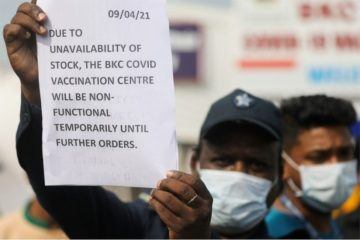 In less than a month, things began to unravel. India was in the grips of a devastating second wave of the virus and cities were facing fresh lockdowns. By mid-April, the country was averaging more than 100,000 cases a day. On Sunday, India recorded more than 270,000 cases and over 1,600 deaths, both new single-day records. If the runway infection was not checked, India could be recording more than 2,300 deaths every day by first week of June, according to a report by The Lancet Covid-19 Commission.
India is in now in the grips of a public health emergency. Social media feeds are full with videos of Covid funerals at crowded cemeteries, wailing relatives of the dead outside hospitals, long queues of ambulances carrying gasping patients, mortuaries overflowing with the dead, and patients, sometimes two to a bed, in corridors and lobbies of hospitals. There are frantic calls for help for beds, medicines, oxygen, essential drugs and tests. Drugs are being sold on the black market, and test results are taking days. “They didn’t tell me for three hours that my child is dead,” a dazed mother says in one video, sitting outside an ICU. Wails of another person outside the intensive care punctuate the silences.
More here.
Richard Linklater Presents: Summer (Le Rayon Vert)
On ‘The Tarot of Leonora Carrington’
Chloe Wyma at Artforum:
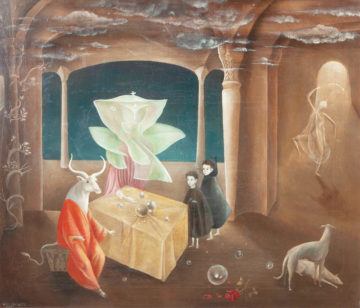 Carrington made The High Priestess, one of only two cards to have been dated, in 1955, around the same time she and her friend Remedios Varo were haunting the metaphysical clubs established by the disciples of Russian mystics P. D. Ouspensky and G. I. Gurdjieff. Esoterica had long been fashionable in Mexico City. Diego Rivera, when called on by the Communist Party in 1954 to justify his membership in the Ancient Mystical Order Rosae Crucis, said the group was “essentially materialist.” But Carrington and Varo’s occultism was especially committed, prodigious, and syncretic, encompassing tarot, alchemy, witchcraft, Kabbalah, and indigenous Mexican magic and healing practices. Carrington’s library included at least thirteen titles on cartomancy by authors including Ouspensky, A. E. Waite, Joseph Oswald Wirth, and her friend Kurt Seligmann (who reportedly fell out with André Breton after correcting his interpretation of a tarot card). A March 1943 issue of the Surrealist journal VVV records, alongside Carrington’s recipe for stuffed beef in sherry wine, her aborted attempt with Roberto Matta to invent a new divinatory system that would be to tarot “what non-Euclidian geometry is to Euclidian geometry.”
more here.
The Novel as a Long Alto Saxophone Solo
Lucy Scholes at The Paris Review:
 The Flagellants, the American writer Carlene Hatcher Polite’s debut novel, is one of those out-of-print books that’s been lurking in the corner of my eye for the past few years. First published by Christian Bourgois éditeur as Les Flagellants in Pierre Alien’s 1966 French translation, and then in its original English the following year by Farrar, Straus and Giroux, the book details the stormy relationship between Ideal and Jimson, a Black couple in New York City. The narrative is largely made up of a series of stream of consciousness orations. Polite’s prose is frenetic and loquacious, and her characters fling both physical and verbal violence back and forth across the page. The French edition received much praise. Polite was deemed “a poet of the weird, an angel of the bizarre,” and the novel was described as “so haunting, so rich in thoughts, sensations, so well located in a poetic chiaroscuro that one [could] savor its ineffaceable harshness.” And while certain American critics weren’t so impressed—“Miss Polite’s narrative creaks with the stresses of literary uncertainty,” wrote Frederic Raphael in the New York Times, summing the novel up as a “dialectical diatribe”—others recognized this young Black woman’s singular, if still rather raw and emergent, talent. Malcolm Boyd, for example, declared the novel “a work of lush imagery and exciting semantic exploration.” It won Polite—then in her midthirties and living in Paris with the youngest of her two daughters—fellowships from the National Foundation for the Arts and Humanities (1967) and the Rockefeller Foundation (1968).
more here.
Tuesday Poem
.
What is my life worth? At the end (I don’t know what end)
One person says: I earned three hundred contos,
Another: I enjoyed three thousand days of glory,
Another: I was at ease with my conscience and that is enough…
And I, if they come and ask me what I have done,
Will say: I looked at things, nothing more.
And that is why I have the Universe here in my pocket.
And f God asks me: And what did you see in those things?
I will answer: Only things … You yourself added nothing else.
And God, who despite all is clever, will make me a new kind of
………. saint.
by Fernando Pessoa
from The Complete Works of Alberto Caeiro
New Directions Paperbook, 2020
translated from the Portuguese by
…Margaret Jull Costa and Patricio Ferrari
Conto: a former money of account in Portugal and Brazil
Places of Mind – a generous and heartfelt biography of Edward Said
Ahdaf Soueif in The Guardian:
 Long after his death in 2003, Edward W Said remains a partner in many imaginary conversations.” The opening line of Tim Brennan’s biography of Said is true – it’s hard to come up with another thinker who remains so present in his absence. Some 50 or so books have been written about him. His writings are taught in universities across the world. Look on social media and you’ll find him constantly referred to, in easy, familiar terms, by the young across the globe. His portrait is on the walls of the old cities of Palestine, in the company of the martyrs. The events of the past years, not least the Arab uprisings and the counter-revolutionary triumphs that followed them, have been for many of us occasions where we turned to his ideas and his example.
Said bestrode not just one world, but several. Just as he was at the same moment a New Yorker and a Palestinian brought up in Egypt, he was also a literary critic, a theorist, a political activist, a musician and more. And if this led to him being “not quite right” in any one world, his genius was to transmute this condition into the engine of ideas around which a considerable part of the intellectual and political life of these worlds came to revolve.
Brennan was Said’s student and friend, familiar with his ideas and comfortable in his company. For Places of Mind he worked closely with Said’s family, conducted interviews with a wide range of his friends and colleagues and (he must have) thoroughly mined the archive held in Columbia University, where Said taught for his entire career. (One delightful moment in the book is when Brennan finds that Said’s teaching notes from 1964 to 1984 prove his old teacher’s statement that some of his best ideas came from his teaching.)
More here.
Lift off! First flight on Mars launches new way to explore worlds
Alexandra Witze in Nature:
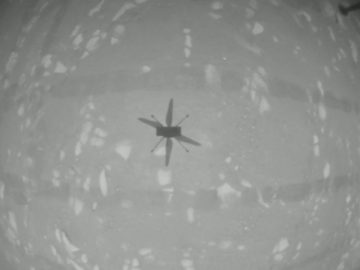 NASA has pulled off the first powered flight on another world. Ingenuity, the robot rotorcraft that is part of the agency’s Perseverance mission, lifted off from the surface of Mars on 19 April, in a 39.1-second flight that is a landmark in interplanetary aviation. “We can now say that human beings have flown a rotorcraft on another planet,” says MiMi Aung, the project’s lead engineer at the Jet Propulsion Laboratory (JPL) in Pasadena, California.
Ingenuity’s short test flight is the off-Earth equivalent of the Wright Brothers piloting their aeroplane above the coastal dunes at Kitty Hawk, North Carolina, in 1903. In tribute, the helicopter carries a postage-stamp-sized piece of muslin fabric from the Wright Brothers’ plane. “Each world gets only one first flight,” says Aung.
The flight came after a one-week delay, because software issues kept the helicopter from transitioning into flight mode two days ahead of a planned flight attempt on 11 April. Today, at 12:34 a.m. US Pacific time, Ingenuity successfully spun its counter-rotating carbon-fibre blades at more than 2,400 revolutions per minute to give it the lift it needed to rise 3 metres into the air. The US$85-million drone hovered there, and then, in a planned manoeuvre, turned 96 degrees and descended safely back to the Martian surface. “This is just the first great flight,” says Aung.
More here.
Sunday, April 18, 2021
The Digital Revolution Is Eating Its Young
Mark Esposito, Landry Signé, and Nicholas Davis in Project Syndicate:
As massive online platforms have given rise to numerous virtual marketplaces, a gap has opened between the real and the digital economy. And by driving more people than ever online in search of goods, services, and employment, the coronavirus pandemic is widening it. The risk now is that a new digital industrial complex will hamper market efficiency by imposing rents on real-economy players whose daily operations depend on technology.
The premise of the Fourth Industrial Revolution (4IR) is that the tangible and intangible elements of today’s economy can coexist and create new productive synergies. The tangible side of the economy provides the infrastructure upon which automation, manufacturing, and complex trade networks rest, and intangibles – logistics, communication, and other software and Big Data applications – allow for these processes to achieve optimal efficiency.
More to the point, the tangible economy is a prerequisite for the intangible economy. Through digitalization, tangibles can become intangibles and then overcome traditional limitations on scale and value creation. While heavily transactional and capital-intensive, this process hitherto has been a positive mechanism for growth, providing some equity of opportunities for small and large countries alike.
But this standard account of the 4IR omits the recent decoupling of the digital and real sectors of the economy.
More here.
First GMO Mosquitoes to Be Released In the Florida Keys
Taylor White in Undark:
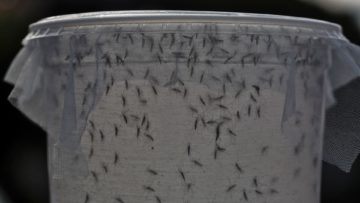
This spring, the biotechnology company Oxitec plans to release genetically modified (GM) mosquitoes in the Florida Keys. Oxitec says its technology will combat dengue fever, a potentially life-threatening disease, and other mosquito-borne viruses — such as Zika — mainly transmitted by the Aedes aegypti mosquito.
While there have been more than 7,300 dengue cases reported in the United States between 2010 and 2020, a majority are contracted in Asia and the Caribbean, according to the U.S. Centers for Disease Control and Prevention. In Florida, however, there were 41 travel-related cases in 2020, compared with 71 cases that were transmitted locally.
Native mosquitoes in Florida are increasingly resistant to the most common form of control — insecticide — and scientists say they need new and better techniques to control the insects and the diseases they carry. “There aren’t any other tools that we have. Mosquito nets don’t work. Vaccines are under development but need to be fully efficacious,” says Michael Bonsall, a mathematical biologist at the University of Oxford, who is not affiliated with Oxitec but has collaborated with the company in the past, and who worked with the World Health Organization to produce a GM mosquito-testing framework.
Bonsall and other scientists think a combination of approaches is essential to reducing the burden of diseases — and that, maybe, newer ideas like GM mosquitoes should be added to the mix. Oxitec’s mosquitoes, for instance, are genetically altered to pass what the company calls “self-limiting” genes to their offspring; when released GM males breed with wild female mosquitoes, the resulting generation does not survive into adulthood, reducing the overall population.
More here.
The Unbearable Burden of Invention: Imitation, once the foundation of creativity in architecture, is banished
Witold Rybczynski in The Hedgehog Review:
 Buildings’ nicknames are the public’s attempt to make sense of the incomprehensible. Several odd-looking London skyscrapers have cheekily illustrative monikers: the Gherkin, the Cheesegrater, the Walkie-Talkie. Angelenos call the mammoth Pacific Design Center the Blue Whale. Beijingites offhandedly refer to the headquarters of China Central Television as Big Underpants. A Shanghai skyscraper with an aperture at the top is the Bottle Opener, and Bilbao has the Artichoke, Frank Gehry’s titanium Guggenheim museum. My favorite is the nickname of an addition to the Stedelijk Museum in Amsterdam—the Bathtub.
The original Stedelijk Museum, or city museum, was built in 1895 in the style of the sixteenth-century Dutch Renaissance. The gingerbread red-brick building with pale stone stripes is pretty as a picture. The 2012 modern addition, which doubled the size of the museum, is the work of the Amsterdam architectural firm Benthem Crouwel. The competition-winning design ignores its neighbor and obviously aspires to be the Dutch equivalent of the Bilbao Guggenheim, an in-your-face architectural icon. From certain angles, the windowless white form, raised in the air and covered in a reinforced synthetic fiber finished in glossy white paint, really does resemble a giant hot tub. Michael Kimmelman of the New York Times observed that “entering an oversize plumbing fixture to commune with classic modern art is like hearing Bach played by a man wearing a clown suit.” Not good.
More here.
Negative Space: Close Reading Trauma Porn
Maya Gurantz in the Los Angeles Review of Books:
 Buy me a drink and I’ll break down for you my new obsession: the abuse documentary. It’s a new genre, it’s everywhere on streaming media, and I’ve watched them all.
I can describe the precise differences between Part I of Surviving R. Kelly and Part II: The Reckoning; at precisely what point the second half of the series The Keepers loses its initial unrelenting momentum; what makes Lorena, about the Bobbitt case, best of genre; what makes On the Record, about music executive Russell Simmons, peak #MeToo; how Leaving Neverland, the four-hour-long two-parter about Michael Jackson’s pedophilia is critically enhanced by the coda of the Oprah Winfrey-hosted, talk show-format After Neverland; why Seduced, about Keith Raniere and the NXIVM cult, is an abuse doc; why The Vow, about Keith Raniere and the NXIVM cult, isn’t; why the two separate Jeffrey Epstein series (Surviving Jeffrey Epstein and Jeffrey Epstein Filthy Rich) both oddly feel like we’re jumping the shark a bit; and how two Larry Nassar documentaries, At the Heart of Gold and Athlete A, can hit so many identical beats while coming to such entirely different conclusions. You might think I’ve fallen behind this past month, what with the release of the four-part Allen v Farrow and the 8-episode CBC Podcast Evil by Design (about Peter Nygard, the “Canadian Jeffrey Epstein”), but don’t you worry. I’m all caught up.
How did the unraveling of serial sexual abuse become a blockbuster genre? What constitutes its formal newness, on the one hand, and its connection to a rich lineage of American sentimental storytelling about women’s injury on the other?
More here.
Sunday Poem
Summer
Winter is cold-hearted,
Spring is yea and nay,
Autumn is a weathercock
Blown every way.
Summer days for me
When every leaf is on its tree;
When Robin’s not a beggar,
And Jenny Wren’s a bride,
And larks hang singing, singing, singing,
Over the wheat-fields wide,
And anchored lilies ride,
And the pendulum spider
Swings from side to side;
And blue-black beetles transact business,
And gnats fly in a host,
And furry caterpillars hasten
That no time be lost,
And moths grow fat and thrive,
And ladybirds arrive.
Before green apples blush,
Before green nuts embrown,
Why one day in the country
Is worth a month in town;
Is worth a day and a year
Of the dusty, musty, lag-last fashion
That days drone elsewhere.
by Christina Rossetti
from the National Poetry Library