
David Builes at Notre Dame Philosophical Reviews:
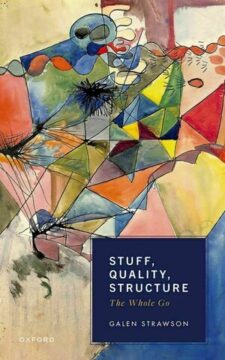 As the reader might have guessed, the views that Strawson defends in the book are far apart from mainstream views in contemporary analytic metaphysics. Moreover, it is worth mentioning that the style of the book is also distinctive. For one, the focus of the book is on developing a unified “big picture” view of fundamental matters in metaphysics, so one might find less detailed argument and critical engagement with alternative views in this book than in other contemporary books in metaphysics, e.g., one could easily write an entire book on categorical monism, or on the powerful qualities view, or on thing-monism, or on kind-monism). The book also seamlessly incorporates references to the history of philosophy throughout. Although Strawson knows full well that his views are not very popular in contemporary metaphysics, he argues that many of his views have been endorsed by some of the most prominent philosophers throughout history (including Descartes, Spinoza, Leibniz, Kant, Schopenhauer, Nietzsche, Whitehead, Russell, and others).
In my view, Strawson does an excellent job of bringing out the intuitive motivations for the views that he discusses in an accessible manner, and I strongly recommend the book to anyone who is interested in fundamental metaphysics. In what follows, I will focus on two of Strawson’s main claims: categorical monism and the powerful qualities view.
more here.
Enjoying the content on 3QD? Help keep us going by donating now.
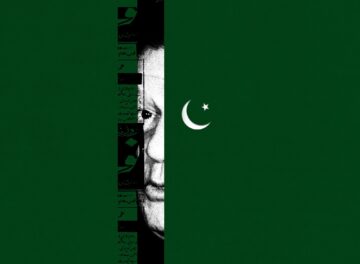 Just so we’re clear, the following is a fact. Not opinion, not a point of view, not a hot take. Fact. There is no Pakistani – male, female, dead, alive, real, imagined – as famous as Imran Khan. Every turn in a multifarious public life has abounded in fame, first as a cricket legend, then as a beloved philanthropist who built a cancer hospital for the poor, latterly as a maverick politician who swept to power promising reform, and now, as the sole occupant of a cell in Pakistan’s most notorious jail. So famous he’s been the subject of two death hoaxes – most recently in November, when he went unseen for so long that many concluded he had died.
 When I read the story, I was convalescing from an affair with a married person. I did love him back, and he didn’t change his life for me, and since you can’t heal at home from a heartbreak nobody knows about, I had gone abroad. Nothing in my life seemed to be working, and I must have searched up Cheever as part of my attempt to try the opposite of everything I had been doing. I had to admit that in the mirror “The Country Husband” held up to me, I appeared a little less broken than I felt. Writing from Francis Weed’s point of view, Cheever had, at a time when I really needed it, validated my experience of how powerful and real and obliterating extramarital love can be—even and especially for the married party. This, by the way, was years before the ubiquity of open marriages made moot the need for affairs, the way de Tocqueville has described the democratic election’s quelling the need for violent revolution. But the impulse to escape, resist, defy; the flirting with destruction, complete overhaul, change—this doesn’t go away just because one container for it has gone licit.
 Hark! A sign of the End Times. No, not the Four Horsemen, nor a black sun, nor the resurrection of the dead. The omen that the rapture is upon us is none other than artificial intelligence.
 For nineteen years, until his retirement in 1885, Herman Melville would awake, slick back his dark hair and unsnarl the snags from his beard, don a uniform of dark navy pilot cloth and affix to his chest the brass badge of a U.S. Customs Inspector. Operating at the Lower Manhattan docks, Melville’s task was to examine ship manifests against unloaded cargo. “I am tormented with an everlasting itch for things remote,” said Ishmael in Moby-Dick. “I love to sail forbidden seas, and land on barbarous coasts.”
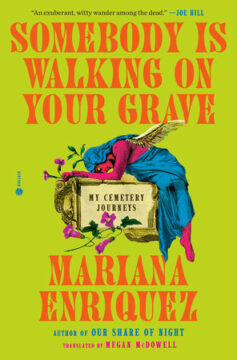 New Orleans has around 350 thousand inhabitants—over a million if you include its metropolitan area—and forty-two cemeteries. That’s a lot. Graves here are aboveground; there are almost no burials. The city is in a swamp, so close to the water table that it’s as if it were floating. To attempt an underground grave means condemning the coffin to float out someday, when the water rises. That’s why there are only niches, vaults, mausoleums.
 Vanya Gregor Rohwer slid open a drawer to display the rich pink spread wing of a roseate spoonbill, one of thousands of mounted wings at the Cornell University Museum of Vertebrates.
 On a summer day in 1924, a young Indian physicist named Satyendra Nath Bose sent a paper and a letter to Albert Einstein. It would shape the nascent field of quantum mechanics and secure Bose a place in the annals of scientific history.
 Among the job doomsayers of the AI revolution, David Autor is a bit of an outlier. As the MIT economist has
  In April 2024, microbial geneticist Norberto Gonzalez-Juarbe stood over an enigmatic drawing in a private New York City collection. Gently, he rubbed its centuries-old surface, front and back, with a swab like those used in COVID-19 testing. “It’s not every day,” Gonzalez-Juarbe recalls with a laugh, “that one gets to touch a Leonardo.” Rendered in red chalk on paper, Holy Child shows a young boy’s head inclined slightly to the side, his features sketched with feathery strokes. Light pools softly around his cheeks and brow, dissolving the edges of his pensive face in a haze of sfumato. The late art dealer Fred Kline, who acquired the drawing in the early 2000s, had claimed stylistic features such as left-handed hatching, a trademark of Leonardo da Vinci’s, link Holy Child to the Renaissance master. But its authorship remains in dispute; experts say one of his students could have produced it.
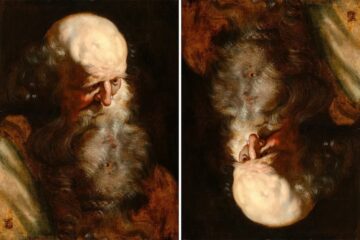 Three years ago, Belgian art dealer
  Earth has entered an “era of water bankruptcy” due to over-consumption and global warming, with 3 in 4 people living in countries that face water shortages, water contamination or drought.
 Joan Didion could hardly stand It. More than once,