Anthony Lane in The New Yorker:
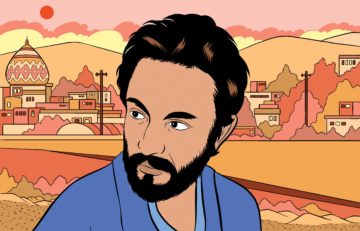 The hero of “A Hero,” the new film from Asghar Farhadi, is a sign painter and calligrapher named Rahim (Amir Jadidi). As the story begins, he leaves prison and is driven up the wall. To be precise, up a cliff of pale rock, rich in elaborate carvings, northeast of the Iranian city of Shiraz. The cliff is the home of a necropolis, Naqsh-e Rostam, and Rahim finds it covered in scaffolding; climbing high, he greets his brother-in-law, the rotund and genial Hossein (Alireza Jahandideh), who is working at the site. The wind whistles gently around them, and Hossein brews tea, close to the tomb of Xerxes the Great, a Persian king who died almost two and a half thousand years ago. Rahim, by contrast, is on a furlough for two days, after which—not unlike Eddie Murphy in “48 Hrs.” (1982)—he must return to prison. Observing the scene, you feel dizzy at the doubleness of time. It expands and contracts, either stretching far into the distance or slamming shut.
Something else, however, makes you no less uneasy, and that is Rahim’s smile. It looks friendly and generous, but it’s also weirdly weak, and it can fade like breath off a mirror. This is clever casting on Farhadi’s part; we warm to Rahim’s crestfallen charm, and instinctively feel him to be down on his luck, yet we don’t entirely trust him, and the film proceeds to back our initial hunch. What led to his incarceration was an unpaid debt. His creditor, Bahram (Mohsen Tanabandeh), is grave, dour, and disinclined to forgive, despite being related to Rahim by marriage. (Just to thicken the mood, Bahram is a dead ringer for the Mandy Patinkin character, Saul, in “Homeland.”) “I was fooled once by his hangdog look, that’s enough,” Bahram says of Rahim, and we can’t help wondering, Could the dog be fooling us as well?
Anyone who has seen Farhadi’s earlier films, such as “About Elly” (2009) and “A Separation” (2011), will know how cunningly he doles out information, piece by piece. Thus, in the new movie, we gradually realize that Rahim has an ex-wife; that she will soon be married to someone else; that, while he’s been locked up, his sister Mali (Maryam Shahdaei) has been caring for his son, a shy kid with a stutter; that Farkhondeh (Sahar Goldust), a young woman beloved of Rahim, is the boy’s speech therapist; and so on. These things are true, but they are hard to cling to, because they are bundled up with things that are not necessarily true—secrets and lies, in which Rahim is all too quick to acquiesce. And the bundling only gets worse.
More here.

 The presumption is that art must shock—that the violation of taboo is what gives art its charge; and that, actually, shock and the overturning of societal norms is art’s highest purpose.
 In 1963, as the Beach Boys were playing on the radio and Christmas was approaching, two California schoolboys threw a coin. They were deciding who would be the guinea pig in a school science project they had designed—to beat the world record for staying awake. The lucky “winner” was Randy Gardner, a 16-year-old from San Diego. When the experiment was over, he had stayed awake for eleven days and twenty five minutes. It yielded some fundamentally important observations, fortunately recorded by William Dement, one of America’s few sleep researchers at the time. Nearly forty years later, Gardner still holds the world record—which is unlikely to be broken, as the Guinness World Records will no longer accept entries. Why? It is much too dangerous for the brain.
 My book,
  The Right to Sex has to have the cleverest title on the women’s studies shelf since Roxane Gay’s Bad Feminist. It’s bold and provocative, even a little shocking: “OK,” it seems to say, “so they’re crazy, misogynistic, and dangerous—but are those incels on to something?”
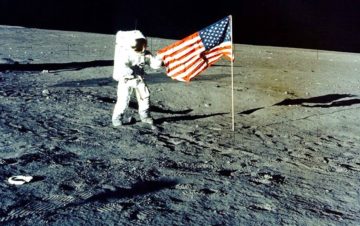 Those venturing into space in 2022 have the moon in their eyes. Not that ferrying all sorts of people into orbit and suborbit will be abandoned. 2021 saw not only astronauts and scientists but also several tourists sent skyward for unmatched views of the big, blue marble that is Earth. They were young and old, women and men, various nationalities – even William Shatner, never a real spaceship captain but who played one on TV.
 Over at the podcast Myself With Others:
 Suzanne Schneider in Late Light:
 Eduardo Peñalver in The Chronicle of Higher Education:
 Maggie Gyllenhaal has a theory that the mothers we see on-screen tend to fall into one of two categories. First, there’s the “fantasy mother,” who’s perfect in every way except when she has, say, some oatmeal on her sweater or runs a little late for a parent-teacher conference. On the flip side is the “monstrous mother,” who either mistreats her children or struggles with emotions that stifle her ability to parent; her story arc builds toward making her more palatable to viewers. Many films that attempt to rehabilitate an imperfect mother, such as Woman Under the Influence and Terms of Endearment, have been directed by great artists, and these characters have been played by great actors. And yet, Gyllenhaal told me over Zoom last month, with such movies, “you’re basically watching the destruction of this powerful life force.”
 If a single medical objective could be applied to the entire range of cancers, it would be detecting the disease as soon as possible. “At the highest level, finding any cancer early gives you the opportunity for curative treatments,” says Andrea Ferris, CEO of research funding organization, LUNGevity.
 I
I Even if Peter Bogdanovich, who died on Thursday, at the age of eighty-two, had never exposed a frame of film as a director, he’d be one of the history-making heroes of the world of movies.
  It was exactly two years ago that it first became publicly knowable—though most of us wouldn’t know for at least two more months—just how freakishly horrible is the branch of the wavefunction we’re on. I.e., that our branch wouldn’t just include Donald Trump as the US president, but simultaneously a global pandemic far worse than any in living memory, and a world-historically bungled response to that pandemic.
 Last June, we