
Chris Hall in The Guardian:
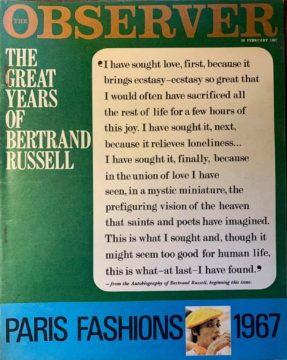 The Observer Magazine has never again featured an extract from the autobiography of a philosopher on its cover after ‘The Great Years of Bertrand Russell’, 26 February 1967.
But then Bertrand Russell was no ordinary philosopher. ‘Three passions, simple but overwhelmingly strong, have governed my life,’ he wrote. ‘The longing for love, the search for knowledge and unbearable pity for the suffering of mankind.’
Russell had his share of death to deal with – his mother, father and sister all died before he was four and his grandfather (a former prime minister) when he was six. His grandmother was the most important person to him in his childhood, although ‘by the age of 14, her intellectual limitations became trying to me, and her Puritan morality began to seem to me to be excessive’.
More here.
 New high-speed cellphone services have raised concerns of interference with aircraft operations, particularly as aircraft are landing at airports. The Federal Aviation Administration has
  Every few days, there’s another article pointing out the likelihood that a Democratic win[1] in the 2024 US election will be overturned, and suggesting various ways it might be prevented, none of which seem very likely to work. The best hope would seem to be a crushing Democratic victory in the 2022 midterms, which doesn’t look likely right now[2]
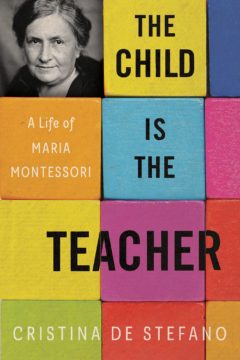 She hires the daughter of a custodian to teach kindergarten. It is 1907 in a poor neighborhood in Rome, where there has never been a kindergarten before. An agency tasked with improving neighborhoods in the city is trying to provide a place for children to go while their parents are working, and Maria Montessori has been asked to run the program. Montessori instructs the inexperienced teacher that the children should be allowed to lie on the floor or sit under the table—to do whatever they want. Observe them closely and tell me what you notice, she says. The new teacher reports back: the children are more interested in helping her sweep than in playing with the donated toys. Montessori writes this down. One day when Montessori is on her way to the classroom, she notices a peaceful baby girl with her mother in the courtyard. She invites them in and challenges the young children to be as quiet as the baby. This goes well. Montessori decides to make a ritual out of it: a period of silence for the children, one that ends when each child is called by name into the next room. This, also, the children love. The practice is adopted.
 The essays in Extinct often answer two questions: What was it that has disappeared and why? And then, what was the significance of this loss? Some, like Slessor’s, are lucidly personal meditations, stuffed with anecdotes and design history; others are more technical treatises on the reason a particular technology failed to take root. The editors identify six general reasons why things become extinct and categorize each object in this way. Certain objects are deemed “failed”; they simply didn’t work. Many more, though, are “superseded” by more advanced models of similar things. Some dead objects, especially commercial products, are “defunct”—these have failed to gain widespread adoption, or couldn’t be mass-produced, or have simply gone out of style. Others are “aestivated,” meaning that they disappear but are revived in a new form. Still others are classified as “visionary,” in that they never quite came into being at all. The rest are “enforced,” basically regulated into disappearance.
 When Oscar Wilde left prison in 1897, shocked observers saw how a two-year sentence with hard labour for gross indecency had prematurely aged the Irish playwright. Shunned by London society and ostracized by his family, he died penniless in Paris three years later, aged 46. Had the scientific field of human ageing
  F
F Ars Technica: You make frequent references not just to The Matrix but to other classic works in science fiction in your book. What is it about such works that resonate so strongly with philosophers?
 When I was a journalist for The Times (London) in Moscow in December 1992, I saw a print-out of a speech by the then Russian foreign minister, Andrei Kozyrev, warning that if the West continued to attack vital Russian interests and ignore Russian protests, there would one day be a dangerous backlash. A British journalist had scrawled on it a note to an American colleague, “Here are more of Kozyrev’s ravings.”
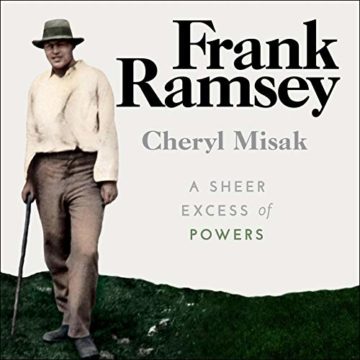 Cheryl Misak’s new book is the first intellectual biography of Frank Plumpton Ramsey, a brilliant but tragically short-lived scholar who illuminated Cambridge in the 1920s. The biography has been eagerly awaited by many of us, in several fields, who’ve built chunks of our own careers from fragments of Ramsey’s astonishing meteorite.
 When you wake up in the morning, how do you know who you are? You might say something like: ‘Because I remember.’ A perfectly good answer, and one with a venerable history. The English philosopher John Locke, for example, considered memory to be the foundation of identity. ‘Consciousness always accompanies thinking,’ he wrote in 1694. ‘And as far as this consciousness can be extended backwards to any past Action or Thought, so far reaches the Identity of that Person.’
 The Cold War ended 30 years ago. But since the 2007-08 financial crisis, it has not only returned but mutated into a hybrid lukewarm war. And with the United States and its European allies now struggling to manage the threat of a Russian attack on Ukraine, the specter of a hot war is looming. The 1938
 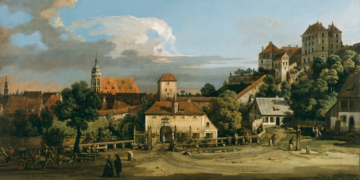 Olga Tokarczuk’s twelfth book, the novel The Books of Jacob, first published in Poland in 2014 to great acclaim and considerable controversy, kicks off in 1752 in Rohatyn, in what is now western Ukraine, and winds up in a cave near Korolówka, now eastern Poland, where a family of local Jews has hidden from the Holocaust. Between mid-18th-century Rohatyn and mid-20th-century Korolówka, Olga traverses the Habsburg and Ottoman Empires and the Polish-Lithuanian Commonwealth in search of the manifold secrets of Jacob Frank, a highly charismatic real historical figure, beloved and despised by his contemporaries, the leader of a wildly heretical Jewish sect that converted in different moments to both Catholicism and Islam.