
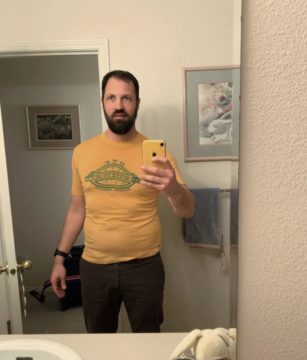
 Sam Anderson in the New York Times:
There were a few bad moments, over the course of a few bad months, that led me to download the weight-loss app. These will probably sound trivial to anyone who is not me, and of course they are trivial — but we are talking about bodies here, and about my body in particular, and one of the defining features of having a body is that it is a fire hose of tiny humiliations blasting you constantly in the face, never allowing you to look away, even when you most want to.
One bad moment happened in Los Angeles. I had flown out, during a lull in the pandemic, to visit my great friend Alan, a friend so close he is basically a reflection of my own soul — and as Alan and I wrapped each other in a big hug of ecstatic reunion, he suddenly reached down to my waist and playfully pinched my love handles, probed them in the way a fishmonger might assess a large hunk of priceless tuna, and he said: “What happened here? Did you eat my friend Sam?” I chuckled, but in a complicated key.
Like many Americans, I put on serious weight during the pandemic. How much? No idea. It had been years since I’d stepped on a scale. We were suffering a worldwide supertrauma, and my approach to calamities has always been extremely simple: I snack. Do you know the saying “Don’t fill up on chips?” That saying is about me. I am the guy who fills up on chips.
More here.
 Ryan Ruby in The New Left Review’s Sidecar:
 Patrick J. Deneen over at his substack The Postliberal Order (photo by Matt Cashore/University of Notre Dame):
 Suzanne Cope in Aeon: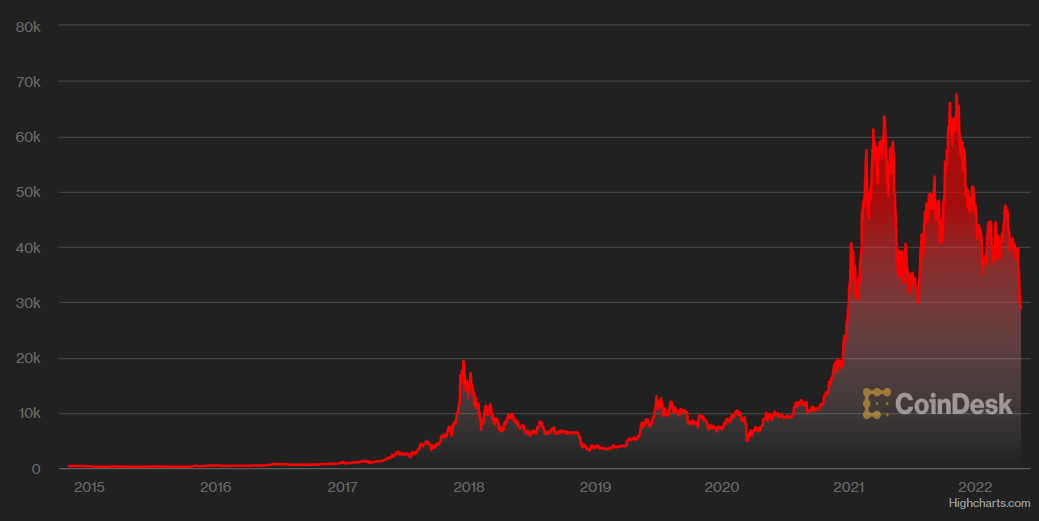
 One of the recent trends on TikTok is an aesthetic called “night luxe.” It embodies the kind of performative opulence one usually encounters at New Year’s Eve parties: champagne, disco balls, bedazzled accessories, and golden sparkles. “Night luxe” doesn’t actually mean anything. It isn’t a
 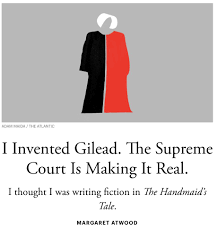 In the early years of the 1980s, I was fooling around with a novel that explored a future in which the United States had become disunited. Part of it had turned into a theocratic dictatorship based on 17th-century New England Puritan religious tenets and jurisprudence. I set this novel in and around Harvard University—an institution that in the 1980s was renowned for its liberalism, but that had begun three centuries earlier chiefly as a training college for Puritan clergy.
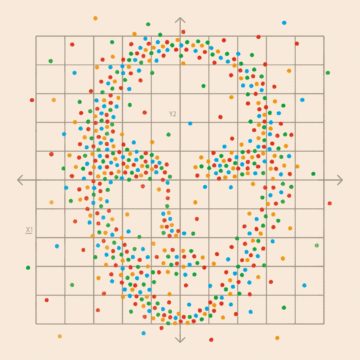 While living in an internment camp in Vichy France, Alexander Grothendieck was tutored in mathematics by another prisoner, a girl named Maria. Maria taught Grothendieck, who was twelve, the definition of a circle: all the points that are equidistant from a given point. The definition impressed him with “its simplicity and clarity,” he wrote years later. The property of perfect rotundity had until then appeared to him to be “mysterious beyond words.”
 Though the 1973 decision in Roe established a constitutionally protected right to abortion, it never guaranteed abortion access. The Supreme Court held only that state criminal laws banning abortion were an infringement of the constitutional right to privacy. Patients, in consultation with their physicians, could elect to have an abortion for any reason during the first trimester of pregnancy. In the second trimester states could regulate abortions in order to protect the pregnant person’s health or the dignity of potential life, but after the second trimester, a state was permitted to ban abortion unless terminating the pregnancy was necessary to preserve the patient’s life or health. This trimester system was abandoned in 1992, when the Court held that states could restrict abortion before viability—around twenty-four weeks of gestation—so long as the regulation did not place a “substantial obstacle in the path of a woman seeking an abortion of a nonviable fetus.” The Court’s decision to reject Roe’s trimester framework nevertheless claimed to preserve “the essential holding of Roe.”
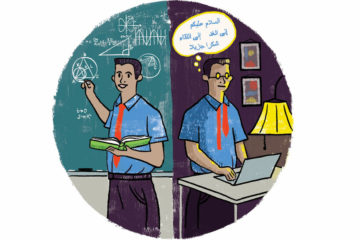 I am a university professor. I make my living teaching and doing research at a liberal arts school in Southern California. Last year, I took a brave step: I decided to become a student and signed up for online Arabic classes. I joined an online language course offered by a company based in Cairo. Full disclosure: This was my third attempt at learning Arabic over the past 10 years. Arabic is a notoriously hard language, given its expansive vocabulary. A Moroccan feminist scholar told me once that there are 50 words for “love” in Arabic – a fascinating and intimidating fact. My earlier attempts at mastering synonyms had proved her right.
 The mystery at the heart of the Milky Way has finally been solved. This morning, at simultaneous press conferences around the world, the astronomers of the Event Horizon Telescope (EHT) revealed the first image of Sagittarius A*, the supermassive black hole at the center of the Milky Way. It’s not the first picture of a black hole this collaboration has given us—that was
  The genre is as old, almost, as the modern novel, and shares its subversive nature. If Don Quixote, among many other things, brought fiction down from the chivalric heights to the pedestrian grounds, so literary biography served as a tonic to the genre of biography as a whole, which has always tended toward the exemplary. James Boswell’s Life of Samuel Johnson, considered by many to be the first modern literary biography, details its subject’s appetite for drink, his shabby clothes, his disgusting eating habits. Johnson himself thought it the “business of the biographer to…lead the thoughts into domestic privacies, and display the minute details of daily life.”
 If, in 1979, Rosalind Krauss famously said, “we find it indescribably embarrassing to mention art and spirit in the same sentence,” today many of us find it indescribably embarrassing not to.
 What explains the dramatic progress from 20th-century to 21st-century AI, and how can the remaining limitations of current AI be overcome? The widely accepted narrative attributes this progress to massive increases in the quantity of computational and data resources available to support statistical learning in deep artificial neural networks. We show that an additional crucial factor is the development of a new type of computation. Neurocompositional computing (Smolensky et al., 2022) adopts two principles that must be simultaneously respected to enable human-level cognition: the principles of Compositionality and Continuity. These have seemed irreconcilable until the recent mathematical discovery that compositionality can be realized not only through discrete methods of symbolic computing, but also through novel forms of continuous neural computing. The revolutionary recent progress in AI has resulted from the use of limited forms of neurocompositional computing. New, deeper forms of neurocompositional computing create AI systems that are more robust, accurate,