
Karen Hao in the MIT Technology Review:
 Over the last few years, an increasing number of scholars have argued that the impact of AI is repeating the patterns of colonial history. European colonialism, they say, was characterized by the violent capture of land, extraction of resources, and exploitation of people—for example, through slavery—for the economic enrichment of the conquering country. While it would diminish the depth of past traumas to say the AI industry is repeating this violence today, it is now using other, more insidious means to enrich the wealthy and powerful at the great expense of the poor.
I had already begun to investigate these claims when my husband and I began to journey through Seville, Córdoba, Granada, and Barcelona. As I simultaneously read The Costs of Connection, one of the foundational texts that first proposed a “data colonialism,” I realized that these cities were the birthplaces of European colonialism—cities through which Christopher Columbus traveled as he voyaged back and forth to the Americas, and through which the Spanish crown transformed the world order.
More here.
 Researchers have completed the first open-air study of genetically engineered mosquitoes in the United States. The results, according to the biotechnology firm running the experiment, are positive. But larger tests are still needed to determine whether the insects can achieve the ultimate goal of suppressing a wild population of potentially virus-carrying mosquitoes.
 The war has exposed Russia as a conventional also-ran bristling with 4,500 nuclear warheads, but not a great power. The war has also unleashed a number of complications: it has heightened the dependency of Russia’s economy on energy exports; jeopardized those exports to the lucrative European market; affected Russia internally by making it more autocratic and opening a new brain drain; generated remarkable solidarity in the West, including a probable further expansion of NATO in the Nordic region and deployments of military assets to eastern members; and led those democracies to impose severe economic sanctions on Russia, including a freeze on Russia’s sovereign wealth deposits in their banks and a disabling of Russian banks from using the SWIFT system. Dozens of Western companies, under societal pressure, have closed down or suspended operations in Russia. (By “the West,” I mean, following convention, not only North America and Europe but also other wealthy democracies including Japan, South Korea, Australia, and New Zealand, all of which thus far have joined the sanctions against Russia.)
 What makes Puerto Rico and the Marshall Islands attractive to crypto-entrepreneurs is how islands offer spaces where “empathy and control are simultaneously possible. … All that exists, whether cultural, economic or physical, can be observed and regulated, qualities that have ensured that islands have been both seen and used as laboratories and which have implied that, in isolation, utopian communities might exist, be established and evolve there.” Entrepreneurs and crypto-friendly politicians can present their fintech solutions as a form of benevolent capitalism, one that promises not only to fast-track the integration of Small Island Developing States in the global economy, but to create new wealth—magic internet money—that could be used to address complex socioeconomic issues and the existential threat of climate change. These ventures’ marketing typically implies that islanders’ way of life somehow prefigured the development of blockchain technology, which is then marketed as a logical next-step in the fight against climate change and cultural survival for these island nations.
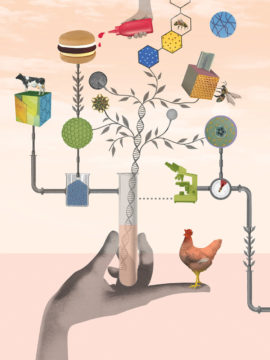 Even the most ardent carnivore might struggle to argue that meat is a force for good today. The global livestock industry produces more greenhouse gases than the exhaust from every form of transport on the planet combined. While doctors try to curb the prescription of antibiotics to slow the emergence of medicine-resistant superbugs, 80 per cent of the antibiotics used in the US are administered to healthy food-producing animals to minimise infections on crammed farms. Industrial animal agriculture is a major cause of deforestation, water waste, water pollution, eutrophication and outbreaks of diseases such as E coli and salmonella, not to mention a significant contributor to new zoonotic diseases and global pandemics. Every year, 70 billion animals are slaughtered to satisfy the global appetite for meat, their lives often miserable and artificially accelerated.
 I
I Every few months, like clockwork, hundreds of videos promising tips and tricks to “hack” your gut flood TikTok. In March, influencers pushed shots of aloe vera juice: “My digestive system, like my gut health? Never been better,” one gushed in
 JH: What was Philadelphia like when you first arrived?
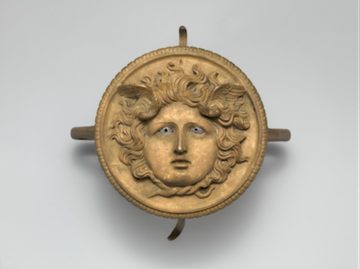 FEW MONSTERS HAVE had as many revamps as Medusa. For many, our first encounter with the gorgon was the fiery stare of Ray Harryhausen’s snake-bodied stop-motion creature, as Harry Hamlin’s Perseus took her head in 1981’s Clash of the Titans. Despite becoming a cultural touchstone for representations of Medusa, Harryhausen’s creation was innovative, a far cry from ancient depictions of Perseus’ prey in presenting a predatory gorgon who attacked back. But Medusa continues to be resurrected in new and varied forms, and the contemporary pop-culture Medusa has herself moved on from her depiction in Clash of the Titans. Shucking her monstrous form, she has been the subject of considerable feminist revision. This feminist vision recasts her as a quite human victim of patriarchy and rape culture. In the most well-known ancient versions of the myth, the mortal Medusa is raped by Poseidon in Athena’s temple, resulting in her punishment by monstrous transformation. This first injustice is then compounded by Perseus’ quest for her head. Following these tales from antiquity, many of which are deeply steeped in misogyny, feminist retellings have rehabilitated the gorgon by bestowing upon her agency expressed through anger.
 In today’s Britain, the figure of Winston Churchill is all but deified. His face adorns the £5 note, where he glares sternly out at passersby, the only Prime Minister to be so honored; he is a perennial subject for BBC
  I love writing reviews of bad books. There’s nothing like the feeling when you’re halfway through a book and it dawns on you that this book is really bad, and that it deserves a pummeling in print for misleading the reader, spreading dodgy ideas, or getting tangled up in the barbed wire of its own prose.
 There are countless problems with economic sanctions.
 Many scholars agree that a subjectively meaningful existence often
  Florida Gov. Ron DeSantis is both a Trump follower and possible Trump opponent, as he’s declined to say whether he’d face off against the former president for the 2024 GOP nomination. He’s pushed through a number of state bills that deal with hot button partisan issues, such as the recently enacted Parental Rights in Education, dubbed by critics the “don’t say gay” law, that bans school teaching of sexual topics deemed non-age-appropriate. Florida is “becoming redder all the time, and it has a very arch-conservative edge – a culture war edge,” says Orlando-based historian James Clark, author of “Hidden History of Florida.”