Justin E. H. Smith in his Substack newsletter, The Hinternet:
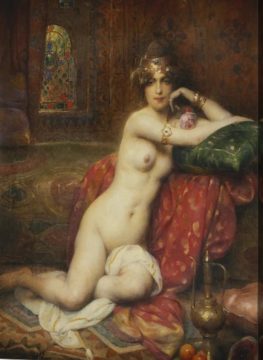 A curious passage in Salammbô, Gustave Flaubert’s 1862 Orientalist phantasmagoria, describes a mostly forgotten practice of the ancient Carthaginians:
[A group of Barbarian soldiers] ran to see it. It was a lion, attached to a cross by its four limbs like a criminal. Its enormous muzzle was falling upon its chest, and its two front paws, half-disappearing beneath the abundance of its mane, were spread wide like the two wings of a bird. Its ribs, all lined up, jutted forth beneath its taut skin; its hind legs, nailed alongside one another, rose up somewhat; and the black blood, pouring through its hairs, had collected in stalactites at the end of its tail that hung straight down along the length of the cross. The soldiers amused themselves with it; they called it consul and citizen of Rome and threw pebbles at its eyes to chase away the flies.
One hundred steps further they saw two more, then suddenly there appeared a long line of crosses bearing lions. The ones had been dead for so long that only the debris of their skeletons remained on the wood; others, half-eaten, twisted their faces into a horrible grimace; some of them were enormous, the tree of the cross folded beneath them and they swung in the wind, as above their heads bands of crows circled in the air without stopping. Thus did the Carthaginian peasants avenge themselves when they captured a ferocious beast; they hoped by this example to terrify the others. The Barbarians, when they had stopped laughing, fell into a long astonishment. “Who are these people,” they wondered, “who amuse themselves by crucifying lions!?” [Emphasis added].
Flaubert’s novel had been among the readings in preparation for my stay at the École Normale Supérieure in Tunis earlier this month. I am probably as much in love with Flaubert as with any author — I’ve written in this space before of the ecstasies to which his “Saint Julien L’Hospitalier” has brought me. But previously I could never finish Salammbô, written in part during his own sojourn in Tunis and vicinity in order to escape the stupid controversy in his home country over the purported obscenity of Madame Bovary. It took a stay in Tunisia for me to be able to feel my way into the novel, which reimagines ancient events mostly drawing on source material from Polybius, and other Roman authors who related the history of the Punic wars.
More here.

 When Salman Rushdie turned seventy-five, last summer, he had every reason to believe that he had outlasted the threat of assassination. A long time ago, on Valentine’s Day, 1989, Iran’s Supreme Leader, Ayatollah Ruhollah Khomeini, declared Rushdie’s novel “The Satanic Verses” blasphemous and issued a fatwa ordering the execution of its author and “all those involved in its publication.” Rushdie, a resident of London, spent the next decade in a fugitive existence, under constant police protection. But after settling in New York, in 2000, he lived freely, insistently unguarded. He refused to be terrorized.
 A magnitude-7.8 earthquake hit southeastern Turkey and parts of Syria in the early hours of the morning of 6 February. At least 5,000 people are known to have lost their lives, with thousands more injured. The quake was followed by a magnitude-7.5 event some 9 hours later, as well as more than 200 aftershocks.
 Thirty years ago, Imran Khan led the Pakistani national team to victory at the Cricket World Cup, cementing his place as one of the greatest athletes in the history of the sport, and as a hero in his country. He retired at the age of thirty-nine. Four years later, in 1996, he founded a political party called Pakistan Tehreek-e-Insaf (P.T.I.), and he began speaking out more on political and cultural issues. In 2013, his party started winning significant power, thanks largely to Khan’s popularity. Then, in 2018, in an election marred by polling irregularities, and with the support of Pakistan’s military, which wields de-facto control of the country,
  If we don’t know how to distinguish bad thinking from good, we can end up believing what we shouldn’t, and behaving in ways that are harmful to ourselves, to others, and to the planet.
 In 1852, the Third Avenue Railroad Company was founded. It ran between City Hall and 62nd Street in Manhattan. Its horse-drawn streetcars quickly became the primary mode of transportation in the city. A small number of the cars carried placards indicating that they accepted African American passengers. Additional cars occasionally allowed Black passengers at the discretion of the operator, and with the approval of the white passengers.
 The new class of obesity drugs — referred to as “GLP-1-based,” since they contain synthetic versions of the human hormone glucagon-like peptide-1 — are considered the most powerful ever marketed for weight loss. Since the US Food and Drug Administration
  Two hundred million years ago, long before we walked the Earth, it was a world of cold-blooded creatures and dull color — a kind of terrestrial sea of brown and green. There were plants, but their reproduction was a tenuous game of chance — they released their pollen into the wind, into the water, against the staggering improbability that it might reach another member of their species. No algorithm, no swipe — just chance.
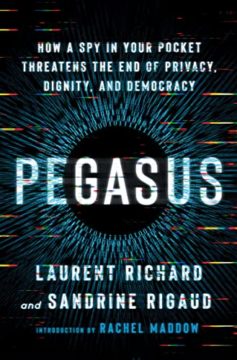 Some of NSO’s human targets had already been beaten or tortured in, for example, Morocco (for oppositional activity or revealing property deals involving the royal family), where five thousand phones were invaded. In Mexico, where over 150 journalists (including those investigating drug cartels) have been murdered by both cartels and the police since 2000, fifteen thousand phone numbers were on NSO’s list. Among NSO’s targets in Mexico, alongside lawyers and journalists, were the driver, the cardiologist and the wife of the politician Andrés Manuel López Obrador (who was elected president in 2018), along with three of his children.
 Caitlin Zaloom (CZ): Your book presents a counterintuitive perspective: that emotions live between people, not only inside them. How did you come to see emotions as fundamentally social?
 The trouble with
  But what, exactly, is mourning, and how does doing it well contribute to a fully human life? These are good questions, addressed too rarely. In
  Colossal Biosciences, the headline-grabbing, venture-capital-funded juggernaut of de-extinction science, announced plans on January 31 to bring back the dodo. Whether “bringing back” a semblance of the extinct flightless bird is feasible is a matter of debate.
 Israel has
  Prompted in large part by the dissolution of his engagement to