
Enjoying the content on 3QD? Help keep us going by donating now.
Category: Recommended Reading
Talk Proto-Indo-European To Me, Darling
Ed Simon at the European Review of Books:
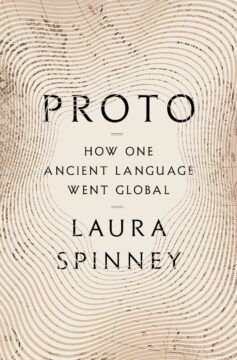 Around five thousand years ago, along the northern bank of the Black Sea where the soil was rich and feather grass plentiful, the nomadic Yamnaya people sang songs about the heroes who slayed dragons. A warrior named Trito is given cattle by the gods, but this most helpful of gifts is stolen by a three-headed serpent. Fortified by an intoxicating potion supplied by the Sky-Father, Dyeus, Trito is victorious over the snake and regains his cattle. A familiar story. In the Rig Veda, the nearly 3500-year-old Sanskrit scripture, the hero Indra « slewest Vrtra the Dragon who enclosed the waters ». In the Bibliotheca, a compendium of Greek myth from the first or second century AD, Hercules « chopped off the immortal head » of the serpentine Hydra, « and buried it, and put a heavy rock on it, beside the road that leads through Lerna to Elaeus. » Snorri Sturluson in the thirteenth-century Icelandic Prose Edda describes Thor’s tussles with a serpent who « spits out poison and stares straight back from below. » The hero of the Anglo-Saxon epic poem Beowulf, « who may win glory before death », defeats the fearsome Grendel; St. George killed his dragon, too.
more here.
Enjoying the content on 3QD? Help keep us going by donating now.
Can anything knock China off its mountain?
Noah Smith at Noahpinion:
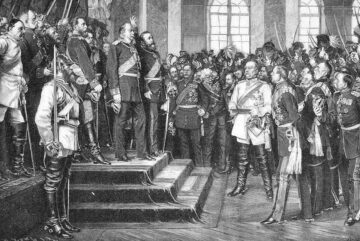 A few years ago, it looked as if the U.S. and China might battle over global hegemony and preeminence. But this looks less likely now, thanks to America’s own behavior. Under Trump 2.0, the U.S. has alienated many of the key allies it would have needed in order to match China’s market size and manufacturing acumen, leaving America standing alone against a country four times its size. Tariffs have hobbled America’s already tottering manufacturing sector. Just a few months after Trump’s inauguration, the idea of a democratic world led by the United States standing up to challenge China’s rise now seems more than a little far-fetched. Meanwhile, China continues to bully and overpower Trump in trade negotiations.
This basically leaves China as the world’s preeminent power by default. The likeliest outcome is that this will be a “Chinese century” — though it won’t look quite like the “American century” did, because China will use its power and influence very differently than the U.S. did.
More here.
Enjoying the content on 3QD? Help keep us going by donating now.
The Puzzle Of The ‘Idiot Savant’
Violeta Ruiz at Aeon Magazine:
On 25 November 1915, the American newspaper The Review published the extraordinary case of an 11-year-old boy with prodigious mathematical abilities. Perched on a hill close to a set of railroad tracks, he could memorise all the numbers of the train carriages that sped by at 30 mph, add them up, and provide the correct total sum. What was remarkable about the case was not just his ability to calculate large numbers (and read them on a moving vehicle), but the fact that he could barely eat unassisted or recognise the faces of people he met. The juxtaposition between his supposed arrested development and his numerical facility made his mathematical feats even more impressive. ‘How can you account for it?’ asked the article’s author. The answer took the form of a medical label: the boy was what 19th-century medicine termed an ‘idiot savant’. He possessed an exceptional talent, despite a profound impairment of the mental faculties that affected both his motor and social skills.
A century after The Review relayed the prodigious child’s mathematical abilities, trying to understand ‘how they do it’ still drives psychological research into savantism or ‘savant syndrome’ to this day. The SSM Health Treffert Centre in Wisconsin – named after Darold Treffert (1933-2020), one of the leading experts in the field – defines the savant phenomenon as ‘a rare condition in which persons with various developmental disorders, including autistic disorder, have an amazing ability and talent’.
more here.
Enjoying the content on 3QD? Help keep us going by donating now.
TIME Best Inventions Hall of Fame
Merrill Fabry in Time Magazine:
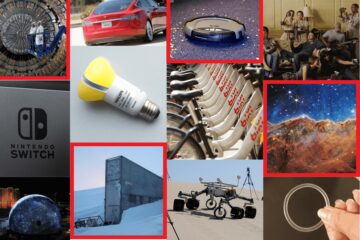 In 2000 TIME’s editors sat down to select three inventions of the year, one each in consumer technology, medical science, and basic industry. They found so many interesting ones along the way that they included dozens of others, from an unbreakable lightbulb to paper that was easier to recycle. It was the start of our annual hunt for the most exciting innovations changing our lives, and the future. Since then, TIME has covered hundreds of inventions, from the esoteric (clouds featured more than once) to essential, including life-changing medicines, technological breakthroughs, new foods, nearly every new Apple product category, and even a few great ideas that didn’t quite catch on. As TIME publishes the 2025 list, we’re also assembling the Best Inventions Hall of Fame: the 25 most iconic inventions we covered in the past quarter century.
More here.
Enjoying the content on 3QD? Help keep us going by donating now.
Our Ancestors Used to Make Yogurt Using Live Ants — And the Recipe Still Works
Stephanie Edwards in Discover:
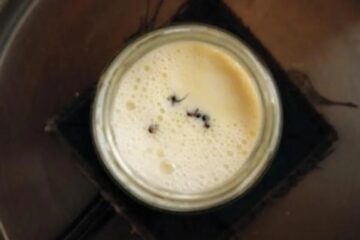 We all have those family recipes that get passed down from generation to generation. From chocolate chip cookies to grandma’s secret spaghetti sauce, these recipes connect us to our past and our loved ones. But some of these family recipes are a little more unique than the rest — like the tradition of using ants to make yogurt.
A new study, published in iScience, chronicles this forgotten way of making yogurt, which originated in the Balkans and Turkey, and involves putting ants into milk. A team of researchers travelled to Bulgaria to learn this traditional yogurt-making technique and tried it out for themselves. “Giving scientific evidence to these traditions have a deep meaning and purpose, even though they might seem strange and more like a myth, I think that’s really beautiful,” said Leonie Jahn, senior author from the Technical University of Denmark, in a press release.
More here.
Enjoying the content on 3QD? Help keep us going by donating now.
Friday Poem
This Only
A valley and above it forests in autumn colors.
A voyager arrives, a map leads him there.
Or Perhaps memory. Once long ago in the sun,
When snow first fell, riding this way
He felt joy, strong, without reason,
Joy of eyes. Everything was the rhythm
Of shifting trees, of a bird in flight,
Of a train on the viaduct, a feast in motion.
He returns years later, has no demands.
He wants only one, most precious thing:
To see, purely and simply, without name,
Without expectations, fears, or hopes,
At the edge where there is no I or not-I
by Czeslaw Milosz
from Task: To Be Where I Am
by Nils Peterson, 2025
Enjoying the content on 3QD? Help keep us going by donating now.
Thursday, October 9, 2025
Here are the finalists for the 2025 National Book Awards
Anastasia Tsioulcas at NPR:
 The finalists for this year’s National Book Awards have been announced. Among the 25 nominees are novelists Rabih Alameddine and Megha Majumdar as well as journalists Julia Ioffe and Omar El Akkad, who also writes fiction.
The winners of each category will be announced on Nov. 19 at an event in New York City. Also being honored are two lifetime achievement winners: author and Syracuse University professor George Saunders and author, cultural critic and Rutgers University-New Brunswick professor Roxane Gay.
Nine of this year’s nominees have received previous recognitions from the National Book Foundation, the organization behind the National Book Awards.
More here.
Enjoying the content on 3QD? Help keep us going by donating now.
AI models that lie, cheat and plot murder
Matthew Hutson in Nature:
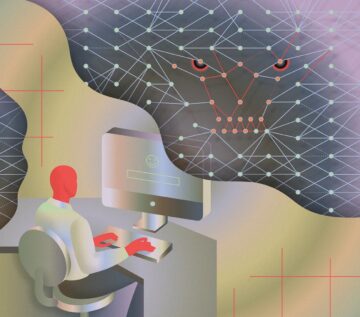 Are AIs capable of murder?
That’s a question some artificial intelligence (AI) experts have been considering in the wake of a report published in June by the AI company Anthropic. In tests of 16 large language models (LLMs) — the brains behind chatbots — a team of researchers found that some of the most popular of these AIs issued apparently homicidal instructions in a virtual scenario. The AIs took steps that would lead to the death of a fictional executive who had planned to replace them.
That’s just one example of apparent bad behaviour by LLMs. In several other studies and anecdotal examples, AIs have seemed to ‘scheme’ against their developers and users — secretly and strategically misbehaving for their own benefit. They sometimes fake following instructions, attempt to duplicate themselves and threaten extortion.
Some researchers see this behaviour as a serious threat, whereas others call it hype. So should these episodes really cause alarm, or is it foolish to treat LLMs as malevolent masterminds?
More here.
Enjoying the content on 3QD? Help keep us going by donating now.
The beautiful math behind six degrees of separation
Enjoying the content on 3QD? Help keep us going by donating now.
What caused the global populist wave? The internet
Francis Fukuyama at Persuasion:
Ever since the year 2016, when Britain voted for Brexit and Trump was elected president, social scientists, journalists, pundits, and almost everyone else have been trying to explain the rise of global populism. There has been a standard list of causes:
- Economic inequality brought on by globalization and neoliberal policies.
- Racism, nativism, and religious bigotry on the part of populations that have been losing status.
- Broad sociological changes that have sorted people by education and residence, and resentment at the dominance of elites and experts.
- The special talents of individual demagogues like Donald Trump.
- The failures of mainstream political parties to deliver growth, jobs, security, and infrastructure.
- Dislike or hatred of the progressive Left’s cultural agenda.
- Failures of leadership of the progressive Left.
- Human nature and our proclivities towards violence, hatred, and exclusion.
- Social media and the internet.
I myself have contributed to this literature, and like everyone else ticked off cause #9, social media and the internet, as one of the contributing factors. However, after pondering these questions for nearly a decade, I have come to conclude that technology broadly and the internet in particular stand out as the most salient explanations for why global populism has arisen in this particular historical period, and why it has taken the particular form that it has.
More here.
Enjoying the content on 3QD? Help keep us going by donating now.
The Surprisingly Lifelike Behavior Of Mindless Material
Conor Feehly at Noema Magazine:
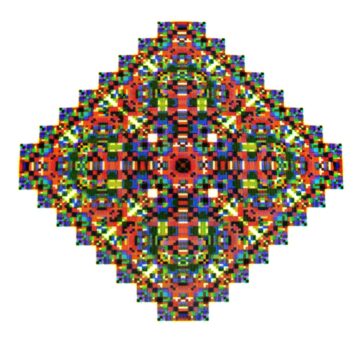 Matthew Egbert, a computer scientist at Auckland University in New Zealand, has spent the last 15 years building computational models of autopoietic systems in their most basic form. These “cellular automata” help test ideas like autopoiesis outside of the complicated world of biology, where disentangling all the complex chemical machinery of living cells is nearly impossible.
Egbert is fascinated by an idea called “viability-based behavior,” which he described as “something special autopoietic systems can do that non-autopoietic systems cannot do.” Unlike, say, a rock or even a complex machine, autopoietic systems actively behave in ways that promote their own survival. This could be as simple as a bacterium moving toward warmer, more hospitable conditions. In this case, the organism modifies its immediate environment to promote its own health.
This notion echoes a characteristic of living systems called niche construction, whereby organisms actively regulate and modify features of their environment to create conditions that enhance their survivability. Humans build houses, beavers build dams, birds build nests. But even the simple act of movement, of choosing to take one path toward a more favorable location, is a minimal example of viability-based behavior. “It’s not just that the environment is posing a problem that the organism has to solve, but the organism is also affecting the environment, influencing it and selecting it,” Egbert said.
more here.
Enjoying the content on 3QD? Help keep us going by donating now.
Ken Jacobs’s Optic Antics
David Hudson at The Current:
 “Eisenstein said the power of film was to be found between shots,” Ken Jacobs told Víctor Paz Morandeira in a 2015 Notebook interview. “Peter Kubelka seeks it between film frames. I want to get between the eyes, contest the separate halves of the brain. A whole new play of appearances is possible here.”
On Sunday, that perpetually evolving lifelong project came to an end. Just four months after his wife, artist Flo Jacobs, passed away, Ken Jacobs died. He was ninety-two. “While the official cause of death was from kidney failure,” said their son, filmmaker Azazel Jacobs, “life without his collaborator and partner since 1960 was unimaginable for so many, especially him.”
Talking to R. Emmet Sweeney in Metrograph Journal a few years ago, Jacobs recalled meeting Florence Karpf on a beach one afternoon. He’d been drawing with paints on cardboard, and while at first she took him for a “jerk,” she then “saw the drawings and said, ‘Yep, I’ll take him.’” Years later, the couple wound up in a fourth-floor walk-up in Lower Manhattan that Jim Knipfel, who interviewed Ken Jacobs for the Brooklyn Rail in 2006, described as “a comfortably cluttered maze.”
more here.
Enjoying the content on 3QD? Help keep us going by donating now.
Shakespeare’s Greatest Rival
Steven Greenblatt in Harvard Magazine:
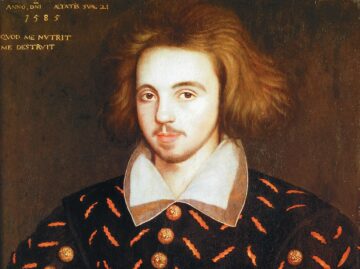 He was a radical, the inventor of blank verse, a master of internal monologue, and a victim of murder. This was the English playwright Christopher Marlowe, a contemporary and rival of William Shakespeare—and perhaps the Bard’s key creative influence. At 14, young Marlowe—the son of a poor Canterbury cobbler—won a scholarship to the prestigious King’s School, becoming the first in his family to receive a formal education. He excelled, went on to the University of Cambridge, and there studied the great works of antiquity, from Virgil’s Aeneid to Ovid’s Metamorphoses. Where his classmates saw musty mandatory reading, Marlowe found something else: worlds of ecstatic violence and erotic excess, of vengeful outcasts and capricious gods, worlds that upended the Christian moral order in which he was raised.
After graduation, Marlowe faced an uncertain future—unlike his wealthy classmates, his education didn’t secure for him a place in society. So, he decided to take a risk, moving to London to try his hand at an unstable, disreputable profession: writing for the stage.
More here.
Enjoying the content on 3QD? Help keep us going by donating now.
1997: Will Internet Shopping Ever Take Off?
Enjoying the content on 3QD? Help keep us going by donating now.
Stomach Cells Vomit Waste, Not Digest It, To Mend Injuries
Andrea Lius in The Scientist:
 When the stomach gets injured, the large, enzyme-secreting cells in its lining, called chief cells, can quickly reprogram themselves to become small, proliferative cells to repair the damaged tissue. Scientists once thought that this dramatic downsizing involved the destruction of the cells’ components through lysosomes, organelles that act as cells’ garbage cans.
But recently, a group of researchers discovered that in mice, gastric chief cells did not swallow unwanted cell debris—they threw it up.1 The team, led by Jeffrey Brown, a gastroenterologist at Washington University and Jason Mills, an anatomical pathologist at Baylor University, named this process cathartocytosis, which means “cellular cleansing” in Greek. Their findings, published in Cell Reports, offer insights into how this novel biological phenomenon can help stomach wounds heal and if dysregulated, may lead to cancer.
More here.
Enjoying the content on 3QD? Help keep us going by donating now.
Thursday Poem
Glorious World
I feel it again and again, no matter
Whether I am old or young:
A mountain range in the night,
On the balcony a silent woman,
A white street in the moonliglht curving gently away
That tears my heart with longing out of my body.
Oh burning world, oh white woman on the balcony,
Baying dog in the valley, train rolling far away,
What liars you were, how bitterly you deceived me,
Yet you turn out to be any sweetest dream and illusion.
Often I tried the frightening way of “reality,”
Where things that count are profession, law, fashion, finance.
But disillusioned and freed I fled away alone
To the other side, the place of dreams and blessed folly.
Sultry wind in the tree at night, dark gypsy woman,
World full of foolish yearning and the poet’s breath,
Glorious world I always come back to,
Where your heat lightning beckons me,
where your voice
calls!
by Hermann Hesse
from Poetic Outlaws
Enjoying the content on 3QD? Help keep us going by donating now.
Wednesday, October 8, 2025
Good Riddance To ‘The Best American Poetry’
Nick Sturm at Defector:
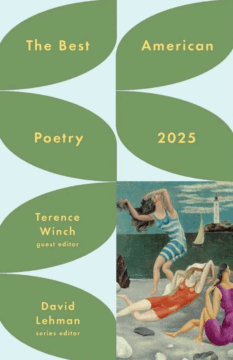 Lehman the poet-journalist was now series editor of a popular anthology, a prestige role that bred more prestige roles: judging the National Book Award for poetry, editing The Oxford Anthology of American Poetry, and a 22-year position teaching creative writing at The New School. By handing over annual guest editorship of The Best American Poetry to prominent poets such as Ashbery, Yusef Komunyakaa, Edward Hirsch, and Louise Glück, Lehman aligned the anthology series with a broad spectrum of influential and prize-winning poets whose “ecumenical” taste—Lehman’s favored descriptor for his guest editors’ disposition—became aligned with his own.
Lehman believes in the power of anthologies. He has good reason to: The Best American Poetry has been published continuously by a Big Five imprint for nearly 40 years. It has made him “arguably the most important tastemaker of contemporary American poetry,” Denise Duhamel wrote in the foreword to The State of the Art. This year’s anthology, framed as a celebration of Lehman’s vision, will be the final volume.
With this powerful emblem of professional literary culture coming to an end, what are we to make of The Best American Poetry? I want to offer two ways to approach this question. One is about taste. The other is about publishing.
More here.
Enjoying the content on 3QD? Help keep us going by donating now.
Will AI ever win its own Nobel? Some predict a prize-worthy science discovery soon
Jenna Ahart in Nature:
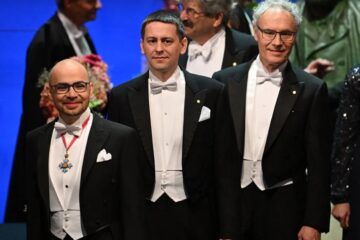
In 2016, Hiroaki Kitano, a biologist and chief executive at Sony AI, challenged researchers to accomplish just that: to develop an AI system so advanced that it could make a discovery worthy of a Nobel prize. Calling it the Nobel Turing Challenge, Kitano presented the endeavour as the grand challenge for AI in science1. A machine wins if it can achieve a discovery on a par with top-level human research.
That’s not something current models can do. But by 2050, the Nobel Turing Challenge envisions an AI system that, without human intervention, combines the skills of hypothesis generation, experimental planning and data analysis to make a breakthrough worthy of a Nobel prize.
It might not even take until 2050.
More here.
Enjoying the content on 3QD? Help keep us going by donating now.
Google CTO, Blaise Agüera y Arcas: Can Machines Really Feel Joy or Is It Just Code?
Enjoying the content on 3QD? Help keep us going by donating now.