
Mujib Mashal in The New York Times:
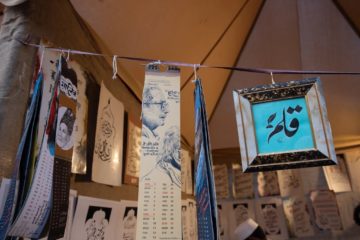 The four designated stages inside the crowded stadium complex in the heart of the busy capital weren’t enough. So the poetry lovers also took to the footpaths and the spaces in between, turning them into impromptu open-mic platforms for India’s embattled language of love.
…That more than 300,000 people came to celebrate Urdu poetry during the three-day festival this month in New Delhi was testament to the peculiar reality of the language in India. For centuries, Urdu was a prominent language of culture and poetry in India, at times promoted by Mughal rulers. Its literature and journalism — often advanced by writers who rebelled against religious dogma — played important roles in the country’s independence struggle against British colonial rule and in the spread of socialist fervor across the subcontinent later in the 20th century.
In more recent decades, the language has faced dual threats from communal politics and the quest for economic prosperity. Urdu is now stigmatized as foreign, the language of India’s archrival, Pakistan. Families increasingly prefer to enroll children in schools that teach English and other Indian languages better suited for the job market.
More here.
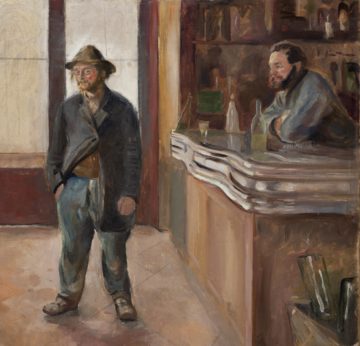 On the evening of December 2, 2020, around 10pm, I swallowed the last of what must have been multiple lifetimes’ worth of mouthsful of red wine. Unlike the partisans of AA, I am confident in saying that I will never again in my life consume alcohol. There are things I just don’t do anymore. I am no less morally certain, for example, that I will never go sky-diving. The version of me that believed a good life is constituted from such “fun” diversions as this died a long time ago. Far from having a “bucket list”, I now understand that the proper conduct of the second half of life is to approach something like what the Tibetan Buddhists call tukdam, to do less and less, but only to sit and meditate, and to breathe once every century or so, so that by the time you actually die there will be scarcely any change to register. I can picture a future not so far from now when, to the question, “Is he alive or dead?”, the only fitting response will be: “Who can say?” You might be able to jolt me into some new movement, like a fly removed from its long sleep in a jar of talc that flicks its wing in reluctant palingenesis (the phenomenon of being “born again”, which by the law of nomen est omen has long tricked me into thinking that Sarah Palin must be destined for a comeback); then again you might not. So, yeah, sky-diving’s out, along with drinking. The version of me that drank died two years ago. We’re coming up on the two-year anniversary of his death.
 A grammatical problem which has perplexed scholars since the 5th century BC has been solved by a
 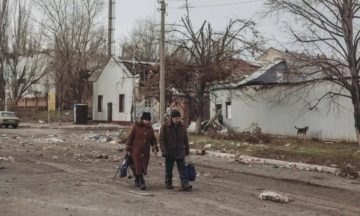 Wherever I turned, in every conversation, there was a total rejection not just of the Russian dictator, not merely of the Russian Federation as a state, but of everything and almost everyone Russian. Polling by the Kyiv International Institute of Sociology shows that some 80% of Ukrainians had a positive attitude to Russia in 2013; by May 2022, the figure was
  The recent study’s analysis of zinc from the tooth enamel of a Neanderthal who lived and died around 150,000 years ago in the Spanish Pyrenees gives new insights into the diet of ancient humans. Zinc isotopes were analyzed from 43 teeth of 12 animal species living in a grassland around the Los Moros I Cave in Catalonia, Spain. These included carnivores such as wolf, hyena, and dhole (also known as mountain wolf); omnivorous cave bears; and herbivores including ibex, red deer, horse, and rabbit. The results brought to life a food web of the Pleistocene steppe, a system of interlocking food chains from plants up to the top carnivores. The zinc in the Neanderthal’s tooth had by far the lowest zinc value in the food web, revealing they were a top-level carnivore.
 Stephen Witt in The New Yorker:
 Vivian Lam in LA Review of Books:
 Philip Andrews-Speed in Green:
 Thomas B. Edsall Talks to Adam Shatz over at the LRB podcast (photo Hannah Beier/Alamy):
 “T
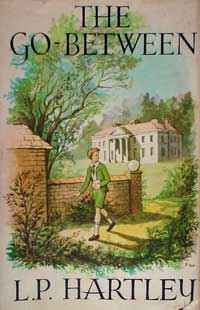
“T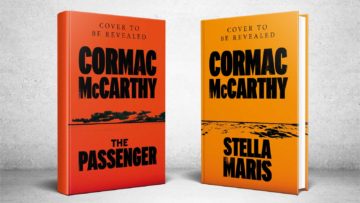 There have always been two dominant styles in Cormac McCarthy’s prose—roughly, afflatus and deflatus, with not enough breathable oxygen between them. McCarthy in afflatus mode is magnificent, vatic, wasteful, hammy. The words stagger around their meanings, intoxicated by the grandiloquence of their gesturing: “God’s own mudlark trudging cloaked and muttering the barren selvage of some nameless desolation where the cold sidereal sea breaks and seethes and the storms howl in from out of that black and heaving alcahest.” McCarthy’s deflatus mode is a rival rhetoric of mute exhaustion, as if all words, hungover from the intoxication, can hold on only to habit and familiar things: “He made himself a sandwich and spread some mustard over it and he poured a glass of milk.” “He put his toothbrush back in his shavingkit and got a towel out of his bag and went down to the bathroom and showered in one of the steel stalls and shaved and brushed his teeth and came back and put on a fresh shirt.”
 It’s time for our roundup of the biggest Pinocchios of the year.
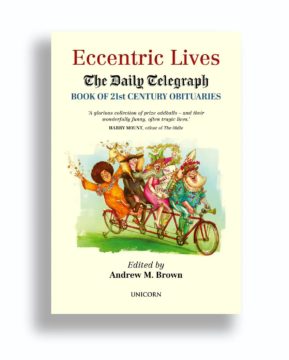 It used to be that, when you died, what you wanted was an obituary in a good newspaper, not that you’d be around to savor it. Since the introduction of the smartphone, the stakes have been raised. “I got a breaking news alert when I croaked,” some overachiever has surely bragged in the great beyond. “How about you?”