
Scott Alexander at Astral Codex Ten:
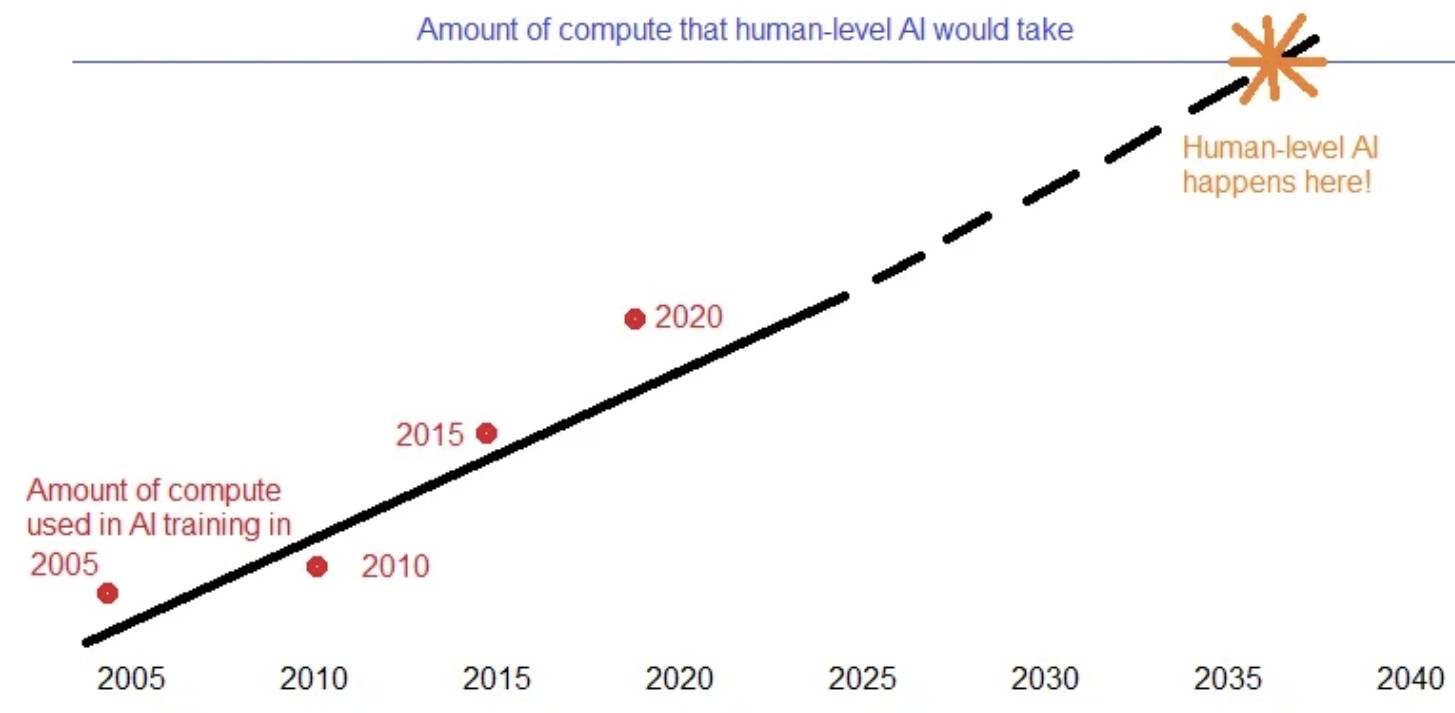 Last year I wrote about Open Philanthropy’s Biological Anchors, a math-heavy model of when AI might arrive. It calculated how fast the amount of compute available for AI training runs was increasing, how much compute a human-level AI might take, and estimated when we might get human level AI (originally ~2050; an update says ~2040).
Compute-Centric Framework (from here on CCF) update Bio Anchors to include feedback loops: what happens when AIs start helping with AI research?
In some sense, AIs already help with this. Probably some people at OpenAI use Codex or other programmer-assisting-AIs to help write their software. That means they finish their software a little faster, which makes the OpenAI product cycle a little faster. Let’s say Codex “does 1% of the work” in creating a new AI.
Maybe some more advanced AI could do 2%, 5%, or 50%. And by definition, an AGI – one that can do anything humans do – could do 100%. AI works a lot faster than humans. And you can spin up millions of instances much cheaper than you can train millions of employees. What happens when this feedback loop starts kicking in?
More here.
 We live in an age of inequality—or so we’re frequently told. Across the globe, but especially in the wealthy economies of the West, the gap between the rich and the rest has widened year after year and become a chasm, spreading anxiety, stoking resentment, and roiling politics. It is to blame for everything from the rise of former U.S. President Donald Trump and the Brexit vote in the United Kingdom to the “yellow vest” movement in France and the recent protests of retirees in China, which has one of the world’s highest rates of income inequality. Globalization, the argument goes, may have enriched certain elites, but it hurt many other people, ravaging one-time industrial heartlands and making people susceptible to populist politics.
 Cormac McCarthy’s Blood Meridian (1985) seems to me the authentic American apocalyptic novel, more relevant now than when it was written. The fulfilled renown of Moby-Dick and of As I Lay Dying is augmented by Blood Meridian, since Cormac McCarthy is the worthy disciple both of Melville and of Faulkner. I venture that no other living American novelist, not even Pynchon, has given us a book as strong and memorable as Blood Meridian, much as I appreciate his Crying of Lot 49, Gravity’s Rainbow, and Mason & Dixon. McCarthy himself has not matched Blood Meridian, but it is the ultimate Western, not to be surpassed.
 History is filled with secret heroes whose behind-the-scenes actions are essential to the exploits of public-facing heroes. Bringing these figures out of the shadows is a key role of historians. Helen Scott is one of those hidden heroines. Scott was the American film publicist, then translator, best known as
  Q\ You deal with a metaphysical question in the book, about new humans.
 Galit Blecher never wanted to start smoking, but during her service in the Israeli military, she succumbed. “Everyone in Israel smoked in the army,” she says. Having held out for more than one year, an especially tedious posting broke her resolve. “I was driving three hours through the desert, several times a week,” she says. “I was falling asleep.”
 Ngũgĩ is a giant of African writing, and to a Kenyan writer like me he looms especially large. Alongside writers such as
  Starting during Barack Obama’s first run for president, I began making a number of predictions that struck most people as outlandish at the time. First was the prediction, based in part on Obama’s rise,
  As Americans, we find ourselves in a culture that so fetishizes success that it cannot tolerate failure. So it deals with it in one of two ways. The first is to view failure in individualized and atomized terms, blaming the losers for their losses. The second, which is equally insidious, is to be so disdainful of failure that it insists that what looks like failure in fact is a mere “stepping-stone to success,” in the philosopher Costica Bradatan’s phrase. Thus the platitudinous self-help bromides that we find adorned on a framed poster in a bank teller’s cubicle (“Failure is success in progress”) or shouted by a fitness influencer hawking protein powder on TikTok (“There’s no failure that willpower can’t turn into success”). In a culture that demands overcoming against all odds, even failure has been commodified by the American self-help industrial complex: rebranded not as a devastating and possibly life-altering event but as a blip en route to a chest-thumping achievement, accomplishment, or acquisition.
 It’s a warm summer afternoon and you have everything set-up for a lovely afternoon in the great outdoors. You’ve got a cold drink in hand and the smell of sausages sizzling away is making you hungry. You fold out the camp chair and dust of the cobwebs, ready to chill out. Just then, the all too familiar buzz of a fly echoes in your ear. And so the onslaught begins. You swat and they just come back, gluttons for the punishment of your lazily swiping hand. Sure, they’re a nuisance. But flies get a bad rap and we’re here to try and convince you that they could in fact be seen as the true heroes of the Aussie summer.
 The Republican political consultant Richard Berman is something of a legend, often credited with taking the art of negative campaigning on behalf of undisclosed corporate clients to the next level. When “60 Minutes” did a profile of him, in 2007, he was portrayed as the “Dr. Evil” of the Washington influence game. More than a decade later, when I visited his office in downtown D.C., he still had a tongue-in-cheek “Dr. Evil” nameplate on his desk. (“If they call you Mr. Nice Guy, would that be better?”