
Enjoying the content on 3QD? Help keep us going by donating now.
Category: Recommended Reading
The riddle of experience vs. memory
Enjoying the content on 3QD? Help keep us going by donating now.
Book: review Grace
From lensculture:
 The woman running through Scott Offen’s Grace, at times decked out like a Nordic goddess brandishing a sunflower in her hand, at others glimpsed as a naked back hidden by large leaves, is on a journey beyond the confines of daily life. Flitting between stuffy interiors and expansive, wild landscapes, she shapeshifts and plays through different emotions, empowered as the protagonist of her own fairytale. Patterns—of clothes, of skin, of tree bark—are brought to the surface, drawing our attention to cycles of time and change.
These carefully-considered monochrome pictures are the outcome of a seven-year collaboration between husband and wife of more than 30 years, Scott and Grace Offen. In response to a teacher’s suggestion to photograph his family, Scott picked up his camera and began to photograph Grace out in nature where she felt free. The photography project evolved into a shared-space of creativity where Grace could grapple with the slippery experience of getting older as a woman. Through an intimate process of co-creation, the pair quit the quotidian to wander and play their way through the questions we face as we age.
More here.
Enjoying the content on 3QD? Help keep us going by donating now.
Sunday Poem
Enjoying the content on 3QD? Help keep us going by donating now.
Friday, January 30, 2026
How “95%” escaped into the world – and why so many believed it
Azeem Azhar and Hannah Petrovic at Exponential View:
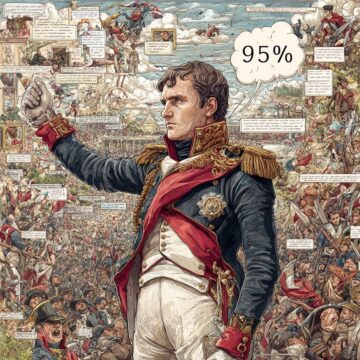
One number still keeps turning up in speeches, board meetings, my conversations and inbox:
“95 percent”
Do I need to say more than that? OK, here’s another clue: this number traveled on borrowed authority in 2025, rarely with a footnote and it started to shape decisions.
The claim is this: “95 percent” of organizations see no measurable profit-and-loss impact from generative AI. Of course, you know what I’m talking about. It has ricocheted through Fortune, the FT, The Economist, amongst others.
Often presented as “MIT / MIT Media Lab research,” the “95 percent” is treated as a settled measurement of the AI economy. It’s invading my conversations and moving the world. I’ve heard it cited by executives as they decide how to approach AI deployments and investors who use it to calibrate risk.
This number basks in the glow of MIT, the world’s best technology university. And I started to wonder if this evidence had truly earned that halo.
More here.
Enjoying the content on 3QD? Help keep us going by donating now.
We could produce a lot of electricity on the land used for biofuels: About enough to meet current global electricity demand
Hannah Ritchie at By the Numbers:
 The numbers were quite staggering. So staggering in fact, that I doubted myself. I ran the calculations many times, convinced I’d accidentally added a zero somewhere. I asked Pablo to also come up with an estimate, without telling him how I got to my numbers. As it turns out, we took slightly different approaches, but landed somewhere similar. We wrote up all of our assumptions and methodology if you’re interested.
If we put solar panels on those 32 million hectares of biofuel land, we could generate around 32,000 terawatt-hours (TWh) of electricity. Incidentally, that’s the same amount of electricity as the world consumes in a year.
So we could keep the biofuels, which amount to around 1,400 TWh of energy, and meet around 4% of global transport demand. Or we could use it for solar and produce enough electricity to meet the world’s current electricity demand.
More here.
Enjoying the content on 3QD? Help keep us going by donating now.
Mental Health Break: “Sailing” by Christopher Cross
Enjoying the content on 3QD? Help keep us going by donating now.
Socialism in One City: The ultimate test for Mamdani’s vision will be successful governance—and so far, it appears to be working
David Austin Walsh at the Boston Review:
 Zohran Mamdani is now the mayor of New York City. Amid the chaos unleashed by Trump in the first weeks of 2026, it can be easy to lose sight of the truly seismic shift in politics his mayoralty represents.
To recap: an obscure, thirty-four-year-old state assemblyman and member of the Democratic Socialists of America, who a year ago could barely fill a seminar room at New York University, beat both incumbent mayor Eric Adams and former governor Andrew Cuomo by running on an unapologetically progressive ticket, critical of ICE and Israel as much as rents being too damn high. India Walton came close to a similar upset in Buffalo four years ago, but this time the socialists prevailed. In his inaugural address on New Year’s Day, sworn in by Bernie Sanders and quoting Fiorello La Guardia, Mamdani spoke of building a city “‘far greater and more beautiful’ for the hungry and the poor.” Handing out free tickets to a theater festival earlier this month, he spoke of his vision of a city “where we make it possible for working people to afford lives of joy, of art, of rest, of expression.” When’s the last time you heard a politician talk like this?
More here.
Enjoying the content on 3QD? Help keep us going by donating now.
The Answer Is Love: On Reds
Laurie Stone in The Paris Review:
 What are we ever really fighting for? The answer is love. Love in the movies, and on the streets, and in our heads—instead of the dead people we are seeing right now. Existence is a contagion of love. That’s why you have to fast-forward through a bunch of scenes in Reds, where men are giving speeches to other men in English and Russian with those faces of certainty—not hope, but certainty—that they are right and have it all figured out.
You know those men. You’ve been to those meetings with the guy in the front—it could be a faculty meeting—the guy jabbing his finger, not like Mick Jagger in a dance routine, more like Moses holding a tablet. Those guys who love the sound of their voice more than they love love. Everyone has been to one of those meetings, or hundreds of them, wondering how they were still breathing with all the air sucked out of the room.
More here.
Enjoying the content on 3QD? Help keep us going by donating now.
Engineered Gut Bacteria Act as Biosensors to Detect Intestinal Disease
Sneha Khedkar in The Scientist:
 The mammalian gut is a dynamic environment, wherein shifts in the local environment can lead to disease. Despite the importance of monitoring biochemical parameters in the gut, the most commonly used tools are invasive endoscopic methods, which provide information at only one point in time. To overcome this, Carolina Tropini, a microbiologist at the University of British Columbia, and her team engineered gut bacteria that would dim their fluorescence under disease conditions. Their system, described in Cell, offers biosensors that can continuously and non-invasively monitor gut osmolarity in mice, highlighting the utility of the microbiome as a tool to track gut health.1
Intestinal factors such as pH, salt balance, and oxygen levels mold the gut environment, with any alterations leading to illnesses. “Understanding these gut changes is essential for advancing our diagnostic and treatment strategies for gut health,” said Tropini in a statement. “For that, we need highly sensitive measurements as those changes occur, including before symptoms appear.”
More here.
Enjoying the content on 3QD? Help keep us going by donating now.
Friday Poem
Theme for English B.
The instructor said,
Go home and write a page tonight.
And let that page come out of you—
Then, it will be true.
I wonder if it’s that simple?
I am twenty-two, colored, born in Winston-Salem.
I went to school there, then Durham, then here
to this college on the hill above Harlem.
I am the only colored student in my class.
The steps from the hill lead down into Harlem,
through a park, then I cross St. Nicholas,
Eighth Avenue, Seventh, and I come to the Y,
the Harlem Branch Y, where I take the elevator
up to my room, sit down, and write this page:
It’s not easy to know what is true for you or me
at twenty-two, my age. But I guess I’m what
I feel and see and hear, Harlem, I hear you:
hear you, hear me—we two—you, me, talk on this page.
(I hear New York, too.) Me—who?
Well, I like to eat, sleep, drink, and be in love.
I like to work, read, learn, and understand life.
I like a pipe for a Christmas present,
or records—Bessie, bop, or Bach.
I guess being colored doesn’t make me not like
the same things other folks like who are other races.
So will my page be colored that I write?
Being me, it will not be white.
But it will be
a part of you, instructor.
You are white—
yet a part of me, as I am a part of you.
That’s American.
Sometimes perhaps you don’t want to be a part of me.
Nor do I often want to be a part of you.
But we are, that’s true!
As I learn from you,
I guess you learn from me—
although you’re older—and white—
and somewhat more free.
This is my page for English B.
Enjoying the content on 3QD? Help keep us going by donating now.
Thursday, January 29, 2026
1000 Years of Development in Japanese Swords
Enjoying the content on 3QD? Help keep us going by donating now.
Björk: Human Behaviour
Jazz Monroe at Pitchfork:
 The story of “Human Behaviour” as we know it begins in 1993, when Björk swanned into London in a fluffy white mohair jacket. She was 27 and ready for adventure, so utterly international she could barely eat anything but curries, still high on her late-’80s supply of rave awakenings at all-nighters by DJs with names like Mixmaster Morris.
Björk saw through the idiot elements of British culture but decided to love it anyway, most of all its charismatic mavericks and prankster producers and the anything-goes musicians she took on tour under the banner of Immigrants United. Her creative soulmates were 808 State’s Graham Massey and Debut producer Nellee Hooper, whom she had found “too good taste, too expensive-sounding” for her industrial-techno soul, before he quelled her sophistiphobia by showing how rave and hip-hop beats might coexist with her voice in the plastic paradise of ’90s pop. “Human Behaviour” was Björk’s formal debut, the salvo of an album so buccaneering and multivalent it could have been called Polygenic. Originally written in her sardonic teens, the song and its lyrics fit the perspective of an outsider arriving in a big city: A child (or in some tellings, an animal) utters conspiratorial warnings to a confidante, marvelling at the oddballs of adultkind.
more here.
Enjoying the content on 3QD? Help keep us going by donating now.
The Undefined Gothic
Beatrice Radden Keefe at the NYRB:
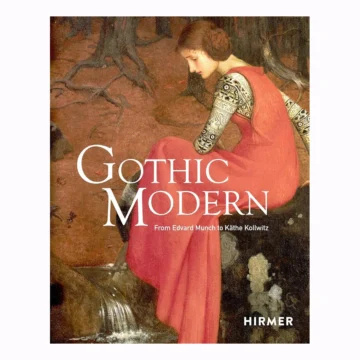 Another bout of Gothic fever in the early twentieth century revolved less around a style than around a restless Gothic energy, an overwrought Gothic sensibility. In 1921 the German art historian Hermann Schmitz remarked that calling something Gothic had become the highest form of praise: a dancer on Berlin’s Kurfürstendamm might be complimented for the Gothic line of her movements, an Expressionist painting for its Gothic feeling. Schmitz bemoaned this misappropriation of the “most glorious legacy of the pious and pure spirit of our forefathers.” Seen as German by Germans and as French by the French, the Gothic was revered by those yearning for a lost age of faith and unity as well as by avant-gardes in search of the new.
Over the past year, the exhibition “Gothic Modern” brought together medieval, Renaissance, and modern works to explore how European artists of different stripes engaged with the Gothic between 1875 and 1925. This is a Gothic that was never exactly defined and flexible enough to include works in a vaguely dark and frightful mode as well as those by the German Renaissance masters Lucas Cranach the Elder, Albrecht Dürer, and Hans Holbein the Younger. The traveling show presented medieval and Renaissance sculptures, woodcuts, engravings, and paintings alongside artworks by Käthe Kollwitz, Edvard Munch, Max Beckmann, and many others.
more here.
Enjoying the content on 3QD? Help keep us going by donating now.
For nine straight years, Hoboken, New Jersey hasn’t seen a single fatal crash and here’s how they did it
Shia Levitt at Reasons to be Cheerful:
 Bhalla picked up the mantle from his predecessor Mayor Dawn Zimmer, launching a five year analysis of Hoboken’s crash data to learn contributing factors and vulnerabilities that could be used to help shape reforms.
That analysis showed that, between 2014 to 2018, 40 percent of the accidents causing serious injuries or death in Hoboken involved bikers or pedestrians, even though people walking and bicycling were only involved in eight percent of all crashes. Given that most bicycle and pedestrian crashes (88 percent) happened in intersection crosswalks, those became a major priority.
Central to Hoboken’s early strategy was a focus on vulnerable road users, such as seniors and kids, which meant prioritizing street redesign near schools, parks and senior centers.
More here.
Enjoying the content on 3QD? Help keep us going by donating now.
Sean Carroll’s Mindscape Podcast: Rachell Powell on Evolutionary Convergence, Morality, and Mind
Sean Carroll at Preposterous Universe:

Evolution with natural selection involves an intricate mix of the random and the driven. Mutations are essentially random, while selection pressures work to prefer certain outcomes over others. There is tremendous divergence of species over time, but also repeated convergence to forms and mechanisms that are unmistakably useful. We see this clearly in eyes and fins, but the basic pattern also holds for brains and forms of social organization. I talk with philosopher Rachell Powell about what these ideas mean for humans, other terrestrial species, and also for forms of life we have not yet encountered.
More here.
Enjoying the content on 3QD? Help keep us going by donating now.
Anil Ananthaswamy: Are We Stuck With AI We Don’t Understand?
Enjoying the content on 3QD? Help keep us going by donating now.
White House alters arrest photo of ICE protester, says “the memes will continue”
Jon Brodkin at Ars Technica:
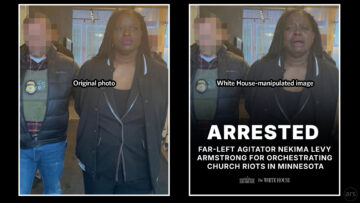 The Trump White House yesterday posted a manipulated photo of Nekima Levy Armstrong, a Minnesota civil rights attorney who was arrested after protesting in a church where a pastor is allegedly also an Immigration and Customs Enforcement (ICE) official.
Secretary of Homeland Security Kristi Noem posted what seems to be the original photo of Armstrong being led away by an officer yesterday morning. A half hour later, the official White House X account posted an altered version in which Armstrong’s face was manipulated to make it appear that she was crying.
“The White House shared an AI-edited photo of Nekima, depicting her in tears and scared when, in actuality, she was poised, determined, and unafraid,” NAACP President and CEO Derrick Johnson said yesterday.
Reader-added context on X said, “This photo has been digitally altered to make Nekima Levy Armstrong appear to be in distress. The Director of DHS herself posted the unedited photo in an earlier announcement.” White House Deputy Communications Director Kaelan Dorr defended the post after criticism of the image manipulation.
More here.
Enjoying the content on 3QD? Help keep us going by donating now.
I’ve reported on UFO sightings for decades. Here’s what I think
Michael Shermer in The Washington Post:
 On Jan. 13, Vermont legislator Troy Headrick (I) proposed creating a state task force that would get to the bottom of “unidentified anomalous phenomena,” or UAPs, that appeared to be buzzing about U.S. military air bases. Days later, Helen McCaw, a former senior analyst in financial security at the Bank of England, urged the bank’s governor to prepare for possible financial collapse should the White House disclose the existence of alien intelligence.
I have been following and writing about UFO phenomena and the people who believe they represent alien visitation since the 1990s, and until recently the topic was always largely treated by the public and media as fringe and beneath serious consideration. That began to change in 2017, when The New York Times published a front-page story about the Pentagon having established the secret Advanced Aerospace Threat Identification Program to learn what was really going on with all these sightings, many of which happened over military facilities.
More here.
Enjoying the content on 3QD? Help keep us going by donating now.
Industry Leaders Predict Life Science Trends for 2026
From The Scientist:
 AI Will Accelerate the Regulatory Pipeline
The Food and Drug Administration (FDA) and the European Medicines Agency have been moving—thoughtfully but decisively—toward a more aligned, forward-looking set of rules that do more than protect the public: They create room for responsible progress. With the EU AI Act coming into effect in the first half of 2026 and the FDA beginning to deploy generative AI tools to support and accelerate regulatory review, there will be a new regulatory position: guidance that is faster, more data-driven, and anchored in transparency, explainability, and continuous performance monitoring.
Regulators appear to be increasingly prepared to let AI handle routine, low-risk research tasks with minimal friction, while keeping firm human control over decisions that directly shape safety, ethics, and public trust. That is the right hierarchy. If they stay on this course, international coordination and iterative learning between agencies will not just keep up with AI, they will shape it. The result is substantial: more efficient drug development, lower costs, and more timely, representative access to better therapies. The challenge, which we cannot underestimate, is to ensure that the governance, safeguards, and ethical commitments evolve as quickly as the technology they aim to oversee.
More here.
Enjoying the content on 3QD? Help keep us going by donating now.