William Deresiewicz in Salmagundi:
 Art is useless, said Wilde. Art is for art’s sake—that is, for beauty’s sake. But why do we possess a sense of beauty to begin with? A question we will never answer. Perhaps it’s just a kind of superfluity of sexual attraction. Nature needs us to feel drawn to other human bodies, but evolution is imprecise. In order to go far enough, to make that feeling strong enough, it went too far. Others are powerfully lovely to us, but so, in a strangely different, strangely similar way, are flowers and sunsets. Art, in turn, this line of thought might go, is a response to natural beauty. Stunned by it, we seek to rival it, to reproduce it, to prolong it. Flowers fade, sunsets melt from moment to moment; the love of bodies brings us grief. Art abides. “When old age shall this generational waste, / Thou shalt remain.”
Art is for truth. Even Wilde suggests as much, though he, and we, don’t call it truth but meaning. Art points beyond itself. At what? At us. The role of art is to compile the endless atlas of human experience. It’s often not a pretty picture for, as Solzhenitsyn said, the line between good and evil runs through every human heart. Except it’s not a line; it’s a tangle. The gurus want to solve human nature; so do the utopians, the ideologues and revolutionaries. The artist, wiser, observes it, above all in herself.
More here.

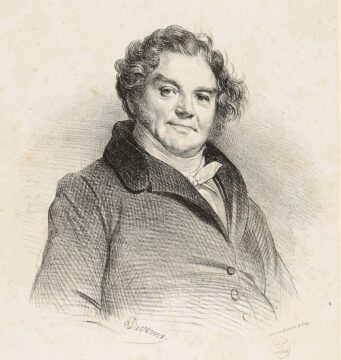 According to his memoirs, Eugène-François Vidocq escaped from more than twenty prisons (sometimes dressed as a nun). Working on the other side of the law, he apprehended some 4000 criminals with a team of plainclothes agents. He founded the first criminal investigation bureau — staffed mainly with convicts — and, when he was later fired, the first private detective agency. He was one the fathers of modern criminology and had a rap sheet longer than his very tall tales. Who was Vidocq?
 Moving a prosthetic arm. Controlling a speaking avatar. Typing at speed. These are all things that people with paralysis have learnt to do
  Notoriously, in the winter of 1969 the Metropolitan Museum of Art opened its first exhibition devoted to African American culture, but with a show devoid of art. Called “Harlem on My Mind: Cultural Capital of Black America, 1900—1968,” it was a photomural-with-texts affair of a kind found in ethnology museums.
 eDNA serves as a surveillance tool, offering researchers a means of detecting the seemingly undetectable. By sampling eDNA, or mixtures of genetic material — that is, fragments of DNA, the blueprint of life — in water, soil, ice cores, cotton swabs, or practically any environment imaginable, even thin air, it is now possible to search for a specific organism or assemble a snapshot of all the organisms in a given place. Instead of setting up a camera to see who crosses the beach at night, eDNA pulls that information out of footprints in the sand. “We’re all flaky, right?” said Robert Hanner, a biologist at the University of Guelph in Canada. “There’s bits of cellular debris sloughing off all the time.”
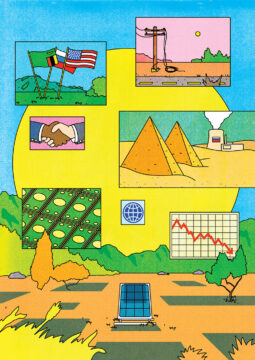 The solution seems so obvious. A region synonymous with abundant sun is hungry for more electricity. Given Africa’s colossal untapped solar radiation, the continent should be installing solar panels at a furious pace. But it’s not. Though home to 60% of the world’s best solar resources, Africa today represents just 1% of installed solar photovoltaic capacity.
 Many Americans, as far as I can tell, don’t want to shape their views in accordance with the data; many Americans, again as far as I can tell, don’t want to create an environment in which a broad range of perspectives are freely articulated and peacefully debated. They don’t want to be hopeful about the possibilities of America. Nor do they want academic freedom in our universities. What many people want, what they earnestly and passionately desire, is to hate their enemies. A few years ago J.D. Vance—now a senator, then a political neophyte—
 Initially, it was suspected that gene regulation was a simple matter of one gene product acting as an on/off switch for another gene, in digital fashion. In the 1960s, the French biologists François Jacob and Jacques Monod first elucidated
  Pakistan is a vast country of 231.4 million people. It’s one of only nine countries in the world with nuclear weapons. It’s located in South Asia, which is now one of the world’s most dynamic and fast-growing regions. It has generally favorable relationships with both the United States and China. It has a long coastline in a generally peaceful region of the ocean. It has plenty of talented people, as evidenced by the fact that Pakistani Americans, on average,
  Much of the attention being paid to generative AI systems has focused on how they replicate the pathologies of already widely deployed AI systems, arguing that they centralise power and wealth, ignore copyright protections,