Bipedal Aliens: What Evolution Can Tell Us About Extraterrestrials and Vice Versa

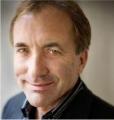
Picture-1197 Michael Shermer over at Scientific Blogging:

If we ever do make contact with an extraterrestrial intelligence, what will it look like? Hollywood has had no shortage of examples for films and television shows that feature aliens, but they are almost always bipedal primates who speak English with a funny accent. This depiction is more the result of wardrobe budget constraints and the flexibility of actors than it is the imagination of writers…

My explanation — that the chances of an ET turning out to be a bipedal primate are close to zero — is not one shared by all scientists. None other than the Oxford evolutionary biologist Richard Dawkins wrote to Josh Timonen, the videographer who filmed and produced this piece:

I would agree with him in betting against aliens being bipedal primates and I think the point is worth making, but I think he greatly overestimates the odds against. Simon Conway Morris, whose authority is not to be dismissed, thinks it positively likely that aliens would be, in effect, bipedal primates. Ed Wilson gave at least some time to the speculation that, if it had not been for the end-Cretaceous catastrophe, dinosaurs might have produced something like the attached.

Dawkins then presented this page from Promethean Fire: Reflections on the Origin of Mindby Charles J. Lumsden and Edward O. Wilson, based on the paleontologist Dale Russell's evolutionary projection of how a bipedal dinosaur might have evolved into something like us had the dinosaurs not gone extinct.

On the Uprisings in Greece

Valia Kaimaki in Le Monde Diplomatique:

Following the killing of 15-year-old Alexis Grigoropoulos by a special police unit on 6 December, school and university students have risen up in an unprecedented outpouring of rage. Spontaneous demonstrations, mostly organised by email and SMS, have shaken towns and cities across the country: Athens, Thessaloniki, Patras, Larissa, Heraklion and Chania in Crete, Ioannina, Volos, Kozani, Komotini.

This is an uprising with many origins; the most obvious is police brutality. Alexis is not the first victim of the Greek police, only the youngest. But its roots also lie in the economic crisis – a national one which struck hard even before the consequences of the global financial storm made themselves felt. On top of this, Greece is going through a profound political crisis, both systemic and moral; it comes from the duplicity of political parties and personalities, which has broken all trust in state institutions.

Alexis’s death wasn’t an exceptional case, or a blot on the otherwise pristine copybook of the Athens police. The list of student and immigrant victims of torture and murder by the police goes back a long way. In 1985, another 15-year-old, Michel Kaltezas, was murdered by a police officer – a crime whitewashed by a corrupt judicial system. The Greek police may be no worse than police forces in other parts of Europe, but the wounds left by Greece’s dictatorship, the military junta of 1967-74, are still open here; and the memory of those seven dark years is deeply ingrained in people’s minds. This society does not forgive as readily as some.

Ten sci-fi devices that could soon be in your hands

In New Scientist:

2 Disappearing act

Few dreams have flipped from science fiction to fact as quickly as “invisibility cloaks”. The first, which worked only for microwaves, was unveiled in 2006. Since then the field has been inundated with attempts to make cloaks to rival Harry Potter's.

Cloaking makes an object disappear by steering electromagnetic waves around it – as if the waves had simply passed through. So far, the only way to do this is with “metamaterials”, which are made of electronic components designed to interact with light and direct it in a controllable fashion. The goal is to create a cloak that works for a broad spectrum of visible frequencies. Making these components isn't easy. They have to be tiny – smaller than the wavelength of light they are designed to interact with.

Last year, a group at the University of California, Berkeley, constructed a material that was able to bend – rather than reflect – visible light backwards for the first time. Ulf Leonhardt at the University of St Andrews, UK, has shown how metamaterials could work over a range of frequencies.

Even more mind-boggling, a team from The Hong Kong University of Science and Technology in China has worked out how to cloak objects at a distance. They suggest using “complementary materials” which have optical properties that cancel each other out. A wave polarised on a single plane passing through one material will become distorted, but this distortion is cancelled out as the wave passes through the complementary material, making it look as if neither material is there.

REFLECTIONS ON A CRISIS: Daniel Kahneman & Nassim Nicholas Taleb: A Conversation in Munich

From Edge:

Taleb201 …Across the world, people believe that devotion to sacred or core values that incorporate moral beliefs — like the welfare of family and country, or commitment to religion and honor — are, or ought to be, absolute and inviolable. Our studies, carried out with the support of the National Science Foundation and the Defense Department, suggest that people will reject material compensation for dropping their commitment to sacred values and will defend those values regardless of the costs.

In our research, we surveyed nearly 4,000 Palestinians and Israelis from 2004 to 2008, questioning citizens across the political spectrum including refugees, supporters of Hamas and Israeli settlers in the West Bank. We asked them to react to hypothetical but realistic compromises in which their side would be required to give away something it valued in return for a lasting peace.

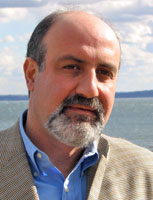
(Picture shows Nassim Taleb)

More here.

op-art radovan

Kenarov-01-thumbnail

Giggles. The Serbian journalist sitting next to me leans over and whispers into my ear, “This is embarrassing.” One of the cameramen—there are four—asks Draga, our tour guide, to please repeat her opening words, so he can get her on film. She complies cheerfully. The microphone crackles in her hand, strangely doubling her voice in the small space of the passenger van. Welcome to the Pop-art Radovan Tour! In the next few hours we’ll visit the places where Dragan David Dabić, also known as Radovan Karadžić, lived and where he spent most of his free time. We’ll sample some of his favorite food. I would also like to mention that this is not a political tour, so any questions regarding politics will not be answered. Giggles again. This is embarrassing. Packed with hungry journalists and bearing the outsized lettering SERBIA: EUROPE’S LAST ADVENTURE, our sightseeing van speeds through the wet streets of Blok 45, a working-class neighborhood in east Belgrade. Fine-grained drizzle smudges the view outside. The four cameramen look dejected. Drab apartment buildings huddle under drab skies, and only the occasional billboard or McDonald’s sign adds any hint of technicolor. Human shadows under shadowy umbrellas tap-dance in a silent musical. Unreal city.

more from VQR here.

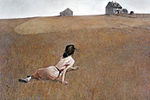
wyeth’s particulars

Saltz1-21-09-1s

Andrew Wyeth, the most famous American painter that almost no one in the art world ever thought of or cared much about, died in his sleep, in his home near Philadelphia, at the age of 91. Known for his sketchy, dry, goldenrod-and-ochre-colored scenes of working farms, rundown sawmills, nature studies, working people, military garb and rustic interiors — he was very good at depicting peeling paint and rotting wood — Wyeth, who was the son of the well-known illustrator N.C. Wyeth, is responsible for one of the most recognized and beloved American paintings of the early 20th century, Christina’s World. Painted in 1948, the work was a stroke of luck and delayed memory. One day, as Wyeth happened to look out his upstairs window, he saw his next-door neighbor — a young woman named Christina Olsen, whom he had been painting for some time — crawling across a field of wheat. Christiana had had polio as a child. Later, Wyeth made sketches of the Olsen house, added a field surrounding it, and, as an afterthought, inserted Christina in a pink dress in the foreground.

more from Artnet here.

Tuesday Poem

///
At the Optometrist's Office
John Hogden

CNN is always on.

The old people seem to like it, the receptionist would say,

the way the stories loop around again, always the same,

the pretty news anchor, the weather in Missouri heading our way.

But today something is happening, live footage unfolding.

The old people lean in, held in its sway.

“They beheaded those soldiers,” I hear one of them say,

and then again, in the way old people say everything twice,

a loop coming round again, “Those soldiers,

those boys, they beheaded them.” And now we all look,

again and again, except the receptionist, who never looks up,

who hates her day-to-day, the rest of us squinting

at the scroll that keeps running at the bottom of the screen,

like a free eye exam, each letter showing up like an apple

on a table, like a head upon a platter, the thing we have seen

since the day they were captured, the thing we keep seeing

even when we look away, the thing that keeps us staring

at the thing that isn't there, the thing we can't imagine,

even with our eyes wide open, even if we walked outside,

took to the street, holding each other gently by the arm,

even if trucks were driving by dragging the boys' bodies,

headless and harrowed, around and around the doctors' offices,

the pretty news anchor, the weather behind her,

the thing we keep looking at, the thing we can't see.
///

Elevating Science, Elevating Democracy

DENNIS OVERBYE in The New York Times:

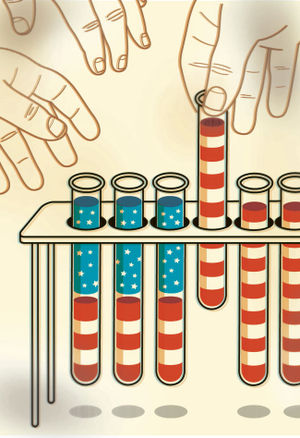
Testtube To be honest, the restoration of science was the least of it, but when Barack Obama proclaimed during his Inaugural Address that he would “restore science to its rightful place,” you could feel a dark cloud lifting like a sigh from the shoulders of the scientific community in this country. When the new president went on vowing to harness the sun, the wind and the soil, and to “wield technology’s wonders,” I felt the glow of a spring sunrise washing my cheeks, and I could almost imagine I heard the music of swords being hammered into plowshares. Wow. My first reaction was to worry that scientists were now in the awkward position of being expected to save the world. As they say, be careful what you wish for.

My second reaction was to wonder what the “rightful place” of science in our society really is.

The answer, I would argue, is On a Pedestal — but not for the reasons you might think.

Forget about penicillin, digital computers and even the Big Bang, passing fads all of them.

More here.

Monday, January 26, 2009

Sunday, January 25, 2009

On G. A. Cohen’s Rescuing Justice and Equality

John Holbo over at Crooked Timber:

The basic claim, although Cohen doesn’t put it in one sentence, like this, is that Rawls’ famous difference principle is an example of Moore’s Paradox.

OK, let stop right there and back up. For those of you who aren’t academic philosophers: Rawls has two basic principles of justice, and the difference principle is one half of the second. It says that social and economic inequalities are permissible only to the extent that they benefit the least well off, relative to a situation in which the inequalities would be eliminated. If I have $10 and you only have $1, this is ‘just’ if any attempt to eliminate the inequality would leave you holding less than $1. Maybe we shift to a position in which I have only 99 cents, and you have 99 cents, and the rest of it goes wherever money goes when it dies. We are equal, but you are actually worse off, absolutely. Rawls says it isn’t necessary to get all drastically Harrison Bergeron, like that. Justice doesn’t demand it. Turning the point around: I can’t permissibly (justly) move from $10 to $11, widening the gap, unless the effect of this trickles down to you to the tune of $1.01 or more. But if you get that extra penny, my extra dollar is acquired consistent with the difference principle…

Now, Moore’s paradox (G.E. Moore, that is). ‘It’s raining, but I don’t believe it’. For any given individual – let’s call him Johnny, at a rainy bus stop – it can be true both that it is raining, and that he doesn’t believe it’s raining. (More denialism about various possibilities of direct trickle-down, I suppose.) But Johnny cannot sincerely (sanely), first-personally avow this potentially true statement. Mild logical curiosity, then. There are possibly true statements that one cannot sincerely (sanely) assert.

Now justice. Cohen is saying that, oddly, lots of individuals won’t be able to avow the difference principle. Not that it is false. It might be true, but they can’t coherently, sincerely avow its truth. Why not? Because they are like Johnny at the bus stop with $10 in pocket, next to someone with only $1. That’s all it takes.

Bollystan: The New, Improved, Trendy, Cosmopolitan and Affluent India

Snoop_dogg_20090123 Sabita Majid in Outlook India:

Around the turn of the millennium, a spate of intersecting events put India abroad in the spotlight: The entries of Lagaan (2001) and Devdas(2003) for the Oscar film competition along with Gurinder Chaddha's Bend it Like Beckham (2003), Andrew Lloyd Webber's Bombay Dreams(2002) and Baz Lurhman's Bollywood-aesthetic inspired Moulin Rouge, suddenly amounted to a critical mass of Indianness on display. Together with India-centered exhibitions, henna tattoos (as they're called in North America), ethnic Indian fashions and Indian music became part of a mainstream interest outside of India.

The acceptance helped second generation Indians in the UK, USA and Canada to wholeheartedly engage with Bollywood music and choreography publically. All of which have helped create the 'cool' Indian image that has spread rapidly through the diasporic capillaries of food, fashion and films that immigrant communities typically express themselves through.

From having survived, South Asian diasporas have shown how they thrive in 'Third Spaces' outside the subcontinent created by immigrants in western metropolises who are able to mark a space out for themselves somewhere between dominant and peripheral societies. Their own status as postcolonial subjects has made immigration to western societies, in particular, a space of immense tension as they have often had to deal with the process of their own decolonization. It has led to a process of self-reflection and a plethora of cultural products connected to a modern Indian identity.

Loree Rackstraw: My affair with Kurt Vonnegut

From The Telegraph:

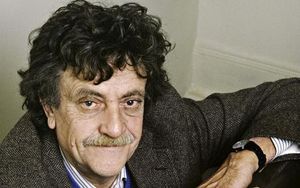
KurtVonnegut_1241556c Loree Rackstraw has given the first details of the 40-year relationship for the first time since the American writer's death in 2007. In a forthcoming “intimate biography”, the English professor recalls the “great bear of a man” that wrote her letters and took her on romantic holidays. The literary love-story, which continued despite long periods of absence and his two marriages, began when Rackstraw attended a writers' workshop at Iowa University led by Vonnegut in 1965, four years before Slaughterhouse-Five was published.

Rackstraw's book will be published in April, almost exactly two years after Vonnegut died following a fall at his home in Manhattan at the age of 84. She had written often about Vonnegut's work but it was only after his death that she trawled through the collection of letters with the thought of writing something personal. “I realised I possessed quite a remarkable chronological story of his life,” she said. “We were very close. It was a friendship unlike any I've had with anyone.”

More here.

On the evolution of Darwin

From The Guardian:

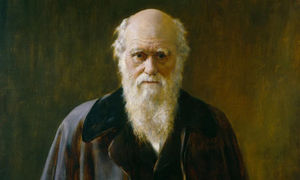
Charles-Darwin-by-John-Co-001 It sounds glib to say that every age moulds Charles Darwin to its own preoccupations, but the temptation is hard to resist. To the Victorians, he was an atheistic agitator undermining humankind's privileged moral status. In the early 20th century, he became a prophet of social engineering and the free market. With sociobiology in the 1970s, Darwinism became a behavioural theory, while neo-Darwinist genetics prompted a bleak view of humanity as gene machines driven by the selfish imperatives of our DNA.

Now, 200 years after Darwin's birth and 150 years after the publication of On the Origin of Species, Adrian Desmond and James Moore, whose doorstop 1991 biography seemed to leave nothing more to be said, offer a new vision of the architect of evolution by natural selection. In Darwin's Sacred Cause (Allen Lane £25), they say that Darwin's work on the common ancestry of all living things was motivated not by abstract curiosity, but by a determination to show that African slaves have the same roots as their white masters. They claim that the foundational text of modern biology was spurred by Darwin's repugnance of the slave trade.

In this view, Darwin's championing of the “brotherhood” of all men might even be considered one of the enabling factors in the election of a black man as US president. There will no doubt be sneers at this “politically correct” Darwin, but it is hard to dispute Desmond and Moore's contention that Darwin aimed to overturn the notion, conveniently adopted by slavers, that blacks and Europeans (and other races) were separate species.

More here.

oh, and by the way, the world is a giant hologram

Mg20126911.300-1_300-1

For many months, the GEO600 team-members had been scratching their heads over inexplicable noise that is plaguing their giant detector. Then, out of the blue, a researcher approached them with an explanation. In fact, he had even predicted the noise before he knew they were detecting it. According to Craig Hogan, a physicist at the Fermilab particle physics lab in Batavia, Illinois, GEO600 has stumbled upon the fundamental limit of space-time – the point where space-time stops behaving like the smooth continuum Einstein described and instead dissolves into “grains”, just as a newspaper photograph dissolves into dots as you zoom in. “It looks like GEO600 is being buffeted by the microscopic quantum convulsions of space-time,” says Hogan. If this doesn’t blow your socks off, then Hogan, who has just been appointed director of Fermilab’s Center for Particle Astrophysics, has an even bigger shock in store: “If the GEO600 result is what I suspect it is, then we are all living in a giant cosmic hologram.”

more from New Scientist here.

vollmann on the ethics of photography

Osvetim_brezinka_sonderkommando1

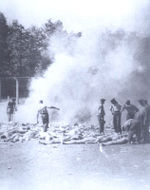
Images in Spite of All discusses four clandestine photographs taken at Auschwitz by a member of the Sonderkommando, the “special detachment” whose members, also prisoners, facilitated the entry of their fellow human beings into the gas chambers, then removed the gold teeth, cut off the women’s hair (it would be woven into cloth), cremated the remains, and, in a few weeks, entered the gas chambers themselves, to be similarly “processed” by their successors. The photographer’s name was Alex. No one knows his last name. He perished soon after, of course. It is miraculous that these negatives survived. Smuggled out in a tube of toothpaste, they constitute, so we are told, the only known photographs of mass killing in the gas chambers. Hence Didi-Huberman’s characterization of them as “images in spite of all,” brave affirmations on the part of the doomed, sad scraps to be treasured, instructions to be followed insofar as we can: We, the victims, show you our fate. Look at us, remember us, save us! This “insofar as we can” now corresponds to “in spite of all,” for the few who were saved and the many who were murdered have long since passed beyond imminence and urgency. Looking and remembering remain valid tasks; these invite us to study each of the four images in detail.

more from Bookforum here.

hating billy joel

090123_Spec_JoelTN

I decided to make a serious effort to identify the consistent qualities across Joel’s “body of work” (it almost hurts to write that) that make it so meretricious, so fraudulent, so pitifully bad. And so, risking humiliation and embarrassment, I ventured to the Barnes & Noble music section and bought a four-disc set of B.J.’s “Greatest Hits,” one of which was a full disc of his musings about art and music. I must admit that I also bought a copy of an album I already had—Return of the Grievous Angel, covers of Gram Parsons songs by the likes of the Cowboy Junkies and Gillian Welch, whose “Hickory Wind” is just ravishing—so the cashier might think the B.J. box was merely a gift, maybe for someone with no musical taste. Yes, reader. I couldn’t bear the sneer, even for your benefit. And I think I’ve done it! I think I’ve identified the qualities in B.J.’s work that distinguish his badness from other kinds of badness: It exhibits unearned contempt. Both a self-righteous contempt for others and the self-approbation and self-congratulation that is contempt’s backside, so to speak. Most frequently a contempt for the supposed phoniness or inauthenticity of other people as opposed to the rock-solid authenticity of our B.J.

more from Slate here.

ramble on, herodotus

Battle-of-Marathon-001

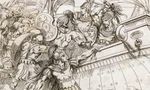
Thucydides is the ancient historian whom prime ministers and presidents most like to quote, and who is taught at West Point (an institution nicknamed Sparta). His work has often been co-opted by later thinkers – to help explain, for example, how democracies can become embroiled in disastrous military expeditions. Bernard Knox, the great American classicist, cited him when referring to the US’s entanglement in Vietnam, but the idea has no doubt been applied to Iraq or Afghanistan. Herodotus, by contrast, has none of this heavyweight support. He was written off by Thucydides, who poured scorn on what he characterises as Herodotus’s fanciful, romantic view of the world. The criticism stuck. Herodotus’s account of the Persian wars of 481-479BC takes six books out of nine (or 300-odd pages of Robin Waterfield’s excellent English translation) even to begin on the Battle of Marathon; for many it is a rambling, rather disappointing try-out for the academic discipline that history would later become.

more from The Guardian here.

w.’s last slide show

Bush Smug BW

Here's L. Paul Bremer. Next.

Aha! Karl Rove. I'm sure y'all have seen ol' Turdblossom shootin' his mouth off on Fox News. Good on ya, Turdblossom.

Here's Donald Rumsfeld—we're sad about Donald. Popped up on that show Intervention. I never heard of an addiction to spray paint. Finally tracked him down at a men's hotel in Dallas. Donald has his good days, Donald has his bad days.

Katrina. Next.

more from McSweeney's here.

“If the testicles hold out, consider him acquitted by trial”

Walker-75

Among the gems in the archive, Brent tells us, is a cache of pornographic cartoons, idly sketched by Politburo members during their meetings. Stalin drew one graphic scene that illustrated his accompanying note: “For all the sins, past and present, hang Bryukhanov by the testicles. If the testicles hold out, consider him acquitted by trial. If they do not hold, drown him in the river.” Bryukhanov, a commissar of finances, was shot in 1938. We know a lot about Stalin now, including his fondness for musicals (he even tried his hand at lyrics). After exploring his personal library with its copious annotations, Brent concludes that Stalin was as much intellectual as brute and calls him “an idealist in the sense that he believed completely in the primacy of ideas.” Brent has a point; Stalin believed in his ideas to the death, or as he put it: “mercilessly destroy anyone who, by his deeds or his thoughts — yes, by his thoughts — ­threatens the unity of the socialist state.”

more from the NY Times here.