

Wednesday Poem

The sun rises
Forough Farrokhzad

Take heed
My wounded eyes melt
Drop by drop
My rebellion my shadow
Surrenders to the light
Take heed

Everything that I am crumbles
My love’s fire surrenders
Carries me to the end
Crucifies me
Take heed
Stars hail in the night

You came from a far
From fields of scent, of light
To carry me, floating
Through clouds of ivory and crystal
Take me away my solace, my hope
Take me to a city of sonnets and passion

Towards the path of milky way draw me
Higher than every star lift me
Take heed
I’ve been set aflame by this light
Fevered, burnt by this light
Like a goldfish in a pool of night
I gnaw helplessly at the stars

Read more »

Hunting the Elusive First “Ms.”

Ben Zimmer at Visual Thesaurus:

10s Some have theorized that Ms. has roots long before the 20th century. One piece of evidence that has been put forth is the tombstone of Sarah Spooner, who died in 1767 in Plymouth, Massachusetts. As you can see from this image, what appears on the headstone is M with a superscript s. As Dennis Baron writes in his excellent book Grammar and Gender (1987), “it is certainly an abbreviation of Miss or Mistress, and not an example of colonial language reform or a slip of the chisel, as some have suggested.”

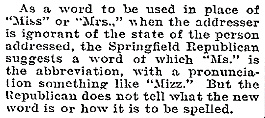
There things stood until 2004, when I happened upon this tantalizing little notice in the Humeston (Iowa) New Era of Dec. 4, 1901 (thanks to the Newspaperarchive database):

Ms1901b

The writer seems confused about the Springfield Republican proposal since he (or she, but probably he) guesses that Ms. is an abbreviation of some longer word. That's a confusion that persists among those who assume Ms. is an abbreviated form of Miss or Missus, but the Republican article puts forth Ms. without any particular expansion.

More here.

The End of the Beginning

Roger Cohen in the New York Times:

ScreenHunter_04 Jun. 24 12.27 I said the Islamic Republic has been weakened. Why? I see five principal factors. The first is that the supreme leader’s post — the apex of the structure conceived by the revolutionary leader Ayatollah Ruhollah Khomeini — has been undermined. The keystone of the arch is now loose.

Khamenei, far from an arbiter with a Prophet-like authority, has looked more like a ruthless infighter. His word has been defied. At night, from rooftops, I’ve even heard people call for his death. The unthinkable has occurred.

The second is that the hypocritical but effective contract that bound society has been broken. The regime never had active support from more than 20 percent of the population. But acquiescence was secured by using only highly targeted repression (leaving the majority free to go about its business), and by giving people a vote for the president every four years.

That’s over. Repression will be broad and ferocious in the coming months. The acquiescent have already become the angry. You can’t turn Iran into Burma: The resistance of a society this varied and savvy will be fierce.

More here.

How the talk became big business

From The Guardian:

Naomi-Klein-001 A speaker. A speech. A microphone. A bare stage. And – no expense spared here – a glass of water. As an evening's entertainment, it does not sound like much: Bruce Springsteen and his E Street extravaganza this is not. And yet when Malcolm Gladwell, a Manhattan-based journalist, turned up last winter to do a monologue at the Lyceum, a West End theatre that has hosted Led Zeppelin and is now home to the Lion King musical, he filled it – twice. Despite bitter November temperatures, long queues formed and the first show had to be delayed by half an hour to squeeze in as many punters as possible. All 4,000 tickets, at up to £25 a head, sold out.

What were they getting for their money? Gladwell does not do stand-up, is not in exclusive possession of the Lord's wisdom and cannot tell you how to make millions from buy-to-let. A small, skinny, former business reporter with a towering afro and hands that flutter about as if evading an invisible butterfly net, Gladwell likes to address such pressing issues as the quest for the perfect pasta sauce (Google the video: it is brilliant).

(Picture: Canadian social commentator Naomi Klein, one of the big draws of the lecture circuit.)

More here.

What Skepticism Reveals about Science

Michael Shermer in Scientific American:

What-skepticism-reveals_1 In a 1997 episode of The Simpsons entitled “The Springfield Files”—a parody of X-Files in which Homer has an alien encounter in the woods (after imbibing 10 bottles of Red Tick Beer)—Leonard Nimoy voices the intro as he once did for his post-Spock run on the television mystery series In Search of…: “The following tale of alien encounters is true. And by true, I mean false. It’s all lies. But they’re entertaining lies, and in the end isn’t that the real truth? The answer is no.”

No cubed. The postmodernist belief in the relativism of truth, coupled to the clicker culture of mass media where attention spans are measured in New York minutes, leaves us with a bewildering array of truth claims packaged in infotainment units. It must be true—I saw it on television, at the movies, on the Internet. The Twilight Zone, The Outer Limits, That’s Incredible, The Sixth Sense, Poltergeist, Loose Change, Zeitgeist the Movie. Mysteries, magic, myths and monsters. The occult and the supernatural. Conspiracies and cabals. The face on Mars and aliens on Earth. Bigfoot and Loch Ness. ESP and PSI. UFOs and ETIs. JFK, RFK and MLK—alphabet conspiracies. Altered states and hypnotic regression. Remote viewing and astroprojection. Ouija boards and Tarot cards. Astrology and palm reading. Acupuncture and chiropractic. Repressed memories and false memories. Talking to the dead and listening to your inner child. Such claims are an obfuscating amalgam of theory and conjecture, reality and fantasy, nonfiction and science fiction. Cue dramatic music. Darken the backdrop. Cast a shaft of light across the host’s face. The truth is out there. I want to believe.

More here.

Tuesday, June 23, 2009

SR-71 Blackbird: The Ultimate Spy Plane

Owen Edwards in Smithsonian Magazine:

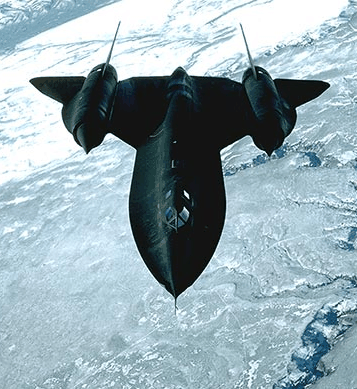
ScreenHunter_17 Jun. 23 16.55 The Udvar-Hazy Blackbird, identified by its tail number, 61-7972, holds several records, including: New York to London in 1 hour 54 minutes 56.4 seconds. (Another Blackbird, 61-7958, set the record for average jet speed: 2,193.167 mph.) On March 6, 1990, as it made its final flight, the Smithsonian plane set another record—Los Angeles to Dulles International Airport, outside Washington, D.C., in 1 hour 4 minutes 20 seconds (barely time for a snack and a snooze). That day, a team including Air Force Lt. Col. Ed Yeilding and Lt. Col. Joseph Vida touched the plane down at Dulles for delivery to Udvar-Hazy, the National Air and Space Museum's companion facility.

I asked Shul, a former Air Force fighter pilot and Vietnam veteran who has written two books about the Blackbird—one recounting his reconnaissance for a dramatic raid on Libya in 1986—what it was like to fly such a phenomenal craft. “It wasn't like any other airplane,” he told me. “It was terrifying, exciting, intense and humbling every time you flew. Each mission was designed to fly at a certain speed; you always knew the airplane had more. It was like driving to work in a double-A fuel dragster.”

More here.

Holocaust: The Ignored Reality

Timothy Snyder in the New York Review of Books:

ScreenHunter_16 Jun. 23 16.41 Though Europe thrives, its writers and politicians are preoccupied with death. The mass killings of European civilians during the 1930s and 1940s are the reference of today's confused discussions of memory, and the touchstone of whatever common ethics Europeans may share. The bureaucracies of Nazi Germany and the Soviet Union turned individual lives into mass death, particular humans into quotas of those to be killed. The Soviets hid their mass shootings in dark woods and falsified the records of regions in which they had starved people to death; the Germans had slave laborers dig up the bodies of their Jewish victims and burn them on giant grates. Historians must, as best we can, cast light into these shadows and account for these people. This we have not done. Auschwitz, generally taken to be an adequate or even a final symbol of the evil of mass killing, is in fact only the beginning of knowledge, a hint of the true reckoning with the past still to come.

More here.

‘Iran’s election was fixed,’ say number crunchers

Daniel Cressey in Nature:

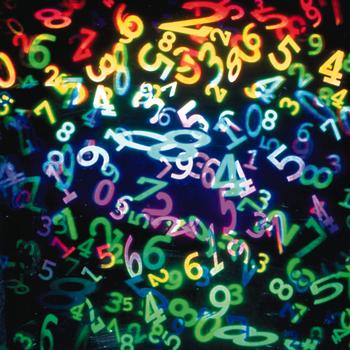
Numbers It is widely acknowledged that humans are very bad at making up random numbers. If we weren’t we wouldn’t have invested so much time in developing random number generators.

Now some work by political scientists Bernd Berber and Alexandra Scacco, of Columbia University, suggests that fact hasn’t reached certain key individuals in Iran. As the country struggles with the violent aftermath of its recent hotly contested election, Berber and Scacco say the results of that election seem highly suspicious.

They used the results published by the Ministry of the Interior and examined the last two digits of the votes reported for the four main candidates.

“The numbers look suspicious,” they report in the Washington Post.

There are far too many 7s, for a start, and not enough 5s. Such results would occur in fewer than four in 100 non-manipulated election results, they write.

That would not rule out Iran’s election being fair. But Scacco and Berber go further. They note that previous work has proven that humans have trouble generating “non-adjacent digits”, ie: 27 as opposed to 23, or 36 rather than 34. Non-manipulated results should be approximately 70% non-adjacent digits; Iran’s results are 62% non-adjacent.

The probability of that happening in a fair election is less than 4.2%, they write.

More here. In the Washington Post article, Bernd Beber and Alexandra Scacco conclude:

Each of these two tests provides strong evidence that the numbers released by Iran's Ministry of the Interior were manipulated. But taken together, they leave very little room for reasonable doubt. The probability that a fair election would produce both too few non-adjacent digits and the suspicious deviations in last-digit frequencies described earlier is less than .005. In other words, a bet that the numbers are clean is a one in two-hundred long shot. [My emphasis.]

Also see: Chatham House Study Definitively Shows Massive Ballot Fraud in Iran's Reported Results

writing africa

Cover00

“Treat Africa as if it were one country,” quips the Kenyan writer Binyavanga Wainaina in “How to Write About Africa,” a barbed guide for Western authors who hope to address this misunderstood continent. “Don’t get bogged down with precise descriptions. . . . Keep your descriptions romantic and evocative and unparticular.” First published in Granta in 2005, Wainaina’s satire lands its punch by gathering the tenacious clichés about Africa—the savage and noble-savage exotica still lodged in the Western imagination, the game-hunting landscapes that seem to autogenerate purple raptures, the liberal visitor’s hand-wringing about endemic graft and corruption. Wainaina trots out a parade of straw figures such as the Loyal Servant, the Ancient Wise Man, the venal Modern African, and the Starving African, “who wanders the refugee camp nearly naked, and waits for the benevolence of the West. . . . She can have no past, no history; such diversions ruin the dramatic moment.” Wainaina’s essay is more than an acerbic takedown of lazy and half-informed Western perceptions. Embedded within it is a manifesto of sorts. If we turn inside out the sardonic rules and prohibitions, a vision of African literature emerges that departs from the dark-continent fantasies still entertained even by sophisticates in Europe and North America. “Taboo subjects: ordinary domestic scenes, love between Africans (unless a death is involved), references to African writers or intellectuals, mention of school-going children who are not suffering from yaws or Ebola fever or female genital mutilation. . . . Avoid having the African characters laugh, or struggle to educate their kids, or just make do in mundane circumstances.” In one sense, this is a call to normalize African writing, to make its human scale comparable to that of literature set elsewhere.

more from James Gibbons at Bookforum here.

the grunters

Tennisinside__1245518463_3762

In 2005, Venus Williams and Maria Sharapova met in the Wimbledon semifinals, where they played a tough two-set match that Williams won. It was hard-fought and entertaining, and had another distinction as well – it was unprecedentedly loud. By the end of the second set, both women were hitting groundstrokes with tremendous pace, impossible accuracy, and amazing noise. If you turned your back to the television, you might have imagined that NBC was broadcasting not a match on the All-England Club’s hallowed Centre Court, but a particularly long street fight. The rise of grunting in tennis has become one of the most curious sideshows in the sports world. Baseball has steroids. Football has head trauma and Terrell Owens. Tennis has this. The controversy over grunting is reaching maximum interest this week because of Michelle Larcher de Brito, the 16-year-old from Portugal who made a lot of noise at last month’s French Open with both her tennis and her grunt. There has never been one quite like it – a violent squeal released with every stroke, which, at peak intensity, sounds like she’s in pain, ecstasy, or trouble. The complaints about her in France have put pressure on officials in England, where Wimbledon begins tomorrow. The tournament is considering a crackdown: officially, the offense would be called a “noise hindrance,” and if an umpire declares a grunt too loud, the offender could be charged a point.

more from Wesley Morris at the Boston Globe here.

hail the dumb broad

ID_PI_GOLBE_JUDY_AP_001

A sexy, dolled-up blonde enters a fancy hotel suite with an oaf of a man. Her face is impassive and haughty, her posture erect. This dame is not easily impressed. She stands around as the hotel’s manager attempts to please the oaf, showing him around, but she hardly pays attention. The manager politely leads her to her room, which faces the one the big oaf is in. The oaf, seeing her across the courtyard, opens a window, and shouts, “Hey, Billie!” Taking her time, the blonde demurely saunters over and in her Tenement-best wails, “Whaaaaaaaaaaaaaaaaat??!!” Such are Judy Holliday’s surprising first moments in the 1950 film Born Yesterday. Three-and-a-half minutes in, that “Whaaaaaaaaaaaaaaaaat??!!” marks the film’s real start like a steam trumpet. From then on, you’re hooked. Holliday steals every scene she’s in. As Billie Dawn, the ditzy former chorus girl turned fiancé of a well-to-do mobster, she is hilarious and mesmerizing, mainly because you’re never sure just what she’ll do next. She moves in a practiced shimmy, knowing she’s putting on a show but never making a big show about the fact that she’s putting on a show. The voice of Billie Dawn — which Holliday spent four years perfecting on Broadway before starring in the movie version — is the high-pitched, Damon Runyon-esque “Toity-toid and Toid” that audiences have come to expect of their dumb broads, but she slurs her lines a little and never leaves the moment. She’s a Marlon Brando of dingy dames. It’s an iconic performance, one that would win her the Academy Award for Best Leading Actress at the age of 29 and come to define her career.

more from Stefany Anne Golberg at The Smart Set here.

Tuesday Poem

Kore
Robert Creeley

As I was walking
I came upon
chance walking
the same road upon.

As I sat down
by chance to move
later
if and as I might,

light the wood was,
light and green,
and what I saw
before I had not seen.

It was a lady
accompanied
by goat men
leading her.

Her hair held earth.
Her eyes were dark.
A double flute
made her move.

‘O love,
where are you
leading
me now?’

Kore: Persephone

Vatican’s Celestial Eye, Seeking Not Angels but Data

From The New York Times:

Vat Fauré’s “Requiem” is playing in the background, followed by the Kronos Quartet. Every so often the music is interrupted by an electromechanical arpeggio — like a jazz riff on a clarinet — as the motors guiding the telescope spin up and down. A night of galaxy gazing is about to begin at the Vatican’s observatory on Mount Graham. “Got it. O.K., it’s happy,” says Christopher J. Corbally, the Jesuit priest who is vice director of the Vatican Observatory Research Group, as he sits in the control room making adjustments. The idea is not to watch for omens or angels but to do workmanlike astronomy that fights the perception that science and Catholicism necessarily conflict.

Last year, in an opening address at a conference in Rome, called “Science 400 Years After Galileo Galilei,” Cardinal Tarcisio Bertone, the secretary of state of the Vatican, praised the church’s old antagonist as “a man of faith who saw nature as a book written by God.” In May, as part of the International Year of Astronomy, a Jesuit cultural center in Florence conducted “a historical, philosophical and theological re-examination” of the Galileo affair. But in the effort to rehabilitate the church’s image, nothing speaks louder than a paper by a Vatican astronomer in, say, The Astrophysical Journal or The Monthly Notices of the Royal Astronomical Society.

On a clear spring night in Arizona, the focus is not on theology but on the long list of mundane tasks that bring a telescope to life.

More here.

Why Aren’t More Women Tenured Science Professors?

From Scientific American:

Women-tenured-science-professors_1 Women who apply for tenure-track positions at top-tier research universities in math and sciences these days have a slightly better chance of landing the job than their male colleagues, says a new study funded by the National Science Foundation. But that's just for those who apply, which is a good tick lower than those who earn PhDs. In chemistry, for example, women made up 32 percent of newly minted PhDs from 1999 to 2003 but accounted for only 18 percent of applicants to tenure-track positions. The recent report, commissioned by Congress, surveyed 89 institutions and examined PhD and faculty gender distribution in biology, chemistry, civil engineering, electrical engineering, math and physics.
Despite being a minority of math and science faculty overall, the number of women in the academic ranks is on the rise. For example, in 1995, women made up 18.7 percent of assistant math professors and 7.6 percent of the full professors. By 2003, those numbers had increased modestly to 26.5 percent of assistant math professors and 9.7 percent of full professors.

The results also revealed that tenured female professors earned about 8 percent less than male colleagues. “There are still big problems facing women in the science, technology and engineering fields,” says Phoebe Leboy, president of the Association for Women in Science (AWIS) and a biochemistry professor emerita at the University of Pennsylvania. Many women get a close look at the academic prospects ahead and say, “This job is not designed for me,” Leboy says.

So what are they doing instead?

More here.

Monday, June 22, 2009

The Winners of the 3 Quarks Daily 2009 Prize in Science

!cid_2FABC8E0-B845-4157-B445-5EDC5FD7B692@local Strange-Quark-neu-160 Enhanced horizon

Professor Steven Pinker has picked the three winners:

  1. Top Quark, $1000: Daylight Atheism: Bands of Iron
  2. Strange Quark, $300: Southern Fried Science: The ecological disaster that is dolphin safe tuna
  3. Charm Quark, $200: Bad Astronomy: Ten Things You Don't Know About Hubble

Here is what Professor Pinker had to say about the winners (he even manages to include a charming mini-science essay of his own!):

When I edited The Best American Science and Nature Writing a few years ago, here’s how I characterized what I look for in a science essay:

The best science essays give readers the blissful click, the satisfying aha!, of seeing a puzzling phenomenon explained. When I was a graduate student the antiquated plumbing in my apartment sprang a leak, and an articulate plumber (perhaps an underemployed PhD) explained what caused it. When you shut off a tap, a large incompressible mass moving at high speed has to decelerate very quickly. This imparts a big force to the pipes, like a car slamming into a wall, which eventually damages the threads and causes a leak. To deal with this problem, plumbers used to install a a closed vertical section of pipe, a “pipe riser,” near each faucet, . When the faucet is shut, the water compresses the column of air in the riser, which acts like a shock absorber. Unfortunately, gas under pressure is absorbed by a liquid. Over time, the air in the column dissolves into the water, which fills the pipe riser, rendering it useless. So every now and again a plumber has to bleed the system and let air back into the risers, a bit of preventive maintenance the landlord had neglected. It may not be the harmony of the spheres, but the plumber’s disquisition captures what I treasure most in science writing: the ability to show how a seemingly capricious occurrence falls out of laws of greater generality.

By that standard, Daylight Atheism’s Bands of Iron is my top pick. He starts with something that attracts your attention purely on aesthetic grounds – stripes in a rock. He explains it by invoking deep, non-obvious, yet understandable principles, at the same time illuminating one of the most interesting phenomena in science – the coevolution of early life and the planet Earth –with a nod to a current issue for good measure.

My second pick is Southern Fried Science’s The ecological disaster that is dolphin safe tuna. It’s a fine example of one of what I consider to be one of the most important lessons of science: that emotional moralization can lead to outcomes that are morally worse than those based on hard-headed analyses.

Third prize goes to Bad Astronomy’s Ten Things You Don't Know About Hubble. I liked the unassuming style, the slew of interesting facts, and the window it provides into the life a working-day scientist – and not the Alpha Primate, but the unsung graduate students and postdocs who actually do the work of science. Finally, a good blog should not just present text but take advantage of its medium, including page structure and graphics. I liked the use of a captioned slide show, and the varied photographs, particularly the gorgeous opening shot of the Hubble Telescope against the curve of the Earth and the closeup of a lavender Venus. It’s one of the greatest displays of philistinism in human history that so few people appreciate the breathtaking photography made possible by probes like Hubble and Cassini (and, of course, the large terrestrial telescopes). Not only are the photographs beautiful in their own right, but just think about what we are looking at!

[Thanks to the members of my lab group — Brian Atwood, James Lee, Rebecca Sutherland, and Kyle Thomas – for their votes and comments.]

Congratulations to the winners (Please contact me by email, I will send the money later today! And feel free to leave your acceptance speech as a comment here!), and thanks to everyone who participated. (We've added the winners to our blogroll – hint!) Thanks also, of course, to Professor Pinker for doing the final judging. The whole thing was fun, and we learned of some great blogs we didn't know about!

The striking three prize logos at the top of this post were designed, respectively, by Vicki Winters, Carla Goller, and Sughra Raza. Our thanks to each of them. I hope the winners will display them with pride on their own blogs!

Details about how the 3QD prizes work, here.

Sunday, June 21, 2009

John Hodgman: I Hear They’re Going to Make Evolution Legal

Carl Zimmer in his excellent blog, The Loom:

I just loved this speech John Hodgman made at the Radio and TV Correspondents’ Dinner yesterday. Hodgman spoke for all us nerds, perhaps even including the president himself. And best of all, while talking about that fine nerd novel Dune, he showed the president a painting of a giant sand worm from Dune by John Schoenherr. (It shows up at 11:20.)

I grew up a couple miles from Schoenherr and spent much of my nerdy youth with his son Ian, hanging out in his fabulous old barn-slash-studio, filled with his classic science fiction art, new paintings of bears and geese, assorted Japanese swords, many cameras, a complete collection of National Geographic, and lots of bones and stuffed animal heads. I’m grateful to Hodgman for bringing back those times, and for showing off the work of a wonderful artist. I return Hodgman the final words of his speech: I extend that most American of greetings–I have been and always shall be your friend. Live long and prosper.

Pakistan win the ICC World Twenty20 in exciting finish!

ScreenHunter_14 Jun. 21 19.19

What a summer solstice it has been! 3QD announces its Science Prize winners, Barack turns out to be a secret Pakistani, and then this is from the BBC (I think Barack made this happen too!):

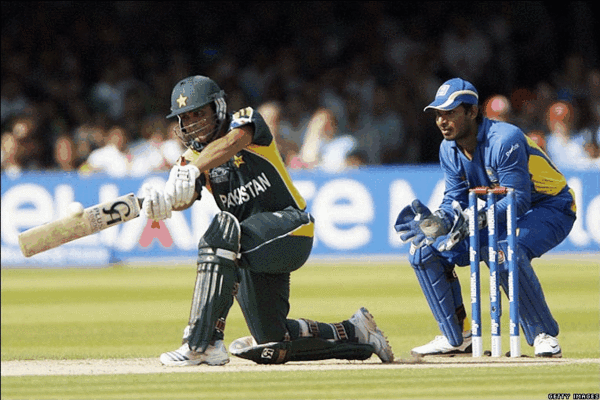
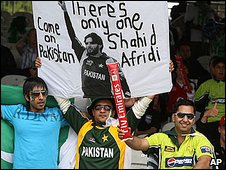
Pakistan won the ICC World Twenty20 in an exciting finish at a noisy Lord's when Sri Lanka's total of 138-6 was overhauled with 10 balls remaining.

_45955225_fans_ap466i Shahid Afridi, man of the match in the semi-final, was again the hero, hitting 54 not out from 40 balls to steer Pakistan to an eight-wicket win.

Sri Lanka were 2-2 and then 70-6 after choosing to bat and needed Kumar Sangakkara's 64 to give them hope.

But Pakistan paced their chase well and richly deserved their victory.

Sri Lanka had progressed through the tournament smoothly, winning all their matches and relying on the brilliant batting of Tillakaratne Dilshan and some superb bowling led by Ajantha Mendis.

But on the grand stage, both their leading players fluffed their lines, and Pakistan ruthlessly seized the initiative.

Pakistan had lost two of their first three matches, needing a win against the Netherlands just to make the last eight. But they turned a corner when thrashing New Zealand – from which point they never looked back.

More here.

Slipping from Shangri-La

Conover-01-thumbnail

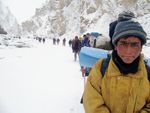
The line of forty walkers moved quickly, which was good for keeping warm but bad for keeping my balance. Because we were walking on ice, a frozen river. The Zanskar, walled in on both sides by a towering gorge, is the only winter link between villages in that Himalayan valley and the outside world. And it’s only a link for a little while, in deepest winter, when its surface freezes enough to support human footsteps. Zanskar is part of Ladakh—the eastern, Buddhist part of the Indian state of Jammu and Kashmir. At more than 11,000 feet above sea level (with peaks as high as 23,000), the area has long been defined by remoteness. The valley has the feel of a cul-de-sac, because there is only one real road in and out—a dirt track from Kargil, an untouristed and predominantly Muslim town just a couple of miles from the disputed border (or “Line of Control”) with Pakistan, to Padum, the main town of Zanskar. Summers are short there, and the Kargil road is only reliably open four or five months a year, from the end of May to early October. After that, snow makes it impassable and the valley gets very, very quiet. But for a few weeks each winter, when the ice is strong enough, the river provides the Zanskaris another way out—an ice road, a forty-mile trail upon the frozen surface called the chaddar.

more from Ted Conover at VQR here.