barthelme

Donald-Barthelme-in-1964-002

It was in my late teens that I fell for Donald Barthelme. No passing adolescent fancy this, but a palpitating obsession of the first water. In his essay The Beards, Jonathan Lethem writes of Talking Heads that “[at] the peak, in 1980 or 1981, my identification was so complete that I might have wished to wear the album Fear of Music in place of my head”. In 1993 I felt much the same way about Forty Stories, the first Barthelme collection I owned. That book and its predecessor Sixty Stories were Barthelme’s self-selected “best-ofs”, their contents culled from nine story collections and work first published in magazines such as the New Yorker and Esquire. His fiction resulted in more letters of complaint being sent to the former publication than any other writer, a predictable result of its audacity. His postmodernist aesthetic, however, is not of the sort that revels in being problematic for its own sake. “Art is not difficult because it wishes to be difficult,” he wrote in his 1987 essay Not-Knowing, ‘but because it wishes to be art.”

more from The Guardian here.

Wednesday Poem

Grief Calls Us to the Things of This World
Sherman Alexie

The eyes open to a blue telephone In the bathroom of this five-star hotel.
I wonder whom I should call? A plumber, Sherman Alexie
Proctologist, urologist, or priest?
…….

Who is most among us and most deserves
The first call? I choose my father because

He's astounded by bathroom telephones.
I dial home. My mother answers. “Hey, Ma,

I say, “Can I talk to Poppa?” She gasps,
And then I remember that my father

Has been dead for nearly a year. “Shit, Mom,”
I say. “I forgot he's dead. I'm sorry–

How did I forget?” “It's okay,” she says.
“I made him a cup of instant coffee

This morning and left it on the table–
Like I have for, what, twenty-seven years–

And I didn't realize my mistake
Until this afternoon.” My mother laughs

At the angels who wait for us to pause
During the most ordinary of days

And sing our praise to forgetfulness
Before they slap our souls with their cold wings.

Those angels burden and unbalance us.
Those fucking angels ride us piggyback.

Those angels, forever falling, snare us
And haul us, prey and praying, into dust.

from Thrash; Hanging Loose Press

The Darfur the West Isn’t Recognizing as It Moralizes About the Region

Howard W. French in The New York Times:

Mamdani190 For many who survey an African landscape strewn with political wreckage, nowadays merely to raise the subject of European colonialism, which formally ended across most of the continent five decades ago, is to ring alarm bells of excuse making. Clearly, the African disaster most in view today is Sudan, or more specifically the dirty war that has raged since 2003 in that country’s western region, Darfur. Rare among African conflicts, it exerts a strong claim on our conscience. By instructive contrast, more than five million people have died as a result of war in Congo since 1998, the rough equivalent at its height of a 2004 Asian tsunami striking every six months, without stirring our diplomats to urgency or generating much civic response.

Mahmood Mamdani, a Ugandan-born scholar at Columbia University and the author of “When Victims Become Killers: Colonialism, Nativism, and Genocide in Rwanda,” is one of the most penetrating analysts of African affairs. In “Saviors and Survivors: Darfur, Politics, and the War on Terror,” he has written a learned book that reintroduces history into the discussion of the Darfur crisis and questions the logic and even the good faith of those who seek to place it at the pinnacle of Africa’s recent troubles. It is a brief, he writes, “against those who substitute moral certainty for knowledge, and who feel virtuous even when acting on the basis of total ignorance.”

More here.

Is Life Too Hard for Honeybees?

From Scientific American:

Bee “For almost two years we've been documenting and sampling colonies that are dying and examining healthy colonies in the same area, trying to determine what factors are involved,” Pettis says. “I think there are interactions going on, like low-level pesticide exposure and poor nutrition weakening the host honeybees and then pathogens doing the killing. It's similar to a human who might not be eating, or is frail and traveling too much, and as a result is more susceptible to pathogens. If you go into a hospital in excellent health, you don't contract pneumonia, but if you go in weakened, pneumonia kills you.”

Pesticides and fungicides
How much pesticide exposure is too much for a honey bee? Traditionally, Pettis says, manufacturers seek clearance for pesticides by using the LD-50 test, which “essentially applies toxic stuff to bees and sees if half or more of them drop dead.” This brute force test does not, however, gauge long-term systemic effects. “The general feeling is that we need to move beyond mortality testing to sublethal testing that looks at the shortening of life span, disorientation, reduced vigor, and other things,” says Pettis, who has been in discussions with the U.S. Environmental Protection Agency (EPA) about developing newer, more sensitive pesticide tests.

More here.

Tuesday, March 31, 2009

The Loyal Opposition of Paul Krugman

Krugman-economy-BZ01-vl-vertical Evan Thomas in Newsweek:

Paul Krugman has all the credentials of a ranking member of the East Coast liberal establishment: a column in The New York Times, a professorship at Princeton, a Nobel Prize in economics. He is the type you might expect to find holding forth at a Georgetown cocktail party or chumming around in the White House Mess of a Democratic administration. But in his published opinions, and perhaps in his very being, he is anti-establishment. Though he was a scourge of the Bush administration, he has been critical, if not hostile, to the Obama White House.

In his twice-a-week column and his blog, Conscience of a Liberal, he criticizes the Obamaites for trying to prop up a financial system that he regards as essentially a dead man walking. In conversation, he portrays Treasury Secretary Tim Geithner and other top officials as, in effect, tools of Wall Street (a ridiculous charge, say Geithner defenders). These men and women have “no venality,” Krugman hastened to say in an interview with NEWSWEEK. But they are suffering from “osmosis,” from simply spending too much time around investment bankers and the like. In his Times column the day Geithner announced the details of the administration's bank-rescue plan, Krugman described his “despair” that Obama “has apparently settled on a financial plan that, in essence, assumes that banks are fundamentally sound and that bankers know what they're doing. It's as if the president were determined to confirm the growing perception that he and his economic team are out of touch, that their economic vision is clouded by excessively close ties to Wall Street.”

If you are of the establishment persuasion (and I am), reading Krugman makes you uneasy. You hope he's wrong, and you sense he's being a little harsh (especially about Geithner), but you have a creeping feeling that he knows something that others cannot, or will not, see.

Voodoo Correlations in Social Neuroscience

HP_12-22-med Via Discover, a new paper by Hall Pashler raises many claims based on fMRI based studies:

Abstract: Functional Magnetic Resonance Imaging studies of emotion, personality, and social cognition have drawn much attention in recent years, with high-profile studies frequently reporting extremely high (e.g., >.8) correlations between behavioral and self-report measures of personality or emotion and measures of brain activation. We show that these correlations often exceed what is statistically possible assuming the (evidently rather limited) reliability of both fMRI and personality/emotion measures. The implausibly high correlations are all the more puzzling because method sections rarely contain sufficient detail to ascertain how these correlations were obtained. We surveyed authors of 54 articles that reported findings of this kind to determine a few details on how these correlations were computed. More than half acknowledged using a strategy that computes separate correlations for individual voxels, and reports means of just the subset of voxels exceeding chosen thresholds. We show how this non-independent analysis grossly inflates correlations, while yielding reassuring-looking scattergrams. This analysis technique was used to obtain the vast majority of the implausibly high correlations in our survey sample. In addition, we argue that other analysis problems likely created entirely spurious correlations in some cases. We outline how the data from these studies could be reanalyzed with unbiased methods to provide the field with accurate estimates of the correlations in question. We urge authors to perform such reanalyses and to correct the scientific record.

Why Minds Are Not Like Computers

Ari Sculman in New Atlantis:

Since the inception of the AI project, the use of computer analogies to try to describe, understand, and replicate mental processes has led to their widespread abuse. Typically, an exponent of AI will not just use a computer metaphor to describe the mind, but will also assert that such a description is a sufficient understanding of the mind—indeed, that mental processes can be understood entirely in computational terms. One of the most pervasive abuses has been the purely functional description of mental processes. In the black box view of programming, the internal processes that give rise to a behavior are irrelevant; only a full knowledge of the input-output behavior is necessary to completely understand a module. Because humans have “input” in the form of the senses, and “output” in the form of speech and actions, it has become an AI creed that a convincing mimicry of human input-output behavior amounts to actually achieving true human qualities in computers.

The embrace of input-output mimicry as a standard traces back to Alan Turing’s famous “imitation game,” in which a computer program engages in a text-based conversation with a human interrogator, attempting to fool the person into believing that it, too, is human. The game, now popularly known as the Turing Test, is above all a statement of epistemological limitation—an admission of the impossibility of knowing with certainty that any other being is thinking, and an acknowledgement that conversation is one of the most important ways to assess a person’s intelligence. Thus Turing said that a computer that passes the test would be regarded as thinking, not that it actually is thinking, or that passing the test constitutes thinking. In fact, Turing specified at the outset that he devised the test because the “question ‛Can machines think?’ I believe to be too meaningless to deserve discussion.” But it is precisely this claim—that passing the Turing Test constitutes thinking—that has become not just a primary standard of success for artificial intelligence research, but a philosophical precept of the project itself.

This precept is based on a crucial misunderstanding of why computers work the way they do.

g20 stinks

M1_021609J_story

The draft G20 communique, as published on the FT’s website, is not encouraging. To be sure, there are humorous moments, such as: each of us commits to candid, even-handed, and independent IMF surveillance of our economies and financial sectors, of the impact of our policies on others, and of risks facing the global economy; Major countries have never allowed this and never will, despite a long tradition of such statements (e.g., ask about whether Gordon Brown welcomed frank assessments of the UK economy during the time he was chair of a ministerial committee that oversees the IMF). Asserting something blandly in a communique does not make it true, but it does – amazingly – often convince much of the media to applaud politely. Watching the spinmeisters at work is always entertaining although, under these circumstances, also more than a little scary. On the real substance, the G20 punts on most of the big issues – as predicted, the language on monetary policy and fiscal policy is completely vacuous…

more from Baseline Scenario here.

isabella’s insect porn

GreenPorno_Fly

WE DEVOUR STORIES about the sex lives of others for the inordinate pleasure of discovering their similarities to, and differences from, our own; the sex lives of insects are no exception. The acts portrayed in Isabella Rossellini’s short-film series Green Porno (2008–2009) are a multifarious sampling of nature’s diversity—yet they are entirely enacted and narrated by Rossellini herself, who, dressed as a male insect, screws inanimate paper representations of her mates. In “Fly,” for example, Rossellini penetrates her “costar” with the lusty abandon of a sex maniac who bangs at “any opportunity, any female!” After this line, the camera lingers on the face of the cardboard fly and then cuts back to Rossellini, as she continuously thrusts. It’s anything but natural—it’s porn. It is thus a charming surprise that Green Porno’s power lies in what porn all too often lacks. What is best about Green Porno is what is best about sex: It can be joyful, surprising, goofy, guileless, funny, and fun. Even the scenes wherein the male star expresses outright terror and loses his life are delicious. The denouement of “Bee” rivals those found in classical tragedy. “I would die . . . without my penis . . . I would bleed to death” are the bee’s final words, and, while undeniably hilarious, there is something oddly antibathetic about this swan song, as it takes us from the ridiculous to the sublime.

more from artforum here.

It was a blonde. A blonde to make a bishop kick a hole in a stained glass window

3200636.41

He’s buried in the Mount Hope Cemetery in San Diego, in an undistinguished grave — just a simple, flat headstone set flush with the ground and surrounded by nearly identical markers arranged in long, boring rows. Nobody thought to plant him next to his wife, whose ashes were stored in a crypt not far away. By then nobody really cared what Chandler might have wanted. If you want to pay a visit to his grave, you have to hunt for it. And there it is: Raymond Thornton Chandler, Author, 1888-1959, In Loving Memory. The “author” part nails it in that sublimely minimal way. Still, it’s a pretty lousy little headstone for such a great writer. We remember Chandler for a lot of things. As the guy who put L.A. on the literary map, along with John Fante and Nathanael West, who published their first novels the same year The Big Sleep came out, in 1939 — a boffo year for L.A. letters. We remember him as the writer who gave the city a lasting identity. As the person who elevated the lowly mystery to the realm of literature. As a damn funny writer who mastered the art of repartee and the bon mot. The guy who took the language of the street, American slang, and made it sing. The King of the Simile. The Bard of Bad Blondes.

more from the LA Weekly here.

The finance industry has effectively captured our government

The crash has laid bare many unpleasant truths about the United States. One of the most alarming, says a former chief economist of the International Monetary Fund, is that the finance industry has effectively captured our government—a state of affairs that more typically describes emerging markets, and is at the center of many emerging-market crises. If the IMF’s staff could speak freely about the U.S., it would tell us what it tells all countries in this situation: recovery will fail unless we break the financial oligarchy that is blocking essential reform. And if we are to prevent a true depression, we’re running out of time.

Simon Johnson in The Atlantic:

ScreenHunter_01 Mar. 31 17.41 Every crisis is different, of course. Ukraine faced hyperinflation in 1994; Russia desperately needed help when its short-term-debt rollover scheme exploded in the summer of 1998; the Indonesian rupiah plunged in 1997, nearly leveling the corporate economy; that same year, South Korea’s 30-year economic miracle ground to a halt when foreign banks suddenly refused to extend new credit.

But I must tell you, to IMF officials, all of these crises looked depressingly similar. Each country, of course, needed a loan, but more than that, each needed to make big changes so that the loan could really work. Almost always, countries in crisis need to learn to live within their means after a period of excess—exports must be increased, and imports cut—and the goal is to do this without the most horrible of recessions. Naturally, the fund’s economists spend time figuring out the policies—budget, money supply, and the like—that make sense in this context. Yet the economic solution is seldom very hard to work out.

No, the real concern of the fund’s senior staff, and the biggest obstacle to recovery, is almost invariably the politics of countries in crisis.

More here.

Tuesday Poem

One Art
Elizabeth Bishop

The art of losing isn’t hard to master;
so many things seem filled with the intent
to be lost that their loss is no disaster.

Lose something every day. Accept the fluster
of lost door keys, the hour badly spent.
The art of losing isn’t hard to master.

Then practice losing farther, losing faster:
places, and names, and where it was you meant
to travel. None of these will bring disaster.

I lost my mother’s watch. And look! my last, or
next-to-last, of three loved houses went.
The art of losing isn’t hard to master.

I lost two cities, lovely ones. And vaster,
some realms I owned, two rivers and a continent.
I miss them, but it wasn’t a disaster.

—Even losing you (the joking voice, a gesture
I love) I shan’t have lied. It’s evident
the art of losing’s not too hard to master
thought it may look like (Write it!) like disaster.

Ants really are random wanderers

From MSNBC:

Ants Ants don't march in predictable patterns to search for crumbs, as you might have thought by watching them. Instead, new research suggests they roam randomly.

This is not a matter of ant versus human intelligence, because a seemingly blind search can still make sense in both practical and mathematical terms.

“The beauty of a mathematical random walk is that it eventually visits all points in space if you walk long enough — and it always returns to its starting point,” said William Baxter, an experimental physicist at Penn State Erie, The Behrend College.

More here.

The Biggest of Puzzles Brought Down to Size

Natalie Angier in The New York Times:

Angier-190 Grim though the economic spur may be, some scientists see a slim silver lining in the sudden newsiness of laughably large numbers. As long as the public is chatting openly about quantities normally expressed in scientific notation, they say, why not talk about what those numbers really mean? In fact, they shamelessly promote the benefits of quantitative and scientific reasoning generally. As they see it, anyone, no matter how post-scholastic or math allergic, can learn basic quantitative reasoning skills, and everyone would benefit from the effort — be less likely to fall for vitamin hucksters, for example, or panic when their plane hits a bumpy patch.

One excellent way to start honing such skills is with a few so-called Fermi problems, named for Enrico Fermi, the physicist who delighted in tossing out the little mental teasers to his colleagues whenever they needed a break from building the atomic bomb.

Here is how it works. You take a monster of a ponder like, What is the total volume of human blood in the world? or, If you put all the miles that Americans drive every year end to end, how far into space could you travel? and you try to estimate what the answer might be. You resist your impulse to run away or imprecate. Instead, you look for a wedge into the problem, and then you calmly, systematically, break it down into edible bits. Importantly, you are not looking for an exact figure but rather a ballpark approximation, something that would be within an order of magnitude, or a factor of 10, of the correct answer. If you got the answer 900, for example, and the real answer is 200, you’re good; if you got 9,000, or 20, you go back and try to find where you went astray.

More here.

Monday, March 30, 2009

Sunday, March 29, 2009

How Rawls’s political philosophy was influenced by his religion

Via Andrew Sullivan, Joshua Cohen and Thomas Nagel in the TLS:

The recognition that political life presents a distinct moral problem is therefore a decisive break in Rawls’s development, and it would be interesting to know when and how it occurred. Rawls says in the Introduction to Political Liberalism (1993) that A Theory of Justice (1971) did not draw a distinction “between moral and political philosophy”. He was, however, concerned from early on with the special moral problems of political society. As early as his doctoral dissertation (submitted in 1950, and addressed to the role of reason in ethical argument), his philosophical work was animated by a sense of the political that is not evident in the undergraduate thesis. Thus he says in the dissertation that a “democratic conception of government . . . views the law as the outcome of public discussions as to what rules can be voluntarily consented to as binding upon the government and the citizens”. For this reason, he continues, “rational discussion . . . constitutes an essential precondition of reasonable law”, and an investigation of the “rational foundation of ethical principles” serves as “an addition to democratic theory, as well as to ethical philosophy”. The close association here of issues of philosophical ethics with concerns about public argument in a democracy marks a sharp departure from the view in the thesis, and anticipates the idea that justice as fairness is “the most appropriate moral basis for a democratic society”. Yet while Rawls came to see that a just society could not be a community “integrated in faith under God”, his personal knowledge and experience of religion were important for the formation of his later view, in particular his views about the kind of public reasoning that we could reasonably expect in a democratic society. Rawls’s liberalism, unlike that of many liberals who know very little about religion, is founded on a vivid sense of the importance of religious faith and an understanding of the difference between genuine and merely conventional religion. He knows what he is talking about when he says in Political Liberalism that the Reformation “introduces into people’s conceptions of their good a transcendent element not admitting of compromise”, that “this element forces either mortal conflict moderated only by circumstance and exhaustion, or equal liberty of conscience and freedom of thought”; and that political thought needs to understand “the absolute depth of that irreconcilable latent conflict”. By insisting on the importance of a terrain of political justification that is consistent with such ultimate commitments but does not depend on them, Rawls was not devaluing religion. On the contrary. The importance of liberty and of separating the state from religion is that they make possible the commitment of all members of a pluralistic society to common political institutions and a shared enterprise of public justification, despite their ultimate disagreements about the nature of the world, the ends of life, and the path to salvation. Such disagreement, he emphasizes, is not a disaster, but the natural consequence of reason’s exercise under free conditions.

Exile, Writing and Cultural Freedom

Bei-dao-65x80 From the Lannan archives, a reading and conversation with Bei Dao:

Bei Dao, who was forced into exile following the Tiananmen Square Massacre in 1989, is widely treasured by those who participated in China's democracy movement. Dao is a member of China's “misty school,” a movement of fresh poetics that emerged in the 1970s using “free verse” in a hermetic, semi-private language characterized by oblique imagery and elliptical syntax. Dao's poetry depicts the intimacy of passion, love, and friendship in a society where trust can literally be a matter of life and death.

Marijuana No Laughing Matter, Mr. President

Norm Stamper in The Huffington Post:

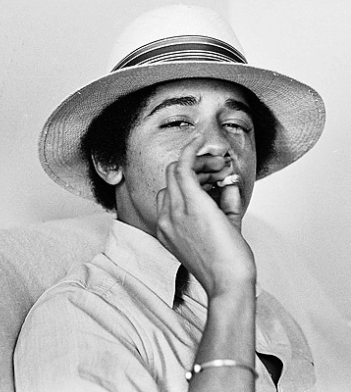
ScreenHunter_09 Mar. 29 19.08 The problem for Mr. Obama is that marijuana reform was at or near the top of the list of all questions in three major categories: budget, health care reform, green jobs and energy. Our leader doesn't seem to understand that millions of his interlocutor-constituents are actually quite serious about the issue.

Which is not to say that drugs, particularly pot, doesn't offer up a rich if predictable vein of humor. Cheech and Chong's vintage “Dave's not here!” routine is still a side-splitter. As Larry the Cable Guy would say, “I don't care who you are, that's funny right there.”

But there's nothing comical about tens of millions of Americans being busted, frightened out of their wits, losing their jobs, their student loans, their public housing, their families, their freedom…

And show me the humor in a dying cancer patient who's denied legal access to a drug known to relieve pain and suffering.

More here. And here are Bill Maher, Mos Def, Salman Rushdie, and Christopher Hitchens talking about the same thing: