To Fight Stigmas, Start With Treatment

From New York Times:

Mind-190 Last fall, British television broadcast a reality program called “How Mad Are You?” The plot was simple: 10 volunteers lived together for a week in a castle in the Kent countryside and took part in a series of challenges. The twist was the lack of a prize. Five of the volunteers had a history of a serious mental illness, like obsessive compulsive disorder and bipolar disorder, and five did not. The challenges, meant to elicit latent symptoms, included mucking out a cowshed, performing stand-up comedy and taking psychological tests.

But the real test came at the end of the week.

Could a panel of experts — a psychiatrist, psychologist and a psychiatric nurse — tell them apart? They could not. After watching hours of videotape, the experts correctly identified only two of the five people with a history of mental illness. And they misidentified two of the healthy people as having a mental illness. The point was made: even trained professionals cannot reliably determine mental illness by appearances alone.

More here.
Monday, April 20, 2009

Sunday, April 19, 2009

Eve Kosofsky Sedgwick, 1950-2009

15eve190 Eve Sedgwick died a week ago. The obituary in the NYT:

Ms. Sedgwick broke new ground when, drawing on feminist scholarship and the work of the French poststructuralist Michel Foucault, she began teasing out the hidden socio-sexual subplots in writers like Charles Dickens and Henry James. In a 1983 essay on Dickens’s novel “Our Mutual Friend,” she drew attention to the homoerotic element in the obsessive relationship between Eugene Wrayburn and Bradley Headstone, rivals for the love of Lizzie Hexam but emotionally most fully engaged when facing off against each other.

Several of her essays became lightning rods for critics of poststructuralism, multiculturalism and gay studies — most notoriously “Jane Austen and the Masturbating Girl,” a paper delivered at the annual meeting of the Modern Language Association in 1989. In it, Ms. Sedgwick argued that Austen’s descriptions of the restless Marianne Dashwood in “Sense and Sensibility” should be understood in relation to contemporary thought on the evils of “self-abuse.”

Such subtexts, she insisted, are woven throughout literary texts, and the job of criticism is to ferret them out, especially the repressed themes of same-sex love.

“It’s about trying to understand different kinds of sexual desire and how the culture defines them,” she told The New York Times in 1998, explaining the function of queer theory. “It’s about how you can’t understand relations between men and women unless you understand the relationship between people of the same gender, including the possibility of a sexual relationship between them.”

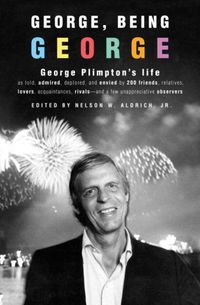
A Book About My Father: George, Being George

Taylor Plimpton in The Rumpus:

51epuugfeyl2 Because it was about him, he probably would have been appalled. (My father preferred being the storyteller, not the story-told, and the very thought of a book like this being done about him most likely would have made him cringe). After all, for a public, extraordinarily social figure, he was a difficult man to know in any sort of intimate detail, and I think he preferred it that way. The self-deprecation and humor, the Scotch, the old New England manners, all of this kept even (and perhaps especially) those closest to him at a safe distance. When one of his old friends and neighbors admits, “There’s a lot I didn’t know about George, and for all of his gregariousness, he was a very private person,” he is not alone in thinking so. He was a mystery, a contradiction even (and perhaps especially) to those who knew him best. I am his son, and reading this book reminds me that I hardly knew him at all.

And so it is this hidden side of him the book attempts to reveal. George, Being George has little to say about his public exploits. His years of participatory journalism—pitching to the All-Star line-up at Yankee Stadium, quarterbacking for the Detroit Lions, boxing Archie Moore, playing goalie for the Bruins—all of these amazing feats are glazed over in this 378-page book in about 25 pages. I was shocked.

More here.

A Plan for the Improvement of English Spelling

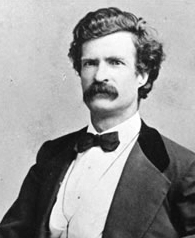
Mark Twain at a website of the California Institute of Technology:

ScreenHunter_04 Apr. 19 17.12 For example, in Year 1 that useless letter “c” would be dropped to be replased either by “k” or “s”, and likewise “x” would no longer be part of the alphabet. The only kase in which “c” would be retained would be the “ch” formation, which will be dealt with later. Year 2 might reform “w” spelling, so that “which” and “one” would take the same konsonant, wile Year 3 might well abolish “y” replasing it with “i” and Iear 4 might fiks the “g/j” anomali wonse and for all. Jenerally, then, the improvement would kontinue iear bai iear with Iear 5 doing awai with useless double konsonants, and Iears 6-12 or so modifaiing vowlz and the rimeining voist and unvoist konsonants. Bai Iear 15 or sou, it wud fainali bi posibl tu meik ius ov thi ridandant letez “c”, “y” and “x” — bai now jast a memori in the maindz ov ould doderez — tu riplais “ch”, “sh”, and “th” rispektivli. Fainali, xen, aafte sam 20 iers ov orxogrefkl riform, wi wud hev a lojikl, kohirnt speling in ius xrewawt xe Ingliy-spiking werld.

Has Turkey been transformed by seven years of Islamic government?

Suzy Hansen in The National:

ScreenHunter_03 Apr. 19 17.02 In the West, telescopic conversations about Turkey usually boil down to one simple underlying anxiety: Is Turkey, the secular star of the Muslim world, becoming more religious? Are the Islamic capitalists of the AKP steering it away from Europe and toward the Middle East? Moments of tension in the Turkish-US alliance – the denial of basing rights for the Iraq war, Erdogan’s Davos donnybrook with Shimon Peres, Turkish coziness with Syria and Hamas – have led Turkey’s “western friends”, as Erdogan calls them, to nervous scrutiny of the shifting mores of Turkish society.

Secularists and outsiders used to fret over what it would mean if an Islamic party came to power. Would they ban alcohol, liberate the headscarf, reject their western allies? The place to gauge the transformation, however, is not in parliament but on the street – in the mahalle.

As in most nearly democratic societies, social transformation happens at the street level, and slowly. It’s not that national politics don’t matter – a giant win for the AKP could lead to the election of a conservative mayor in your neighbourhood, simply because his ties to the party will convince voters he has the access to get things done. In Turkey, and concerning questions of lifestyle, it’s important to fix attention at the local level rather than leaving everything at the feet of a prime minister who must answer to generals, EU officials and the United States. It’s not Erdogan, after all, but your mayor who might ban alcohol at your local municipality cafe.

And yet, after seven years of AKP domination, the question remains: what has the era of Islamic rule meant for everyday life in Turkey?

More here.

Satyajit Ray’s World of Restless Watchfulness and Nuance

From The New York Times:

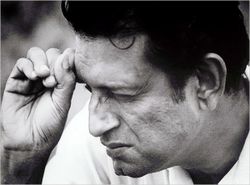
Rayslide1 “I find I am inimical to the idea of making two similar films in succession,” wrote the great Indian director Satyajit Ray in 1966, and in this, as in everything he wrote or filmed, he spoke the truth. At that point, 11 years after the premiere of his first movie, “Pather Panchali,” he had written and directed 13 features, all of which will be on view at the Walter Reade Theater starting Wednesday, along with seven from the next decade of his career. The films are at least as various as his statement suggests, and you’re not likely to worry, as Ray did in 1966, whether their diversity indicates “a restlessness of mind, an indecision, a lack of direction resulting in a blurring of outlook — or if there is an underlying something which binds my disparate works together.”

Restless, yes. Blurry, never. And the “underlying something,” which is simply his bottomless curiosity about how people negotiate the most urgent demands of nature and culture, is impossible to mistake, no matter what kind of Satyajit Ray movie you’re watching.

More here. (Note: “First Light: Satyajit Ray From the Apu Trilogy to the Calcutta Trilogy” runs through April 30 at the Walter Reade Theater, Lincoln Center; (212) 875-5600, filmlinc.com.)

Sunday Poem

Poverty
Pablo Neruda

Ah you don’t want to,
you’re scared
of poverty,
you don’t want
to go to the market with worn-out shoes
and come back with the same old dress.

My love, we are not fond,
as the rich would like us to be,
of misery. We
shall extract it like an evil tooth
that up to now has bitten the heart of man.

But I don’t want
you to fear it.
If through my fault it comes to your dwelling,
if poverty drives away
your golden shoes,
let it not drive away your laughter which is my life’s bread.
If you can’t pay the rent
go off to work with a proud step,
and remember, my love, that I am watching you
and together we are the greatest wealth
that was ever gathered upon the earth.

translation: Donald D. Walsh
from: The Captain’s Verses (Los versos del Capitán),
New Directions Publishing, 1972


La Pobreza

Ay no quieres
te asusta
la pobreza,
no quieres
ir con zapatos rotos al mercado
y volver con el viejo vestido.

Amor, no amamos,
como quieren los ricos,
la miseria. Nosotros
la exterparemos como diente maligno
que hasta ahora ha mordido el corazón del hombre.

Pero no quiero
que la temas.
Si llega por mi culpa a tu morada,
si la pobreza expulsa
tus zapatos dorados,
que no expulse tu risa que es el pan de mi vida.
Si no peudes pagar el alquiler
sal al trabajo con paso orgulloso,
y piensa, amor, que yo te estoy mirando
y somos juntos la mayor riqueza
que jamás se reunió sobre la tierra.

A passage to Canada

From The Guardian:

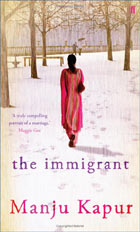
The-Immigrant-by-Manju-Ka-002 Manju Kapur has a non-commonplace gift for writing about commonplace people without exaggerating their dullness for effect or falling into dullness herself. Flaubert is often supposed to be the master of this vein, but just as I find Middlemarch a far subtler, wider-ranging novel than Madame Bovary, I wonder if women aren't usually better at it than men, being perhaps better trained in showing patience with people's limitations. A middling kind of person is likely to belong to the middle classes, so in such a novel we forgo the glamour of the very rich and the very poor to muddle along with dentists and librarians. As most people live lives they believe to be ordinary, so the India and the Indians we meet in The Immigrant are not perceived as, and are not, exotic. Some of Kapur's finest comic moments (mild, bittersweet, like a good vermouth) involve culture-bound westerners: the virtuous horror that can't accept the routine nature of arranged marriage, even that of the couple you're talking to …

The couple are Nina, a college teacher of 30 in India, and Ananda, who has moved to Canada to get his degree and practise dentistry. Wanting a wife, he finds it easier to have his Indian family provide one than to find a Canadian one on his own. He brings Nina back and settles her down in Halifax – where he too, for years, had to face the awful loneliness of the recent immigrant. But he doesn't worry about Nina being bored or lonely. After all, she has him.

More here.

Saturday, April 18, 2009

Bootylicious: The Love Affair with Pirates

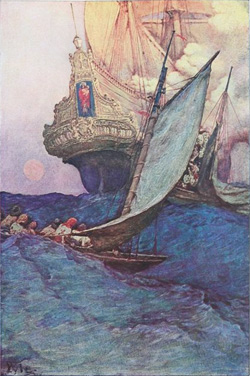
ID_IC_MEIS_PIRATE_AP_001 Morgan on the fascination with pirates, in The Smart Set:

The new Somali pirates exist for two simple reasons. One, Somalia is a desperate failed state. Two, it lies, rather conveniently, at the cusp of one of the world's most important international shipping lanes. Voila! — the new pirates. The logic hasn't changed a bit since the Golden Age. The only thing that's shifted are the players. The now stable and rich states of the West want stable shipping corridors. But the local residents of Puntland take a less sophisticated view, having never been to the Great Outlet Malls on the Western horizon in order to sample the fruits of said international shipping lanes. That's the politics of it, the straight-up socioeconomics.

There is another aspect to our fascination with pirates. It is existential rather than political. It is about civilization and its limits, about our need for a sense of home versus a need to break those boundaries altogether. The sea has always played a big role in that dialectic. The sea is, potentially, an avenue for intercommunication and exchange among men. It is, in short, a vast shipping lane. But it is also an outer boundary. The land stops at the sea. The city stops at the sea. We human beings have conquered this earth, mostly and swiftly, but the sea is still unnatural territory for us, we aren't as sure on its surfaces as we are on those harder surfaces more suited to bipeds.

The pirate takes that insecurity and runs with it. Indeed, the word pirate can ultimately be traced back to the ancient Greek word “peira,” which means trial, attempt, experiment. To have peira, to posses peira, is to have gone through an experience. If I try something, I get to know it. In fact, it is out of the collecting of peira that a person constructs the greater web of experience (ex-peira) that makes one person, one person, and another, another.

The pirate is, quite literally, taking a chance. In doing so, pirates reenact the basic process that everyone goes through in becoming a person.

A Greek gentleman in a straw hat, standing absolutely motionless at a slight angle to the universe

Longenbach-190

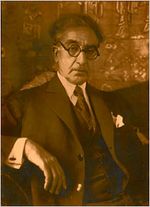
In Cavafy’s world, everything has already happened. The fortune is spent, the pantheon abandoned, the body grown old. This overpowering sense of belatedness is what provokes the tone of his poems — rueful, distanced, knowing but never wise. Mendelsohn maintains that, given the translatability of Cavafy’s tone, he has focused his attention on “other aspects of the poetry” — the exquisite care Cavafy took with diction, syntax, meter and rhyme. But in fact this is not exactly the case. It is only through attention to these minute aspects of poetic language that tone is produced. And Mendelsohn is assiduously attentive. Earlier translators have, to varying degrees, rightly emphasized the prosaic flatness of Cavafy’s language; the flatness is crucial to the emotional power of the poems, since it prevents their irony from seeming caustic, their longing from seeming nostalgic. But as Mendelsohn shows, Cavafy’s language was in subtle ways more artificial than we’ve understood. Most important, Cavafy mingled high and low diction, employing both vernacular Greek and a literary Greek invented at the turn of the 19th century.

more from the NY Times here.

Saturday Poem

For all the Wet Green Girls
Lew Welch

I found myself, green girls, in a month like May579[1]
in a green green garden at the break of day

all around me gray rain beat
and the cage that I am was an empty zoo

In a garden, girls, at a break like May
in the first wet light of the sun

when, from a rock in the arbor leapt
a sleeping cat, through

gray green cages of deserted zoo
where I found myself on a breaking day

as bright rain beat upon the garden stone
where the leapt cat left his belly print

alone, young girls, when my head unbent
in a green green garden at the break of day

and I saw what came
and I watched what went

Green Girls

from; Ring of Bone, Collected Poems 1950-1971;
Grey Fox Press

Physicians’ Tales

Sandeep Jauhar in The New York Times:

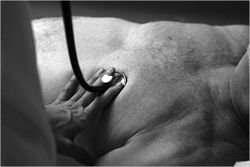
Jauhar-600 “A story like the one I’ve been telling you is unimaginable nowadays,” a physician proclaims in “The Soul of Medicine,” Sherwin Nuland’s new collection of medical tales. The stories — modeled on “The Canterbury Tales” — are intended to “describe that sacrosanct connection between two people that we call the doctor-patient relationship,” Nuland writes. Indeed, the tales, narrated by physicians recalling their most memorable patients, evoke a bygone era in medicine, though one that is thankfully over.

In “The Surgeon’s Second Tale,” a young man is whisked to the operating room to have a ruptured spleen removed on the basis of a history and physical exam — unthinkable nowadays, when a patient with a simple headache cannot get out of the emergency room without a CAT scan of the brain (though the diagnosis was correct). Another surgeon performs a radical mastectomy on a young woman who believes she is getting only a breast biopsy and a simple vaginal procedure, without even waking her up from anesthesia to tell her that the biopsy indicates cancer. Four hours later, the entire breast and mass of contiguous tissue have been removed. “There’s something we have to talk about,” the surgeon tells her at the bedside.

More here.

Closer Look at Einstein’s Brain

From Science:

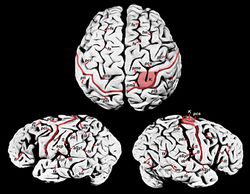
Brain When a rare genius like Albert Einstein comes along, scientists naturally wonder if he had something special between his ears. The latest study of Einstein's brain concludes that certain parts of it were indeed very unusual and might explain how he was able to go where no physicist had gone before when he devised the theory of relativity and other groundbreaking insights. The findings also suggest that Einstein's famed love of music was reflected in the anatomy of his brain.

When Einstein died in 1955 at Princeton Hospital in New Jersey, his brain was removed by a local pathologist named Thomas Harvey, who preserved, photographed, and measured it. A colleague of Harvey's cut most of the brain into 240 blocks and mounted them on microscope slides. From time to time, he sent the slides to various researchers, although few publications resulted. Harvey, who moved around the United States several times in the course of his career, kept the jar containing what remained of the brain in cardboard box. Finally, in 1998, Harvey–who died in 2007–gave the jar to the University Medical Center of Princeton, where it remains today.

More here.

Israel stands ready to bomb Iran’s nuclear sites

Sheera Frenkel in The Times of London:

Bushehr-nuclear-pow_492929a The Israeli military is preparing itself to launch a massive aerial assault on Iran's nuclear facilities within days of being given the go-ahead by its new government.

Among the steps taken to ready Israeli forces for what would be a risky raid requiring pinpoint aerial strikes are the acquisition of three Airborne Warning and Control (AWAC) aircraft and regional missions to simulate the attack.

Two nationwide civil defence drills will help to prepare the public for the retaliation that Israel could face.

“Israel wants to know that if its forces were given the green light they could strike at Iran in a matter of days, even hours. They are making preparations on every level for this eventuality. The message to Iran is that the threat is not just words,” one senior defence official told The Times.

Officials believe that Israel could be required to hit more than a dozen targets, including moving convoys. The sites include Natanz, where thousands of centrifuges produce enriched uranium; Esfahan, where 250 tonnes of gas is stored in tunnels; and Arak, where a heavy water reactor produces plutonium.

The distance from Israel to at least one of the sites is more than 870 miles, a distance that the Israeli force practised covering in a training exercise last year that involved F15 and F16 jets, helicopters and refuelling tankers.

More here.

Dr. Varmus Goes to Washington

Robert Cook-Deegan in American Scientist:

ScreenHunter_02 Apr. 18 08.46 Harold Varmus’s new book, The Art and Politics of Science, is a timely memoir of a remarkable career. It hits the stores just as that career is taking a new turn: Varmus will be one of the foremost scientific advisers to the Obama administration.

In this memoir, Varmus traces the trajectory of his career, outlining events in roughly chronological order. He moves rapidly over his early life, touching on his childhood in New York City, his undergraduate years at Amherst, his graduate studies in English literature at Harvard and his training at Columbia University’s College of Physicians and Surgeons. Armed with a medical degree but drawn to science, he did research in the U.S. Public Health Service at the National Institutes of Health (NIH) as an alternative to military service during the Vietnam War (the “yellow beret” era, which was a golden age for NIH research).

Then in 1970 he took a scientific faculty position at the University of California at San Francisco, where researchers such as J. Michael Bishop and Herbert Boyer were doing groundbreaking research in molecular biology. Varmus entered into a long and conspicuously productive collaboration with Bishop, studying the molecular biology of cancer genes. The two men became famous and influential, primarily because they discovered cellular genes that could cause cancer when mutated and hijacked by RNA viruses. To those in the field, their laboratory was a formidable competitive force, filled with talented graduate students and postdocs attracted by hot science.

More here.