
Huang Li,
Category: Recommended Reading
Sunday, April 26, 2009
Jazz Standards That Aren’t: On the Debut of Secret Society’s New Album Infernal Machines

Each generation tries its hand at grafting new styles onto jazz, with varying results—note Gil Evans's not-always successful use of Jimi Hendrix's music—but lately there have been some hip moves in this direction. On the small-ensemble front, Jason Moran has turned the hip-hop anthem “Planet Rock” inside out on piano, while the Bad Plus have proved they can work up a fever interpreting, by turns, the music of Nirvana and Stravinsky. But often as not, the thrills given off by these mash-ups are those of reinvention, as opposed to sui generis invention itself.
For a wholly original take on big band's past, present and future, look to Darcy James Argue, a 33-year-old Brooklynite who has composed a batch of manifestoes that draws on past legacies, and adds a little postpunk energy to boot. A onetime student of big-band visionary Bob Brookmeyer, Argue himself seems a natural product of an era in which genres can be shuffled with ease on iPod playlists. Talking with him, you go from discussing obscure Italian serialist composers to indie bands like TV on the Radio. The composer calls his music “steampunk big band,” a reference to the niche art movement that fantasizes about modern tech innovations existing in the steam-powered era. That range is reflected—and, more important, is made frictionless—on Argue's debut record, “Infernal Machines.” Argue's tunes can command your attention anywhere—no small feat in our media-saturated world. He and his 18-piece Secret Society band pull off the trick by pairing electro-influenced rhythms with fuzzed-out guitars, fearsome horns and chamber-music voicings in the woodwinds. For all this panstylistic erudition, though, Argue's music still swings hard whenever it wants. “Transit” explodes with an elaborate fire that recalls Mingus's “Let My Children Hear Music.” The song “Jacobin Club,” named after Robespierre's merry band, slinks with the sly wit of “Such Sweet Thunder”–era Ellington, proving Argue is no enemy of history. Listen on headphones, and you can hear a lot of rocklike production layering. Two thirds through “Habeas Corpus (for Maher Arar)”— a civil-rights ode that's timely in light of the Obama administration's release of Bush-era “torture memos”—the production supports its trombones, stabbing like sirens, with a guitar that chugs ominously low in the mix.
It’s Better to Have Rich Parents Than to be Educated, in the US
Via Andrew Sullivan, Ryan Avent points to a remarkable finding in some recent research on education and economic well-being:
The truly amazing thing to me is that parental income isn't just crucial in getting to college, and getting through college — its effects linger on, basically, in perpetuity. One of the most remarkable findings from the Pew Charitable Trusts' Economic Mobility Project is that a child from a family in the top income quintile who does not get a college degree is more likely to wind up in the top income quintile himself than a child from a family in the bottom income quintile who does get a college degree.

‘How to Win a Cosmic War’ by Reza Aslan
From The Los Angeles Times:
Reza Aslan's “How to Win a Cosmic War” recognizes the struggle between Global Jihadism and the war on terror as an insolubly infinite one. He proposes, instead, that we'd be better off if we replaced the rhetoric of the absolute obligation, which characterizes movements, with the campaign's rhetoric of the finite aim. “It is time,” Aslan writes in his introduction, “to strip this ideological conflict of its religious connotations, to reject the religiously polarizing rhetoric of our leaders and theirs, to focus on the material matters at stake, and to address the earthly issues that always lie behind the cosmic impulse.” Aslan goes on to devote much of his book to distinguishing the earthly grievances of Islamists from the cosmic grievances of Global Jihadists, and to detailing how the former are pressed into service of the latter. Islamists, like Hezbollah in Lebanon and the Muslim Brotherhood in Egypt, are “religious nationalists”; they seek specific domestic redress, through Islamic political parties, of political and economic deprivation. Global Jihadists, like Al Qaeda, are “religious trans-nationalists.” They plait together stories of specific injustice — Israeli oppression of the Palestinians, the corruption of decades of secular Egyptian and Saudi leaders, the dispossession of Muslim minorities in Europe — into a “master narrative” of universal Muslim humiliation. They are purists; they prefer the unspecific glory of the struggle to the disheveling imperatives of regency. For nationalists who despise some foreign patriotism, war is the health of the state. For religious trans-nationalists who despise all infidels, jihad is the bloom of the believers.
Aslan is not only a perspicuous, thoughtful interpreter of the Muslim world but also a subtle psychologist of the call to jihad. This book's achievement is less its big point (rather obvious and repetitively made) about the impossible nature of “cosmic war” than its smaller understanding of how, for example, a well-assimilated second-generation European Muslim might blow himself up on a bus; its finest chapter describes the sort of conversion process that allows a Leeds youth like Hasib Hussain to become one of England's 7/7 bombers. Aslan makes a convincing case for jihadism as a quasi-religious variant of militant romanticism: a young man like Hussain comes to look like a disenfranchised Werther with a rudimentary global consciousness.
More here.
The worst thing for the world economy would be to assume the worst is over

Add all this up and the case for optimism fades quickly. The worst is over only in the narrowest sense that the pace of global decline has peaked. Thanks to massive—and unsustainable—fiscal and monetary transfusions, output will eventually stabilise. But in many ways, darker days lie ahead. Despite the scale of the slump, no conventional recovery is in sight. Growth, when it comes, will be too feeble to stop unemployment rising and idle capacity swelling. And for years most of the world’s economies will depend on their governments. Consider what that means. Much of the rich world will see jobless rates that reach double-digits, and then stay there. Deflation—a devastating disease in debt-laden economies—could set in as record economic slack pushes down prices and wages, particularly since headline inflation has already plunged thanks to sinking fuel costs. Public debt will soar because of weak growth, prolonged stimulus spending and the growing costs of cleaning up the financial mess. The OECD’s member countries began the crisis with debt stocks, on average, at 75% of GDP; by 2010 they will reach 100%. One analysis suggests persistent weakness could push the biggest economies’ debt ratios to 140% by 2014. Continuing joblessness, years of weak investment and higher public-debt burdens, in turn, will dent economies’ underlying potential. Although there is no sign that the world economy will return to its trend rate of growth any time soon, it is already clear that this speed limit will be lower than before the crisis hit.
more from The Economist here.
More American Workers Outsourcing Own Jobs Overseas
coral crotcheting with math
Sunday Poem
Step Out…
Lew Welch…

Step out onto the planet.
Draw a circle a hundred feet round.
Inside the circle are
300 things nobody understands, and, maybe
nobody’s ever really seen.
How many can you find?
from: Ring of Bone; Grey Fox Press, 1960
Sunday Iqbal Bano Special
Iqbal Bano, who died a few days ago, was one of Pakistan's most famous and beloved singers. She was expecially known for ghazal singing, and in particular for singing the ghazals of Pakistan's most famous and beloved poet, Faiz Ahmed Faiz. Thanks to my sister, Atiya, I had the privilege of meeting her after a concert once in New York City, and she was as imperious and gracious as I had imagined she would be.
UPDATE 4/27/09: There's a very informative post about Iqbal Bano by Fawad Zakaria here.
Here I have chosen a few videos of her, beginning and ending with poems by Faiz:
Searching for My Pakistani Identity
From Broken Mystic:
It started off funny. I was at the mall buying a birthday gift for a friend of mine and, as usual, the store manager was friendly and conversational. After she took a good look at my gift, the following conversation took place:
MANAGER: Aww, is this for your girlfriend?
ME: She’s not my girlfriend.
MANAGER: That’s an awful lot of money for just a friend.
ME: (smiles) Well, maybe you can lower the price for me.
She laughed as she scanned the item through. Another customer approached the counter and waited patiently. She decided to chime in:
CUSTOMER: Ooh, you’re buying gifts!
ME: (smiles) Yeah, it’s for my friend’s birthday.
CUSTOMER: Aww, that’s so romantic, your girlfriend is going to Love it.
ME: She’s not my girlfriend.
CUSTOMER: Hmm, maybe she’s a special friend!
I laughed at how both of them were teasing me while I waited for the manager to package the gift. The manager was really helpful that day, so I asked her if there was a number I could call to give her an “outstanding” customer service rating. She showed me the number on the receipt and thanked me for asking. As the manager wrote her name on the receipt, the customer waiting in line caught me off guard with an unexpected question:
“What country are you from?”
For some reason, the question struck me in an odd way, as if it triggered an alarm in my head and sprung forth countless things I’ve been ruminating about over the past few weeks. It wasn’t a new question at all. I have brown skin; it’s easy to notice, so I understood. People ask me where I’m from all the time, but it was different now. Almost immediately, I thought about the current crisis in Pakistan, I thought about the corrupt Pakistani president Asif Zardari, I thought about the Taliban taking control of Swat Valley – a beautiful place that I visited once – and I thought about the U.S. drone attacks in Pakistan and my sheer frustration with Obama’s foreign policy. Even though it only took me about two seconds to respond, I still had more thoughts and feelings swell inside me. I feared that disclosing my nationality would disrupt the friendly interaction I had with the manager and customer. I worried that their response would be offensive or ignorant and that I would go home feeling like an “outsider.” It was too late for that. And it wasn’t their fault.
“Pakistan,” I said slowly with an unfamiliar discomfort in my voice.
More here.
Jared Diamond: The Evolution of Religions
In Defense of Common English
Ben Yagoda in the Chronicle of Higher Education:
Not long ago, I took part in a panel discussion at the Free Library of Philadelphia. My fellow panelists were two linguists and a lexicographer. Anyone who knows any linguists and lexicographers will be unsurprised to hear that their position on usage was descriptive rather than prescriptive: They were interested in charting and interpreting recent and historical changes in the way English is written and spoken, not interested in labeling those changes as “mistakes,” and even less interested in decrying such so-called errors as evidence of a decline in American civilization.
At the end of our conversation, there was time for questions from the sizable audience. The first questioner stood up and said (I paraphrase), “It always drives me crazy when people use 'impact' as a verb. How can we abolish that?”
The panelists hemmed and hawed, murmuring sweet nothings like “the language changes” and “functional shifting.”
More here.
Saturday, April 25, 2009
Twice-Sold Tales
William Cannon in American Scientist:
THE BEST AMERICAN SCIENCE AND NATURE WRITING 2008. Edited by Jerome Groopman. Series editor, Tim Folger. xx + 330 pp. Houghton Mifflin, 2008. $14 paper.
THE BEST AMERICAN SCIENCE WRITING 2008. Edited by Sylvia Nasar. Series editor, Jesse Cohen. xvi + 316 pp. Harper Perennial, 2008. $14.95 paper.
THE OXFORD BOOK OF MODERN SCIENCE WRITING. Edited by Richard Dawkins. xviii + 419 pp. Oxford University Press, 2008. $34.95.
People unlucky enough to have been born with the rare genetic disorder Lesch-Nyhan syndrome (nearly all are male) live in fear of attacking themselves uncontrollably with their own hands and teeth. Gifted science journalist Richard Preston gives voice to their otherwise silent suffering in “An Error in the Code,” an article from The New Yorker that is included in The Best American Science Writing 2008. Preston introduces us to two Lesch-Nyhan patients he has befriended who have bitten off their lips, chewed their fingers to the bone and attempted to rip off their noses. I was so riveted by the details of their stories that I was barely aware that I was learning science as I read.
I was less enthralled by the rest of this anthology. Its editor, Sylvia Nasar (the author of A Beautiful Mind), teaches journalism at Columbia and was once an economics correspondent for the New York Times. So it should perhaps come as no surprise that in this collection of articles from 2007 she focuses on “what was in the news and on people’s minds” that year (health and the environment, she says, not math and physics). Many of the articles concern medicine, health policy and the shenanigans of the pharmaceutical industry. The reporting is first-rate and powerfully documented. But by and large, storytelling like Preston’s is difficult to find in these pages.
Not so for The Best American Science and Nature Writing 2008, edited by Jerome Groopman. Groopman’s collection is more eclectic than Nasar’s and is a far better book.
More here. [I have Dawkins' book and it is indeed a brilliant collection.]
Obama Girl + Obama
About-Face
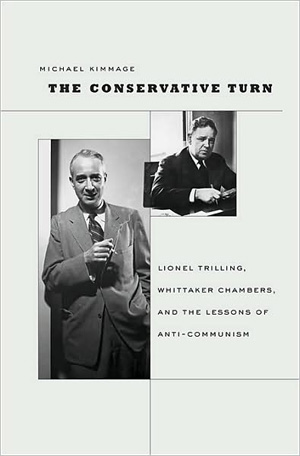
There is no shortage of books about the New York intellectuals—the mostly Jewish circle of writers clustered around Partisan Review—and their ideological schisms. But Kimmage offers a new perspective on this familiar story by focusing on an unlikely pair of protagonists. Lionel Trilling and Whittaker Chambers could not have been more different in terms of personality and background. Trilling, the child of Eastern European Jewish immigrants, was a quintessential New Yorker, who spent his whole career at Columbia University; Chambers, a WASP from Long Island, came to see New York as a symbol of America’s decadence, preferring to live on a remote farm in Maryland. Trilling wrote magisterial literary essays for Partisan Review; Chambers wrote blunt polemical articles for Time Magazine. Most important, Trilling was a reserved, professorial figure, while Chambers was a man of action, a Communist spy turned anti-Communist prophet who figured in one of the most scandalous trials of the century.
Yet The Conservative Turn shows that, from the time they met as classmates at Columbia in the 1920s, Trilling and Chambers followed similar intellectual courses. In the early 1930s, with America sunk in the Depression and fascism on the march in Europe, they were among the many American leftists who turned to the Soviet Union for inspiration. The appeal of Communism was especially strong to American Jews, who saw in Russia’s “great experiment” the promise of a world without poverty, injustice, or prejudice, including anti-Semitism. Hadn’t Lincoln Steffens, the crusading liberal journalist, visited the Soviet Union and proclaimed, “I have the seen the future and it works”?
For Trilling, becoming a fellow traveler was primarily an intellectual commitment, not a practical one. He did nothing more to advance the revolution than joining a Communist front organization, the National Committee for the Defense of Political Prisoners, and writing some pro-Soviet book reviews. Chambers was much more deeply involved in the Communist cause. After joining the Party, he became a secret agent for the Kremlin, helping to organize a spy ring among mid-level New Deal bureaucrats in Washington D.C. He even tried to recruit Lionel and Diana Trilling, asking if they would help him by acting as a “drop” for secret messages. They declined, not wanting to follow Chambers so far into the realm of espionage.
But in the mid-1930s, both Trilling and Chambers underwent a crisis of conscience about Communism.
thames & hudson

During the late Thirties, some of Britain’s most distinguished architects, artists, musicians, film-makers and others, many of them Jewish, arrived on our shores with their meagre belongings having escaped from the Nazi threat in continental Europe. Many of them made their homes here and went on to leave a lasting mark on our intellectual and cultural life. Britain reaped a rich reward for its tolerance. These émigrés later helped to create the Glyndebourne and the Edinburgh Festivals, the magazine Picture Post and the Royal Festival Hall. Sir Ernst Gombrich, author of the classic The Story of Art, was director of the Warburg Institute of the University of London; Sir Nikolaus Pevsner systematically documented the significant buildings of England, and the philosopher Sir Karl Popper, the historian Eric Hobsbawm and many others became important figures in our cultural landscape. Among them were two refugees from Vienna, Walter Neurath and Eva Feuchtwang. Walter had fled with his wife Marianne to London in 1938 and Eva had come later that year with her second husband, Wilhelm, fleeing Berlin on the last train out, just hours before the Gestapo came to pick them up.
more from the London Times here.
duke elric
Maybe it’s the books we read when we’re young that stick with us the longest. That’s the time when books not only excite us, but seem to tell us about ourselves and our futures. As a teenager I read (wallowed in and feasted upon, really) Tolkien, Evelyn Waugh, Emily Brontë, Jane Austen, “Great Expectations” and “David Copperfield,” “Crime and Punishment,” “The Great Gatsby,” P.G. Wodehouse and Kafka. A predictably unstructured and non-academic bag, I guess. I also read, with mounting glee, and seized from different corners of the bookstore when my mother wasn’t watching, the paperbacks of Michael Moorcock, especially those concerning the doomed prince Elric. I didn’t even know, back then, that Moorcock was already becoming one of the greatest British fantasy writers, the heir to Mervyn Peake, nor that his “Elric” books belonged to the “sword and sorcery” genre; and only later, as sword and sorcery swept like a virus through movies and games and into the digital universal, did I understand that I’d read works whose influence would prove to be immense — strange and exhilarating stories from someone at the top of his game. Moorcock is a master, and though he’s written more carefully, and more beautifully, and with much more high-minded purpose (in “Gloriana” and “Mother London” for instance, or the dazzling quartet of books concerning the dandy Jerry Cornelius), he’s never quite slammed home runs as outrageous as these.
more from the LA Times here.
the verse of Sherod Santos makes Logan want to put his hand into the whirring blade of a lawn mower
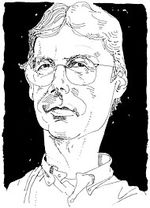
“Our Savage Art,” the latest installment in William Logan’s prolonged and rumbustious assault on the state of American poetry, comes furnished with no fewer than nine epigraphs in which the phrase “savage art” appears. One of these is taken from the second chapter of James Fenimore Cooper’s “Last of the Mohicans”: an unsuspecting party of white travelers, including a pair of sisters, is passing through a gloomy forest unaware that they are being secretly observed by “a human visage, as fiercely wild as savage art and unbridled passions could make it.” “A gleam of exultation,” Cooper continues, “shot across the darkly painted lineaments of the inhabitant of the forest, as he traced the route of his intended victims, who rode unconsciously onward.” One can’t help imagining Logan ripping open a freshly arrived Jiffy-Bag of review copies of slim volumes with a similar kind of exultant gleam shooting across his lineaments; and certainly many a poet over the last few decades must have felt a bit like one of Cooper’s hapless heroines, tied to the stake, war whoops in the ears, a blurred, scalp-hungry tomahawk glinting in the sun, as they absorbed the bad news about their latest collection in one of the hilariously damning New Criterion verse chronicles in which the savage critic biannually vents his spleen.
more from the NY Times here.
Cambodia Targets Opposition MP

An email from Mu Sochua:
Between 1975-79 over 1 million Cambodian women, men and children, were killed by the Khmer Rouges, among them my parents. The world community knew about it but watched from afar. Cambodia has come out of genocide and on the road to reconstruction but this stage of reconstruction is stuck and in many ways fast falling back to point zero.30 years after the genocide of the Khmer Rouge, Cambodia has made some progress but too small. Over 2,000 innocent Cambodian women die every year of childbirth, at least one million Cambodian children go to bed hungry every night, hundreds of thousands Cambodian children and female youth are ruined in brothels, over 200,000 families have been brutally forced of their land and homes, and over 75% of Cámbodia's forests have now been destroyed. Innocent lives of my people could be saved if justice were served, if top leaders of my broken nation were less greedy, if development were meant for all.
INSIDE THE TALIBAN’S ‘GRAVE ERROR’
From MSNBC:
“The Taliban finally made a grave error,” said Javed Siddiq, editor of the influential Urdu language daily Nawa-e-Waqt. “Once they challenged Pakistan’s constitution as un-Islamic, Islamic scholars and the Pakistani people no longer saw them as the self-styled defenders of Islam against western infidels – but infidels themselves who want to dismantle the Pakistani state.” Siddiq said that challenging the constitution was a wrong step and believes it has backfired. Pakistan’s constitution was carefully forged by a board of Islamic scholars in 1973 – every tenet was crafted to make sure it conformed to the principals of Islam. “Now, all the different sects of the Sunni and Shiite, the religious scholars, the army, the politicians and every Pakistani is against the Taliban,” Siddiq said. “They have lost.” The Taliban were quick to sense their blunder and the resulting sea change in the country. “The expansion into Buner was the turning point,” said Siddiq.
‘No ordinary Taliban commander’
It was soon after the Taliban signed the February peace agreement with the Pakistani government that Commander Fateh began to plan the militants’ move into Buner. “I saw Swat as an opening for us,” Fateh told NBC News in a recent interview. “I knew if I planned well, we would be able to advance little by little, hopefully in a peaceful way, and gradually enforce Islam in the valley.” Fateh, a 33-year-old native of Swat, rose up through the ranks of Taliban fighters after almost 15 years of fighting in Afghanistan. The somber-looking commander, who is married with three sons, is considered to be an accomplished military strategist, often brilliant in battle, according to Taliban commanders in the region. With the bearing of a de-facto prince exacting homage from his subjects, Fateh, whose name means victorious in Urdu, rode into Buner last Monday in the back seat of a black Toyota pick-up truck. Taliban fighters flanked his vehicle and brandished Kalashnikovs at the throngs of locals who had come out to catch a glimpse of him.Fateh was meticulously turned out in a silky black turban that hung low on his clean, pressed tunic. He wore expensive-looking light brown leather ankle boots, and his long black beard gave off a heady smell of musk-scented oil in the afternoon sun. “This was no ordinary Taliban commander,” said an NBC cameraman, who caught up with Fateh in Buner. “Most of them are scruffy. This guy was different. I wanted to ask him where he got his shoes.”
More here.