
Category: Recommended Reading
Robert Strange McNamara, 1916-2009
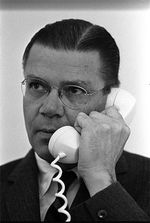
Not until publication of his memoirs in 1995, two decades after the war ended, did McNamara publicly admit that it had always been a mistake. In The Fog of War, Errol Morris’ 2003 documentary about the former defense secretary, McNamara recited some of the lessons he learned in office, one of which was, as he put it, “Rationality will not save us”—a notion that the McNamara of 40 years earlier would have dismissed as absurd. Another lesson was that military power should never be used unilaterally. Until the end, he misremembered—some would say he lied about—certain aspects of his history. He claimed that he helped JFK work toward a peaceful solution to the 1962 Cuban Missile Crisis, when Kennedy’s secret White House tapes reveal that after the first few days he advocated attacking the Soviet missile sites, even at the risk of a broader war. He said that LBJ pushed him to escalate in Vietnam, when Johnson’s secret tapes reveal that the pushing went both ways. He once told me, when I interviewed him for a book about nuclear strategy (The Wizards of Armageddon, 1983), that he would never have approved the multiple-warhead missiles known as MIRVs—although declassified documents show that he signed off on the program from its inception. Someday someone will write a great biography of McNamara. It will be the story not only of his life but of the vast tangle of contradictions and cataclysms that marked America in the 20th century and beyond.
more from Fred Kaplan at Slate here.
north by northwest

A number of New York subway trains currently have posted in them an advertisement for a suspense novel (Brad Meltzer’s Book of Lies) said to be a combination of The Da Vinci Code and North by Northwest. We know about the huge success of the former, especially in its book shape, but it’s reassuring news that a 50-year-old film is still taken to be a household, or rolling stock word. But what about the combination? Meltzer’s novel will tell us how and if it works, but we could still be left puzzling over the intended meaning of the ad, the sign value of the two titles. The Da Vinci Code is pretty easy: murder story with roots in ancient times and entangled in religion. And North by Northwest? Witty, stylish thriller where a man can almost get killed in the middle of nowhere and later scramble about the face of Mount Rushmore? Film where the notion of real-life probability is not just abandoned but lampooned, Hitchcock’s finest attack on the very notion of cause and motive? ‘Here, you see’, he said to Truffaut, speaking about this movie, ‘the MacGuffin has been boiled down to its purest expression: nothing at all!’ He is saying that the espionage that drives the plot does just that: it drives the plot. We don’t have to know what the spies are after or what’s at stake, even if there is a flicker of a mention of the Cold War in the movie. Do the stolen secrets matter? In the world of actual espionage that would probably be a secret too, but in Hitchcock the answer is a revelation. Of course they matter, even in the entire absence of any content for them. They are the way the film pretends it’s about something.
more from Michael Wood at the LRB here.
vice squad

THERE ARE PLENTY of people who cheat on their spouses, plenty of people who hire prostitutes. It’s hardly unheard of for an office to be plagued by a boss sending sexually explicit emails to underlings, even much younger ones, or for a man to solicit sex in a public restroom or to hire a male prostitute and then buy drugs from him. In other words, it’s not just public figures with careers built around denouncing moral turpitude – crusading prosecutors like Eliot Spitzer, evangelical leaders like Ted Haggard, socially conservative politicians like Mark Foley, David Vitter and Larry Craig – who end up confessing to those very acts. And yet, with the back-to-back revelations of marital infidelity by Nevada senator John Ensign and South Carolina governor Mark Sanford, two more cultural conservatives, the question once again arises: why is it that people who set themselves up as moral paragons seem to have the hardest time living up to their own standards?
more from Drake Bennett at the Boston Globe here.
Kill Khalid
Sameer Rahim in The Telegraph:
When I lived in Damascus, my fellow Arabic students were always spotting Khalid Mishal around town. I suspected they were mistaken. Mishal was one of the exiled leaders of Hamas. It was the summer of 2006 and the Palestinian militant group had just captured an Israeli soldier in a cross-border tunnelling raid. Israel had carried out assassinations in Damascus before and Mishal would now be top of their list. Added to this, as Paul McGeough relates in his biography of Mishal and history of Hamas, Israel was still smarting from the humiliation of Mossad’s failed attempt to kill Mishal nine years earlier. That September, two agents disguised as Canadian tourists entered the Jordanian capital armed with a specially designed camera, loaded with poison. When Mishal’s bodyguards dropped him outside his offices, one agent approached and knelt down in front of him – then rose suddenly and sprayed the liquid in Mishal’s ear. He and his accomplice tried to escape but the bodyguards gave chase and eventually surrendered them to Jordanian custody. Mishal, meanwhile, was starting to feel unwell. The poison was designed to slowly paralyse his nervous system, leading to death.
When King Hussein was told of the plot he was furious. Jordan had signed a peace treaty with Israel in 1994 and was its closest Arab ally. Hussein knew that if Mishal died his people would suspect him of having co-operated with the Israelis. His careful balancing of interests meant that Amman hosted both an Israeli embassy and Hamas headquarters. Though no friend to Hamas, this meant he could appease his country’s large Palestinian population and maintain some control over the group. The stability of his kingdom was under threat, so he bypassed diplomatic protocol and made a direct call to the US president Bill Clinton.
More here.
A Doctor by Choice, a Businessman by Necessity
Sandeep Jauhar in The New York Times:
To meet the expenses of my growing family, I recently started moonlighting at a private medical practice in Queens. On Saturday mornings, I drive past Chinese takeout places and storefronts advertising cheap divorces to a white-shingled office building in a middle-class neighborhood. I often reflect on how different this job is from my regular one, at an academic medical center on Long Island. For it forces me, again and again, to think about how much money my practice is generating. A patient comes in with chest pains. It is hard not to order a heart-stress test when the nuclear camera is in the next room. Palpitations? Get a Holter monitor — and throw in an echocardiogram for good measure. It is not easy to ignore reimbursement when prescribing tests, especially in a practice where nearly half the revenue goes to paying overhead.
Few people believed the recent pledge by leaders of the hospital, insurance and drug and device industries to cut billions of dollars in wasteful spending. We’ve heard it before. Without fundamental changes in health financing, this promise, like the ones before it, will be impossible to fulfill. What one person calls waste, another calls income. It is doubtful that doctors and other medical professionals would voluntarily cut their own income (even if some of it is generated by profligate spending). Most doctors I know say they are not paid enough. Their practices are like cars on a hill with the parking brake on. Looking on, you don’t realize how much force is being applied just to maintain stasis.
More here.
Monday, July 6, 2009
Perceptions
Sunday, July 5, 2009
Ousted Honduran president seeks to return after OAS move
Patrick Markey in the Washington Post:
Ousted Honduran President Manuel Zelaya prepared to fly back home on Sunday, setting the stage for a possible confrontation as the interim government that has defied international pressure said it would not let him enter the country.
Honduras' interim government, slapped with suspension from the Organization of American States over its refusal to reinstate Zelaya, said it would refuse Zelaya permission to land.
Zelaya, a leftist who had been due to leave power in 2010, was bundled out of office by troops and into exile a week ago in a military coup that has been widely condemned abroad.
Ecuadorean President Rafael Correa, a leftist ally of Zelaya's, said U.N. General Assembly President Miguel D'Escoto would accompany the ousted president on his planned return to Honduras.
More here.
Meis on Rye
Our own Morgan Meis in The Smart Set:
I'm for the kids. It’s crazy not to be. Are you, dear reader, mighty Atlas, going to hold the world in place and keep it from changing into something new? One lesson of all hitherto existing human history is that the kids have the advantage in the long run. This is a function of time and finitude. The only real wisdom comes in realizing that the kids of today will get their comeuppance with the swift passing of a decade or so. They, too, will wake up one day to find themselves representatives of what was, instead of what shall be. The kids keep on coming.
We learned recently (from a New York Times article by Jennifer Schuessler) that Holden Caulfield, the anti-hero of J.D. Salinger's The Catcher in the Rye, has lost his appeal among the teenage crowd. This came without fair warning. No pimply representative of the Millennials stepped forward to cushion the blow. Instead, we are informed by Barbara Feinberg — “who has observed numerous class discussions of 'Catcher'” — that a 15-year-old boy from Long Island has said, “Oh, we all hated Holden in my class. We just wanted to tell him, ‘Shut up and take your Prozac.’”
It is easy to respond defensively and with contempt. People don't like to have their heroes snubbed, especially when the snubbing comes from some little punk from Long Island whose fingers are surely rubbed raw from constant tweeting, texting, gaming, and masturbation. We (shall we define 'we' as that part of the population over 30?) find subtle ways to undercut the legions of cheeky hormone machines. Trying to explain the sudden disdain for Mr. Caulfield, a cultural critic by the name of Mr. Dickstein says,
The skepticism, the belief in the purity of the soul against the tawdry, trashy culture plays very well in the counterculture and post-counterculture generation. [Today], I wouldn’t say we have a more gullible youth culture, but it may be more of a joining or togetherness culture.
Indeed, Mr. Dickstein would never say that we have a more gullible youth culture now than in his time, except that he just did. Such are the sneaky tactics of the older generations in the face of youthful boldness.
More here.
A priest, a rabbi, an imam, and a Buddhist monk walk into a game show…
From CBC News:
A new game show on Turkish television will pit a Greek Orthodox priest, a rabbi, an imam and a Buddhist monk against one another in attempt to convert atheists to their respective religions.
In each episode of Penitents Compete, to be broadcast by Turkey's Kanal T television station in September, the four faith guides will try to persuade 10 atheists of the merits and truth of their creeds.
The show's producers say there is a good chance none of the atheists will be converted, Turkey's Hurriyet Daily News and Economic Review reports.
But those who are will be sent on a pilgrimage. New Muslims will head to Mecca, Buddhists to Tibet and Jews and Christians to Jerusalem – with television cameras following them.
More here.
green menu
risky
Saudis give nod to Israeli raid on Iran
Uri Mahnaimi and Sarah Baxter in The Sunday Times:
The head of Mossad, Israel’s overseas intelligence service, has assured Benjamin Netanyahu, its prime minister, that Saudi Arabia would turn a blind eye to Israeli jets flying over the kingdom during any future raid on Iran’s nuclear sites.
Earlier this year Meir Dagan, Mossad’s director since 2002, held secret talks with Saudi officials to discuss the possibility.
The Israeli press has already carried unconfirmed reports that high-ranking officials, including Ehud Olmert, the former prime minister, held meetings with Saudi colleagues. The reports were denied by Saudi officials.
“The Saudis have tacitly agreed to the Israeli air force flying through their airspace on a mission which is supposed to be in the common interests of both Israel and Saudi Arabia,” a diplomatic source said last week.
Although the countries have no formal diplomatic relations, an Israeli defence source confirmed that Mossad maintained “working relations” with the Saudis.
More here.
Sunday Poem
Got a Bird that Whistles
Allan Peterson
A small song floats over the reef of dishes in the sink.
If I love her, later we will catalog the moons.
I do, so right off there are four out of the ordinary:
ours and three tonight of Jupiter counted by binoculars.
Then there are thousands, one for every ripple in the sound
a universe of glass and a reservoir of questions.
Moon, paper plates, some thick as dishes
some as dunes, softly as she answers to my hands.
Got a bird that wishes baby got a bird with springs
and I cannot count up these hours by birdsong
and cannot say baby since you are so deliciously full-grown
I can only listen quietly, dry the platters and ask.
I can only say swallows are the needlework of noon
Let Freedom Ring
From Washington Post:
In 1983, a rising young comic superstar named Eddie Murphy appeared before a capacity crowd at Constitution Hall in Washington, D.C., a venue that had once been the focal point of our nation's continuing struggle to provide equal rights for all. For most of his performance, Murphy declined to mention the hall's historical import — not unreasonable considering the ribald nature of his material. But just before curtain, he offered a brief nod to history. He told his audience, “I think maybe like 30 years ago there was a woman who wanted to sing in here, a black lady that sang opera, what was her name? Mary Anderson? This place was segregated. And they couldn't sing here. She couldn't even sing in this place. Here we are, not even 50 years later. . . ” Murphy went on to cite his freedom to fondle his genitalia onstage as evidence of social progress. One could imagine Marian Anderson, the singer whom Murphy struggled to recall, rolling over in her grave — except that, of course, she was still alive at the time.
Nearly forgotten in 1983, Anderson once was one of the best-known women in the country, if not the world. In 1939, her promoters tried to parlay her European triumphs by booking a concert for her at Constitution Hall. She was turned away by the building's owners, the Daughters of the American Revolution (DAR). The DAR's refusal ultimately led to Anderson's outdoor concert at the Lincoln Memorial on Easter Sunday, April 9, 1939, the event that history professor Raymond Arsenault makes the centerpiece of his new book, “The Sound of Freedom.” Before an estimated 75,000 people, Anderson performed arias, spirituals and a stirring rendition of “America.” The program was broadcast over NBC radio, and, Arsenault reports, millions more subsequently “read about it in newspapers and magazines or watched the newsreel footage in movie houses.”
The concert lasted less than an hour, but its consequences resonated for decades. Mary McLeod Bethune, a friend of Anderson's and perhaps the most influential black woman in the country at that time, noted, “Something happened in all our hearts. . . . Through the Marian Anderson protest concert we made our triumphant entry into the democratic spirit of American life.”
More here.
Leading Clerics Defy Ayatollah on Disputed Iran Election

Michael Slackman and Nazila Fathi in the New York Times:
The most important group of religious leaders in Iran called the disputed presidential election and the new government illegitimate on Saturday, an act of defiance against the country’s supreme leader and the most public sign of a major split in the country’s clerical establishment.
A statement by the group, the Association of Researchers and Teachers of Qum, represents a significant, if so far symbolic, setback for the government and especially the authority of the supreme leader, Ayatollah Ali Khamenei, whose word is supposed to be final. The government has tried to paint the opposition and its top presidential candidate, Mir Hussein Moussavi, as criminals and traitors, a strategy that now becomes more difficult — if not impossible.
“This crack in the clerical establishment, and the fact they are siding with the people and Moussavi, in my view is the most historic crack in the 30 years of the Islamic republic,” said Abbas Milani, director of the Iranian Studies Program at Stanford University. “Remember, they are going against an election verified and sanctified by Khamenei.”
More here.
It Came from Wasilla
Todd S. Purdum in Vanity Fair:
As Palin makes her way slowly across the crowded ballroom—dressed all in black; no red Naughty Monkey Double Dare pumps tonight—she is stopped every few inches by adoring fans. She passes the press pen, where at least eight television cameras and a passel of reporters and photographers are corralled, and spots a reporter for a local community newspaper getting ready to take a happy snap with his pocket camera. For a split second she stops, pauses, turns her head and shoulders just so, and smiles. She holds the pose until she’s sure the man has his shot and then moves on. A few minutes later, the evening’s nominal keynote speaker, the Republican Party’s national chairman, Michael Steele, who has been reduced to a footnote in the proceedings, introduces the special guest speaker as “the storm that is the honorable governor of the great state of Alaska, Sarah Palin!”
Just where that storm may be heading is one of the most intriguing issues in American politics today. Palin is at once the sexiest and the riskiest brand in the Republican Party. Her appeal to people in the party (and in the country) who share her convictions and resentments is profound. The fascination is viral, and global. Bill McAllister, until recently Palin’s statehouse spokesman, says that he has fielded (and declined) interview requests from France, England, Italy, Switzerland, Israel, Germany, Bulgaria, “and probably other countries I’ve forgotten about.” (Palin, keeping her distance from most domestic media as well, also declined to talk to V.F.). Whatever her political future, the emergence of Sarah Palin raises questions that will not soon go away.
More here.
Oh, just watch it!
Via Phil Plait in Bad Astronomy:
Saturday, July 4, 2009
Crosshatching in the Crosshairs
Brian Hayes in American Scientist:
We live on a planet wrapped in a fishnet of meridians and parallels. To get along in this world, we learn to navigate the streets and avenues of a city, the aisles of a supermarket, the columns and rows of a spreadsheet. At the airport we glance at the tabular listing of departing flights (columns and rows again), then solve minor problems in coordinate geometry to find gate B18 and seat 23C. Grids and networks are everywhere. Even our entertainments present themselves as arrays of squares: the chessboard, the Scrabble board, crossword puzzles, Sudoku.
In The Grid Book, Hannah B. Higgins looks into the cultural significance of all these crosshatch patterns and other geometric devices for organizing space and time. Higgins’s field is art history, and so she gives generous attention to manifestations of the grid in the arts: Piet Mondrian makes an appearance, the cubists get their due, and there’s a whole chapter on the evolution of perspective drawing. But Higgins also explores more widely, touching on city planning, writing and printing, weaving, mapmaking, musical notation, accounting, and of course the Web.
More here.
Street Smart: Urban Dictionary
Virginia Heffernan in the New York Times Magazine:
With more than four million definitions submitted so far, and 2,000 more coming in every day, Urban Dictionary is a stunningly useful document that unlike most media is made and used by actual young people — in droves. The site had 15 million unique visitors in April. In a typical month, 80 percent of its users are younger than 25.
The population with the biggest ego stake in slang — divining it, protecting it, practicing it, spreading it, declaring it over — actually creates and patrols the content.
Almost perversely, Urban Dictionary avoids most of the standard dictionary apparatus. You won’t find information about parts of speech, etymologies or even standard spellings in it. Its sensibility, in fact, borders on the illiterate, which must be a first for a dictionary. It’s also packed with redundancies and made-up entries. This chaos seems to please Aaron Peckham, the company’s founder and chief executive. “Wikipedia strives for its N.P.O.V. — its neutral point of view,” he told me by phone. “We’re the opposite of that. Every single word on here is written by someone with a point of view, with a personal experience of the word in the entry.”
Better, then, to accept at the outset that Urban Dictionary is not a lexicographical project at all. Its wheelhouse is sociolinguistics.
More here.