Wednesday Poem

The Next Superpower

On the much-publicised full moon
festive youths and families gorge

on overpriced moon-cakes
to celebrate mid-autumn. How

very poetic. Not all that far away
the plants’ wastes flow

to choke the Yangtze. I can’t
appreciate the taste of the cakes,

their severe sweetness. The Chinese
cherish the stuff. This, they say,

is a beloved tradition. I can’t
remember ever loving anything

resembling one. You can’t finish
yours, and stroll onto the balcony

Read more »

World at Dawn

Diane Ackerman in Orion Magazine:

World AT DAWN, the world rises out of darkness, slowly, sense-grain by grain, as if from sleep. Life becomes visible once again. “When it is dark, it seems to me as if I were dying, and I can’t think anymore,” Claude Monet once lamented. “More light!” Goethe begged from his deathbed. Dawn is the wellspring of more light, the origin of our first to last days as we roll in space, over 6.684 billion of us in one global petri dish, shot through with sunlight, in our cells, in our minds, in our myriad metaphors of rebirth, in all the extensions to our senses that we create to enlighten our days and navigate our nights.

Thanks to electricity, night doesn’t last as long now, nor is it as dark as it used to be, so it’s hard to imagine the terror of our ancestors waiting for daybreak. On starless nights, one can feel like a loose array of limbs and purpose, and seem smaller, limited to what one can touch. In the dark, it’s hard to tell friend from foe. Night-roaming predators may stalk us. Reminded of all our delectable frailties, we become vulnerable as prey. What courage it must have taken our ancestors to lie down in darkness and become helpless, invisible, and delusional for eight hours. Graceful animals stole through the forest shadows by night, but few people were awake to see them burst forth, in twilight or moonlight, forbidding, distorted, maybe even ghoulish or magical. Small wonder we personalized the night with demons. Eventually, people were willing to sacrifice anything—wealth, power, even children—to ransom the sun, immense with life, a one-eyed god who fed their crops, led their travels, chased the demons from their dark, rekindled their lives.

More here.

The interview: Ivan Klima

From The Guardian:

Ivan-Klima-001 Ivan Klima grew up knowing exactly what freedom was. Freedom was the opposite of his childhood. In 1941, when Klima was 10, his father was sent on the first Nazi transport to Terezin, the “fortress ghetto” north of Prague, and the family followed. Klima remained in Terezin for the duration of the war. He had, he says, not been aware that his parents were Jewish until Hitler came to power. “Anyone who has been through a concentration camp as a child,” he once wrote, “who has been completely dependent on an external power which can at any moment come in and beat or kill him and everyone around him – probably moves through life at least a bit differently from people who have been spared such an education. That life can be snapped like a piece of string – that was my daily lesson as a child.” There were other lessons, too, though; lessons in survival, lessons in escape. Klima had only one book with him in Terezin, The Pickwick Papers . He read it over and over, and transported himself daily to the world of Sam Weller and Nathaniel Winkle. Freedom was established in his mind as storytelling.

He started to write while in the camp, aware that any page he finished could be his last, and found that the trick of escape worked even better. He wrote plays and made his own puppets to perform in them, and then stories about the girls he fancied, daydreams about his first loves. The sense of liberation he found in these made-up sentences never left him. “I have always pursued inner freedom,” Klima tells me now, at his home in Prague. “I have never been censored.”

More here.

Tuesday, August 4, 2009

How to count to a zillion without falling off the end of the number line

Brian Hayes in American Scientist:

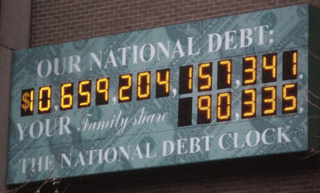
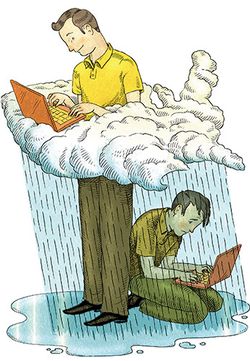
ScreenHunter_01 Aug. 05 00.30 Last year the National Debt Clock in New York City ran out of digits. The billboard-size electronic counter, mounted on a wall near Times Square, overflowed when the public debt reached $10 trillion, or 1013 dollars. The crisis was resolved by squeezing another digit into the space occupied by the dollar sign. Now a new clock is on order, with room for growth; it won’t fill up until the debt reaches a quadrillion (1015) dollars.

The incident of the Debt Clock brings to mind a comment made by Richard Feynman in the 1980s—back when mere billions still had the power to impress:

There are 1011 stars in the galaxy. That used to be a huge number. But it’s only a hundred billion. It’s less than the national deficit! We used to call them astronomical numbers. Now we should call them economical numbers.

The important point here is not that high finance is catching up with the sciences; it’s that the numbers we encounter everywhere in daily life are growing steadily larger. Computer technology is another area of rapid numeric inflation. Data storage capacity has gone from kilobytes to megabytes to gigabytes, and the latest disk drives hold a terabyte (1012 bytes). In the world of supercomputers, the current state of the art is called petascale computing (1015 operations per second), and there is talk of a coming transition to exascale (1018). After that, we can await the arrival of zettascale (1021) and yottascale (1024) machines—and then we run out of prefixes!

More here.

Is Google Killing General Knowledge?

NopassesIn More Intelligent Life Magazine, Brian Cathcart looks at the issue:

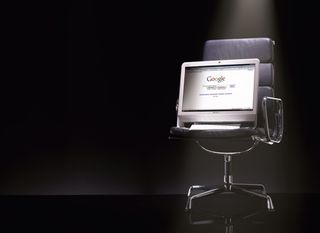
One day last year a daughter of Earl Spencer (who is therefore a niece of Princess Diana) called a taxi to take her and a friend from her family home at Althorp in Northamptonshire to see Chelsea play Arsenal at football. She told the driver “Stamford Bridge”, the name of Chelsea’s stadium, but he delivered them instead to the village of Stamford Bridge in Yorkshire, nearly 150 miles in the opposite direction. They missed the game.

Such stories are becoming commonplace. A coachload of English schoolchildren bound for the historic royal palace at Hampton Court wasted an entire day battling through congested central London as their sat-nav led them stubbornly to a narrow back street of the same name in Islington. A Syrian lorry driver aiming for Gibraltar, at the southern tip of Spain, turned up 1,600 miles away in the English east-coast town of Skegness, which has a Gibraltar Point nearby.

Two complementary things are happening in these stories. One is that these people are displaying a woeful ignorance of geography. In the case of Stamford Bridge, one driver and two passengers spent well over two hours in a car without noticing that instead of passing Northampton and swiftly entering the built-up sprawl of London, their view continued to be largely of fields and forests, and they were seeing signs for Nottingham, Doncaster and the North. They should have known.

The other is more subtle. Everybody involved in these stories has consciously handed over responsibility for knowing geography to a machine. With the sat-nav on board, they believed that they did not need to know about north or south, Spain or England, leafy Surrey or gridlocked Islington. That was the machine’s job. Like an insurance company with its call centre or a local council with its bin collections, they confidently outsourced the job of knowing this stuff, or of finding it out, to that little computer on the dashboard.

Galileo’s Vision, 400 Years Later

Galileo-Jupiter-moons-388David Zax in Smithsonian.com:

Certain pursuits were not in an astronomer’s job description, says Dava Sobel, author of the bestselling historical memoir Galileo’s Daughter (1999). “You didn’t talk about what the planets were made of,” she says. “It was a foregone conclusion that they were made of the fifth essence, celestial material that never changed.” Astronomers might make astrological predictions, but they weren’t expected to discover anything new.

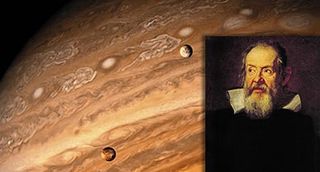
So when Galileo, then 45 years old, turned his telescope to the heavens in the fall of 1609, it was a small act of dissent. He saw that the Milky Way was in fact “a congeries of innumberable stars,” more even than his tired hand could draw. He saw the pockmarked surface of the moon, which, far from being perfectly spherical, was in fact “full of cavities and prominences, being not unlike the face of the Earth.” Soon he would note that Jupiter had four moons of its own and that Venus had moonlike phases, sometimes waxing to a disk, sometimes waning to a crescent. He later saw imperfections in the sun. Each discovery drew Aristotle’s system further into question and lent ever more support to the dangerously revolutionary view that Galileo had privately come to hold—set out just a half-century earlier by a Polish astronomer named Nicolaus Copernicus—that the Earth traveled around the sun.

“I give infinite thanks to God,” Galileo wrote to powerful Florentine statesman Belisario Vinta in January of 1610, “who has been pleased to make me the first observer of marvelous things.”

Can Religious Instruction Help in the Battle against Islamophobia in Europe?

60insegnamcoverengOver at Reset Dialogues on Civilization, Marco Cesario makes the case:

What is the meaning nowadays of teaching about the Islamic religious phenomenon rather than the Islamic religion as such? The International Institute of Religious Thought in Paris (IIIT) attempted to answer this difficult question during a study day attended by intellections and experts on Islam. Speakers included Mohammed Mestiri (director of the IIIT), Mustafa Cherif, a philosopher and the director of the Masters in Islamic Studies at Barcelona University, Stéphane Lation Professor at Fribourg University and Charles Saint-Prot, Director of the Institute of Geopolitical Studies in Paris.

The debate showed that nowadays Islam should no longer be considered a spiritual subject or an organisation of worship of the divine, but rather a phenomenon. This new and ambitious paradigm also involves the Humanities; philosophy, sociology, history, epistemology and anthropology. Islam is above all a reality, a phenomenon that extends over time and space through a diversity of eras and societies. All too often the historical, anthropological and the generally scientific perspective has opposed the religious, theological or spiritual. These two approaches are not mutually exclusive, on the contrary they should cooperate in the multi-disciplinary character to allow Islam to move forwards in the 3rd millennium.

Only if one considers Islam as a religious phenomenon and not a collection of irrefutable dogmas, and only if its analysis is accompanied by the scientific discipline of the Humanities, will communities be allowed to improve and integrate with modernity without trauma.

Pynchon’s Inherent Vice

Thomaspynchon090810_250Sam Anderson in New York Magazine:

This is probably going to make me sound, yet again, like a Neanderthal shouting from the back of the classroom, and might even destroy my career and end a few friendships and scandalize my children and cast shame upon my ancestors—but I have something to confess. After years of deceiving myself and others (felonious head nods in grad seminars, forced cocktail-party chuckles), I have decided it’s time to stop living a literary-critical lie. There is no easy way to say this, so here it is. I hate Thomas Pynchon.

I should not, probably, hate Thomas Pynchon. He is an indisputably, uniquely gifted genius who shares artistic DNA with almost all my favorite writers (Joyce, Barthelme, DeLillo, et al). Basic demographics and taste-algorithms suggest, in fact, that I should be a full-fledged Pynchon groupie, the kind of guy who names all his hamsters Slothrop and slaps W.A.S.T.E. stickers on the windows of his local post office. But I can’t help it. My distaste is visceral, involuntary, and preconscious—a spasm of my aesthetic immune system. While I fully appreciate Pynchon in the abstract, as a literary-historical juggernaut—a necessary bridge from, say, Nabokov (with whom he studied at Cornell) to David Foster Wallace—sitting down with one of his actual books makes my eyebrows start to smolder. I find him tedious, shallow, monotonous, flippant, self-satisfied, and screamingly unfunny. I hate his aesthetic from floor to ceiling: the relentless patter of his Borscht Belt gags, his parodically overstuffed plots, his ham-fisted verbs (scowling, growling, glaring, leering, lurching) and adjectives (lurid, louche, lecherous), the tumbling micro-rhythms of his sentences, the galloping macro-rhythms of his larger narratives. I hate the discount paranoia he slathers over everything with an industrial-size trowel. I hate the cardboard cutouts he tries to pass off as human characters, and I hate—maybe most of all—his characters’ stupid names. (I even hate his name, which makes him sound like some kind of 29th-century sci-fi lobster.) I hate the fake song lyrics he invents for his characters to sing and the fake restaurants (Man of La Muncha) he invents for them to eat at and the stupid acronyms he invents for them to pledge their lives to.

This confession comes courtesy of Pynchon’s newest novel, Inherent Vice, a manically incoherent pseudo-noir hippie-mystery that should fit in nicely with the author’s recent series of quirky late-career non-masterpieces (Mason & Dixon, Against the Day).

[H/t: Maeve Adams]

“Enlightenment fundamentalism?”

515LIe2c8aL._SL500_AA240_

Equating fundamentalism with terrorism is loose thinking, but the biggest drawback is the loss of historical memory that making the parallel entails. Much of the state terror in the past century was secular, not religious. Lenin and Mao were avowed disciples of an Enlightenment ideology. Some will object that they misapplied this. And yet it is a feature of the fundamentalist mindset to posit a pristine faith, innocent of complicity in any crime its practitioners have ever committed, and capable – if only it is implemented in its pure, unsullied form – of eradicating practically any evil. This is pretty much what is asserted by those who claim that the solution to the world’s problems is mass conversion to “Enlightenment values”. If Garton Ash is reluctant to talk of Enlightenment fundamentalism, this may be in part because it suggests that we are at risk of drifting into an intractable conflict. Yet clearly the danger of clashing fundamentalisms is real. In this respect, the facts are subversive, and the vagaries of the present discourse should not stand in the way of recognising the facts.

more from John Gray on Timothy Garton Ash’s new book of essays at The New Statesman here.

minoan fakes, minoan facts

Knossos_Palace_Reconstruction_1

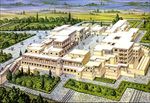
The masterpieces of Minoan art are not what they seem. The vivid frescoes that once decorated the walls of the prehistoric palace at Knossos in Crete are now the main attraction of the Archaeological Museum in the modern city of Heraklion, a few miles from the site of Knossos. Dating from the early or mid-second millennium BC, they are some of the most famous icons of ancient European culture, reproduced on countless postcards and posters, T-shirts and refrigerator magnets: the magnificent young “prince” with his floral crown, walking through a field of lilies; the five blue dolphins patrolling their underwater world between minnows and sea urchins; the three “ladies in blue” (a favorite Minoan color) with their curling black hair, low-cut dresses, and gesticulating hands, as if they have been caught in mid-conversation. The prehistoric world they evoke seems in some ways distant and strange—yet, at the same time, reassuringly recognizable and almost modern. The truth is that these famous icons are largely modern. As any sharp-eyed visitor to the Heraklion museum can spot, what survives of the original paintings amounts in most cases to no more than a few square inches.

more from Mary Beard at the NYRB here.

true grit

G__1249132061_4790

It’s the single most famous story of scientific discovery: in 1666, Isaac Newton was walking in his garden outside Cambridge, England – he was avoiding the city because of the plague – when he saw an apple fall from a tree. The fruit fell straight to the earth, as if tugged by an invisible force. (Subsequent versions of the story had the apple hitting Newton on the head.) This mundane observation led Newton to devise the concept of universal gravitation, which explained everything from the falling apple to the orbit of the moon. There is something appealing about such narratives. They reduce the scientific process to a sudden epiphany: There is no sweat or toil, just a new idea, produced by a genius. Everybody knows that things fall – it took Newton to explain why. Unfortunately, the story of the apple is almost certainly false; Voltaire probably made it up. Even if Newton started thinking about gravity in 1666, it took him years of painstaking work before he understood it. He filled entire vellum notebooks with his scribbles and spent weeks recording the exact movements of a pendulum. (It made, on average, 1,512 ticks per hour.) The discovery of gravity, in other words, wasn’t a flash of insight – it required decades of effort, which is one of the reasons Newton didn’t publish his theory until 1687, in the “Principia.”

more from Jonah Lehrer at the Boston Globe here.

Goody-Goody Hormone Now Linked to Envy, Gloating

From Scientific American:

Oxytocin-hormone_1 Breathing in the hormone oxytocin has been shown in recent years to trigger all kinds of feel-good emotions in people, such as trust, empathy and generosity. Now scientists find it might have a dark side: Snorting oxytocin might also incite envy and gloating. Past studies have shown that oxytocin plays a wide role in social bonding in mammals—between mates, for instance, or mother and child—and recent work suggested the hormone was linked with pro-social behavior in people, such as altruism. Still, neuroscientist Simone Shamay-Tsoory in University of Haifa in Israel and her colleagues noted that oxytocin was found to raise aggression in rodents, suggesting the hormone might play a wider role in social emotions in humans. The researchers decided to investigate envy and gloating—feelings related to the tendency to compare oneself with others—to see if oxytocin ramped up these emotions or dialed them down.

The researchers gave 56 volunteers either oxytocin or a placebo and paid them to take part in a game of chance with another participant which, unknown to them, was a computer. They were shown three doors on a video screen, either red, blue or yellow, and told that behind each door was a different sum of money they could keep after the game.

More here.

Does a Nation’s Mood Lurk in Its Songs and Blogs?

From The New York Times:

Mind Neither music historians nor hard-core metal fans will gasp to learn that the band Staind, with songs like “Painful” and “Mudshovel,” tends to go far more negative in its lyrics than did the heavyweight of soul, Luther Vandross, whose many hits included “The Closer I Get to You.” Or that Slayer (“Raining Blood”) paints darker word pictures than Faith Evans (“I’ll Be Missing You”).

Yet who knew that Slayer was about 30 percent more negative than Mr. Vandross — and that such calculations might say something about the mood of the country? In a new paper, a pair of statisticians at the University of Vermont argue that linguistic analysis — not just of song lyrics but of blogs and speeches — could add a new and valuable dimension to a growing area of mass psychology: the determination of national well-being. “We argue that you can use this data as a kind of remote sensor of well-being,” said Peter Sheridan Dodds, a co-author of the new paper, with Christopher M. Danforth; both are in the department of mathematics and statistics.

More here.

Monday, August 3, 2009

Sunday, August 2, 2009

“The World Will Know”: Shohreh for Soraya

Stoning-of-soraya-m-spMatt Mazur interviews Shohreh Aghdashloo in PopMatters:

Editor’s note: This interview contains some minor film spoilers…

Based on French-Iranian journalist Freidoune Sahebjam’s novel of the same name, the film will force audiences to confront, perhaps for the first time, what it really means to be a witness to this kind of outdated capital punishment that is almost exclusively inflicted upon women (beheading, burning and whipping are among the others). Kudos must be given to the filmmakers for even getting this kind of film made in the first place, as it is one that deals primarily with international women’s rights issues in a conscious-raising, politically-relevant way—not exactly a bankable topic, in Hollywood terms. On paper, the odds were definitely stacked against such a dangerous subject.

The depiction of Soraya’s violent death onscreen is eerily reminiscent of the recent public death of Neda Agha-Soltan, the young woman gunned down in the streets of Tehran who became a symbol for freedom the world over, when video of the moment of her death spread virally through media outlets and social networking almost instantaneously. The thought of someone dying in such a public, bloody way, surrounded by hatred, violence or fear hits a raw nerve. I didn’t want to be confronted with the disturbing imagery of Neda bleeding to death in the street either, but like Soraya, Neda is representative of something bigger that must be addressed. The images of Soraya’s and of Neda’s deaths are haunting, but they drive home a very specific, lasting point: the wrongful deaths of the innocent cannot be tolerated in Iran or anywhere else.

Soraya’s brave female lead Zahra breaks the cycle of violence and oppression in her village by having the courage to stand up for what she believes is right and by speaking the truth, even when her life is at stake.

The Art and Culture of the Year of Revolt

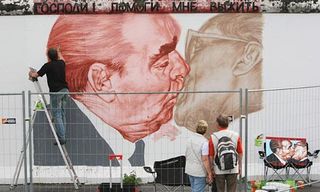
Dmitry-Vrubel-paints-a-mu-001Several critics assess the impact of 1989 on art in and about Eastern Europe in the Guardian. William Skidelsky:

Books

The most striking thing is how few notable novels about the events of that year there have been; or at any rate, how few have made a big impression on the English-speaking world. Perhaps the best-known work to deal directly with 1989 is Waiting for the Dark, Waiting for the Light by Ivan Klíma. Set during Czechoslovakia's Velvet Revolution, it tracks the life of a cynical cameraman whose ideals have been compromised by his complicity with the old regime.

Klima's French-based compatriot Milan Kundera has never written a 1989 novel although he dramatised the dilemmas of the exile returning to post-communist Prague in his fine 2000 novella Ignorance. Other former Soviet bloc writers, too, have found inspiration in the world ushered in by 1989. A fantastical, surrealist strain runs through the best post-communist satires, such as Andrey Kurkov's Death and the Penguin, Pavel Huelle's Mercedes-Benz and Victor Pelevin's The Clay Machine-Gun.

Oddly enough, perhaps the best fictional chronicler of 1989, other than Klima, is Julian Barnes, whose short 1992 novel, The Porcupine, concerns the trial of the recently deposed dictator of a nameless Soviet satellite state.

Mr. Tambourine Man

Dudu-073109Dan Friedman in The Forward:

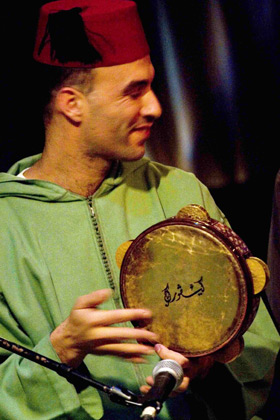
The tambourine, or “riq” as it’s called in Arabic, is actually, despite its Western connotations of preschool classrooms, a staple of classical Arabic music. Unlike kids or folk dancers who shake or clap it, classical musicians hold it vertically and still, at knee level. Like the larger bongolike dumbek, there are three major categories of sound: the “dum” the “tak” and the “kat.” But on the riq, each note can be varied not only by the tension and pace of the hand or the number of fingers applied, but also by the amount of accompanying jingle, the tautness of the drum skin and the amount of resonance the player allows any given beat or sequence.

What makes it so hypnotic and so deeply impressive is the range of simultaneous effects that the skilled player can conjure from the single instrument. In duets such as those that Buchbut played with Dalal, the audience is left wondering how the rhythmic scatter of one person’s hands around the riq could possibly correspond to the complicated, insistent percussion section accompanying the oud. Each finger is almost its own instrumentalist, playing a different pattern on its own and as part of a group.

With modesty appropriate for a player of this most self-effacing of percussion instruments, Buchbut says he knows for certain of two riq players better than himself in New York, and resists any attempt to talk about himself as one of the great riq players of that city. A software engineer by day, he took up the riq only eight years ago. “I was going to learn the djembe [a knee-high drum], but my friend’s girlfriend was learning belly-dancing, so he wanted to learn the dumbek to accompany her, so I started learning with him, and learning the riq came from that,” he said.

(You can hear Layali El Andalus here.)

The News About the Internet

Michael Massing in the New York Review of Books:

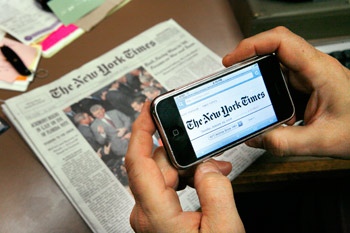
Iphone-350 Of all the dismal and discouraging numbers to have emerged from the world of newspapers—the sharp plunges in circulation, the dizzying fall-off in revenues, the burgeoning debt, the mounting losses—none seems as sobering as the relentless march of layoffs and buyouts. According to the blog Paper Cuts, newspapers lost 15,974 jobs in 2008 and another 10,000 in the first half of 2009. That's 26,000 fewer reporters, editors, photographers, and columnists to cover the world, analyze political and economic affairs, root out corruption and abuse, and write about culture, entertainment, and sports.

The membership of the Military Reporters and Editors Association has fallen from six hundred in 2001 to under one hundred today. In April, Cox Newspapers closed its Washington office, contributing to the dramatic decline in the number of reporters covering the federal government. The Boston Globe, The Baltimore Sun, The Philadelphia Inquirer, and Newsday have all closed their foreign bureaus. Because of repeated retrenchments, the McClatchy newspapers, which include The Sacramento Bee, The Charlotte Observer, and more than two dozen other dailies across the US, cannot afford to open a South Asia bureau that's been in the works for three years, or to keep a full-time correspondent in Mexico or even Baghdad, where its bureau has done such standout work. In “the good old days,” McClatchy editor Mark Seibel recently wrote, the organization could lay off reporters “and insist with a straight face that there would be no change in our ability to cover the news. No more. The last year of layoffs, cutbacks and consolidations have hurt. Bad.”

More here.