I.
When I fall asleep in a coffin posture, supine, with my feet tenting beneath the covers and my nose tracing a line up toward the wobbling ceiling fan, I frequently wake up a committed if unwilling Cartesian.
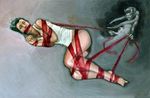 Like anyone else in R.E.M. sleep, as soon I slip under my brain starts sending hormonal relaxants to my muscles that anesthetize and effectively paralyze them. Problem is, when I wake up from R.E.M. only a fraction of me pops awake sometimes. It’s not a split between the left and right sides of my body, like a stroke patient, nor a top-bottom paraplegic split. And it’s nothing like a foot or hand falling asleep, then dethawing with that achy tingle. Mine is an old-fashioned, cogito-ergo mind-body bifurcation. Mentally, “I” pop right awake, and as a natural course of being awake this “I” sends signals for my legs and arms and mouth and eyes to yawn, or stretch, or see what time it is and whether I have to go to the bathroom. Those signals echo, ignored. My mind casts the spell again, but it turns out I cannot twiddle a toe or even flex a nostril, no matter how much I strain. Within seconds of the failure, I’m agonizingly aware of the discrepancy. It’s not a dream (there’s nothing fantastical happening), more like a huge karmic blunder, what being reincarnated as a park statue would feel like.
This rigor mortis is actually easy to shrug off, as long as—and here’s the philosophically troubling bit—the outside world intervenes. I can still sense my environment, like some sort of amoeba or slug—that’s a passive act—but the universe must change somehow. I’m powerless to effect change myself and will remain locked up, alone. A sudden alarm clock will unchain me, but not any noises that were already mewing when I “woke” up. A dramatic unmasking of a window might do it, but not the slow creep of the sun. The slightest nudge from my girlfriend will budge me (I suppose it’s the opposite of those little jerks she makes whenever she falls asleep), but the heat of an arm already draped across me is useless.
Read more »