
[Thanks to Zehra Raza.]
Category: Recommended Reading
Why I Love Al Jazeera
The Arab TV channel is visually stunning, exudes hustle, and covers the globe like no one else. Just beware of its insidious despotism.
Robert Kaplan in The Atlantic:
Has anyone watched the English-language version of Al Jazeera lately? The Qatar-based Arab TV channel’s eclectic internationalism—a feast of vivid, pathbreaking coverage from all continents—is a rebuke to the dire predictions about the end of foreign news as we know it. Indeed, if Al Jazeera were more widely available in the United States—on nationwide cable, for example, instead of only on the Web and several satellite stations and local cable channels—it would eat steadily into the viewership of The NewsHour With Jim Lehrer. Al Jazeera—not Lehrer—is what the internationally minded elite class really yearns for: a visually stunning, deeply reported description of developments in dozens upon dozens of countries simultaneously…
Al Jazeera is also endearing because it exudes hustle. It constantly gets scoops. It has had gritty, hands-on coverage across the greater Middle East, from Gaza to Beirut to Iraq, that other channels haven’t matched. Its camera crew, for example, was the first to beam pictures from Mingora, the main town of Swat, enabling Al Jazeera to confirm that the Pakistani military had, in fact, prevailed there over the Taliban.
More here.
Sunday Poem
The Solitary Angler
One day I woke up
And did not fear the old gods.
I called the number on my fridge
And when the movers arrived
I gave them everything.
On my way out of town
I spat into the wind
And did not linger to see where it landed.
Who can say for sure
If the dream has ended or begun?
A frail dimness rims my craft.
Stars swim up to the surface
Of a bottomless well
And sink back when I take my eye off them.
There is no greater calamity
Than to underestimate the strength of your enemy.
The ancients saw the stars
And called them angels.
They turned everything else into a clock
I say wear a watch if you must.
But don’t count on it.
by Suzanne Buffam
from Crazyhorse No. 75
Saturday, September 26, 2009
Evolution doesn’t make U-turns
Michael Torrice in Science:
Evolution doesn't make U-turns, according to a new study of proteins. The study shows that simply reversing selective pressure won't make a biomolecule revert to an earlier form. The finding confirms a much-debated biological law that, evolutionarily speaking, there's no going back.
Since the late 19th century, evolutionary biologists have debated whether evolution can go in reverse. If not, then evolution may depend on more than just natural selection. Multiple evolutionary paths could be possible through small chance events. It hasn't been easy to examine reversibility. Previous studies have focused on complex traits such as whale flippers, and scientists often lack sufficient information about ancestral traits or how present-day traits evolved.
So evolutionary biologist Joseph Thornton of the University of Oregon, Eugene, and his colleagues picked a more tractable subject: a single protein.
More here.
Contagious yawning, why we share, and Bernie Madoff
Laura Fitzpatrick in Time:
Gordon Gekko got it wrong. In his new book The Age of Empathy: Nature's Lessons for a Kinder Society, primatologist Frans de Waal uses a variety of studies on empathy in animals to debunk the idea that humans are competitive to the core. He talked to TIME about contagious yawning, why we share and Bernie Madoff.
How do you define empathy?
Empathy is sometimes defined by psychologists as some sort of high-level cognitive feat where you imagine how somebody else feels or how you would feel in their situation. But my definition is more focused on the whole of empathy, and that includes emotions. If you are sad and crying, it's not just that I try to imagine how you feel. But I feel for you and I feel with you.
You explain in the book that empathy really starts with our bodies: running together, laughing together, yawning together. So yawning really is contagious?
Yeah. Dogs catch yawns from their owners. Chimpanzees yawn [in response to those] that we show them. Yawn contagion is very interesting because it's a very deep bodily connection between humans or between animals. Humans who have problems with empathy, such as autistic children, don't have yawn contagion.
More here.
A Tale of Two Countries
Frederika Randall in The Nation:
Next month the Constitutional Court will rule on whether a tailor-made 2008 law granting Berlusconi full judicial immunity is constitutional. If the measure is knocked down, the prime minister could be exposed to prosecution in a corruption case. His leading ally in his Popolo della Libert party, Chamber of Deputies president Gianfranco Fini, has been marking his distance from Berlusconi and signaling he's ready to replace him. Berlusconi's European partners and the Obama administration are said to be annoyed about his effusive displays of friendship to Vladimir Putin and Muammar Qaddafi. The European Union has censured Italy for towing boatloads of desperate Eritreans and Somalis, many of them certainly eligible for refugee status, back to Libya from where they set out–and where they will be interned in barbaric prison camps. And the worst of the world economic crisis is expected to hit Italy this winter.
For the first time, there is talk about the end of Berlusconi. And for the first time, comparisons of this regime to Fascism are being advanced not just as rhetoric but in all seriousness.
More here.
Muslim Americans answer the call to serve
Salma Hasan Ali in Common Ground News Service:
Muslim Americans Answer the Call is a nationwide grassroots response to mobilise every single Muslim American in a united effort for community service. The Qur'an says: “Race one another in good works” (Qur'an 5:48). And since the campaign continued through Ramadan, many of us felt there was no better way to show our faith than in action. Beginning 22 June, the group committed to completing 1,000 community service projects, and we surpassed 3,000.
Projects ranged from partnering with the Salvation Army, an organisation dedicated to relieving poverty, to preparing thousands of meals for the homeless in our nation's capital, to working with publishers to provide textbooks for under-funded schools on Native American reservations.
Last week I attended Fast2Feed, an interfaith iftar dinner marking the end of the daily fast, at the Sixth and I Historic Synagogue in Washington, DC.
More here.
Morals Class Is Starting; Please Pass the Popcorn
Patricia Cohen in the New York Times:
Many of the 14,000 or so students who have taken Harvard’s wildly popular course “Justice” with Michael J. Sandel over the years have heard the rumor that their professor has a television avatar: Montgomery Burns, Homer Simpson’s soulless ghoul of a boss at Springfield’s nuclear power plant.
The joke, of course, is that Mr. Sandel — who at one time or another taught several future writers for Fox’s “Simpsons” and shares a receding hairline with the evil-minded cartoon character — is the anti-Burns, a moral philosopher who has devoted his life to pondering what is the right thing to do.
Now Mr. Sandal gets to play himself on television, not to mention online, as Harvard and public television stations across the country allow viewers to sit in on his classroom discussions about Wall Street bonuses and Aristotle, same-sex marriage and Kant, for the next 12 weeks.
More here. And watch the first episode of Justice:
Scuba Diving in a Newly Flooded Meadow
[Thanks to Michael Slatky.]
Logicomix
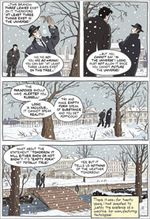
Well, this is unexpected — a comic book about the quest for logical certainty in mathematics. The story spans the decades from the late 19th century to World War II, a period when the nature of mathematical truth was being furiously debated. The stellar cast, headed up by Bertrand Russell, includes the greatest philosophers, logicians and mathematicians of the era, along with sundry wives and mistresses, plus a couple of homicidal maniacs, an apocryphal barber and Adolf Hitler. Improbable material for comic-book treatment? Not really. The principals in this intellectual drama are superheroes of a sort. They go up against a powerful nemesis, who might be called Dark Antinomy. Each is haunted by an inner demon, the Specter of Madness. Their quest has a tragic arc, not unlike that of Superman or Donald Duck.
more from Jim Holt at the NYT here.
pornographia
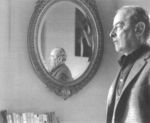
The carriage moved on. Karol sat on the driver’s seat, next to the coachman. She, in the front—and where her little head ended, there he began above her as if placed on an upper story, his back toward us, a slim contour, visible yet featureless—while his shirt billowed in the wind—and the combination of her face with the absence of his face, the complement of her seeing face with his unseeing back struck me with a dark, hot duality. . . . They were not unusually good-looking—neither he nor she—only as much as is appropriate for their age—but they were a beauty in their closed circle, in their mutual desire and rapture—something in which practically no one else had any right to take part. They were unto them-selves—it was strictly between them. And especially because they were so (young). So I was not allowed to watch, I tried not to see it, but, with Fryderyk in front of me and sitting next to her on the small seat, I was again persistently asking myself: Had he seen this? Did he know anything? And I was lying in wait to see a single glance of his, one of those supposedly indifferent ones yet sliding by surreptitiously, greedily.
more from Danuta Borchardt’s new translation of Witold Gombrowicz’s masterpiece at The Quarterly Conversation here.
naked lunch is 50
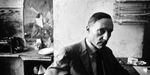
Naked Lunch, the chaotic masterpiece by William Burroughs, turned 50 this year, and odds are you probably haven’t read it. Not unlike Ulysses, War and Peace or anything by Thomas Pynchon, Naked Lunch is often lauded but seldom read, even by admitted bibliophiles. But for those who have indeed read it, the book packs a literary punch that continues to ripple through Western culture, particularly among avant-garde writers and (strangely enough) musicians. Which brings to mind the question: why is Naked Lunch still relevant 50 years later? Or, conversely, is it still relevant? Is this book just meaningful to a few fans and leftover NYC lit-punks who hope their special brand of shock still resonates long after the anger of youth has faded and the office job has begun to make sense? Or does Naked Lunch offer something more to the present day than anyone expected?
more from Dave Teeuwen at PopMatters here.
Bike-Seat Philosopher
From The New York Times:
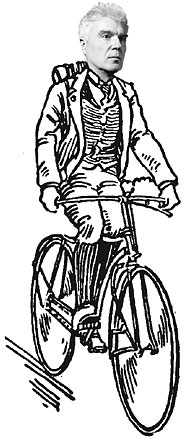
“David Byrne: singer, artist, composer, director, Talking Head.” I’m quoting the bartender Moe Szyslak from “The Simpsons” here, from an episode in which Byrne appeared. One could also add photographer, author, designer and, since the early 1980s, serious bicyclist. At first he just rode in downtown Manhattan, but as his career has taken him around the world he’s packed his full-size folding bike and carried it with him, sometimes resentfully paying a $125 “sports equipment” surcharge on airplanes. “Bicycle Diaries” contains accounts of his travels in distant cities like London, Berlin, Buenos Aires and Manila, as well as some closer to home — New Orleans, San Francisco and Detroit. His description of riding in Detroit is especially good: “I bike from the center of town out to the suburbs. It’s an amazing ride — a time line through a city’s history, its glory and betrayal.”
For Byrne bicycling is partly a means, partly an end. It helps him get places, makes him feel more connected to life on the streets, and also serves as a “form of meditation” that keeps him sane. Inevitably the diary format gives the book a random, scattershot quality: Byrne is in no sense a “programmatic” bike rider, and he admits he’s sometimes just skimming over the surface of the cultures he encounters. Even so, his interests and activities — cutting-edge art exhibitions, rock festivals, a subversive PowerPoint presentation about PowerPoint presentations, a belly dance party — and certainly his personality are singular enough to give the book consistency and coherence.
More here.
Friday, September 25, 2009
secrets up north

In 1927, Emily Carr was creatively blocked, financially insolvent, spiritually arid, and on the verge of becoming the greatest discovery in the history of Canadian art. The fifty-five-year-old spinster had largely given up art and was raising chickens in her backyard in Victoria when Eric Brown, the director of the National Gallery of Canada, knocked at her door and asked if he could look around. Painfully shy, she reluctantly hauled out a few of her “old Indian pictures,” experimental works that set faithful renderings of the totem poles and war canoes of the Haida Gwaii against dynamic, impressionistic landscapes. Brown was besotted. On the spot, he offered to feature her work in an upcoming exhibit in Ottawa focusing on modern Canadian landscape painters, including the Group of Seven. Carr, who’d never heard of the National Gallery or the loose collective of artists who had won international acclaim at the British Empire Exhibition three years earlier, initially declined the invitation. Brown recommended that she read A Canadian Art Movement: The Story of the Group of Seven, by Fred Housser, a Toronto journalist and good friend of the group. After he left, having secured her participation, Carr dashed to the bookstore.
more from Brett Grainger at The Walrus here.
the salvation of science writing
What I’m trying to say is that science writing will go on forever, in one form or another. Why? Because there’s so much science in our world, and it’s so interesting. There is also a desire—even a hunger, I believe—to learn things about our world that are not likely to be eclipsed by the next day’s events, as is the case with so much news. There is considerably more hunger for science reporting—and, in my opinion, a considerably more sophisticated readership for it—than many of the people who run newspapers realize. I’ll speculate on why that may be in a minute. Suffice it to say, science reporting is a growth industry in journalism, and has been for about 20 years. It will continue to be because science is something Americans do very well. Science is also something that Americans are counting on, rightly or wrongly, to solve a lot of the problems facing them. I believe this truth—that people want to learn about scientific discoveries, the systematic exploration of our material world—carries with it an opportunity for journalism to improve itself and in some sense to remake itself.
more from David Brown at The American Scholar here.
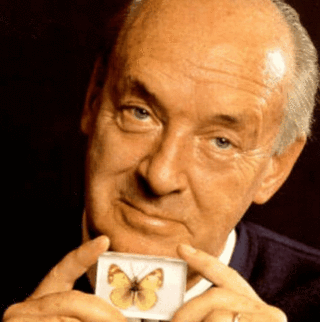
A first encounter with Laura, Nabokov’s last, unfinished work
Ron Rosenbaum in Slate:
It shouldn't be surprising that the forthcoming (Nov. 17) release of the long-locked-away Holy Grail of higher lit, Vladimir Nabokov's unfinished draft of The Original of Laura, is attended with an air of the clandestine.
In order to read the text now, one cannot simply order a review copy. One must enter the lobby of the Random House building (currently adorned with promotional cards for Dan Brown's The Lost Symbol) and ascend to the 21st floor, where, in an unused office, the only copy shown to outsiders reposes on a table. Once there, one is instructed that one can read it but must not (for several reasons, including a commitment to publish excerpts from the work in Playboy) disclose anything about it that has not previously appeared in print until the Playboy installment is on the stands.
The restrictions were frustrating, but there was something thrillingly forbidden about my first encounter with Laura, whose text, as we shall see, I played no small part in bringing to light. And then there was the shocker on Page xix, which I've been allowed to disclose.
More here. [Thanks to Ahmad Saeedullah.]
fetish objects

September 15, 2009. The day publishing died. Or was saved. It’s really hard to tell which, but everyone agrees on one thing: That Dan Brown cat sure did something major to the book industry with the release of his new novel The Lost Symbol. Outside the talk about whether the monstrous sales (one million copies sold in the first 24 hours — a record for adult hardcover fiction) will save reading, or destroy independent bookstores through the competitive discounts of their rivals, one thing is for sure: People are going to overreact to the fact that Amazon is reporting more e-book sales than sales of physical copies of The Lost Symbol. Get ready for the latest round of books-as-physical-objects-are-dead, and the ebook will destroy publishing. (You think I’m exaggerating, but just go ahead and Google “will destroy publishing” or “will destroy reading” and see what you get.) Putting aside the fact that there are many more advantages to reading The Lost Symbol in particular on an e-book device — no need to look at that ugly cover art, nor to be sneered at by the high and mighty book critics who might be on your subway — this is not a sign that reading is dead, nor that the book as a physical object will disappear within our lifetime. While people are going to be reading in multiple formats — including e-book readers and iPhones, Web sites and miniformats like Twitter — the book is still a fetish object.
more from Jessa Crispin at The Smart Set here.
Edward Said (1935 – 2003)
In honor of the sixth death anniversary of the great literary critic and distinguished Palestinian intellectual Edward Said, I am linking back to a column published by Asad Raza (September 26, 2005) on this blog:
Optimism of the Will
By Asad Raza
The first time I saw Edward Said, in 1993, I was an undergraduate studying literature at Johns Hopkins, where he had come to give a lecture. An extremely pretentious young person, I arrived in the large hall (much larger than the halls in which other visiting literature professors spoke) with a mixture of awe and, I'm afraid to say, condescension. This was born of the immature idea that the author of Orientalism had ceased to occupy the leading edge of the field, postcolonial studies, which his work had called into being. At that time, the deconstructionist Homi Bhabha and the Marxist Aijaz Ahmad were publishing revisions of (and, in the case of Ahmad, ad hominem attacks on) Said's work, and Said himself seemed to be retreating from “theory” back to some vaguely unfashionable (so it seemed to me) version of humanism.
There are interludes in which a thinker's work, no matter how enabling or revolutionizing, are liable to attack, to labels such as “dated” or “conservative,” from more insecure minds. In this case, the actual presence of Said destroyed those illusions utterly. Seated on a dais at a baby-grand piano, he delivered an early version of his reading of “lateness,” on the late work of master figures such as Beethoven and Adorno. In a typical stroke, Said's use of Beethoven's late work as one example, and then Adorno's late work on Beethoven as a second example, highlighted the mutual relationship between artist and critic, each dialectically enabling the other's practice. The further implication, of course, that Said himself was a master critic entering such a late period (he had recently been diagnosed with cancer) was as palpably obvious as the idea that Said would say such a thing aloud was preposterous. And on top of it all, he played the extracts from Beethoven he discussed for us, with the grace of a concert pianist (which he was). I left the auditorium enthralled.
Within the next year, I was lucky enough to be invited to dinner with Said by my aunt Azra, who was one of the doctors treating him for leukemia. Seated next to him, I challenged him on several subjects, with the insufferable intellectual arrogance of youth. His responses were sometimes pithy and generous, sometimes irritated and indignant. On Aijaz Ahmad, who had been attacking him mercilessly and unfairly, he simply muttered, “What an asshole.” How refreshing! When I asked him why we continued to read nineteenth-century English novels, if they repressed the great human suffering that underwrote European colonial wealth, he gave the eminently sensible answer, “Because they're great books.” At another dinner, at a Manhattan temple of haute cuisine where he addressed the waiters in French, I complained that the restaurant's aspirations to a kind of gastronomic modernism were at odds with their old-fashioned, country club-ish “jacket required” policy. He raised an eyebrow at me and dryly remarked, “I hadn't even noticed the internal contradiction.” Score one for the kid.
In 2003, as a graduate student in English at NYU, I rode the subway up to Columbia each week for a seminar with Said, which turned out to be the last one he taught. Wan and bearded, Said would walk in late with a bottle of San Pellegrino in hand and proceed to hold forth, off the cuff, about an oceanic array of subjects relating to the European novel (Don Quixote, Gulliver's Travels, Sentimental Education, Great Expectations, Lord Jim, etc.), alternately edifying and terrifying his audience. He had an exasperation about him that demanded one to know more, to speak more clearly, to learn more deeply in order to please him. Some found the constant harangues too traumatic for their delicate sensibilities; I loved to have found a teacher who simply did not accept less than excellence. It was a supremely motivating, frightening, vitalizing experience. In a class on Robinson Crusoe, a fellow student became confused about the various strands of eighteenth-century non-conformist Protestantism, prompting Said to irritatedly draw a complex chart of the relations between Dissenters, Puritans, Anglicans, etc. Similar demonstrations of the sheer reserves of his knowledge occurred on the subjects of the revolutions of 1848, the history of Spanish, and the tortuous philosophical subtleties of Georg Lukacs' Theory of the Novel, among other things. Said had a whole theory of the place of nephews in literature (not the real son, but the true inheritant), and he made himself his students' challenging, agresssive, truth-telling, loving uncle.

More here.
Friday Poem
In Flight
after a day of talking too much
one moment of solitude
not quite silence
parked for the night behind Rip's Hotel
en route to the bay on Route 301
mountainous trucks a warring of noise
but nobody talking here no TVs
lawn spring-green to harlequin woods
in the warm end-of-October sun
I perch on the Subaru tailgate
open a $1.25 carton of soup
sweet-and-sour to ease the throat
and consider every spoonful
(the fortune cookie message reads
Lions on a Hunt Don't Roar)
then a vee of Canada geese
flies querulous overhead until
all at once they still their wings
lose altitude over an unseen marsh
and twenty-four dark-gray angels
in silence vanish into the dusk
by Elisavietta Ritchie
from Delaware Poetry Review, Vol. 2 No.1, Sept. 2008
A Whiff of Water Found on the Moon
From Science:
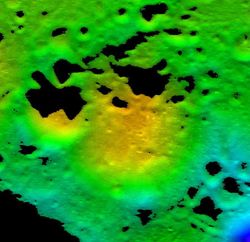
Yes, the moon is a “wetter” place than the Apollo astronauts ever could have imagined, but don't break out the beach gear just yet. Although three independent groups today announced the detection of water on the lunar surface, their find is at most a part per 1000 water in the outermost millimeter or two of still very dry lunar rock. The discovery has potential, though. Future astronauts might conceivably wring enough water from not-completely-desiccated lunar “soil” to drink or even to fuel their rockets. Equally enticing, the water seems to be on its way to the poles, where it could be pumping up subsurface ice deposits that would be a real water bonanza.
A less dry moon makes its debut courtesy of the Moon Mineralogy Mapper (M3) that has been orbiting the moon onboard India's now-defunct Chandrayaan-1 spacecraft. A spectrometer, M3 detected an infrared absorption at a wavelength of 3.0 micrometers that only water or hydroxyl–a hydrogen and an oxygen bound together–could have created.
More here.