asteroid plimpton

Naminginside__1253983778_8331

There’s something special about naming a celestial body, putting your thumbprint in the heavens up there with Jupiter and Mars and the Horsehead Nebula. The idea speaks to our desire for immortality–attaching a name to something that, if not quite eternal, will last far longer than anyone will be around to remember. The world of commerce has figured this out, of course. Various services have arisen that claim to put your name on a star for a fee. Unfortunately, as nice as it sounds, these names don’t count: You pay your money and get a certificate, but it isn’t recognized by the only organization that actually matters, the International Astronomical Union. So what if you really do want to name a piece of the sky? Is there a way to name a newly discovered star, or planet, or comet–maybe not after yourself, but maybe after someone you admire?

more from Samuel Arbesman at The Boston Globe here.

I am an American woman

Lars2x

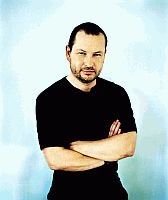
Katja Nicodemus interviews Lars von Trier, originally in Die Zeit, over at Signandsight:

You seem to be fascinated by power relationships. With the Dogma rules, you formulated an aesthetic manifesto and your last two films “Dogville” and “Manderlay” are based on strict formal principles. What so interests you about guidelines and rules?

I come from a family of communist nudists. I was allowed to do or not do what I liked. My parents were not interested in whether I went to school or got drunk on white wine. After a childhood like that, you search for restrictions in your own life.

But communists actually have very strict rules.

That’s true, but that’s where things start to get very complicated. All my life I’ve been interested in the discrepancy between philosophy and reality, between conviction and its implementation. The general assumption is that all people are able to differentiate more or less equally between good and evil. But if this is the case, why does the world look like it does? Why have all the good intentions of my parents come to nothing. And why do my own good intentions lead to nothing?

The Return of John Maynard Keynes

Keynes-in-his-Bloomsbury--001

Paul Krugman reviews Robert Skidelsky’s Keynes: The Return of the Master in the Guardian:

In Part I of his 1936 masterwork, The General Theory of Employment, Interest, and Money, Keynes asserted that the core of his theory was the rejection of Say’s Law, the doctrine that said that income is automatically spent. If it were true, Say’s Law would imply that all the things we usually talk about when trying to assess the economy’s direction, like the state of consumer or investor confidence, are irrelevant; one way or another, people will spend all the income coming in. Keynes showed, however, that Say’s Law isn’t true, because in a monetary economy people can try to accumulate cash rather than real goods. And when everyone is trying to accumulate cash at the same time, which is what happened worldwide after the collapse of Lehman Brothers, the result is an end to demand, which produces a severe recession.

Some of those who consider themselves Keynesians, myself included, agree with what Keynes said in The General Theory, and consider the rejection of Say’s Law the core issue. On this view, Keynesian economics is primarily a theory designed to explain how market economies can remain persistently depressed.

But there’s an alternative interpretation of what Keynes was all about, one offered by Keynes himself in an article published in 1937, a year after The General Theory. Here, Keynes suggested that the core of his insight lay in the acknowledgement that there is uncertainty in the world – uncertainty that cannot be reduced to statistical probabilities, what the former US defence secretary Donald Rumsfeld called “unknown unknowns”. This irreducible uncertainty, he argued, lies behind panics and bouts of exuberance and primarily accounts for the instability of market economies.

Where Will Synthetic Biology Lead Us?

Synthbio

Michael Specter in The New Yorker:

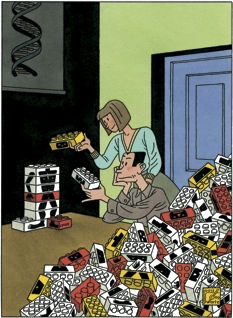
“What if we could liberate ourselves from the tyranny of evolution by being able to design our own offspring?” Drew Endy asked, the first time we met in his office at M.I.T., where, until the summer of 2008, he was assistant professor of biological engineering. (That September, he moved to Stanford.) Endy is among the most compelling evangelists of synthetic biology. He is also perhaps its most disturbing, because, although he displays a childlike eagerness to start engineering new creatures, he insists on discussing both the prospects and the dangers of his emerging discipline in nearly any forum he can find. “I am talking about building the stuff that runs most of the living world,” he said. “If this is not a national strategic priority, what possibly could be?”

Endy, who was trained as a civil engineer, spent his youth fabricating worlds out of Lincoln Logs and Legos. Now he would like to build living organisms. Perhaps it was the three well-worn congas sitting in the corner of Endy’s office, or the choppy haircut that looked like something he might have got in a tree house, or the bicycle dangling from his wall—but, when he speaks about putting together new forms of life, it’s hard not to think of that boy and his Legos.

Endy made his first mark on the world of biology by nearly failing the course in high school. “I got a D,” he said. “And I was lucky to get it.” While pursuing an engineering degree at Lehigh University, Endy took a course in molecular genetics. He spent his years in graduate school modelling bacterial viruses, but they are complex, and Endy craved simplicity. That’s when he began to think about putting cellular components together.

What Have We Done to Democracy?

Arundhati Roy in The Nation:

ScreenHunter_02 Sep. 29 15.58

The question here, really, is what have we done to democracy? What have we turned it into? What happens once democracy has been used up? When it has been hollowed out and emptied of meaning? What happens when each of its institutions has metastasized into something dangerous? What happens now that democracy and the free market have fused into a single predatory organism with a thin, constricted imagination that revolves almost entirely around the idea of maximizing profit?

Is it possible to reverse this process? Can something that has mutated go back to being what it used to be? What we need today, for the sake of the survival of this planet, is long-term vision. Can governments whose very survival depends on immediate, extractive, short-term gain provide this? Could it be that democracy, the sacred answer to our short-term hopes and prayers, the protector of our individual freedoms and nurturer of our avaricious dreams, will turn out to be the endgame for the human race? Could it be that democracy is such a hit with modern humans precisely because it mirrors our greatest folly–our nearsightedness?

More here.

Whitewashing Roman Polanski

Bill Wyman in Salon:

ScreenHunter_01 Sep. 29 15.01

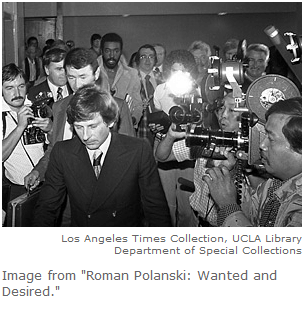
Bad art is supposed to be harmless, but the 2008 film “Roman Polanski: Wanted and Desired,” about the notorious child-sex case against the fugitive director, has become an absolute menace. For months, lawyers for the filmmaker have been maneuvering to get the Los Angeles courts to dismiss Polanski's 1978 conviction, based on supposed judicial misconduct uncovered in the documentary. On Tuesday, Los Angeles Superior Court Judge Peter Espinoza ruled that if Polanski, who fled on the eve of his sentencing, in March 1978, wanted to challenge his conviction, he could — by coming back and turning himself in.

Espinoza was stating the obvious: Fugitives don't get to dictate the terms of their case. Polanski, who had pleaded guilty to having unlawful sex with a 13-year-old girl, was welcome to return to America, surrender, and then petition the court as he wished. Indeed, the judge even gave Polanski more than he deserved, saying that he might actually have a case. “There was substantial, it seems to me, misconduct during the pendency of this case,” he said, according to the Los Angeles Times. “Other than that, he just needs to submit to the jurisdiction of the court.”

Polanski deserves to have any potential legal folderol investigated, of course. But the fact that Espinoza had to state the obvious is testimony to the ways in which the documentary, and much of the media coverage the director has received in recent months, are bizarrely skewed. The film, which has inexplicably gotten all sorts of praise, whitewashes what Polanski did in blatant and subtle fashion — and recent coverage of the case, in the Los Angeles Times, the New York Times and elsewhere, has in turn accepted the film's contentions at face value.

More here. [Thanks to Cyrus Hall.]

Also see: Reminder: Roman Polanski raped a child –excellent article by Kate Harding

And: Child Rape Apologists Love Roman Polanski –by Gautham Nagesh

THE MAKING OF A PHYSICIST: A Talk With Murray Gell-Mann

From Edge:

Ed

In June, 1948, I graduated from Yale and prepared to enter graduate school in physics in the fall. The results of my applications were very disappointing. Harvard admitted me but offered no financial aid. Princeton turned me down flat. At Yale, I was admitted to graduate school in mathematics, but not in physics. The one encouraging reply from a physics department came from MIT. I was admitted and offered the job of assistant to a theoretical physics professor named Victor Weisskopf, of whom I had never heard. When I inquired about him, I was told he was a wonderful man and an excellent physicist and that everyone called him by his nickname, Viki. He wrote me a very nice letter saying he hoped I would come to MIT and work with him.

I was still discouraged, though, about having to go to MIT, which seemed so grubby compared with the Ivy League. I thought of killing myself (at the age of 18) but soon decided that I could always try MIT and then kill myself later if it was that bad but that I couldn't commit suicide and then try MIT afterwards. The two operations, suicide and going to MIT, didn't commute, as we say in math and physics jargon.

More here.

Quest for a Long Life Gains Scientific Respect

Nicholas Wade in The New York Times:

Diet

Who would have thought it? The quest for eternal life, or at least prolonged youthfulness, has now migrated from the outer fringes of alternative medicine to the halls of Harvard Medical School. At a conference on aging held here last week, the medical school’s dean, Jeffrey Flier, was to be seen greeting participants who ranged from members of the 120 club (they intend to live at least that long) to devotees of very low calorie diets. The heavyweight at the conference was Sirtris Pharmaceuticals. The company is developing drugs that mimic resveratrol, a chemical found in some red wines. Resveratrol has been found to activate proteins called sirtuins, from which the company derives its name. Activation of sirtuins is thought to help the body ride out famines.

Mice and rats put on a diet with 30 percent fewer calories can live up to 40 percent longer. They seem to do so by avoiding the usual degenerative diseases of aging and so gain not just longer life but more time in good health. Sirtris’s researchers think that drugs that activate sirtuins mimic this process, strengthening the body’s resistance to the diseases of aging. The company has developed thousands of small chemical compounds that are far more potent than resveratrol and so can be given in smaller doses.

More here.

Remembering the Language Maven

Ben Zimmer at the Visual Thesaurus:

Ws

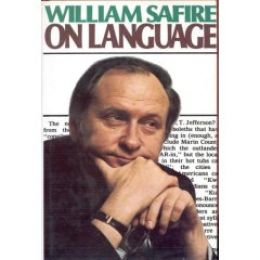
William Safire passed away over the weekend at the age of 79, and his loss is felt particularly strongly by those who loyally followed his “On Language” column in the New York Times Magazine for the past three decades. Safire retired from his Pulitzer Prize-winning political column for the Times in 2005, but he continued to relish his role as “language maven” to the very end. He was not simply a pundit on matters political and linguistic, however: he was also an extremely generous man, both publicly in his philanthropic work with the Dana Foundation and privately with friends and colleagues.

On hearing of his passing, fellow maven Paul Dickson remarked to me that Safire “opened a door which a lot of people got to walk through and play with words as a vocation.” That was certainly true in my case. As a word nerd in training, I read “On Language” religiously every Sunday. When I was perhaps nine or ten, I recall taking issue with something Safire had said in one of his columns and writing a letter to him (in pencil!). Unfortunately, I was too intimidated to follow through and never mailed the letter.

Flash-forward to 2003, when I was bit braver in corresponding with him. He often published requests for assistance from those he dubbed “Lexicographic Irregulars” (word sleuths after the manner of Sherlock Holmes' Baker Street Irregulars). On this occasion he sent out a request about the history of the expression “stay the course.”

More here.

Monday, September 28, 2009

The Owls: A Natural History


A Natural History of My Feet

By Maureen Gibbon

Right after I’m born, I turn yellow with jaundice, so doctors change part of my blood through my heels. Welshman Bérnard Keller gives me the pints. Diolch yn fawr, Bérnard.

When I’m little, my father paints my toenails.

I wear my new first grade shoes everywhere, even with nightgowns.

At fifteen I get round-heeled. I tip backward into backseats and beds.

I leave one pair of shoes in Paris.

Each summer I break in new sandals. What really breaks are blisters.

At twenty-six, my lover tells me my Via Spiga heels are “killer shoes.” I should have used one on him.

In each of my feet, there’s a fan of metatarsals. My skin’s the silk, my talus the rivet.

My ex’s mother lost her legs by inches, starting with her toes.

I plan to keep my feet on the ends of my legs.


Gibbonfoot

*

Maureen Gibbon is the author of Swimming Sweet Arrow, Magdalena, and Thief, a new novel forthcoming from Farrar, Straus & Giroux in 2010. She lives in a meadow in northern Minnesota with black bears and wild turkeys.

*

The Owls is a site for collaborative writing projects. Selections from the site are cross posted here by the generosity of 3QD. Projects appear according to the plans and schedules of their writers and curators. Don’t forget your mittens.

“A Natural History of My Feet” is part of the Natural Histories Project. Curator Sean Hill asked writers to: “Focus in on one particular part of your self, tangible or intangible, and write a natural history of it based on your observations. This could be a natural history of almost anything; for instance, your eyebrows, stretch marks, tongue, ingrown toenails, frowns, tragi, tendency to embellish or ignore the truth, laughs, wanderlust, farts, pragmatism, shins, or asthma.” New Natural Histories appear every Wednesday. Read “A Natural History of My Earlobes” by Danielle Evans and “A Natural History of My Curiosity” by Brian Barker.

Other current projects at The Owls site include:

Days of Awe, an ongoing conversation via Twitter by Gabbat.
A new series of photographs via Flickr by cinematographer Fredrick Schroeder.
New Stamps by Cari Luna, Jonathan Railey, and Elatia Harris.

You can follow updates at The Owls site via RSS or join a free email newsletter by writing to owlsmag(AT)gmail(DOT)com.


Sunday, September 27, 2009

Tito: Between Legend and Thriller

Tito_230w

Slavenka Drakulic in Eurozine:

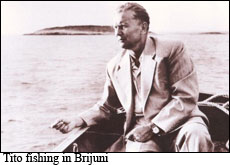
When I imagine paradise on earth, it is as a small, deserted island surrounded by turquoise blue sea, with pine trees and pebble beaches. Exactly like the one I saw the other day, while travelling on a boat towards the Brijuni archipelago in the northern Adriatic near Pula.

Josip Broz Tito must have had the very same idea when he visited the islands for the first time in 1947. However, the difference was that for him, this paradise on earth became reality. Soon afterwards, the late president of the former Yugoslavia moved to a newly built residence in Vanga, one of fourteen islands. After him, no one else had a chance to nurture the same dream. Ordinary mortals could no longer even visit the islands. It is said that the surveillance was so strict that even the fishing village of Fazana, on the mainland directly across from the archipelago, was populated solely by secret policemen and their families.

After Tito’s death in 1980, the Brijuni archipelago was proclaimed a national park. On my visit that day I learned that over the thirty or so years that Tito enjoyed the privilege of living there, he often managed to spend up to four months a year in Vanga and Veli Brijun, which he loved the most. I could find out all about his life in Brijuni in a photographic exhibition from 1984 on the first floor of the local museum. There, in hundreds of sepia coloured photos, I saw him in his role as head of state with his important visitors, as well as in his private moments. I could also see that, during his stay in paradise, Tito not only relaxed. He spent his holidays working – as the head of state, chairman of the communist party and commander of the military. At the same time he played host to political leaders from Fidel Castro to Queen Elisabeth, Indira Gandhi to Willy Brandt, Leonid Brezhnev to the Persian tsar Reza Pahlavi – and many, many others.

MySpace to Facebook = White Flight?

Whiteflight

Dayo Olopade in The Root:

MySpace is no longer cool. As a matter of fact, its number of users is now one-half the size of rival Facebook. Is this because MySpace is too black for the rest of America? Teenage Internet users may hold the answer. High-schoolers report their use of the social-networking giants along racial lines—MySpace is seen as “black,” while Facebook is “white.” And even within the networks, black kids befriend other black kids, Latinos mix with Latinos, and the self-segregation often practiced in real life is rampant online. Danah Boyd, a social media researcher at Microsoft and a fellow at Harvard’s Berkman Center for Internet and Society, compares this dash from MySpace to Facebook to “white flight” from inner cities.

The Root caught up with Boyd after she presented her “white flight” thesis to hundreds at the Personal Democracy Forum, a June conference on technology and politics at the Lincoln Center in New York City.

The Root: Your research is controversial. Are social networks truly segregated? Does teenage behavior really mimic real-life divisions?

Danah Boyd: We’re seeing a reproduction of all kinds of all types of social segregation that we like to pretend has gone away.

Even before Facebook came into play, I was working with a group of kids in a school in Los Angeles. And there was a big difference between the teachers’ language about race, and the students’ language about race. The teachers’ language was: ‘It’s a highly diverse school and all of the classes are deeply integrated, and there are no problems with race.’ That was the meta narrative. When you talk to the students, they say, ‘Well, this area is called Disneyland and that’s where the white kids hang out, and that’s the Ghetto, where the black kids hang out.’ They have all of this language for marking out the schoolyard in this super “diverse” school.

I went and looked at these kids’ MySpace profiles—this is before Facebook. Sixty to 70 percent of them had MySpace profiles that I could find. There were deep segregations in the friending patterns. Latinos friended Latino kids, black kids friended black kids, and white kids friended other white kids. There was very little overlap.

Making the Illegal Legal

Zizekwestbank

Slavoj Zizek on the bureaucracy of the Israeli occupation of the West Bank, in In These Times:

In Palestine Inside Out: An Everyday Occupation, Saree Makdis describes how, while the Israeli occupation of the West Bank is ultimately enforced by the armed forces, it is an “occupation by bureaucracy”: Its primary forms are application forms, title deeds, residency papers and other permits. It is with this micro-management of daily life that Israel secures its slow but steadfast expansion. One has to ask for a permit in order to live with one’s family, to farm one’s land, to dig a well, to go to work, to school, to a hospital.

Though it has been largely ignored by the media, Israel is clearly engaged in a slow, invisible process—a kind of underground digging of the mole—gradually undermining the basis of Palestinian livelihood so that, one day, the world will awaken and realize that there is no more Palestinian West Bank, that the land is Palestinian-free, and that all we can do is accept it.

The story has been going on since 1949: While Israel accepts the peace conditions proposed by the international community, it anticipates that the peace plan will fail. While condemning the openly violent excesses of “illegal” settlements, the State of Israel promotes new “legal” West Bank settlements. A look at the changing map of East Jerusalem, where the Palestinians have been gradually encircled and their space sliced, tells it all. The map of the Palestinian West Bank already looks like a fragmented archipelago.

The condemnation of unsanctioned anti-Palestinian violence obfuscates the true problem of state violence; the condemnation of illegal settlements obfuscates the illegality of the “legal” ones.

A Novel Gearing Up for a Fantastical Feud

From The Washington Post:

Book

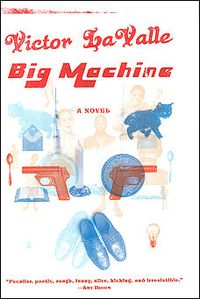
In Victor LaValle's spectacular new novel, “Big Machine,” race and religion are the subterranean tributaries that threaten to destroy America's underclass, even as they help to sustain it. Along with Junot Diaz, Lev Grossman, Kelly Link and Kevin Brockmeier, LaValle is part of an increasingly high-profile and important cohort of writers who reinvent outmoded literary conventions, particularly the ghettos of genre and ethnicity that long divided serious literature from popular fiction. In that spirit, the epigraph for “Big Machine” is from John Carpenter's remake of “The Thing,” and in LaValle's acknowledgments he thanks not just Thomas Paine but also Octavia Butler, Stephen King, Shirley Jackson and “my man Ambrose Bierce,” all of whom stand as spiritual godparents to this sprawling, fantastical work.

“Lurking in toilets was my job,” says Ricky Rice, the novel's narrator. Ricky is a 40-year-old janitor, a recovering junkie and childhood survivor of the Washerwomen, a communal religious cult whose catastrophic, bloody demise evokes that of the Branch Davidians and Philadelphia's MOVE organization. Ricky is cleaning a toilet stall in Utica, N.Y., when he opens a mysterious envelope addressed to him. Inside he finds a one-way bus ticket to Burlington, Vt., as well as a cryptic note: “You made a promise in Cedar Rapids in 2002. Time to honor it.”

More here.

Kids’ Smiles Predict Their Future Marriage Success

From Scientific American:

Kids-smiles-predict-their-future_1

ictures of grinning kids may reveal more than childhood happiness: a study from DePauw University shows that how intensely people smile in childhood photographs, as indicated by crow’s feet around the eyes, predicts their adult marriage success. According to the research, people whose smiles were weakest in snapshots from childhood through young adulthood were most likely to report being divorced in middle and old age. Among the weakest smilers in college photographs, one in four ended up divorcing, compared with one in 20 of the widest smilers. The same pattern held among even those pictured at an average age of 10.

The paper builds on a 2001 study by psychologists at the University of California, Berkeley, that tracked the well-being and marital satisfaction of women from college through their early 50s. That work found that coeds whose smiles were brightest in their senior yearbook photographs were most likely to be married by their late 20s, least likely to remain single into middle age, and happiest in their marriage; they also scored highest on measures of overall well-being (including psychological and physical difficulties, relationships with others and general self-satisfaction).

More here.