Lazy male spiders avoid dinner date

From Nature:

Spider Male spiders that saunter onto a female's web after a rival has spent hours wooing her can quickly copulate without being prematurely eaten by the female. This tactic could lead to small spider suitors seeking out competition with larger rival spiders rather than avoiding it, Canadian researchers say.

The Australian redback spider (Latrodectus hasselti), a member of the black widow family, has a particularly deadly mating ritual. It is one of only a handful of spider species in which the males willingly and actively assist the females with sexual cannibalism — in which the female consumes the male after copulation. In the process of mating, the tiny redback male, whose 4-millimetre body is dwarfed by that of the centimetre-long female, inserts one of his two penis-like organs into one of the female's two sperm-storage sacs. The male then somersaults to place his abdomen over the female's mouthparts, and the female starts eating him as they mate.

More here.
In Shift, Cancer Society Has Concerns on Screenings

Gina Kolata in The New York Times:

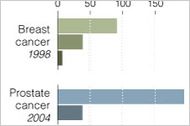
Cancer The American Cancer Society, which has long been a staunch defender of most cancer screening, is now saying that the benefits of detecting many cancers, especially breast and prostate, have been overstated. It is quietly working on a message, to put on its Web site early next year, to emphasize that screening for breast and prostate cancer and certain other cancers can come with a real risk of overtreating many small cancers while missing cancers that are deadly. “We don’t want people to panic,” said Dr. Otis Brawley, chief medical officer of the cancer society. “But I’m admitting that American medicine has overpromised when it comes to screening. The advantages to screening have been exaggerated.”

Prostate cancer screening has long been problematic. The cancer society, which with more than two million volunteers is one of the nation’s largest voluntary health agencies, does not advocate testing for all men. And many researchers point out that the PSA prostate cancer screening test has not been shown to prevent prostate cancer deaths. There has been much less public debate about mammograms. Studies from the 1960s to the 1980s found that they reduced the death rate from breast cancer by up to 20 percent. The cancer society’s decision to reconsider its message about the risks as well as potential benefits of screening was spurred in part by an analysis published Wednesday in The Journal of the American Medical Association, Dr. Brawley said.

More here.

Wednesday Poem

Red Stands Out

Think of the tropisms of hyacinth blooms
canted toward morning in Florida. Think

of slouching pole barns in August in Ohio.
Think of the terrain of exhausted summer

and certain varieties of Rome apple, rust—
the seasonally blistered hands of laborers.

Think of a pair of male cardinals preening
in shade, safe from the blur of knife-blades.

Think of ribboned trees marked for clearing
and the lipstick shivers of crimson brushfires.

Think of blood come to absolve the world
of its chief sin: loving all the wrong things.

Think of neural flarings in the cranial dark
mapped as signature moments on an MRI.

Red stands out. Who can trust bland white
when purity has fallen so far out of fashion?

And blue: so inseparable from sky as to be
ceded to the celestial clockwork of the literal.

Think of red as a definition of transcendence:
that intemperate slit-skirt she made magnificent

teaching you to tango in a bar in Buenos Aires,
the aria of her lies as sweet as won money.

by Roy Bently

from Magnolia, Oct. 20, 2009

An Open Letter to Bill Maher on Vaccinations

Michael Shermer in Skepticblog:

Dear Bill,

Years ago you invited me to appear as a fellow skeptic several times on your ABC show Politically Incorrect, and I have ever since shared your skepticism on so many matters important to both of us: creationism and intelligent design, religious supernaturalism and New Age paranormal piffle, 9/11 “truthers”, Obama “birthers”, and all manner of conspiratorial codswallop. On these matters, and many others, you rightly deserved the Richard Dawkins Award from Richard’s foundation, which promotes reason and science.

However, I believe that when it comes to alternative medicine in general and vaccinations in particular you have fallen prey to the same cognitive biases and conspiratorial thinking that you have so astutely identified in others. In fact, the very principle of how vaccinations work is additional proof (as if we needed more) against the creationists that evolution happened and that natural selection is real: vaccinations work by tricking the body’s immune system into thinking that it has already had the disease for which the vaccination was given. Our immune system “adapts” to the invading pathogens and “evolves” to fight them, such that when it encounters a biologically similar pathogen (which itself may have evolved) it has in its armory the weapons needed to fight it. This is why many of us born in the 1950s and before may already have some immunity against the H1N1 flu because of its genetic similarity to earlier influenza viruses, and why many of those born after really should get vaccinated.

Vaccinations are not 100% effective, nor are they risk free. But the benefits far outweigh the risks, and when communities in the U.S. and the U.K. in recent years have foregone vaccinations in large numbers, herd immunity is lost and communicable diseases have come roaring back. This is yet another example of evolution at work, but in this case it is working against us.

More here.

The Music Genome Project

Rob Walker in the New York Times Magazine:

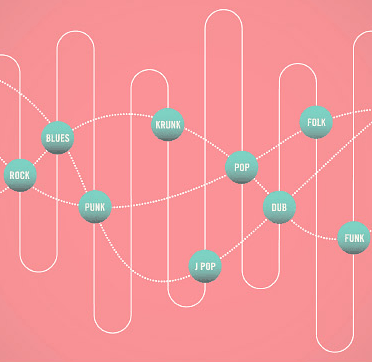
ScreenHunter_02 Oct. 21 11.37 On first listen, some things grab you for their off-kilter novelty. Like the story of a company that has hired a bunch of “musicologists,” who sit at computers and listen to songs, one at a time, rating them element by element, separating out what sometimes comes to hundreds of data points for a three-minute tune. The company, an Internet radio service called Pandora, is convinced that by pouring this information through a computer into an algorithm, it can guide you, the listener, to music that you like. The premise is that your favorite songs can be stripped to parts and reverse-engineered.

Some elements that these musicologists (who, really, are musicians with day jobs) codify are technical, like beats per minute, or the presence of parallel octaves or block chords. Someone taking apart Gnarls Barkley’s “Crazy” documents the prevalence of harmony, chordal patterning, swung 16ths and the like. But their analysis goes beyond such objectively observable metrics. To what extent, on a scale of 1 to 5, does melody dominate the composition of “Hey Jude”? How “joyful” are the lyrics? How much does the music reflect a gospel influence? And how “busy” is Stan Getz’s solo in his recording of “These Foolish Things”? How emotional? How “motion-inducing”? On the continuum of accessible to avant-garde, where does this particular Getz recording fall?

There are more questions for every voice, every instrument, every intrinsic element of the music. And there are always answers, specific numerical ones. It can take 20 minutes to amass the data for a single tune. This has been done for more than 700,000 songs, by 80,000 artists. “The Music Genome Project,” as this undertaking is called, is the back end of Pandora.

More here.

Nearly universal literacy is a defining characteristic of today’s modern civilization; nearly universal authorship will shape tomorrow’s

Denis G. Pelli and Charles Bigelow in Seed:

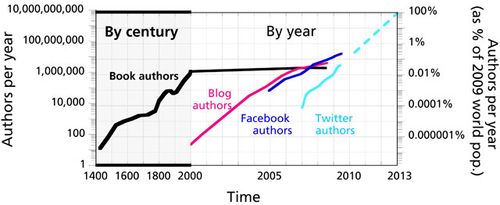
Nearly everyone reads. Soon, nearly everyone will publish. Before 1455, books were handwritten, and it took a scribe a year to produce a Bible. Today, it takes only a minute to send a tweet or update a blog. Rates of authorship are increasing by historic orders of magnitude. Nearly universal authorship, like universal literacy before it, stands to reshape society by hastening the flow of information and making individuals more influential.

To quantify our changing reading and writing habits, we plotted the number of published authors per year, since 1400, for books and more recent social media (blogs, Facebook, and Twitter). This is the first published graph of the history of authorship. We found that the number of published authors per year increased nearly tenfold every century for six centuries. By 2000, there were 1 million book authors per year. One million authors is a lot, but they are only a tiny fraction, 0.01 percent, of the nearly 7 billion people on Earth. Since 1400, book authorship has grown nearly tenfold in each century. Currently, authorship, including books and new media, is growing nearly tenfold each year. That’s 100 times faster. Authors, once a select minority, will soon be a majority.

Authors-per-year_inline_640x262

But does increasing authorship matter? And is this increase a blip or a signpost? Authorship has risen steeply before. The period of the first steep rise, near 1500, coincides with the discovery of the New World and Protestantism, which saw the publication of the first vernacular Bible, translated by Martin Luther. The second, near 1800, includes the Industrial Revolution and its backlash, Romanticism. The current rise is much steeper.

More here.

Tuesday, October 20, 2009

Leap Into Light

William_Butler_YeatsRobert Huddleston in the Boston Review:

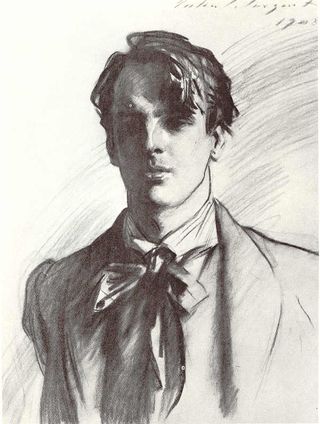
William Butler Yeats has been called the twentieth century’s greatest poet. He may even deserve the title. As Richard Ellmann wrote in his classic study Yeats: The Man and the Masks, “it is not easy to assign him a lower place.” Others may have attempted more; none achieved it. Ezra Pound, T. S. Eliot, Wallace Stevens, and all the other contenders of Yeats’s illustrious generation—none stakes quite the same claim on the imagination, or on the idiom, of our time. “Things fall apart; the centre cannot hold”; “A terrible beauty is born”; “Now days are dragon-ridden, the nightmare / Rides upon sleep.” Even Joyce has his protagonist Stephen Dedalus murmuring lines from Yeats’s early poem “Who Goes with Fergus?” on Sandymount strand: “And no more turn aside and brood / Upon love’s bitter mystery.” Like Shakespeare, Yeats is inescapable.

Yet few critics, including Ellmann, have seemed entirely comfortable with this fact. As a man, Yeats could be personally unappealing, even arrogant and intolerant, although not more so than Eliot and less so than Pound. The problem with casting Yeats as the ne plus ultra of twentieth-century poets stems from the fact that his work defies preconceptions about what a sufficiently modern—and specifically Modernist—poetry should be. Yeats’s ties to the nineteenth century and the legacy of Romanticism were vital and strong. Most importantly, Yeats forsook radical formal innovation and was instead a lifelong advocate of traditional poetic meter and form. However, as Calvin Bedient writes in The Yeats Brothers and Modernism’s Love of Motion—his lively new study of the poet and his brother, the painter Jack Yeats—“Yeats knew what technical resources to call upon to convey movement as force.” Despite the conventionality of its composition, Bedient maintains, Yeats’s work is a revelation and enactment of the twentieth century’s discoveries about the nature of the physical world and of the human psyche. He is the poet of dynamism, of “creative destruction,” and also of violence and horror.

lolita cover contest

Suzene-Ang1-187x300

In judging the submissions I tended to avoid lingerie, lollipops, roses, hearts, lipstick prints, butterflies, heart shaped sunglasses, and overtly sexual poses (as well as the unexpected recurring themes of swings and Rorschach blots) which by now have been indelibly linked to the cultural concept “Lolita” if not the novel itself. It’s important to keep in mind that the novel may be considered a love story, but it’s not Lolita who is in love. And, of course, well beyond that one can explore the brutality and humor of the novel, the beauty of the prose and the cleverness of the wordplay. This is a tall order for a book cover, and of necessity draconian choices must be made. I was able to narrow my selection to fifteen or so covers, from which I chose four that were conceptually quite different but all excellent. Keep in mind that any of these could have been first place covers.

more from Crikey here.

laden with experience, and yet somehow jaunty

Ideas2__1255806998_7898

WHO WILL SAY a good word for the cliché? Its sins are so numerous. Exhausted tropes, numb descriptors, zombie proverbs, hackneyed sentiments, rhetorical rip-offs, metaphorical flat tires, ideas purged of thought and symbols drained of power – the cliché traffics in them all. A lie can be inventive; an insult can be novel. Even plagiarism implies a kind of larcenous good taste. But a cliché is intellectual disgrace. The word itself seems to shape the mouth into a Gallic sneer. Writers of course have always been extra-spooked by cliché. “Shall I compare thee to a summer’s day?” No, I don’t think I shall – because somebody else already did that. And in 2001 Martin Amis officially declared war against cliché with a book entitled, uh, “The War Against Cliché.” “All writing,” he proclaimed, pennants flying, “is a campaign against cliché. Not just clichés of the pen but clichés of the mind and of the heart.” And indeed Amis in his dazzling career has routed cliché, scattered it, seen it off with a thousand boilingly brilliant and novel images.

more from James Parker at the Boston Globe here.

Tuesday Poem


Impatiens/Jewelweed

The first: domestic, tamped in pots,
Unloaded into wheelbarrows, fitted tight in plastic trays.
Her foliage is sweet: leaf hearts; her petals symmetrical and flat.
She bides inside your gate, keeps low and still,
Faints easily from lack of drink and too much sun,
Though on occasion, after dark, she might
Dare light your way along the primrose path
Of you-know-what. Summer’s end, her ribbed pods
Swell, implore you for release.
Best keep her locked and watered.

Her wild twin just won’t be bartered,
Won’t be packed in sixes, sold, dangled from a fence.
She grows tall and full of juice along the river, woods.
And those gem-like mouths—red and orange wrath,
And laughter—simply nod, refusing to take fright
At foxes, squall, or stomping deer. Alone
On no man’s land, she procreates at will,
Or wills wind or quill to pop her. Silver paths
Crisscross her leaves; it’s just a fancy maze
That leads back where you started. Touch her. Touch her nots.


by Sarah Hannah

from Inflorescence, Tupelo Press
via Writers and Artists

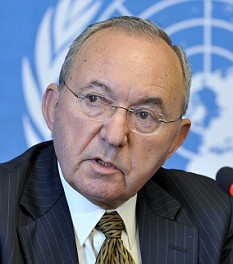
Goldstone on the Goldstone Report: My mission – and motivation

Richard Goldstone in The Jerusalem Post:

Richard_Goldstone I begin with my own motivation, as a Jew who has supported Israel and its people all my life, for having agreed to head the Gaza mission. Over the past 20 years, I have investigated serious violations of international law in my own country, South Africa, in the former Yugoslavia, in Rwanda and the alleged fraud and theft by governments and political leaders in a number of countries in connection with the United Nations Iraq Oil for Food program. In all of these, allegations reached the highest political echelons. In every instance, I spoke out strongly in favor of full investigations and, where appropriate, criminal prosecutions. I have spoken out over the years on behalf of the International Bar Association against human rights violations in many countries, including Sri Lanka, China, Russia, Iran, Zimbabwe and Pakistan.

I would have been acting against those principles and my own convictions and conscience if I had refused a request from the United Nations to investigate serious allegations of war crimes against both Israel and Hamas in the context of Operation Cast Lead.

As a Jew, I felt a greater and not a lesser obligation to do so. It is well documented that as a condition of my participation I insisted upon and received an evenhanded mandate to investigate all sides and that is what we sought to do.

More here.

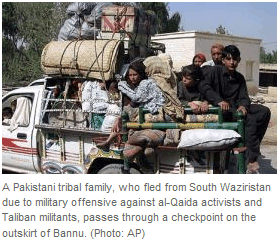
A New Battle Begins in Pakistan

Syed Saleem Shahzad in Common Dreams:

ScreenHunter_01 Oct. 20 11.28 On Monday, clashes between the Pakistan military and the militants continued for the third day in South Waziristan. Islamabad says that 60 militants have been killed, with 11 soldiers dead.

The army had serious reservations about sending ground troops into South Waziristan, firstly for fear of a strong militant backlash in other parts of the country and secondly because there is no guarantee of success. However, under pressure from the United States, and with the carrot of US$1.5 billion a year for the next fives years in additional non-military aid, Pakistan's political government has bitten the bullet. The timing might have been influenced by a string of militant attacks in the country over the past few days.

The offensive is concentrated in the areas of the Mehsud tribe in South Waziristan, which is also the headquarters of the Tehrik-i-Taliban Pakistan (TTP).

In preparation for the assault, the army made ceasefire deals with several influential Taliban warlords who run large networks against coalition troops in Afghanistan. They include Mullah Nazir, the chief of the Taliban in Wana, South Waziristan, who operates the largest Taliban network in the Afghan province of Paktika. Mullah Nazir is neutral in this Pakistani conflict and agreed to allow passage to the army to enter Mehsud territory.

In North Waziristan, two top Taliban commanders, Hafiz Gul Bahadur and Moulvi Sadiq Noor, also agreed to remain neutral. They are members of the Shura of the Mujahideen and a main component of the Taliban's insurgency in the Afghan province of Khost.

This leaves a few thousand Mehsud tribal fighters along with their Uzbek and Punjabi militant allies to fight against the military. Thousands of civilians have fled the area.

However, Hakimullah Mehsud of the TTP, according to Asia Times Online contacts, has apparently adopted a strategy that will not expend too many resources on protecting the Mehsud area. Instead, he aims to spread chaos by attacking security personnel in the cities.

More here. [Thanks to Muhammad Idrees Ahmad.]

Lard Lesson: Why Fat Lubricates Your Appetite

From Scientific American:

Lard-lesson-why-fat-lubri_1 When you've spent the weekend splurging on greasy fast foods, your bathroom scale isn't alone in reeling from the impact. Your brain does, too. New research shows just how saturated fat tricks us into eating more and elucidates the evolutionary basis for the propensity for poundage in developed nations. Our brain physiology, it seems, is glaringly out-of-date in the modern world.

Researchers have long known that the hormones leptin and insulin play key roles in appetite and food intake. In healthy people leptin, which is secreted by fat tissue, acts as a molecular measuring tape for our waistlines, quashing feelings of hunger. Insulin spikes when the pancreas gets a whiff of the blood sugar increase after a meal; once the brain detects the spike, it knows to tamp down the desire for food.

More here.

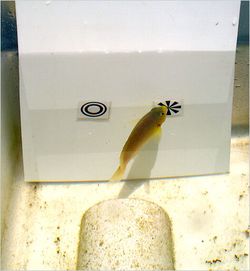
For Fish in Coral Reefs, It’s Useful to Be Smart

Sean Carroll in The New York Times:

Creature.450 I have long suspected that fish are smarter than we give them credit for.

As a child, I had an aquarium with several pet goldfish. They certainly knew it was feeding time when my hand appeared over their tank, and they excitedly awaited their delicious fish flakes. They also exhibited a darker, disturbing behavior. Evidently, a safe life with abundant food was not fulfilling. From time to time, either sheer ennui or the long gray Toledo winter got to one of the fish and it ended its torment with a leap to my bedroom floor. Maybe my anthropomorphizing is a bit over the top. But, really, just how smart are fish? Can they learn?

A 10-gallon tank with a plastic sunken pirate ship is certainly not the most stimulating habitat. But in the colorful, diverse and dangerous world of coral reefs, fish must be able to recognize not only food, but also to discriminate friends from foes, and mates from rivals, and to take the best action. In such a complex and dynamic environment, it would pay to be flexible and able to learn. A series of studies has recently revealed that reef fish are surprisingly adaptable. Freshly caught wild fish quickly learn new tasks and can learn to discriminate among colors, patterns and shapes, including those they have never encountered. These studies suggest that learning and interpreting new stimuli play important roles in the lives of reef fish.

More here.

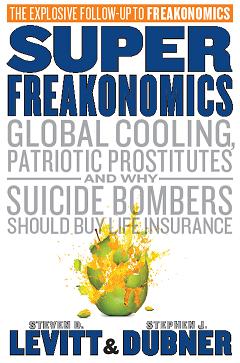
Everything in Superfreakonomics About Global Warming Is Wrong

Tim Lambert in Deltoid:

Superfreakonomics-bookcover I reviewed Freakonomics when it first came out and really liked it. So I was looking forward to the sequel Superfreakonomics. Unfortunately, Levitt and Dubner decided to write about global warming and have made a dreadful hash of it. The result is so wrong that it has even Joe Romm and William Connolley in agreement.

So what went wrong? One possibility is that Freakonomics was superficially plausible but also rubbish, and it was only when they wrote about an area where I was knowledgeable that I noticed. But I don't think this is the correct explanation. I've read the journal papers on sumo cheating, Lojack and abortion and crime that they cite in Freakonomics and they are fairly represented. Superfreakonomics, on the other hand, misrepresents the scientific literature on global warming. The difference here is that the papers cited by Freakonomics were Levitt's own work and he understood them, while Levitt and Dubner do not understand the climate science literature. This by itself would not be fatal, but what has taken them off the cliff is the Freakonomics formula: “What you thought you knew about X is wrong!”. If you want to apply this formula to global warming you can easily find many superficially plausible arguments on why the mainstream science is wrong. Bang those into your chapter on global warming without bothering to check their accuracy and the only work that remains is the tour to promote your book.

But enough on why they got everything wrong. Let's look at what they got wrong.

More here. [Thanks to Sean Carroll.]

And speaking of global warming, check out this “cool” project for kids. [Thanks to Jane Langley.]

Monday, October 19, 2009

Sunday, October 18, 2009

The Case for Humility in Afghanistan

A Taliban victory would have devastating consequences for U.S. interests. But to avoid disaster, America must beware the Soviet Union’s mistakes — and learn from its own three decades of failure in South Asia.

Steve Coll in Foreign Policy:

ScreenHunter_04 Oct. 19 10.11 To protect the security of the American people and the interests of the United States and its allies, we should persist with the difficult effort to stabilize Afghanistan and reverse the Taliban's momentum. This will probably require additional troops for a period of several years, until Afghan forces can play the leading role.

However, that depends on the answer to Gen. Colin Powell's reported question, “What will more troops do?” As Gen. Stanley McChrystal wrote in his recent assessment, “Focusing on force or resource requirements misses the point entirely.” Instead — after years of neglect of U.S. policy and resources in Afghanistan and after a succession of failed strategies both in Afghanistan and Pakistan — the United States, as McChrystal put it, has an “urgent need for a significant change to our strategy and the way that we think and operate.” While I cannot endorse or oppose McChyrstal's specific prescriptions for the next phase of U.S. engagement in Afghanistan because I do not know what they are, I do endorse the starting point of his analysis, as well as his general emphases on partnering with Afghan forces and focusing on the needs of the Afghan population. I believe those emphases are necessary but insufficient.

More here. [Thanks to Feisal H. Naqvi.]

How Messy it All Is

David Runciman reviews Richard Wilkinson and Kate Pickett's The Spirit Level: Why More Equal Societies Almost Always Do Better in the LRB:

The argument of this fascinating and deeply provoking book is easy to summarise: among rich countries, the more unequal ones do worse according to almost every quality of life indicator you can imagine. They do worse even if they are richer overall, so that per capita GDP turns out to be much less significant for general wellbeing than the size of the gap between the richest and poorest 20 per cent of the population (the basic measure of inequality the authors use). The evidence that Wilkinson and Pickett supply to make their case is overwhelming. Whether the test is life expectancy, infant mortality, obesity levels, crime rates, literacy scores, even the amount of rubbish that gets recycled, the more equal the society the better the performance invariably is. In graph after graph measuring various welfare functions, the authors show that the best predictor of how countries will rank is not the differences in wealth between them (which would result in the US coming top, with the Scandinavian countries and the UK not too far behind, and poorer European nations like Greece and Portugal bringing up the rear) but the differences in wealth within them (so the US, as the most unequal society, comes last on many measures, followed by Portugal and the UK, both places where the gap between rich and poor is relatively large, with Spain and Greece somewhere in the middle, and the Scandinavian countries invariably out in front, along with Japan). Just as significantly, this pattern holds inside the US as well, where states with high levels of income inequality also tend to have the greatest social problems. It is true that some of the most unequal American states are also among the poorest (Mississippi, Louisiana, West Virginia), so you might expect things to go worse there. But some unequal states are also rich (California), whereas some fairly equal ones are also quite poor (Utah). Only a few (New Hampshire, Wyoming) score well on both counts. What the graphs show are the unequal states tending to cluster together regardless of income, so that California usually finds itself alongside Mississippi scoring badly, while New Hampshire and Utah both do consistently well. Income inequality, not income per se, appears to be the key. As a result, the authors are able to draw a clear conclusion: ‘The evidence shows that even small decreases in inequality, already a reality in some rich market democracies, make a very important difference to the quality of life.’ Achieving these decreases should be the central goal of our politics, precisely because we can be confident that it works. This is absolutely not, they insist, a ‘utopian dream.