
Marching
At dawn I heard among bird calls
the billions of marching feet in the churn
and squeak of gravel, even tiny feet
still wet from the mother's amniotic fluid,
and very old halting feet, the feet
of the very light and very heavy, all marching
but not together, criss-crossing at every angle
with sincere attempts not to touch, not to bump
into each other, walking in the doors of houses
and out the back door forty years later, finally
knowing that time collapses on a single
plateau where they were all their lives,
knowing that time stops when the heart stops
as they walk off the earth into the night air.
by Jim Harrison
from Saving Daylight;
Copper Canyon Press, 2006
Category: Recommended Reading
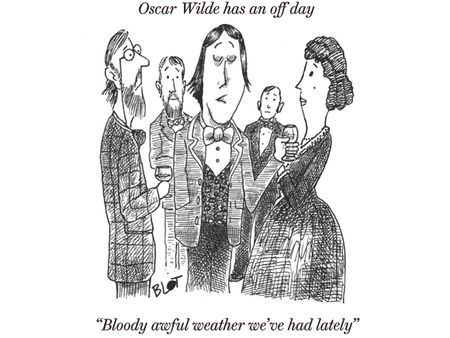
Oscar Wilde
From Prospect Magazine:
Luminous 3-D Jungle Is a Biologist’s Dream
From The New York Times:
When watching a Hollywood movie that has robed itself in the themes and paraphernalia of science, a scientist expects to feel anything from annoyance to infuriation at facts misconstrued or processes misrepresented. What a scientist does not expect is to enter into a state of ecstatic wonderment, to have the urge to leap up and shout: “Yes! That’s exactly what it’s like!” So it is time for all the biologists who have not yet done so to shut their laptops and run from their laboratories directly to the movie theaters, put on 3-D glasses and watch the film “Avatar.” In fact, anyone who loves a biologist or may want to be one, or better yet, anyone who hates a biologist — and certainly everyone who has ever sneered at a tree-hugger — should do the same. Because the director James Cameron’s otherworldly tale of romance and battle, aliens and armadas, has somehow managed to do what no other film has done. It has recreated what is the heart of biology: the naked, heart-stopping wonder of really seeing the living world.
The real beauty of it, though, is that you do not have to be a scientist to enjoy the experience. “Avatar” is well within reach of becoming the highest-grossing film of all time. And while the movie’s dazzling animation and use of 3-D has received so much attention, it cannot be anything but the intense wonder so powerfully elicited, rather than merely the technical wizardry itself, that has people lining up to see it.
More here.
A new memoir of Osama bin Laden by his wife and son
Thomas Hegghammer in The National:
Omar was initially in denial about his father’s responsibility for September 11, but he gradually came to terms with it and began distancing himself publicly from the elder bin Laden. In 2007 he married a British woman 24 years his senior, left Saudi Arabia for Qatar and began seeking political asylum in various European countries. According to Jean Sasson, Omar himself contacted the publisher with the book proposal in 2008. One suspects that the book is partly an attempt by Omar to convince the outside world of his peaceful intentions and to increase his prospects of moving to the West. Omar’s bitterness toward his father shines through in the text, but not to the point of undermining his own credibility.
It is much less clear what motivated Najwa bin Laden, who was still married to Osama when she wrote the book (and still is, as far as we know). Najwa, who has lived in her native Syria since 2001, seems to have been a reluctant participant of this book project. It was allegedly Jean Sasson who suggested she be a co-author, and she only agreed after being persuaded by Omar. Perhaps she is hoping that the book will help dissociate her children from their father’s legacy and make their lives easier.
At any rate, Najwa is considerably less critical than Omar toward Osama; she neither condemns nor supports her husband’s activities. She comes across as a naive, subservient figure with few political opinions of her own. She prefers to talk about family matters and wants to appear as a loyal wife while showing empathy with the victims of her husband’s attacks. Her position is understandable, but annoyingly spineless. Still, her description of events seems sincere. On the whole, the book must be taken seriously as a historical document.
More here.
Malika Pukhraj: Tum Meray Pas Raho
If Haiti is to `build back better’
Paul Farmer, founder of Partners In Health, in the Miami Herald:
A few months ago, I joined President Clinton as a volunteer to, in his words, help Haiti “build back better'' after a series of storms in 2008 destroyed an estimated 15 percent of already beleaguered Haiti's GDP. We had just been meeting about these efforts and a series of upcoming forums to be held in Port-au-Prince, and I was then going to join colleagues from Partners In Health in central Haiti, where I have had the good fortune to work with remarkable Haitian medical colleagues for many years. The day before our New York meeting, Port-au-Prince was flattened by an earthquake. There is not a lot left to be said, but having just returned from Port-au-Prince, there are some points worth underlining.
If Haiti is to “build back better,'' as President Clinton has been saying, there are lessons to be learned from our efforts, not always honorable or effective, to help Haiti over the past two centuries. This can change and must do so, if we are to be real partners in responding to this latest misfortune.
The scale of the disaster is coming into view. All of the clichés born of extremity came to mind as I saw the city of Port-au-Prince in the dark after this huge earthquake. Symbols of authority and some sort of civility were flattened or tottering. The National Palace looked like a meringue pie that had been sat on. A foul smell hung over the General Hospital, which had just run out of diesel fuel and was surrounded by the injured, the sick, and, of course, piles of those who did not make it. But contrary to rumors of looting and mayhem, the city of two million was quiet, which in itself was unusual. I had never experienced Port-au-Prince without the blaring of radios and car horns. And I expect it will remain this way — calm, as long as people are offered dignity and respect and the necessities of daily survival: food, water, sanitation and shelter.
More here. And this video with Dr. Farmer is from 60 Minutes:
Watch CBS News Videos Online
Monday, January 18, 2010
perceptions

Sunday, January 17, 2010
The Two Gentlemen of Lebowski

[Enter LEBOWSKI, on a cart. Exit BRANDT]
LEBOWSKI
Marry, sir!—You be Lebowski, I be Lebowski, ‘tis a wondrous strange comedy of errors. But I am a man of business, as I imagine you are; tell me what you’d have me do for you.
THE KNAVE
Sir, I possess a rug, that, i’faith, tied the room together—
LEBOWSKI
You sent Brandt a messenger on horseback; he inform’d me. Where is my fitting?
THE KNAVE
They sought thee, these two gentlemen—
LEBOWSKI
I shall repeat; you sent Brandt a messenger on horseback; he inform’d me. Where is my fitting?
THE KNAVE
Then thou art aware ‘twas thy rug, sir, that was the target of this crime.
LEBOWSKI
Was it I, sir, who urinated on your rug?
[H/t: Darcy James Argue]
Raymond Geuss’ 60 Second Idea
Over at the BBC, E. O. Wilson, Hans Ulrich Obrist and Raymond Geuss discuss Geuss's idea to change the world.
Jyoti Basu, 1914-2010
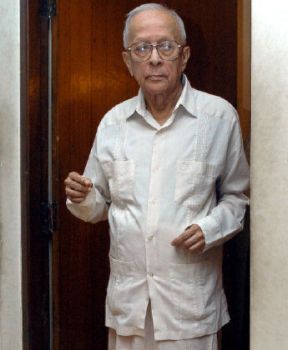
Mr. Basu was India’s pre-eminent Communist leader, and one of post-independence India’s greatest and most respected mass political leaders. He was the last of the nine founding Polit Bureau members and India’s longest-serving Chief Minister.
Mr. Basu was a man of immense charisma, and one whose faith in the people was unflinching. He lived a full life, characterised by struggle and by successes in government that few other political leaders in India have been able to match. He was immaculate in dress and bearing, a person of extraordinary personal discipline, and, well into his 80s, known for the briskness of his stride, and for consistently outpacing the security guards who accompanied him.
A byword for intellectual, political and personal integrity and for a straightforward, self-assured and imperturbable style in politics, Mr. Basu made a profound, long-term difference to the large, populous and strategically important State that was his first priority and commanded his best efforts. As has been widely noted, his enduring legacy as Chief Minister of West Bengal between 1977 and 2000 includes land reforms, accountable governance, functioning panchayat institutions, and the creation of a stable atmosphere of communal harmony and secularism.
However, those who remember him chiefly as India’s longest-serving Chief Minister are likely to underestimate his long experience in the crucible of struggle: as a trade union organiser, as a popular agitator, and as a revolutionary fighter – starting, as was typical for his generation, as a freedom fighter and courageously facing and overcoming state-sponsored repression and intolerance in independent India as well. They are likely also to underestimate the inner resources of one of the most attractive and gifted mass political leaders that India, or indeed any country, has seen over the past half century.
1st September 1939
motorcrash
betty boop
Haiti – A Historical Timeline
From The Root:
1492 – Dec. 5, Columbus lands on a large island he names Isla Española (Spanish Island), later changed to Hispaniola. It is inhabited by Taino and Arawak Indians.
1503 – First Africans brought to Hispaniola for labor after pleas from a Spanish priest who wants to save the Indians from extinction.
1592 – Spanish governor executes Queen Anacaona, the last Taino chief.
1659 – First official settlement on Tortuga (off the coast of Haiti) by French buccaneers who hunt wild cattle and by pirates who attack ships sailing from South America to Europe.
1664 – French West India Company takes control of Western third of the island and names it Saint-Domingue.
1670 – First French settlement on the main island, named Cap Francois, later Cap-Français and now Cap-Haitien, the second largest city in Haiti. Settlers grow cacao, coffee, tobacco and indigo and begin importing slaves as labor.
1685 – Louis XIV enacts the Code Noir, which regulates the treatment of slaves and sets obligations for owners. Corporal punishment is allowed, sanctioning brutal treatment.
1697 – Spain formally cedes the Western third of the island to France via the Treaty of Ryswick.
1749 – Port-au-Prince is founded.
More here.
The Education of a British-Protected Child
Sameer Rahim in The Telegraph:
In June 1958 William Heinemann published a first novel by a Nigerian radio producer called Chinua Achebe. Things Fall Apart was immediately recognised for its subtle portrayal of tribal life in Igboland, the area of south-east Nigeria where Achebe was born and raised. After 52 years that book has become a classic of world literature. In an essay in Achebe’s new book, The Education of a British-Protected Child, the author reflects on the appreciative letters he has received from readers of all backgrounds. “In spite of serious cultural differences,” he writes, “it is possible for readers in the West to identify, even deeply, with characters and situations in an African novel.”
The novel’s title is taken from Yeats’s “The Second Coming”: “Things fall apart; the centre cannot hold; / Mere anarchy is loosed upon the world.” At the novel’s centre is the village of Umuofia and its strongest personality, Okonkwo. We see his life destroyed by a series of calamities, the most significant of which is the British arrival in Igboland. He is impotent when his son abandons his tribal religion to attend a mission school. When it emerges that the British have brought not only a religion, but also a government and a queen, Okonkwo’s refusal to compromise leads to his tragic end.
More here.
Quantum theory via 40-tonne trucks
Marcus Chown in The Independent:
In the mid-1980s, I was lucky enough to be taught by Feynman as a student at the California Institute of Technology in Pasadena. Before arriving at Caltech, I had watched a BBC TV Horizon programme about the man. For 50 minutes, the camera simply focused on Feynman while he talked engagingly about his life, his children and his father, who had no formal education but had nevertheless infected Feynman with a deep curiosity about the world. Unusually, my mum watched the whole thing, declaring when it was finished: “What an interesting man.”
Now my mum had no interest whatsoever in science, and I was forever trying to explain to her why, for instance, people in Australia did not fall off the other side of the world. So when I arrived at Caltech, I had an idea: plucking up my courage, I knocked on Feynman's office door and asked, nervously, whether he would write to my mum.
He did. “Dear Mrs Chown,” he wrote. “Please ignore your son's attempts to teach you physics. Physics is not the most important thing. Love is. Richard Feynman.”
It wasn't quite what I had expected. It is not every day, after all, that the world's greatest living physicist announces that physics is not the most important thing. But I was not discouraged. Although my attempt to explain science to my mum had ended in abject failure, I persisted in trying to communicate the fun things I had learnt at Caltech, eventually becoming a science writer.
More here.
Todd Shea reports from Haiti
Frans de Waal and David Berreby talk about empathy and more
Dork: The Adventures Of Robin ‘Einstein’ Varghese
From Spicezee Bureau:
‘Dork: The Incredible Adventures of Robin ‘Einstein’ Varghese’ by Sidin Vadukut is nothing less than delightful. The incredible adventures of the protagonist – Robin ‘Einstein’ Varghese is sure to keep you in splits.
A stupendously naïve but academically gifted young man, Robin graduates from one of India’s best business schools with a Day-Zero job at the Mumbai office of Dufresne Partners, a mediocre mid-market management consulting firm largely run by complete morons.
Through a stunning series of blunders, mishaps and inadvertent errors, Robin begins to make his superiors rue the day they were driven by desperation into hiring him. To make matters worse, Robin realises that his mad, passionate, one-sided relationship with batchmate Gouri Kalbag might be over before it even started.
With things going spectacularly wrong, will he manage to achieve his short-term goal of being promoted to Associate in under a year, and beat the record set by Boris Nguyen at Dufresne’s Vietnam office?
Published by Penguin, the book is the hilarious story of Robin, super-dork and unlikely corporate hero, for all of those who’ve ever sat depressed in cubicles and wanted to kill themselves with office stationery.
[Okay, so I modified the actual cover of the book—shown here in the 2nd picture—just a little! I think it looks better with Robin's real face on it. No?]
Saturday, January 16, 2010
Naomi Klein on how corporate branding has taken over America
From The Guardian:
In May 2009, Absolut Vodka launched a limited edition line called “Absolut No Label”. The company's global public relations manager, Kristina Hagbard, explained that “For the first time we dare to face the world completely naked. We launch a bottle with no label and no logo, to manifest the idea that no matter what's on the outside, it's the inside that really matters.”
A few months later, Starbucks opened its first unbranded coffee shop in Seattle, called 15th Avenue E Coffee and Tea. This “stealth Starbucks” (as the anomalous outlet immediately became known) was decorated with “one-of-a-kind” fixtures and customers were invited to bring in their own music for the stereo system as well as their own pet social causes – all to help develop what the company called “a community personality.” Customers had to look hard to find the small print on the menus: “inspired by Starbucks”. Tim Pfeiffer, a Starbucks senior vice-president, explained that unlike the ordinary Starbucks outlet that used to occupy the same piece of retail space, “This one is definitely a little neighbourhood coffee shop.” After spending two decades blasting its logo on to 16,000 stores worldwide, Starbucks was now trying to escape its own brand.
More here.
Here's the bottom line: If things don't start improving very rapidly, then life and limb-threatening infections and deadly dehydration and unnecessary conflict will likely emerge within the affected population on a scale that has the potential of becoming rampant and widespread, resulting in more death and injury that could still be avoided, though time is fast running out. The current path to giving Haiti the relief it desperately needs is simply taking way too long in developing in order to be a reasonable and defensible short term emergency strategy. Each country should, by now, be realizing that it is very much the correct option would be to stage multiple and overwhelmingly robust and well managed multi-national supply lines and helicopter sorties using locations and bases other than Port Au Prince Airport, particularly from the Dominican Republic through the border near Jumani, D.R. It's 7-10 hours by road (depending on the kind of vehicle and size of the load), but it's a darn good road compared to the roads in the Pakistan earthquake affected areas that I've been traveling on for the past four years. Distributing aid from several points over a more widespread area can reach far more people far more quickly.