Pakistan’s Universities: The New War Within

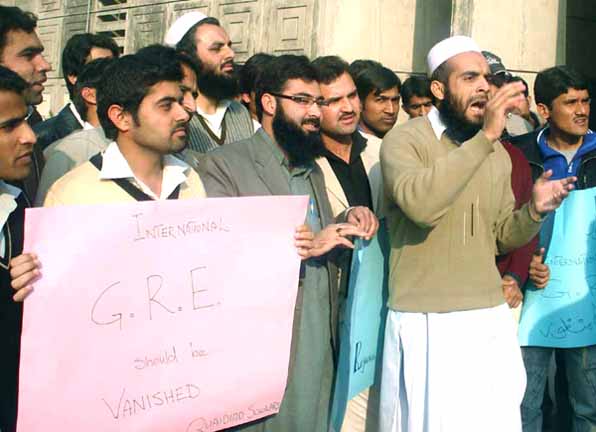
GRE Protest

[This article was first published in Dawn on January 25, 2010. It is posted here with corrections, and with Dr. Hoodbhoy's permission. Photo also provided by Dr. Hoodbhoy.]

by Pervez Hoodbhoy

Dark clouds are gathering over Pakistan’s universities, portending a conflict that is likely to be long, bitter, and uncertain in outcome. On one side are those who say that individuals to be awarded PhD degrees must have, at the very minimum, undergraduate level knowledge in the relevant discipline. On the other side are PhD aspirants, together with their supervisors, who demand unearned degrees. They hold that passing examinations and taking courses is unnecessary and an affront to their dignity.

The first volleys have already been fired. Earlier this month about one hundred students, registered for the PhD degree at Quaid-e-Azam University, angrily mobbed the executive director of the Higher Education Commission (HEC) as he entered the campus. Their demand: cancel the current requirements of passing the international Graduate Record Examinations (GRE) as well as taking and passing graduate level courses. They say that producing research papers entitles them to receive the highest degree in their chosen discipline.

To his credit, the HEC officer stood his ground. He pleaded that removing essential graduation requirements would make their degrees meaningless, that they really did need to know subject basics before doing research, etc. But these obvious and sensible arguments cut no ice with those who believe that PhD degrees are a birthright. Rhythmic cries “hum nahin mantay zulm kay zabtay” (we will not tolerate tyranny!) reverberated across the campus. This leads one to wonder: for how long can the HEC withstand such pressures? What if the floodgates give way?

Read more »

Tuesday, January 26, 2010

See No Evil

Klausen_84x84 An interview with Jytte Klausen in Eurozine, originally in the Index on Censorship:

Jytte Klausen's book The Cartoons That Shook the World (published by Yale University Press) is the first scholarly examination of the notorious controversy that erupted in 2006. Klausen is a respected scholar: she won the Carnegie Scholars Award for her research on Muslims in Europe and is professor of comparative politics at Brandeis University in the US. Three years ago, she set out to unravel the genesis of the debacle and to analyse the cartoons and their impact. Last summer, several months before publication, Yale University Press unexpectedly took the decision not to publish the cartoons in her book. After reading Klausen's manuscript in the spring, the director of the press, John Donatich, was ambivalent about republishing the cartoons: on grounds of taste, offence and the possibility that it might reignite the conflict. He also noted that the cartoons were available for readers to see online. He consulted Yale University who assembled an advisory panel of diplomats, academics and US and UK counter-terrorism officials who advised that there was a strong chance of violence breaking out if the cartoons were published. Klausen was told that she could only read the dossier that Yale had compiled of the panel's opinions if she signed a gagging order. Not only were the cartoons removed from the book, but historic illustrations of Mohammed that Klausen had wanted to include to illustrate her thesis were also omitted. When the story leaked to the American press last summer, Yale was widely criticised for undermining academic freedom. Christopher Hitchens described it as “the latest and perhaps the worst episode in the steady surrender to religious extremism”. In a statement, Yale University Press defended its decision with reference to the expert panel's advice “that there existed a substantial likelihood of violence that might take the lives of innocent victims”. John Donatich took full responsibility for the final decision, but there have been concerns at the university's intervention in the press's independence. (Index on Censorship)

Index: Was there any discussion about the cartoons at the time of signing the contract for the book three years ago? Or any anticipation that there might be a difficulty about publishing them?

Jytte Klausen: I warned the press and the commissioning editor Jonathan Brent that I intended to include the cartoons. He was extremely supportive of that and wanted the page [in the book]. We had some discussions about how it was going to be done and I insisted that it had to be put in as part of a set of documentation.

My idea was not to engage the provocation of: “Do I now dare to print these bad pictures or not?” That would never be my purpose. My purpose was to get the whole page from the newspaper as it was reprinted that day. There have been many misunderstandings and often the online versions of the cartoons have incorrect translations of the captions. In the book, and it was written with this purpose, I ask the reader to put on different glasses and look at the images and analyse them from the vantage point of the different arguments that were made against and for the cartoons at the time. What would a Danish reader see? What did the cartoonist intend to show? Why would a secular Muslim say they were Islamaphobic? Why would a religious Muslim say they were blasphemous?

The “Devastating” Decision

Ronald Dworkin in the New York Review of Books:

ScreenHunter_04 Jan. 26 16.50 Against the opposition of their four colleagues, five right-wing Supreme Court justices have now guaranteed that big corporations can spend unlimited funds on political advertising in any political election. In an opinion written by Justice Anthony Kennedy and joined by Chief Justice John Roberts and Justices Samuel Alito, Antonin Scalia, and Clarence Thomas, the Court overruled established precedents and declared dozens of national and state statutes unconstitutional, including the McCain-Feingold Act which forbade corporate or union television advertising that endorses or opposes a particular candidate.

This appalling decision, in Citizens United v. Federal Election Commission, was quickly denounced by President Obama as “devastating”; he said that it “strikes at our democracy itself.” He is right: the decision will further weaken the quality and fairness of our politics.

More here. And here's Glenn Greenwald on the decision:

ScreenHunter_01 Jan. 26 16.44 I want to note one extremely bizarre aspect to the discussion yesterday. Most commenters (though not all) grounded their opposition to the Supreme Court's ruling in two rather absolute principles: (1) corporations are not “persons” and thus have no First Amendment/free speech rights and/or (2) money is not speech, and therefore restrictions on how money is spent cannot violate the First Amendment's free speech clause. What makes those arguments so bizarre is that none of the 9 Justices — including the 4 dissenting Justices — argued either of those propositions or believe them. To the contrary, all 9 Justices — including the 4 in dissent — agreed that corporations do have First Amendment rights and that restricting how money can be spent in pursuit of political advocacy does trigger First Amendment protections.

More here.

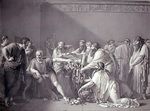
Hippocrates

Hippocrates-alex

For the sake of propriety, although it was far too late for propriety, when I was sent away from Jaffna to Colombo, I travelled in the company of another girl. She, unlike me, had done nothing wrong, and when the train jostled us so that our sweaty wrists touched, she jerked her body away from mine, and I thought I deserved it. We had known each other since we were very young, and for many years had touched each other in the familiar way of friends and schoolmates and neighbours, but that did not matter now. When I had returned to Jaffna, no one in our village had asked me about what I had done while I was with the Tigers. They had assumed, and rightly, I thought then, that I was apart from them, and that I could not return to the life to which I had been born. No one spoke of where I had gone, or with whom I had travelled. This was not from any code of silence, but rather a sense of futility: there was no point in discussing what had already happened. We had reached a moment at which living took so much effort that no one could spare the breath to speak to me. I understood this and was not offended. Although I was not myself a Tiger, I had been with them, and I had left them. There was nothing for me in the village now, although it was still the place I knew and loved the best.

more from V. V. Ganeshananthan at Granta here.

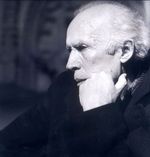
on eric rohmer 1920-2010

Tn_imagen_t2_587c

Someone is walking somewhere from someplace else—so begins an Eric Rohmer movie. Two secretaries in an office chat about nothing in particular; mail is sorted; a boat is at sea. The pointless opening is crucial for establishing the rhythm of these movies, and what happens as they unfold is not that events get more exciting but that the pointless events grow richer in meaning. These movies capture the formless sequentiality of life, which moves us along until we find ourselves somewhere other than where we thought we were, or thought we might end up. Jean-Louis’s conversation during My Night at Maud’s feels like those real late-night sessions, mostly in college, which you can never plan in advance or later quite recall; in The Aviator’s Wife, after hours of brooding and planning and anticipating the effects of what he has to say to his girlfriend, François never dreams that one thing he says will make her defensive, another will make her jealous, and a third will make her cry, so their talk shifts back and forth and it bewilders the boy, and perhaps the older woman too. Rohmer’s understated theory of the relations between the sexes is nothing more than this: men and women drift farthest, and fastest, and most mysteriously, in their dealings with each other.

more from Damion Searls at n+1 here.

Tuesday Poem

………………………..

Shale

What leaves us trembling in an empty house
is not the moon, my moon-eyed lover.
Say instead there was no moon
though for nine nights we stood

on the brow of the hill at midnight
and saw nothing that was not
contained in darkness, in the pier light,
our hands, and our lost house.

Small wonder that we tired of this
and chose instead to follow the road
to the back of the island, and broke
into the lighthouse-keeper’s house.

We found the lower windows boarded up
and the doors held fast, but one.
Inside, we followed the drag of light
through empty rooms of magenta and sky blue.

This house has been decided by the sea.
These rooms are stones washed over by waves
and spray from the lighthouse
by which we undress

to kneel under the skylight.
Our hands and lips are smeared with blackberries.
Your skin, my sloe-skinned lover,
never so sweet, your hand so quiet.

The sea is breaking and unbreaking on the pier.
You and I are making love
in the lighthouse-keeper’s house,
my moon-eyed, dark-eyed, fire-eyed lover.

What leaves us trembling in an empty room
is not the swell of darkness in our hands,
or the necklace of shale I made for you
that has grown warm between us.

by Vona Groarke
From: Shale; Gallery Press, Oldcastle, 1994

Free Nazia Quazi

From The Nation:

In most countries, a woman in her mid-20s is legally an adult. And in most countries, foreigners are free to leave when they like. In its flagrant rejection of these two principles, Saudi Arabia is unique, and that is a big problem for 24-year-old Nazia Quazi. For more than two years Nazia, an IT specialist who graduated from the University of Ottawa and holds dual Canadian-Indian citizenship, has been trying to leave Riyadh and go home to Canada. Her troubles began on November 23, 2007, when she entered Saudi Arabia with her parents on a visitor's visa. In Saudi Arabia, foreign visitors must have a sponsor, a local man who handles their paperwork. Nazia's sponsor is her father, Quazi Malik Abdul Gaffar, an Indian citizen who has worked in Saudi Arabia for many years. At some point Nazia's father clandestinely switched her visitor's visa to a more permanent visa–one that requires that he, as her sponsor, approve her exit visa. This he refuses to do. No exit visa, no departure. Worse, Nazia says he has confiscated both her Indian and Canadian passports and all her identity documents–driver's license, health card, credit cards and so on–and refuses to return them. She is trapped.

Nazia's father is not only her sponsor; he is also her mahram, or guardian, the male relative who in the Saudi system controls nearly every moment of a woman's life. As detailed in a 2008 Human Rights Watch report, under this system a woman must seek her mahram's permission to go to school, travel abroad, marry, open a bank account, hold a job, rent an apartment or even have elective surgery. (In June the Saudi government told the UN Human Rights Council that the guardianship system no longer exists, but HRW and the Saudi newspaper Al-Watan confirm that it does.) In effect, it makes women children for life–there are middle-aged Saudi women who are under the legal control of their own sons. Nazia's father thus has not only been able to force his daughter, through the sponsorship system, to remain in Riyadh; as her mahram he has total control of her life while she is there–even though neither Nazia nor her father is a Saudi citizen.

More here. (Note: Thanks to my friend Professor C.M. Naim)

Corporate Backing for Research? Get Over It

John Tierney in The New York Times:

Research I find myself in the unfamiliar position of defending Al Gore and his fellow Nobel laureate, Rajendra K. Pachauri. When they won the prize in 2007, they were hailed for their selfless efforts to protect the planet from the ravages of greedy fossil fuel industries. Since then, though, their selflessness has been questioned. Journalists started by looking at the money going to companies and nonprofit groups associated with Mr. Gore, and now they have turned their attention to Dr. Pauchauri, the chairman of the United Nations Intergovernmental Panel on Climate Change.

The I.P.C.C., which is supposed to be the gold standard of peer-reviewed climate science, in 2007 warned of a “very high” likelihood that global warming would cause the Himalayan glaciers to disappear by 2035. When the Indian government subsequently published a paper concluding there was no solid evidence of Himalayan glaciers shrinking because of global warming, Dr. Pachauri initially dismissed it as “voodoo science” beneath the I.P.C.C.’s standards. But then it came out that the I.P.C.C.’s projection was based not on the latest peer-reviewed evidence, but on speculative comments made a decade ago in a magazine interview by Syed Hasnain, a glaciologist who now works in an Indian research group led by Dr. Pachauri. Last week, the I.P.C.C apologized for the mistake, which was embarrassing enough for Dr. Pachauri. But he also had to contend with accusations of conflict of interest. The Telegraph of London reported that he had a “worldwide portfolio of business interests,” which included relationships with carbon-trading companies and his research group, the Energy and Resources Institute.

More here.

A Little While

Edwidge Danticat in The New Yorker:

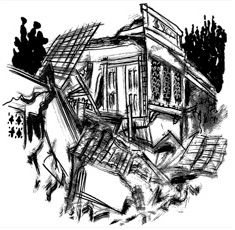
ScreenHunter_05 Jan. 26 11.30 My cousin Maxo has died. The house that I called home during my visits to Haiti collapsed on top of him.

Maxo was born on November 4, 1948, after three days of agonizing labor. “I felt,” my Aunt Denise used to say, “as though I spent all three days pushing him out of my eyes.” She had a long scar above her right eyebrow, where she had jabbed her nails through her skin during the most painful moments. She never gave birth again.

Maxo often complained about his parents not celebrating his birthday. “Are you kidding me?” I’d say, taking his mother’s side. “Who would want to remember such an ordeal?” All jokes aside, it pained him more than it should have, even though few children in Bel Air, the impoverished and now shattered neighborhood where we grew up, ever had a birthday with balloons and cake.

When Maxo was a teen-ager, his favorite author was Jean Genet. He read and reread “Les Nègres.” These lines from the play now haunt me: “Your song was very beautiful, and your sadness does me honor. I’m going to start life in a new world. If I ever return, I’ll tell you what it’s like there. Great black country, I bid thee farewell.”

Two days after a 7.0 earthquake struck Haiti, on January 12, 2010, I was still telling my brothers that one night, as we were watching CNN, Maxo would pop up behind Anderson Cooper and take over his job.

More here.

The cold hard facts of freezing to death

Peter Stark in Outside:

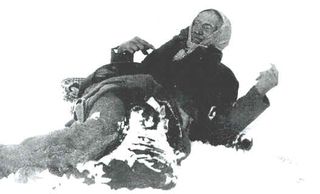
Frozen In fact, many hypothermia victims die each year in the process of being rescued. In “rewarming shock,” the constricted capillaries reopen almost all at once, causing a sudden drop in blood pressure. The slightest movement can send a victim's heart muscle into wild spasms of ventricular fibrillation. In 1980, 16 shipwrecked Danish fishermen were hauled to safety after an hour and a half in the frigid North Sea. They then walked across the deck of the rescue ship, stepped below for a hot drink, and dropped dead, all 16 of them.

More here.

Monday, January 25, 2010

On Seeing (an Imitation)

by Daniel Rourke

“Mimesis here is not the representation of one thing by another, the relation of resemblance or of identification between two beings, the reproduction of a product of nature by a product of art. It is not the relation of two products but of two productions. And of two freedoms… 'True' mimesis is between two producing subjects and not between two produced things.”

Jacques Derrida, Economimesis

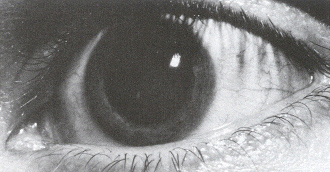
Enlarged pupil (an eye with iritis)

As the day drew closer to its end so I strained my eyes to compensate. A milieu of symbols littered my computer screen, each connected to a staccato breach between breath and tongue. And in conjunction, fused one to another in a series, these symbols formed words and concepts, visions and ideas to which I felt an obligation.

I was designing a book, turning a text into a form through the processes of a computer design interface. The semblance of a page confronted each turn of my wrist or tap of finger, until the virtual book lay splayed open, its central fissure dilating as the words grew bigger or shrank to barely perceptible pricks of black. By manipulating the interface I could expand letters until they inked out the screen, or, in turn, spiral to infinite distance, turning definite symbols into the pixels of a cloud.

This process of making occurred at a virtual distance to me and yet, as the nights rolled onwards, this work was limiting my ability to see.

The doctor examined my right eye. I had iritis, a strain of the pupil with no particular cause, except perhaps for its over-use: for one's over-reliance on its mechanical operation. Being that my right eye was the strongest of the two it had over-compensated at each dimming of the day, allowing my left eye to relax as the symbols of my book whirled on. The strain resulted in a blood-shot appearance accompanied by a searing, throbbing pain. It hurt to see, and even more so to look. It hurt because looking was its cause.

Standing at the base of the Southern tower I arced my neck back as far as I dare. As the horizon descended into my stomach I could just about perceive the towers' tallest corners, pinching at sky. How many coins did it take to build these things? And how many steps was I expected to ascend in order to get to the 'observation deck'?

In exchange for my tiny coin I fathomed a giant network called 'New York'. From up here everything was horizon: the imaginary boundary between earth and sky that moves in respect of one's position.

In 2001 the two towers tumbled. How profane their figures seem now. How could it be that these prisms, designed and built in the 1960s, opened and occupied in the 1970s, witness of boom in the 80s and bust in the 90s, would come to stand for all the tumult and turmoil, striving and hope of our newest century?

The precision of the prism – flat, grey surfaces observed in isometric space – will forever be bound to these charismatic towers built of steel, concrete and capital. That they now stand as symbols effaces their identity in time or in space. They will always be contemporary, so long as cities are built and planes soar the skies above them. Looking back at them it is now I that stand on the horizon. Yet, howsoever I alter my vision, the towers stay solid and fixed to their position, being at one and the same time the landscape, the illumination and the roving eye.

Read more »

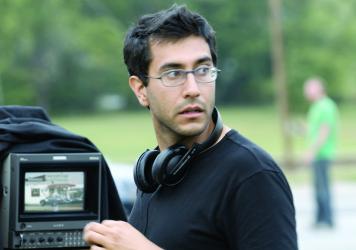
Helping strangers, learning other lives and escaping escapism: a conversation with filmmaker Ramin Bahrani

Ramin Bahrani is the director of such films as Man Push Cart, Chop Shop and the new Goodbye Solo. He was named, somewhat controversially, as being on the vanguard of the “neo-neo realism” by A.O. Scott in the New York Times and called “the new great American director” by Roger Ebert. Colin Marshall originally conducted this conversation on the public radio show and podcast The Marketplace of Ideas.

Bahrani, Ramin, director of CHO I’ve been reading Roger Ebert for over ten years, and I’ve never seen him praise someone as much as he praises you. He’s given your films four stars, he’s put Chop Shop on his list of “the great movies”, he had this wonderful blog post about you. How must this feel, to get such accolades from a man like Ebert?


It’s very humbling, and I’m very grateful because Roger Ebert is a legendary critic, known as the most important in America for decades. I’d like to stress that it’s not just me; he’s said this about a handful of other important directors that I really learned a lot from, like Martin Scorsese, and that makes it all the more wonderful a feeling. Watching Mean Streets as a teenager was one of the most important cinematic moments of my life. It really got me interested in making movies, and what kind of movies, and how to make them. Roger has the ability to write about films in a profound way anyone could understand, and that’s a rare gift. I really appreciate all that he’s done for my films.

It must also feel, just looking at this from the outside, that there’s a little bit of a – maybe a lot of an – “upping the ante” feel to it. Is there an anxiety-inducing side to this?

It’s natural for any artist, when the work seems to be catching on and people are paying attention and enjoying it, that there’s always some kind of an anxiety. You want to make sure the next one is good too, but when it actually comes to the nitty-gritty of doing the work or writing the script, making the film, it’s important to put those things aside. Just follow your own vision and do your best to make a film you believe in, that you believe an audience could enjoy and appreciate and understand and be challenged by. That’s what I’m working on now. I’m working on a new project, and at some point you really just have to put everything aside and move forward.

It just has to be you, your collaborators, the project and nothing else in your mind?

I’m glad you mention the collaborators. That’s a big part of it: Michael Simmonds, my cinematographer, my co-writer and others, but I do think about the audience with every film. It’s incredibly important, as we’re working, to make sure: can the audience understand what’s going on? I don’t just mean plot-wise, which is critical – can the audience understand what’s going on in the story? – but if we’re going after certain emotions, or if we’re going after certain ideas or certain questions, do we think the audience can understand those? Increasingly, what’s been on my mind with each film, Chop Shop and Goodbye Solo even more: would an audience be engaged by the story? Not just wonderful people like you who love movies and are cinephiles, but I honestly. and my collaborators also, we think about our moms, our brothers. People who like good movies but aren’t necessarily cinephiles. Could they enjoy the movie also?

Read more »

Sunday, January 24, 2010

Can Pop Music Survive Without a Mass Market?

1261594563-largeJ. Gabriel Boylan in The Nation:

Unlike the introduction of the compact disc, which was developed by major labels and music retailers, as well as Phillips and Sony, the current tumult was unplanned and unforeseen. Digital technology has put far more power in the hands of ordinary consumers to wrest music from its gatekeepers. But crashing the gates has caused the music economy to dip down between cheap and free; people are storing more music on their hard drives than they're likely to listen to in the next decade, yet major labels, music retailers and even jukebox manufacturers are spiraling toward obsolescence. Offbeat and invaluable aspects of the mass music experience are slipping away as well, from the cranky exclusivity of the niche record shop to the tastemaking role of college radio to the music press itself.

The conventional, romantic view of the history of popular music is one of pure eras and movements reaching a creative peak before being co-opted, oversold or otherwise spoiled by runaway commercialism. Ragtime enthusiasts, rockabilly fans and punk proselytizers all claim that the early days of their favorite pet sounds were the best, most revolutionary and purest. The only truly lucky genres are those nobody ever liked–at least they were able to fade away honorably. The history of the popular music industry is often told in the same way, from its quirky, tentative beginnings through its benign, if greedy, golden age, when big labels could be handmaiden to terrific music reaching the masses. The cause of the industry's demise, the story goes, was avarice: the labels prized dastardly strategies for persuading music fans to part with as much cash as possible. The result, then, is the current mess. The potential chaos of a future where music is unprotected and unsellable (that is, an unviable profit center for labels or artists) might be worrying, but it's a prospect the industry created. Kot, a music critic at the Chicago Tribune, is excited about the new ways that bands are selling their music and trying honorably not to fade away. He is pleased that digital technology allows music to live and breathe beyond the grip of the record industry, which he thinks doesn't deserve any sympathy, since its response to the digital revolution has been not bold ideas about marketing or distribution but lots of lawsuits.

Iago and the Apologetics of Evil

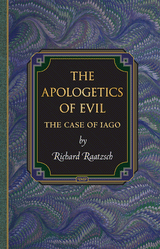
J8926 Over at Notre Dame Philosophical Review, Colin McGinn on Richard Raatzsch's The Apologetics of Evil: The Case of Iago:

Perhaps Iago is the only person not puzzled by Iago, and there are signs in the play that he isn't entirely clear about Iago either. We know his actions perfectly well, and he works as a dramatic figure, but we don't understand why he does what he does — we don't grasp his motivation. We observe his plot to destroy Othello by instilling jealousy (and incidentally Cassio and Desdemona) but we don't discover what motivates him to undertake such a plot — with its evil, its risk, and its extremity. Worse, we seem to apprehend that he has no motivation; he is a motivational blank tablet, ontologically not merely epistemologically. In The Apologetics of Evil Richard Raatzsch edges probingly around this void, trying his best to make sense of it: his book is astute, determined, sensitive — but not an unmitigated success. The puzzle of Iago persists.

Raatzsch is on the right track when he notes the phonetic affinity of “Iago” and “ego”: Iago is certainly egotistical, egoistic, and egocentric. He recognizes no standard beyond himself; indeed, he hardly seems to grasp the reality of other people at all, save as tools, marks and dupes — always means, never ends. Raatzsch sees the character Iago as an incarnation of what he calls the “the concept of Iago”, the idea he embodies: he is best understood as a paradigm or exemplar. But it is still unclear what concept he embodies. He seems like a pathological version of something, but of what exactly? Iago is memorable and exciting, and universally hated by audiences of Othello; we have strong feelings about him. He also seems locked in a kind of dark conceptual symbiosis with Othello — as if he is the other half of a hybrid organism. Othello is warm, ingenuous, honorable, trusting, yet fatally credulous and weak; Iago is none of those things, but cold, deceptive, manipulative, and impervious to anything but his own perverse will. We feel we understand Othello — only too well, in fact — while Iago challenges our normal ways of explaining human action. It all seems so gratuitous.

The introduction to the book can be found here.

$123,000,000,000,000*

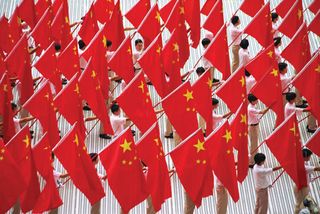
China_flagsRobert Fogel makes the case that we’re underestimating China’s rise, in Foreign Policy:

In 2040, the Chinese economy will reach $123 trillion, or nearly three times the economic output of the entire globe in 2000. China’s per capita income will hit $85,000, more than double the forecast for the European Union, and also much higher than that of India and Japan. In other words, the average Chinese megacity dweller will be living twice as well as the average Frenchman when China goes from a poor country in 2000 to a superrich country in 2040. Although it will not have overtaken the United States in per capita wealth, according to my forecasts, China’s share of global GDP — 40 percent — will dwarf that of the United States (14 percent) and the European Union (5 percent) 30 years from now. This is what economic hegemony will look like.

Most accounts of China’s economic ascent offer little but vague or threatening generalities, and they usually grossly underestimate the extent of the rise — and how fast it’s coming. (For instance, a recent study by the Carnegie Endowment for International Peace predicts that by 2050, China’s economy will be just 20 percent larger than that of the United States.) Such accounts fail to fully credit the forces at work behind China’s recent success or understand how those trends will shape the future. Even China’s own economic data in some ways actually underestimate economic outputs.

It’s the same story with the relative decline of a Europe plagued by falling fertility as its era of global economic clout finally ends. Here, too, the trajectory will be more sudden and stark than most reporting suggests. Europe’s low birthrate and its muted consumerism mean its contribution to global GDP will tumble to a quarter of its current share within 30 years. At that point, the economy of the 15 earliest EU countries combined will be an eighth the size of China’s.

This is what the future will look like in a generation. It’s coming sooner than we think.

What, precisely, does China have going so right for it?